Netanyahu arrives in US for UAE-Israel peace signing ceremony
Author:
Mon, 2020-09-14 20:30
WASHINGTON: Benjamin Netanyahu arrived on Monday in Washington ahead of a signing ceremony for the UAE-Israel peace deal.
The Israeli prime minister will join UAE foreign minister Sheikh Abdullah bin Zayed at the White House on Tuesday to ink the agreement, which was brokered by US President Donald Trump and announced last month.
Bahrain announced its own agreement with Israel on Friday and is also expected to attend the ceremony.
“On our way to bring peace in exchange for peace,” Netanyahu tweeted before departing from Ben Gurion airport in Tel Aviv, where Israeli, US, UAE and Bahraini flags adorned the aircraft’s entrance.
On Sunday, Netanyahu told cabinet ministers: “We now have two historic peace agreements with two Arab countries within one month. I am sure that we all praise this new age… I want to promise you that each and every one of you through your ministries will be a part of it, because this is going to be a different peace.
“It will be a warm peace, an economic peace in addition to a diplomatic peace; a peace between nations.”
Sheikh Abdullah arrived in the US capital a day earlier, heading a delegation of several senior Emirati officials and ministers, as well as the UAE’s permanent representative to the United Nations Lana Nusseibeh.
The UAE deal to establish full relations included an Israeli promise not to annex occupied Palestinian land in the West Bank.
Bahrain will be the fourth Arab country to set up relations with Israel. Crown Prince Salman bin Hamad is in the US and is expected to hold talks with Trump on Monday.
Egypt and Jordan already established relations with Israel in 1979 and 1994 respectively.
Oman, Sudan and Morocco welcomed Bahrain’s announcement, prompting Israeli media to report that they are among the next countries that the US is in talks with to follow suit.
The peace deals with the UAE and Bahrain have been widely opposed by Palestinian factions.
UAE foreign minister arrives in US for Israeli peace signing ceremonyDefense ministers of Bahrain and Israel hold talks
Beirut blast aid faces an obstacle course in Lebanon
Mon, 2020-09-14 20:16
DUBAI: No sooner had the explosion of Aug. 4 devastated Beirut than the Lebanese diaspora came to their home country’s rescue.
The extent of the damage to homes and infrastructure was still not clear, but no one was under any illusion about the blast’s severity given that the shockwaves were felt more than 200 km away in Cyprus.
By the morning of Aug. 5, Impact Lebanon, a non-profit based in London, had collected close to £1.5 million ($2 million).
Since then the organization, which was founded by a group of UK-based Lebanese when anti-government protests erupted in Lebanon in October last year, has built up an impressive $8.23 million.
But as fundraising activities by diaspora communities continue worldwide, a concern that looms large over them is how Lebanese civil-society groups will be able to access the money.
One of the biggest challenges the Lebanese people face, as they pick up the pieces after last month’s explosion in Beirut, is the country’s troubled financial system.
A complex set of regulations that govern transactions involving dollar bank accounts in Lebanese banks meant that Impact Lebanon was able to begin transferring the funds it had raised from Aug. 25 — three weeks after the blast.
The transfers were made in small instalments in order to reduce the risk of loss while navigating a corrupt banking system.
Under a scheme known as “fresh money,” individuals outside the country can transfer dollars into a “fresh money” account in Lebanese banks.
But access to such an account is granted only to those who can prove they are the recipients of dollar transfers from abroad.
How long the scheme will last is open to question, though, which partly explains why Impact Lebanon volunteers decided against a lump-sum transfer of the funds it had collected.
Fundraising activities by diaspora communities continue worldwide, but concerns looms large over about how Lebanese civil-society groups will be able to access the money. (Supplied: Mariana Wehbe)
“Money will be sent in different instalments to the 15-20 different NGOs the fund is supporting inside the country,” said Maya Hodroj, co-founder and director of Impact Lebanon.
Since it is still to be registered as a charity in the UK, Impact Lebanon used crowdfunding platform JustGiving for fundraising and partnered with Lebanese International Financial Executive, a non-profit organization with branches in Lebanon, the UK, the US and Switzerland, to distribute the money among a mix of Lebanon-focused NGOs.
Currently, despite the web of restrictive banking regulations, aid is getting channeled through civil-society and international aid organizations, including many in-kind donations of food, personal protective equipment, sanitary items and other goods, particularly from Gulf Cooperation Council member states such as the UAE, Kuwait and Saudi Arabia.
Disruptions, however, continue to affect humanitarian work, such as the huge fire that broke out on Sept. 10 at a warehouse in Beirut port where the International Committee of the Red Cross (ICRC) stores food parcels.
Opinion
This section contains relevant reference points, placed in (Opinion field)
Recently, the Trump administration said it would not be sending aid to the Lebanese government for fear it might end up in the hands of the Shiite Lebanese party Hezbollah, which is a US-designated terror group. Aid from the US will thus have to be sent through alternative channels.
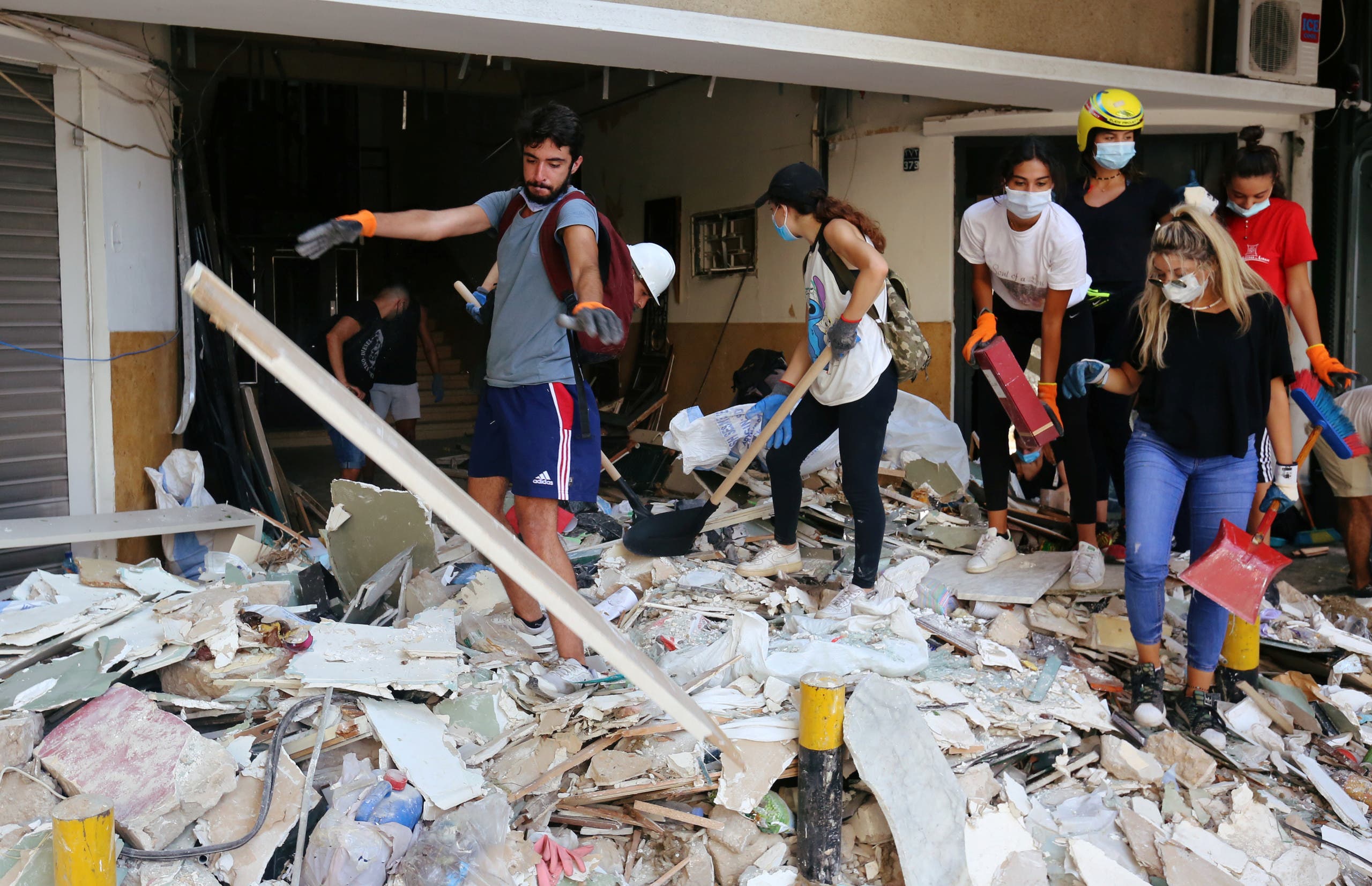
Immediately after the blast of Aug. 4, residents of Beirut had no choice but to take care of themselves. The sense of helplessness prompted the rapid formation of a number of organizations by young Lebanese.
Their goal, in the immediate term, was to help the wounded, homeless and traumatized and, in the long term, to rebuild Beirut.
“In the absence of government support, the Lebanese people had to fend for themselves, fixing the country and the people mentally and physically,” said Nancy Gabriel, co-founder along with Mariana Wehbe of Beb w Shebbek, an organization dedicated to repairing or replacing blast-damaged doors and windows of 80,000 homes.
Beb w Shebbek is an organization dedicated to repairing or replacing blast-damaged doors and windows of 80,000 homes. (Supplied: Mariana Wehbe)
“Beb w Shebbek is exactly like other Lebanese organizations born after the explosion. We had to create this initiative to help others because the government is totally absent,” Gabriel added.
“Three weeks after the explosion, most people are still living with open windows and doors. Their homes are totally destroyed. They have nowhere else to go.”
After the end of the civil war in 1990, foreign aid emerged as a key pillar of Lebanon’s financial and economic stability.
Since the blast, donor countries have pledged close to $300 million in aid. Additionally, the UN is trying to raise more than $500 million for Lebanon.
But some of the slogans heard on the streets of Beirut since Aug. 4 oppose more international assistance to the country.
Many Lebanese not only have little faith in aid reaching the right recipients, they are convinced that the country’s political elites are the ultimate beneficiary of the economic model.
“Many Lebanese government officials and advisors are paid with the millions allocated by programs such as those managed by the UNDP (UN Development Programme),” said Gino Raidy, a Lebanese activist and blogger.
“There’s a lack of trust right now in some international aid organizations, including the UN. It’s not about just giving money, but finding long-term solutions that will put an end to the corruption, instead of inadvertently encouraging it like we’ve seen for decades.”
Activist Mouin Jaber told Arab News from Beirut: “We’re actually playing the role of the Lebanese government, which stayed silent and remained inactive during the first two weeks of the disaster.”
He drew attention to the eyebrows raised by the sight of Lebanese military officers handing out aid to citizens three weeks after the disaster.
“Right now, the Lebanese Army is distributing food boxes to people, with camera crews documenting the propaganda,” said Jaber.
“They’ve been extremely incompetent and inefficient in providing aid to their citizens. It’s a joke.”
Jaber and his friends got in touch with four youth organizations and NGOs formed during the October protests to deliver relief kits to people affected by the explosion.
These include Minteshreen, a youth-led group that has been distributing food boxes during the coronavirus pandemic; Baytna Baytak, an NGO providing alternative housing to patients suffering from COVID-19 who could not go back to their homes, and is now arranging accommodation for those who lost their homes in the blast; Muwaten Lebnene; and Embrace Lebanon, a mental-health clinic.
“We assembled a team of engineers to assess damage to homes, and provided people with temporary solutions until long-term plans for rebuilding can be finalized,” said Jaber. “This is all voluntary work. No one is being paid.”
Some volunteers have set up an informal base camp for better coordination of aid and relief operations being managed separately by dozens of local NGOs.
“Instead of sending relief to these big organizations, it would be better to send money to reconstruction companies that have bank accounts abroad so that they have full access to the money,” said Jaber.
“This would be better than sending to third-party intermediaries because you never know where the money will go when it arrives in Lebanon.”
Beb w Shebbek is an organization dedicated to repairing or replacing blast-damaged doors and windows of 80,000 homes. (Supplied: Mariana Wehbe)
That said, fears expressed by some Lebanese on social media about NGOs encountering difficulty in getting aid into the country and relief supplies being mishandled by the government may have been overblown.
Nabih Jabr, under-secretary-general at the Lebanese Red Cross, said his teams received relief items and distributed them to those in need. “The problem was that we received too many in-kind donations too soon,” he told Arab News from Beirut.
“Some of them didn’t cater to the immediate needs of the affected population, and we rapidly ran out of space in nearby warehouses, so we took some of these items for processing in our warehouses all over the country,” he said.
“It always happens with in-kind donations that some end up sold in stores. People receive in-kind aid but need the cash, so some sell it to be able to get what they really need, and this is exactly why in-kind aid isn’t always the best aid.”
Jabr said in-kind donations can harm the local economy. “Small local businesses are already in trouble, and soon they’ll be in even more trouble if people don’t start buying again,” he added.
Jabr said the next step for the Lebanese Red Cross is handing out direct cash assistance. “This will start very soon,” he added. “This is the best and most efficient way to help people as long as there’s still a functioning local economy.”
Defense ministers of Bahrain and Israel hold talks
Mon, 2020-09-14 18:20
DUBAI: Bahraini Minister of Defense Affairs Major General Abdullah bin Hassan Al-Nuaimi held talks on Monday with his Israeli counterpart Benny Gantz.
During a phone call, the officials discussed the importance for regional stability in the Middle East of a new deal to normalize relations with Israel, the Bahrain News Agency reported.
They also talked about their expectations to establish a close partnership between the two defense ministries. This would contribute to enhancing the capabilities of both countries and will maintain regional security, the BNA added.
The Israeli defense minister also offered to host his Bahraini partner on an official visit to Israel, and they agreed to continue the dialogue together.
Bahrain and Israel announced on Friday they would normalize relations after the UAE made a similar deal last month.
Earlier on monday, Zayed bin Rashid Al-Zayani, Bahrain’s industry and trade minister, and Israel’s regional cooperation minister Ofir Akunis discussed trade, industry and tourism cooperation.
Normalization will “positively impact both countries’ economies,” BNA said.
Oman welcomes Bahrain-Israel normalization decisionSaudi Arabia’s King Salman receives letter from King Hamad of Bahrain
Israel to lock down nationwide in main holiday season amid COVID-19 surge
Author:
Reuters
ID:
1600028091388952700
Sun, 2020-09-13 19:11
JERUSALEM: Israel will enter a three-week nationwide lockdown starting on Friday to contain the spread of the coronavirus after a second- wave surge of new cases, Prime Minister Benjamin Netanyahu said on Sunday.
During the lockdown, which comes during the Jewish high-holiday season, Israelis will have to stay within 500 meters of their houses, but can travel to workplaces that will be allowed to operate on a limited basis.
Schools and shopping malls will be closed but supermarkets and pharmacies will remain open. The public sector will operate with fewer staff, but non-governmental offices and businesses will not have to close, as long as they do not accept customers.
Indoor gatherings are limited to 10 people and no more than 20 people outdoors.
“I know those measures will exact a heavy price on us all,” Netanyahu said in a televised address. “This is not the kind of holiday we are used to. And we certainly won’t be able to celebrate with our extended families.”
The Finance Ministry said the lockdown will cost the economy, which slipped into a recession in the wake of the virus, an estimated 6.5 billion shekels ($1.88 billion).
Netanyahu, who has faced increasing criticism over his handling of the coronavirus crisis, said he instructed his finance minister to come up with a new economic package to assist businesses hurt by the lockdown.
Israel declared an even tighter lockdown in April when the virus first arrived, after which daily cases dropped to low double digits among a population of nine million.
But as the economy reopened, daily infections jumped, passing 4,000 last week. On Saturday, 2,715 new cases were reported. Since the outbreak began, 1,108 people have died.
The country’s health system “raised a red flag” a few days ago, spurring the government to act, Netanyahu said.
The director general of the Health Ministry, Hezi Levy, said in a radio interview earlier on Sunday that “dozens of localities are being sucked into the circle of morbidity.”
“We have to impose severe restrictions, but they will be able to stem this wave and not bring us to the brink of an abyss,” Levy said. ($1 = 3.4566 shekels)
UAE FM arrives in US for Israeli peace signing ceremonyBahrain: Israeli peace agreement contributes to regional stability
UAE coronavirus cases drop after topping 1,000 a day earlier
Sun, 2020-09-13 23:01
DUBAI: The UAE on Sunday recorded 640 new COVID-19 cases — significantly lower than recent days when numbers hit the highest level since the pandemic broke out.
The health ministry said the total number of cases had reached 79,489.
All the cases, who are various nationalities, are “stable and subject to the necessary health care,” the ministry said.
The number of daily cases in the UAE had dropped steadily from a high point on May 22 of 994. But figures have surged from 164 cases on Aug. 3.
The UAE recorded 1,007 new cases on Saturday, the highest daily number and the first time cases crossed the 1,000 mark.
The ministry said 468 people had “fully recovered from the symptoms of the virus” bringing the total number of recoveries to 69,451.
آخر الإحصائيات حول إصابات فيروس كوفيد 19 في الإمارات
— وزارة الصحة ووقاية المجتمع الإماراتية – MOHAP UAE (@mohapuae) September 13, 2020
The ministry also said no deaths had been recorded in the previous 24 hours. The UAE has recorded 399 deaths from the coronavirus since the pandemic began.
Authorities across the country have issued a number of closure orders and large fines in efforts to bring the virus under control.
On Saturday, Dubai closed down a restaurant in Bluewaters Island and a swimming pool at a sports facility, while Ras Al-Khaimah ordered the closure of a wedding hall. In Fujairah several facilities were closed for not complying with the measures set by the government.
Dubai Police said on Saturday it had reported 141 violations and 1,422 warnings were issued in four shopping centers in one day.
One young man infected with coronavirus was caught violating home quarantine instructions.
He had published a video on social media, where he confirmed he had the virus and bragged about going out to buy coffee. He has been fined Dh50,000 and faces imprisonment and a further fine ranging from Dh200,000 ($54,453) to one million dirham for encouraging the public to violate the laws.
The government also issued a new list of updated fines for individuals and entities not complying with the coronavirus measures and said they were increasing inspections. The fines, which range between Dh1,000 — 50-000, apply federally but authorities in each emirate can apply additional measures.
The Ministry of Health and Prevention launched a campaign to increase testing to isolate cases and those who they have been in contact with.
More than 84,000 new examinations were carried out in the space of 24 hours.
Dubai Health Authority (DHA) on Sunday also issued a detailed list of health and safety guidelines for parents and children as students go back to school.
Meanwhile, Kuwait on Sunday reported two deaths and 553 new infected cases, bringing the total number to 560 and 94,764 respectively.
The Ministry of Health said that 591 cases have recovered bringing the total to 84,995.
Oman’s health ministry said 52 new cases have emerged, bringing the total to 89,746, but announced a 93.3 percent recovery rate, with 83,771 cases having recovered from the virus so far.
The sultanate did not record any deaths on Sunday but the total death rate stands at 780.
The coronavirus pandemic has affected over 29 million people in 213 countries and territories around the world and the death rate has topped 920,000. (Dh1 = $0.27)