Prisoners threaten suicide to pressure Lebanese parliament over amnesty law

Author: 
Wed, 2020-09-30 22:19

BEIRUT: Inmates at Lebanon’s Roumieh Central Prison threatened to kill themselves on Wednesday in a bid to pressure parliament over an amnesty law.

Video footage from inside the prison showed them threatening to hang themselves if the law was not passed.

“Yes, we have stolen, but that was due to hunger and poverty,” said one inmate. “The big thieves are untouchable, and only those who steal an egg get prosecuted. The one who killed former PM Rafic Hariri has been acquitted.”

Another inmate wrapped cloth around his neck, preparing a noose. “If they do not approve the general amnesty, our lives do not concern us,” he said. “May I rest in peace.” Others were quick to stop him from taking his own life. 

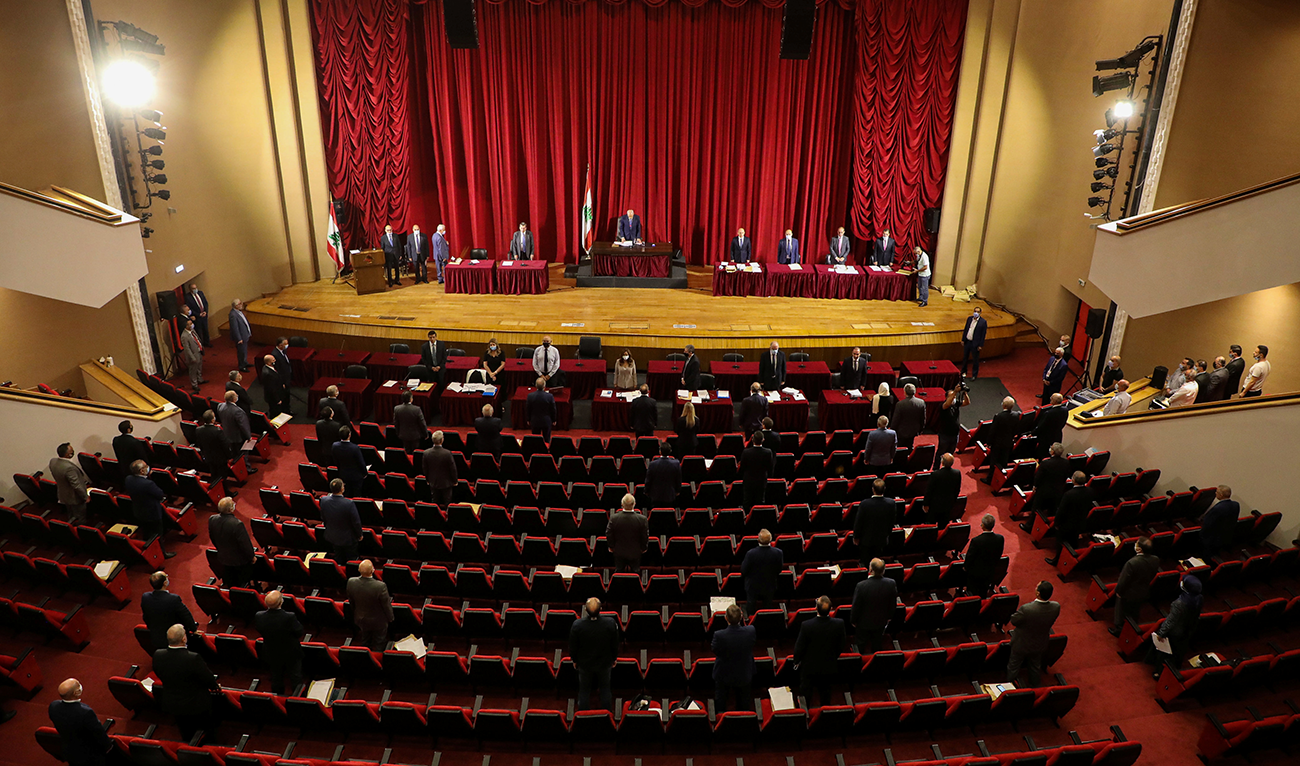
The families of detainees demanded amnesty for their loved ones and held a sit-in near where parliamentarians were meeting to discuss the law. 

But disagreements among parliamentary blocs meant the proposed law was referred to a committee.

Another point of difference during the session was the Illicit Enrichment Act. Parliament Speaker Nabih Berri said the matter required a session to amend the constitution in order to waive immunity for everyone. 

He told Parliament: “As long as there is sectarianism and sects, progress cannot be made in Lebanon. Ministers have been arrested, and I was the one who turned them in, and no one bid on it.”

The Free Patriotic Movement (FPM) said the bill’s wording affected everyone including ministers and MPs, while the Future Movement believed it did not because they enjoyed immunity.

The bill was approved with an amendment upon request from the Future bloc, which demanded the removal of the phrase “waiving the immunity of the prime minister and the ministers” and replacing it with: “The offense of illicit enrichment is subject to the jurisdiction of the judicial judiciary.”

The act has been a demand of the civil movement for about a year and one of the reform terms required of Lebanon.

FPM head Gebran Bassil, who is in quarantine due to having coronavirus, hailed the passing of the bill as an achievement for his parliamentary bloc “on the path of holding every public service accountable.”

But Future bloc MP Hadi Hobeich said the act did not include parliamentarians, ministers, and presidents, and that this matter required a constitutional amendment.

“The immunity of an MP is constitutional, and illicit enrichment is a criminal offense,” he said. “The current text did not extend to the prime minister and ministers, and we want an amendment to extend this act to the president, the prime minister, speaker of parliament, and the employees.”

The fate of Lebanon’s government – or rather the formation of a new one – still hangs in the balance and was further complicated by a speech from Hezbollah leader Hassan Nasrallah on Tuesday night. 

“Hezbollah wants to participate in the government, and we want to choose those who represent the Shiites in it,” Nasrallah said. “The goal is not that the Shiites are represented and that they take this portfolio or that. Rather, what is required is to know who controls the decision of these Shiites.”

He also declared that the party’s presence in government was about having access to the conditions that the IMF would impose in exchange for financial aid to Lebanon.

Prime Minister-designate Mustapha Adib, who was tasked with forming the government, resigned after Hezbollah and the Amal Movement insisted on taking the finance portfolio and naming all the Shiite ministers in the government.

Their demands undermine an initiative from France, which has called for a mini-government comprising specialized ministers who have nothing to do with the political parties in power.

Former MP Fadi Karam, the secretary of the Strong Republic Parliamentary bloc, criticized Nasrallah. 

“The rescue initiatives of Lebanon’s friends have their conditions and steps, and they will not be according to your demands and instructions,” he said. “The initiatives basically emerged to rescue Lebanon from the disasters caused by your policies, your axes, and the corruption of your authorities. You want it to rescue you, and that is why you held the people of Lebanon hostage, but these initiatives are here to rescue the people from you.”

MP Nadim Gemayel reminded Nasrallah of his refusal to declare Hassan Diab’s government, which resigned in August after a massive explosion in Beirut, as Hezbollah’s.

“Here is Hezbollah today telling the whole world that it wants to participate in the government to protect the resistance and rescue the country,” he said. Hezbollah’s weapons were “illegal” and the cause of the country’s “destruction and devastation.” 

“Your words are proof of your determination to eliminate what is left of Lebanon,” he added.
Main category: 

Lebanon says 9 Daesh-linked suspects killed in hunt for ‘terrorists’Two soldiers killed in northern Lebanon barracks attack

Iran-backed groups behind Erbil rocket attack -Iraqi Kurdish security agency

Wed, 2020-09-30 22:11

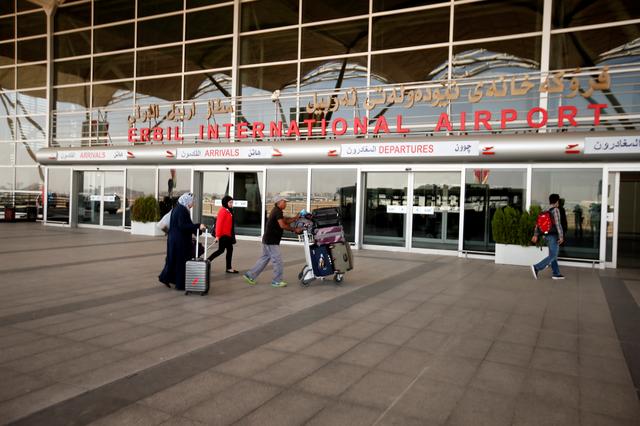
SULAIMANIYA/MOSUL: Iran-backed Iraqi paramilitary groups launched a rocket attack targeting U.S. troops in the semi-autonomous Kurdistan Region’s capital Erbil, Iraqi Kurdistan’s counter terrorism service said on Wednesday.
“Six rockets were launched from the borders of the Sheikh Amir village in Nineveh province by the Popular Mobilisation Forces who were targeting (U.S.-led) coalition forces in Erbil International Airport,” the service said in a statement.
Four rockets landed at the edge of the airport compound and two did not explode, it added.

Main category: 
Tags: 

Italian defense minister, Iraqi Kurds hold talksUS warns Iraq of Baghdad embassy closure if attacks continue


US pressures Assad by slapping new sanctions on Syrian entities and individuals

Author: 
Associated Press
ID: 
1601492787630051300
Wed, 2020-09-30 16:28

BEIRUT: The Trump Administration imposed sanctions Wednesday on entities and individuals in Syria as part of Washington’s pressure campaign against President Bashar Assad and his inner circle.
The sanctions came a day after intense clashes in southern Syria broke out between Russia-backed Syrian troops and local fighters who belong to the minority Druze sect, killing and wounding dozens. The sanctions were not related to the fighting in southern Syria.
The Treasury Department and State Department sanctions are the result of legislation known as the Caesar Syria Civilian Protection Act, named after the pseudonym of a Syrian policeman who turned over photographs of thousands of victims of torture by the Assad government.
Among those sanctioned Wednesday was the Syrian army’s Russian-backed 5th Corps that was established during the country’s conflict that started in March 2011. The 5th Corps includes rebels who later paid allegiance to Assad’s government.
The State Department said it is sanctioning 5th Corps commander Maj. Gen. Milad Jedid “for his involvement in the obstruction, disruption, or prevention of a cease-fire in Syria.”
The sanctions also included two sisters of Yasser Ibrahim, who is suspected of obstructing a political solution to the Syrian conflict and using his networks across the Middle East and beyond to cut deals to enrich Assad.

*****

READ MORE: Syrians dread impact of Caesar Act sanctions aimed at Assad

Caesar Act sends Syria’s Bashar Assad a stark reality check

*****

“The Ibrahim family, led by Yasser Ibrahim, acts as a front for Bashar Assad and his wife Asma Al-Akhras,” Secretary of State Mike Pompeo said. The State Department identified the sisters as Nasreen and Rana.
The US began implementing the Caesar Act in June with a raft of economic and travel sanctions for human rights abuses and blocking a settlement of the country’s bloody nine-year conflict.
Sanctions imposed earlier this year included Assad and his wife and their eldest son, Hafez, as well as members of the extended Assad family, senior military leaders and business executives. Many of those on the list were already subject to US sanctions, but the penalties also target non-Syrians who do business with them.
The new wave of sanctions came as opposition activists reported clashes in southern Syria between the 5th Corps and local fighters who belong to the minority Druze sect.
The Britain-based Syrian Observatory for Human Rights, an opposition war monitor, said the fighting that broke out Tuesday in Sweida province left 16 Druze fighters and 12 members of the 5th Corps dead. It added that dozens were wounded on both sides.
The Observatory said the situation was relatively calm in the province Wednesday.
The Suwayda 24, an activist collective in Sweida, said a funeral was held Wednesday in the provincial capital, also called Sweida, for 15 fighters killed the day before.
It said the fighting broke out on Tuesday when local fighters attacked the 5th Corps in the nearby village of Qaraya to force them out of agricultural lands they had entered earlier.

Main category: 

Syrians dread impact of Caesar Act sanctions aimed at AssadCaesar Act sends Syria’s Bashar Assad a stark reality check


UAE reports 3 COVID-19 deaths, 995 new cases, a jump from previous days

Author: 
Tue, 2020-09-29 22:12

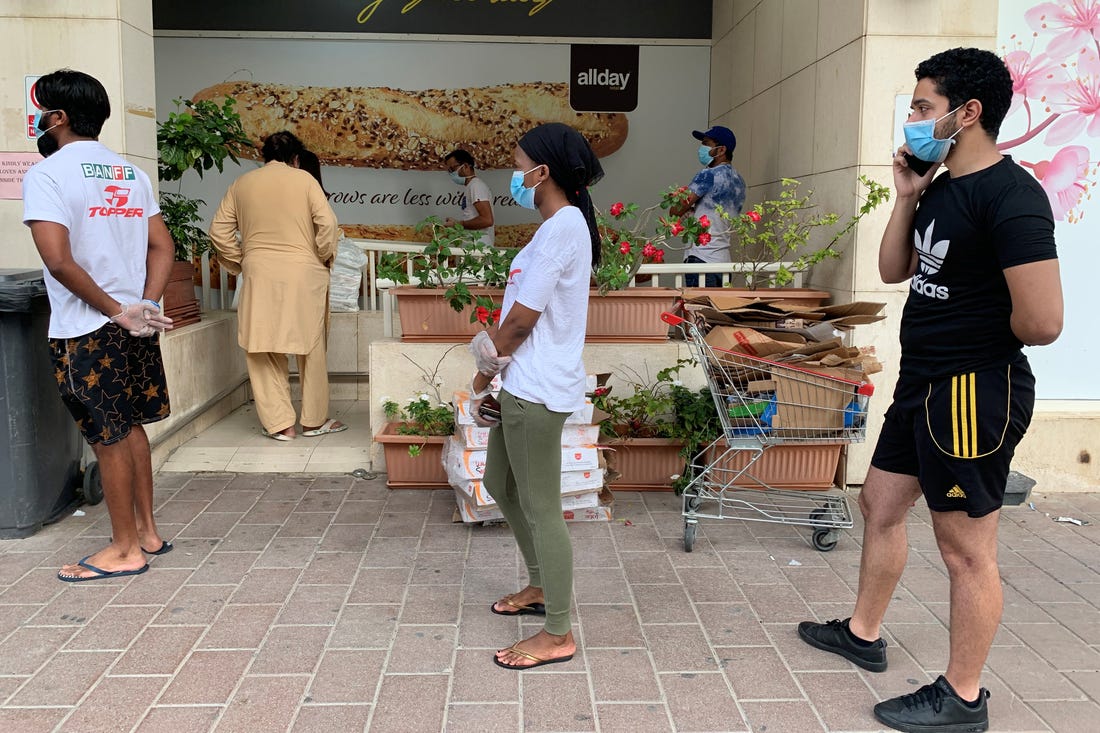
DUBAI: The UAE on Tuesday reported three deaths from COVID-19, a slight jump from the previous days, bringing the death toll to 416.
The Ministry of Health and Prevention said 995 new confirmed cases were reported, bringing the total number of infected cases since the pandemic began to 93,095, while the total deaths reached 413.
The ministry also said 1,076 cases recovered from coronavirus over the previous 24 hours, bringing the total to 82,538 cases.
Dubai Health Authority said it launched three new COVID-19 testing centers around the city, increasing the number of centers to five.

The centers will operate seven days a week, starting from 11am to 6pm, with a capacity of 550 examinations per day for each center.
The National Emergency Crisis and Disaster Management Authority (NCEMA) said between Sept. 1-15, 24,894 violations were detected in different regions of the UAE, and the most common violation was not wearing face masks, followed by violations regarding the number of passengers permitted per vehicle.
NCEMA said the 81 percent of the violations were made by Asian nationals and 19 percent were made by Arabs, with the highest violations detected in Dubai, followed by Abu Dhabi, Sharjah, Ajman, Fujairah, Umm Al-Quwain and finally Ras Al-Khaimah.
NCEMA also announced the return of sporting activities in the country with specific procedures and controls to prevent the spread of the virus.
“Protocols and guidelines have been developed to ensure a safe return to sporting activities based on studies, data and best global practices all under the supervision of medical teams with focal points managed by sport federations,” it said.
Dubai Police arrested two employees at one of the testing centers for allegedly “exploiting their positions” and for accepting bribes to falsify COVID-19 test results.
NCEMA said in a statement that they allegedly used images of negative examination samples previously preserved in the database belonging to other uninfected persons, in order to be able to enter Abu Dhabi.
The health ministry approved on Tuesday the provision of the first dose of the COVID-19 vaccine to employees working on the front lines at Sharjah International Airport in cooperation with the government of Sharjah, “as they are exposed due to the nature of their work.”

Meanwhile, Dubai Economy said it issued fines to 10 commercial establishments and gave warnings to 11 shops for not adhering to anti-COVID-19 measures, while 643 businesses were found to be compliant.
These included shops in a number of shopping centers around Dubai, as well as four gyms that were fined in cooperation with Dubai Sports Council.
Elsewhere, Kuwait reported 587 new COVID-19 cases, bringing the total to 104,568, while the death toll reached 607 after two new deaths were registered.

Oman recorded 528 new COVID-19 cases and 11 deaths, bringing total numbers to 98,585 and 935 respectively.

Main category: 

UAE announces 626 new COVID-19 cases, a drop from previous dayUAE confirms 851 new COVID-19 cases, one death


Reimagining the city in the age of COVID-19

Tue, 2020-09-29 22:37

DUBAI: The year 2007 was a momentous one for mankind. That year, according to the United Nations, for the first time in history, more people lived in urban than in rural locations. The concept of the city — which had been inexorably advancing for several thousand years — was finally dominant.

The trend towards urbanization began in the Middle East, so it is fitting that over the next three days the region will again be at the center of strategic thinking about the urban phenomenon as it faces perhaps its most serious challenge ever — the threat of the COVID-19 pandemic.

The first high-density settlements were in Egypt and what became modern-day Iraq. Although they were little more than small towns by today’s standards, the attraction gradually spread around the world. Industrialization and the age of technology gave it the final boost. Now most of us are “citizens” — in the original meaning of the word.

People leave the village and move to the city for a variety of reasons. They seek lifestyle enhancement, they want to better themselves materially, they are looking for work, or education or medical care. Maybe they are just looking for company.

Cities have proved to be one of mankind’s most successful innovations. Some 70 percent of global gross domestic product is generated in cities, which are recognized as hubs of innovation and technological and scientific progress. The attraction of cities throughout history is that they provide all these things in close proximity.

But they are also the location — some rural dwellers would even say the inspiration — of all the opposites: poverty, crime, discrimination and the modern alienation of “urban loneliness”. Along with all that urban prosperity, cities also produce 75 percent of all global carbon dioxide emissions, around 75 percent of all the refuse and waste products we struggle to dispose of, and, on top of that, they consume 75 percent of the world’s natural resources.


A picture taken on March 9, 2016 shows towers under construction at the King Abdullah Financial District in the Saudi capital Riyadh. (AFP/File Photo)

Nothing illustrates the dichotomy better than the age of the pandemic. Cities are the perfect incubator for the disease, as New York or Milan can tragically testify. But they can also be the location of the best healthcare facilities, and a better environment in which to lock down, as Singapore or Seoul bears witness to.

Cities have been at the epicenter of the global outbreak and suffered greater impact due to high density and the concentration of economic activities. Despite cities’ overwhelming contribution to global GDP, they account for only 2 percent of the world’s land mass.

Rapid urbanization surges have resulted in cities becoming densely packed and in close spatial proximity, making them more vulnerable. They have also acted as vectors for the disease, with heavy reliance on public transport and car ridership, as well as being the hubs for regional, national and international travel.

Opinion

This section contains relevant reference points, placed in (Opinion field)

Over the next three days, experts — mayors, civic leaders and urban planners among others — from around the world will come together in the U20, the urban track of the G20 leaders’ organization this year under the presidency of Saudi Arabia.

It is the third occasion that the U20 has met, and delegates from around the world will debate — virtually — all the familiar issues of urbanization: mobility, transportation, architecture and design, demographics, education and social services. But in 2020, they will debate for the first time whether the pandemic is, as some analysts believe, the death knell of the city.

“The pandemic has the potential to really affect cities,” Peter Clark, professor of European urban history, has said, pointing not just to the exodus of people fearing infection — like they did from plague outbreaks in the medieval world — but also the long-term adoption of working and socializing habits that have become the norm during the coronavirus lockdowns.


n this file photo taken on August 6, 2020 tourists visit the Esplanade des Droits de l’Homme with the Eiffel tower in the background, in Paris. (AFP/File Photo)

Mark Zuckerberg, the founder and CEO of Facebook, says he expects half his company’s workforce to be working from home in the next 10 years, and many other executives are thinking about the future of their businesses in the age of “telecommuting.”

Even if they don’t leave en masse, avoiding the prospect of “ghost cities,” the economics of modern urban life is likely to change dramatically. Highrise and high-density office space will become less attractive and financially viable, while the armies of support workers that make urban life bearable — from metro drivers to sandwich makers — will come under economic pressure to move too.

However, many experts believe that, although urban communities will have to adapt to the new post-pandemic reality, there is still much to admire and appreciate about city life. In the Middle East, home to many of the fastest growing cities on the planet, that is certainly the case. For example, it is hard to see dynamic hi-tech metropolises such as Dubai and Manama — fishing villages in the lifetimes of some of their older inhabitants — ever reverting to their previous roles.


A near-deserted tourist boat travels past the London Eye in central London on September 24, 2020, during the novel coronavirus COVID-19 pandemic. (AFP/File Photo)

Certainly Riyadh — from where the U20 is being virtually run — has few doubts about its future. The city has grown exponentially in size in the past few decades, and is now home to 7.5 million people. But it is also in the middle of a multibillion-dollar expansion strategy that will see it grow to 15 million inhabitants by the year 2030, with plans to improve the quality of life for its residents with greater mobility, more public spaces and communal leisure facilities, and all the trappings of an artistic and cultural hub.

Fahd Al-Rasheed, president of the Royal Commission for Riyadh City, spoke recently of the ambition to turn the Saudi capital into something like Florence during the Italian Renaissance. It is difficult to see how that could even be contemplated if an age of social distancing was near.

Cities have risen and fallen throughout history, but have always been succeeded by another, usually grander, urban metropolis. A wise English writer, Samuel Johnson, said: “When a man is tired of London, he is tired of life.” History suggests that principle applies not only to the British capital, but to the very concept of the city.

———————–

Twitter: @frankkanedubai

Main category: 

Riyadh hosts Urban20 talks in preparation for G20 summitG20’s urban engagement group identifies key issues affecting cities