Yemen leader rejects UN peace deal, denounces Houthi demands

Author: 
Tue, 2020-10-13 22:53

AL-MUKALLA: Yemeni President Abed Rabbo Mansour Hadi rejected a peace proposal presented by UN Special Envoy for Yemen Martin Griffiths on Monday.

According to a government official, the proposal fell outside the agreed framework to achieve peace in the country.

The internationally recognized Yemeni government will only support peace initiatives that comply with the GCC Initiative, the outcomes of the National Dialogue Conference and UN Security Council Resolution 2216, official sources told Arab News on Tuesday.

The Security Council Resolution 2216 recognizes the Hadi-led government’s authority over Yemen and requires the Iran-backed Houthis to disarm and abandon territory under their control.

Despite Hadi’s rejection of the agreement, a report in SABA, Yemen’s official news agency, said the leader still fully supported Griffith’s efforts to broker a peace deal.

The report added that the government had already offered many concessions to the Houthis to reach an amicable solution.

Hadi also accused Iran-backed militias of violating the UN-brokered Stockholm Agreement through growing military activity in the western province of Hodeidah.

Another senior government official told Arab News that Hadi rejected two Houthi demands included in the Joint Declaration presented by Griffiths — maintaining control of an oil pipeline from the central city of Marib to the western city of Hodeidah and exempting aircraft departing from Houthi-controlled airports from inspections.

“Instead of agreeing to emptying the decaying Safer oil tanker, the Houthis demanded the resumption of oil pumping to the same facility,” the official said.

On Tuesday, the UN envoy said on Twitter: “Last evening, I met with President Hadi. We discussed the UN efforts to mediate a resolution to the conflict in Yemen, and exchanged views on the draft of the Joint Declaration.”

In recent months, the UN envoy has urged Yemen’s warring parties to accept the Joint Declaration, a peace proposal that requires the internationally recognized government and Iran-backed Houthis to enter a nationwide truce and introduce humanitarian and economic measures to alleviate the suffering of the Yemeni people.

After halting hostilities, both parties can engage in direct peace talks aimed at reaching a comprehensive peace settlement. The two parties on Sept. 10 received a revised draft of the Joint Declaration that included their comments, edits and suggestions, Griffiths said.

Yemeni parliament speaker Sultan Al-Barakani told Griffiths in Riyadh on Monday that the UN’s tolerance of the Houthis has encouraged them to violate truces and agreements, shell cities, target Saudi Arabia with ballistic missiles and drones and reject warnings about the decaying Safer tanker, SABA reported.

Yemen’s Vice President Ali Mohsen Al-Ahmer also repeated the government’s demands to include the three requirements in peace proposals.

Al-Ahmer told outgoing French Ambassador to Yemen Christian Tiesto in Riyadh that the Yemeni government will only support peace deals that follow the agreed framework.

Yasser Al-Yafae, an Aden-based political analyst, told Arab News that the government should avoid taking a tough stance on the three requirements because the Yemen conflict has “produced new powerful forces that oppose the framework.”

He said: “Since 2015, the war has produced a new reality as the Houthi movement has gained control over large areas in northern Yemen and is expanding. The Southern Transitional Council that appeared in 2017 controls important parts in the south. Insisting on the references means continuing the war.”

Fierce fighting

Fighting intensified on Monday and Tuesday in almost all major battlefields in northern, western and southern Yemen.

On Tuesday, local army officers told Arab News that heavy mortar, canon and katyusha shelling on residential areas in the southern city of Taiz killed five civilians and wounded many others.

Abdul Basit Al-Baher, a Yemeni army spokesman in Taiz, said that army troops exchanged heavy fire with Houthi fighters.

“The army troops responded to the Houthi shelling, targeting the source of the fire. They have mobilized a huge number of forces and targeted Taiz with all kinds of heavy weapons,” Al-Baher said.

In the northern province of Jouf, army commanders said that Arab coalition warplanes hit a convoy of Houthi military vehicles, killing several militants, including a senior field commander.

Another Houthi military leader, Col. Sultan Abdul Kareem, was killed along with five associates in fighting with government forces in Jouf’s Beir Al-Mazareq area.

On Monday, hundreds of Houthis in Sanaa attended the funeral of Mohammed Yahiya Al-Houri, a field military commander who was killed in fighting with government forces in the western province of Hodeidah earlier this week.

Main category: 

Yemeni president pledges ‘permanent support’ to UN peace effortsYemeni government rejects latest UN peace plan draft



Tunisians protest after man dies in kiosk demolition

Author: 
AFP
ID: 
1602616384704833200
Tue, 2020-10-13 17:50

KASSERINE, Tunisia: Angry residents took to the streets of an impoverished Tunisian town on Tuesday after a man died when authorities demolished an illegal kiosk where he was sleeping.
The shop in Sbeitla, in the central province of Kasserine, was demolished in the early hours on the orders of local authorities, security sources told AFP.
Abderrazek Khachnaoui, the father of the shop’s owner, was killed in the operation, according to the same sources and his son.
“I was not informed of this decision… and agents of the municipality proceeded with the destruction without checking if there was someone inside,” said the son, 25-year-old Oussama Khachnaoui.
“My father, who was only 49 years old, died on the spot. Security agents fired tear gas at my family who had tried to approach my kiosk to save my father,” he told AFP.
The death sparked angry protests by residents who blocked roads and set fire to a municipal car in Sourour district, where the shop selling newspapers and cigarettes was located, witnesses told an AFP correspondent.
The protesters also threw stones and other objects at the security forces, said interior ministry spokesman Khaled Hayouni, who did not confirm the cause of the man’s death.
Military and security forces were deployed “as a precaution” to protect sensitive sites in the town, said defense ministry spokesman Mohamed Zekri.
Sbeitla, in Tunisia’s economically marginalized center, has often seen protests in the past over lack of jobs and investment.
Youths often turn to selling newspapers and bread on the informal market in order to support their family’s incomes while out of work.
Tunisia’s Prime Minister Hichem Mechichi on Tuesday voiced his support for Khachnaoui’s family, announcing the launch of an enquiry into the incident.
In a statement, he said he had sacked two top regional officials, a district security chief and Sbeitla’s police head, as well as sending Interior Minister Taoufik Charfeddine “immediately” to offer support to the victim’s family.
Inland regions of Tunisia have higher unemployment than the already dire national average, which is currently at 18 percent and could top 21 percent by the end of the year.
Khachnaoui’s death came as Tunisia prepares to mark 10 years since a revolution sparked when a young street vendor, Mohamed Bouazizi, set himself alight to protest against police harassment.

Main category: 
Tags: 

Tunisia considers curfew to slow second wave of pandemicWhere the Arab Spring began


Lebanon, Israel set to hold first maritime talks

Tue, 2020-10-13 21:34

BEIRUT: After decades of conflict, Lebanon and Israel are set for the first round of talks over their maritime border that runs through potentially oil- and gas-rich Mediterranean waters.
The US-mediated meeting between officials from both sides will be held at the headquarters of the UN Interim Force in Lebanon (UNIFIL) on Wednesday. This will be followed by talks on demarcating the land border.
David Schenker, US undersecretary of state for Near Eastern affairs, will preside over the inaugural session of the maritime talks, according to the State Department. Beirut insists that these talks “have nothing to do with normalization” of ties with Israel.
On the eve of the meeting, Lebanese President Michel Aoun reviewed preparations for it and met with Jan Kubis, UN special coordinator for Lebanon.
“The UN welcomes hosting the negotiations session,” Kubis said. “The international organization will do its duty by hosting and sponsoring the negotiations, and provide all necessary facilities to make it successful.”
Aoun met with the Lebanese negotiating delegation, and expressed hope “to reach a just solution that protects the sovereign rights of the Lebanese people.”
According to Aoun’s media office, he said: “The negotiations are technical and limited to demarcating the maritime borders … The US party is present in the negotiations as a mediator to facilitate the process.”
He instructed the delegation “to stick to and defend Lebanese rights recognized internationally.”
Lebanon is putting high hopes on a positive outcome, which could foster a secure environment for international companies to explore oil and gas fields off the country’s coast.

Opinion

This section contains relevant reference points, placed in (Opinion field)

The contested zone between Lebanon and Israel in the Mediterranean is estimated at 860 sq. km and is known as Block 9, which is rich in oil and gas.
“What’s expected on Wednesday during the negotiations is that each party will come up with a paper that includes all subjects that will be put on the table, and the US side might come up with a paper that includes some solutions,” Dr. Riad Tabbarah, former Lebanese ambassador to Washington, told Arab News.
“Usually an agenda is set with a primary point that negotiations would revolve around, then points that might lead to an agreement would be picked up to build on them to reach a final agreement over all other points,” he said.
“Each party will try whatever it can to get the maximum that it could in the negotiations. These talks might also be stalled so that each party would refer to its government.”
But the absence of a government in Lebanon begs the question: To whom will the country’s delegation refer?
Former Minister Rachid Derbas told Arab News: “In this case and according to the constitution, it will be the president of the republic, but in case of the need to take a decision, this necessitates the availability of an active government and not a caretaker government, as is the case today.”
Former Prime Minister Fouad Siniora criticized Aoun “for breaching the constitution while forming the negotiating delegation with Israel,” because “according to the constitution and to the norms, the president should have consulted with the prime minister prior to the formation of the delegation.”

Main category: 

Lebanon names team for maritime border talks with IsraelLebanon, Israel to hold maritime border talks


Israel approves plan for immigration of 2,000 Ethiopian Jews

Author: 
AFP
ID: 
1602533081415863700
Mon, 2020-10-12 14:43

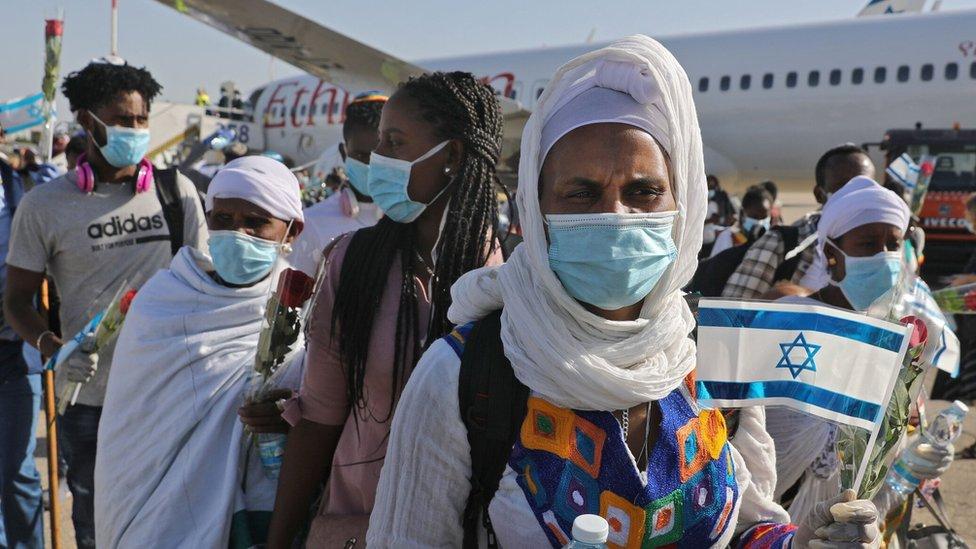
JERUSALEM: Israel’s government on Monday approved immigration plans for 2,000 Ethiopians whose desire to move to the Jewish state has stirred controversy and faced extended delays.
The group are members of the Falash Mura, descendants of Ethiopian Jews who converted to Christianity — many under duress — in the 19th and 20th centuries.
They are not recognized as Jews by Israel’s Orthodox rabbinical authorities, but claim the right to immigrate under family reunification rules.
The government approved about 9,000 claimants in 2015 but then rescinded the decision the following year, citing budgetary constraints.
Some groups in Israel, including members of the Ethiopian community, have opposed immigration of the Falash Mura, citing doubts over their claim to be Jewish.
Netanyahu told his cabinet on Monday that it was time to bring “2,000 of our people, our brothers and sisters from Ethiopia.”
“We will also act to bring all of the rest,” he said.
Integration Minister Pnina Tamano-Shata, the first Ethiopian Jewish woman elected to Israel’s parliament, praised the government’s “unanimous vote to bring 2,000 people to Israel who are waiting in Ethiopia to be united with their families.”
The bulk of Ethiopia’s Jewish community was brought to the country between 1984 and 1991 under the Law of Return, which guarantees Israeli citizenship to all Jews.
The Ethiopian-Israeli community has since grown to 140,000-strong, including 50,000 born in Israel.
Many say they faced racial discrimination, notably abuse by Israel’s police.

Main category: 

Ethiopian-Israelis decry family separation as discriminatoryAngered by police killing, Ethiopian-Israelis demand change


Lebanese ex-PM looks to revive French rescue plan

Author: 
Mon, 2020-10-12 22:49

BEIRUT: Former Lebanese prime minister Saad Hariri has put himself forward as a potential leader in a bid to break the country’s growing political deadlock.

He also began political consultations with other parties in order to revive the possibility of a successful French rescue plan on Monday.

After a meeting with President Michel Aoun in the Presidential Palace, Hariri said: “We have no time to waste on political polemics. If someone wants to change the concept of the French initiative, let them bear the responsibility.”

The French plan, launched by President Emmanuel Macron on Sept. 1 to help Lebanon cope with its crises, failed after Hezbollah and the Amal Movement demanded ownership of the finance portfolio and the presence of Shiite ministers in a new government.

Hariri said that the government should be “formed of specialists who do not belong to parties and who will undertake specific reforms within a specific timetable, which does not exceed a few months.”

Lebanon is scheduled to begin negotiations with Israel on Wednesday to demarcate maritime borders amid an absence of government in the country, which is enduring one of its worst economic and financial crises to date.

President Aoun said he “wants to form a new government as soon as possible, because the situation no longer tolerates further deterioration.”

Aoun also urged “the necessity of adhering to the French initiative.”

In a statement, Hariri said the consultations, which also included meetings with Parliament Speaker Nabih Berri and other former prime ministers, were designed to “float Macron’s initiative.”

He added that the French plan “is the only and last opportunity to stop the collapse and rebuild what was destroyed by the Beirut Port explosion.”

Hariri said he would “send a delegation to communicate with all the main political blocs to ensure that they are still fully committed to the terms of the paper that they previously agreed upon during the meeting with President Macron at the Pine Palace.”

“The government’s goal is to implement only economic, financial and administrative reforms. Governments formed on the traditional basis of party representation failed to implement reforms and brought the country to the great collapse in which we are living.

“The great collapse threatens our country with more tragedies and threatens the state with complete demise.

“Macron has pledged to all of us to mobilize the international community to invest in Lebanon and to provide external financing. Do you understand what that means? It means that he will hold a conference to save Lebanon from collapse.”

“If any political party wants to change the concept of the initiative, especially concerning its economic aspect and the clause of specialized ministers, knowing in advance that this leads to its failure, then let them assume their responsibility before the Lebanese people and inform them of this matter,” he added.

President Michel Aoun will begin consultations with parliamentary blocs on Oct. 15 to assign a Sunni figure to form the next government and succeed Prime Minister Hassan Diab’s caretaker administration.

Diab’s government resigned on Aug. 10 following the Beirut explosion, while Mustapha Adib, who was assigned prime minister-designate on Aug. 31, stepped down a month later after he failed to form a Cabinet based on the French plan.

Following Adib’s downfall, Macron condemned Lebanon’s political dysfunction, with a particular focus on Hezbollah and the Amal Movement.

He singled out the former as a “terrorist militia that terrorizes political forces with weapons,” adding, “some of the leadership preferred to be hostages with Hezbollah.”

On Monday, Lebanon listed the members of its delegation being sent to discuss maritime borders with Israel. The meeting, which begins on Oct. 14 at the Naqoura UNIFIL headquarters, will be overseen by US officials.

The leader of the delegation is Brig. Gen. Pilot Bassam Yassin, while members include Marine Col. Mazen Basbous, Petroleum Administration official Wissam Chbat and maritime expert Najib Masihi.

The Presidency of the Republic said the negotiations are “purely technical,” downplaying rumors that the talks are part of a normalization process with Israel.

Hezbollah’s parliamentary bloc said last week that the negotiations “have nothing to do with making peace with Israel and do not come in the context of reconciliation with the enemy, nor with normalization policies.”

The economic stranglehold on the Lebanese public is tightening, with citizens voicing complaints about lack of medicine available in pharmacies.

The country’s chemists are preparing to stage their first-ever strike on Tuesday, in a bid to prevent “the smuggling of subsidized medicines out of Lebanon, and steps to remove subsidies on medicines.”

President of the Pharmacists Syndicate Dr. Ghassan Al-Amin said medicine smuggling is affecting Lebanon’s ability to provide vital medicine to the public. He added: “There are 17 pharmacies in Iraq that sell drugs smuggled from Lebanon, and there are pharmacies in Syria that sell smuggled Lebanese medicine.”

Amin also warned of “importers storing subsidized drugs in Lebanon.”

Minister of Health Hamad Hassan revealed during a meeting with the Pharmacists Syndicate that “a truck covered with shades was seized containing a large number of vaccines being transported abroad.”

The minister also warned of “large quantities of medicines arriving at pharmacies and being smuggled at night across the border with Syria.”


Main category: 
Tags: 

Lebanon names team for maritime border talks with IsraelFires brought under control in Syria, Lebanon