UAE, Bahrain welcome decision to remove Sudan from US terror list

Tue, 2020-10-20 21:26

DUBAI: The UAE and Bahrain both welcomed on Tuesday the US removing Sudan from a list of state sponsors of terrorism.
Donald Trump said a day earlier he would remove Sudan from the list after the country agreed to pay compensation to US victims of terror attacks.
The UAE Ministry of Foreign Affairs and International Cooperation said it supported all efforts to remove Sudan from the list.
The ministry added it that it supported everything that “contributes to strengthening Sudan’s security, stability and prosperity.”
The Bahraini foreign ministry also said it welcomed the decision, calling it a positive step.

Sudan’s central bank said on Tuesday it had transferred $335 million in compensation to the US. 

The money is for victims of the 1998 bombings of the US embassies in Kenya and Tanzania, which were conducted by Al-Qaeda while Osama bin Laden was based in Sudan.

Sudan is ruled by a transitional government installed after the downfall of President Omar Al-Bashir last year.

The removal from the terror list will allow Sudan to access international loans and aid to revive its economy.

Main category: 
Tags: 

Donald Trump says Sudan will be removed from terrorism listSudan’s premier backs demands for justice as ICC prosecutor visits


Kuwait’s new emir calls for national unity ahead of elections

Author: 
Reuters
ID: 
1603214708036680800
Tue, 2020-10-20 09:30

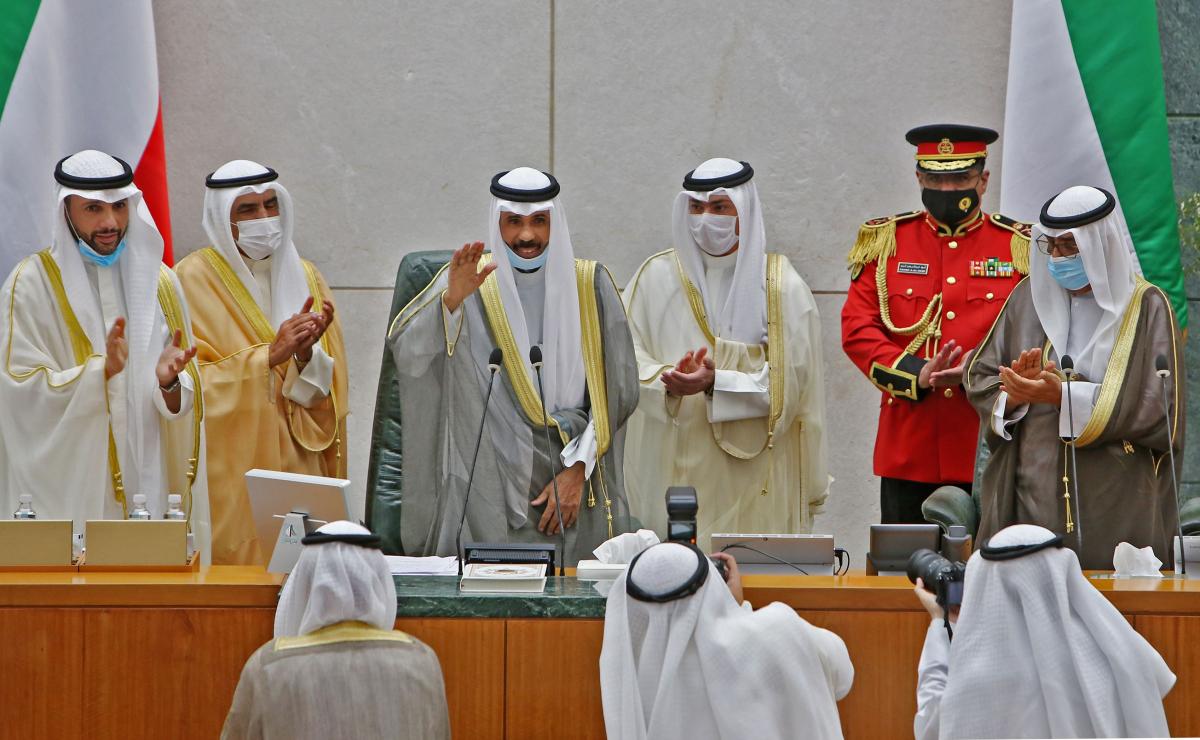
KUWAIT: Kuwait’s Emir Sheikh Nawaf Al-Ahmad Al-Sabah called on Tuesday for national unity to meet challenges facing the Gulf state, in a speech to lawmakers ahead of elections on Dec. 5.
The parliamentary elections come at a time when the wealthy OPEC member is facing a liquidity crisis caused by low oil prices and the coronavirus pandemic against the backdrop of continued tensions between larger neighbors Saudi Arabia and Iran.
“National unity has proven to be our strongest weapon in facing challenges, dangers and crises,” said the emir, who assumed power last month on the death of the previous ruler.
Frequent clashes between the cabinet and parliament have led to successive government reshuffles and dissolutions of parliament, hindering investment and reform efforts. The outspoken assembly, the Gulf’s oldest legislature, can block bills and question ministers.
Prime Minister Sheikh Sabah Al-Khalid Al-Sabah, also addressing the opening of a supplementary legislative session, called for greater efforts to “diversify revenue sources and rationalize spending and consumption … without detriment to citizens” in the cradle-to-grave welfare state.
He said the government was seeking more sustainable tools to finance the budget, in which public sector salaries and subsidies accounted for 71% of spending for the 2020-2021 fiscal year.
The nearly $140 billion economy is facing a yawning deficit of $46 billion this year. A priority will be overcoming legislative gridlock on a bill that would allow Kuwait to tap international debt markets.
Lawmakers opposed to the debt law have called for clarity on government plans to reduce reliance on oil exports, which accounted for 89% of revenues in the last fiscal year.
The emir is expected to maintain oil and investment policy and a balanced foreign policy that strove for Arab unity.
In his speech, the premier said Kuwait would continue mediation efforts to end a Gulf dispute that has seen Saudi Arabia and its allies boycott Qatar since mid-2017. He reiterated his country’s support for Palestinians’ rights.

Main category: 

Kuwait Cabinet approves decree for parliamentary elections to be held Dec. 5


Female domestic workers regularly abused in Qatar: Report

Tue, 2020-10-20 18:52

LONDON: Female migrant workers in Qatar regularly suffer extreme abuse and are frequently overworked, according to a report published on Tuesday by Amnesty International.

The report, which surveyed the experiences of 105 female migrant domestic workers in the Gulf state, said some were forced to work excessive hours, were not paid properly, were denied food, and suffered severe physical mistreatment at the hands of employers, including sexual assault.

It documented instances of regular beatings suffered by 15 of the women, with 40 saying they had been slapped, spat at or had their hair pulled. Most were frequently insulted; one said she had been treated “like a dog” by her employer. 

Another said her employer had threatened to cut out her tongue and kill her. “I am only a (maid), I cannot do anything,” she told Amnesty.

Eighty-seven of the 105 said their passports had been confiscated by their employers, preventing them from returning home, and they were offered no protection by Qatari authorities.

Ninety of the women interviewed said they worked for over 14 hours per day, and half said 18-hour days were normal — double the standard hours stipulated in their contracts. Many had never received days off.

Five of the women surveyed by Amnesty said they have suffered sexual abuse at the hands of employers or their family members, with one adding that she had witnessed the son of her employer raping another domestic worker.

She and her colleague were offered money by the employer to keep quiet. When they went to the police instead, she said, they were accused of making the story up.

Qatar is thought to have around 173,000 migrant domestic workers and as many as 2.7 foreign workers overall, making up nearly 90 percent of the country’s population, with most coming from India, Nepal, Bangladesh and the Philippines.

Qatar has been dogged by allegations of systematic mistreatment of such workers, including denying them the right to set up unions, or to return home without their employer’s permission for years.

International focus has been drawn to the way the country has treated migrant laborers since Qatar was awarded the right to host the 2022 FIFA World Cup.

Problems persist, including late or non-payment of wages, inadequate housing and exploitative behavior by employers.

Despite moves to bring in such functions as a minimum wage and the 2017 Domestic Workers Law, which ostensibly guaranteed rights on issues such as working hours, breaks, days off and holidays, most measures are not enforced and migrant domestic workers in particular have been left behind, Amnesty said.

“The women we spoke to were resilient and independent — they had left their homes and traveled halfway across the world. Instead of being isolated and silenced, these women should be given a voice so they can advocate for their rights,” said Steve Cockburn, Amnesty’s head of economic and social justice.

“Domestic workers told us they were working an average of 16 hours a day, every day of the week, far more than the law allows. Almost all had their passport confiscated by their employers, and others described not getting their salaries and being subjected to vicious insults and assaults,” he added.

“The overall picture is of a system which continues to allow employers to treat domestic workers not as human beings, but as possessions. Despite efforts to reform labor laws, Qatar is still failing the most vulnerable women in the country.”

A Qatari government statement said allegations raised by the report will be investigated to ensure “all guilty parties” are held to account.

“If proven to be true, the allegations made by the individuals interviewed … constitute serious violations of Qatari law and must be dealt with accordingly,” the statement added.

Main category: 

Qatar workers face old problems despite reform promises


Turkey withdraws some observation posts from northern Syria

Author: 
Tue, 2020-10-20 00:53

ANKARA: A Turkish military base in the Syrian town of Morek is being completely demolished by Sunday evening, according to Turkish sources who said that other observation points and military sites were also due to be dismantled.

Control towers and logistical equipment inside the base are being taken down and the walls are being removed. The Syrian Arab Army, which surrounded the post from all sides, is expected to take full control of the zone that became Turkey’s weakest point against military attacks.

Turkey’s presence in northwestern Syria has come under increasing pressure since mid-September, with a Turkish Red Crescent worker being killed and two others injured. Afrin Liberation Forces also targeted a Turkish observation point in the Al-Ghazawiyah area of Afrin city, northwestern Aleppo, in mid-September.

Attacks on a joint Russian-Turkish patrol on the international M4 highway that injured Russian soldiers have also been a source of concern.

Turkish forces are alleged to have been transferred from Morek to the Jabal Al-Zawiya region of neighboring Idlib governorate.

Ankara has yet to officially confirm its withdrawal. But Russian state-owned news agency Sputnik reported that Turkey had notified Russia of its withdrawal decision from the region.

The Turkish military still has more than 50 observation posts across northern Syria, creating a serious source of tension with Damascus because Ankara was only allowed to open 12 posts to the north and east of Idlib, according to the 2018 Sochi agreement.

Eight of these observation posts and five fortified positions are currently under siege by Syrian forces.

Navvar Saban, a military analyst at the Omran Center for Strategic Studies in Istanbul, said that Turkey did not want to take any risks in case of a military operation.

“As some Turkish observation points are besieged right now, Turkey has the lower hand that might affect negotiation terms,” he told Arab News. “The Russians will have the upper hand because they control the fate of these besieged points.”

Saban said that Turkey was planning to pull out from all of these points and redirect them to an area south of the M4.

Moscow has tried to convince Ankara to reduce its military presence in Idlib and remove some of its observation posts in the area.

But Turkish government officials have indicated that a withdrawal is out of the question because a regional presence is a bargaining chip in negotiations with Damascus and Moscow. On the other hand, holding Idlib under control is of key importance for Turkey to prevent any refugee wave toward its borders.

How Turkey will proceed against rising security threats against its military deployment in the area is a big question. A war in Idlib might be on the horizon in light of a recent military build-up by Turkey to Idlib’s south.

Aydin Sezer, an expert on Turkey-Russia relations, said the Turkish military was getting ready for any upcoming military clashes in the region.

“Tensions between Turkey and Russia have escalated recently, especially after the engagement of both countries in the conflict between Armenia and Azerbaijan where the Kremlin criticized Ankara for pushing a military solution to the Nagorno-Karabakh conflict,” he told Arab News.

According to a March agreement between Turkey and Russia, Turkey pledged to wipe out terror zones in and around Idlib in six months.

“This withdrawal might have been triggered by Russian pressure on Turkey considering the local dynamics in Turkey,” Sezer added. “Russian military police were trying to protect some observation points which were already under the siege of (President Bashar) Assad’s troops to prevent any direct clash. The latest disagreements in the South Caucasus have also stimulated Russia in putting the Idlib issue on the top on its agenda.”

But he thought that Turkey could not sustain a long-term presence in the south of the M4 because Russia expected total security along the highway to open it for road traffic, while a Turkish presence would introduce a source of tension with Assad forces.

Dr. Emre Ersen, an expert on Turkey-Russia relations from Marmara University in Istanbul, said the agreement reached between Turkey and Russia regarding the Idlib crisis in March was a temporary solution to prevent a possible military clash between Turkish forces and the Assad regime.

“Yet the COVID-19 outbreak, which became an urgent issue around the same period, forced both governments to focus on their domestic problems,” he told Arab News. “Now, it seems that Russia is gradually returning to its pre-pandemic agenda in foreign policy and this is probably why it has been exerting more pressure on Ankara to withdraw from some of the military observation posts in Idlib.”

But Ersen added that the timing of the pressure was interesting, especially considering the growing rift between Ankara and Moscow about other conflicts such as Nagorno-Karabakh and Libya.

“In this sense, Moscow will probably try to use the Idlib issue as part of a greater bargain with Ankara which also includes the settlement of other disputes in the Caucasus and the Middle East.”


Main category: 
Tags: 

Ukrainian fitness influencer who branded COVID-19 a hoax dies from virus after trip to TurkeyGreece finalizes plan to build wall on border with Turkey


Lebanese economic bodies call for assistance amid government formation crisis

Author: 
Mon, 2020-10-19 23:57

BEIRUT: The new Lebanese prime minister to head the next government is expected to be named within two days. Meanwhile, questions are being raised regarding Thursday’s parliamentary consultations, with President Michael Aoun rumored to be considering delaying them for a second time.

Former Prime Minister Saad Hariri is the only name proposed to form the new government, with the two Christian parties — the Free Patriotic Movement (FPM) and the Lebanese Forces — objecting to his nomination.

Richard Kouyoumjian, former minister and serving member of the Lebanese Forces parliamentary bloc, said that his party’s objection does not mean it is refusing to participate in the binding consultations.

“The mere participation of the bloc’s representatives in the parliamentary consultations makes it legal as per the common agreed values and laws, whether or not the bloc names the person who will be assigned to head the new government,” he said.

Kouyoumjian called for “the implementation of the constitution” and said: “Enough bidding in the name of the sect.”

The stance of the Lebanese Forces means the FPM is the only bloc disrupting the parliamentary process.

The Lebanese Forces’ decision not to propose anyone to head the government differed from its position in the two previous parliamentary consultations. In these consultations, the party proposed Ambassador Nawaf Salam.

Future parliamentary bloc member Mohammad Hajjar hoped that the consultations would not be postponed as “it will not be in the interest of the country and the people.”

He told Arab News: “The first postponement was not justified. We said that the French initiative is an opportunity to rescue the country and that it should not be wasted. We said that postponement does not change anything, but rather will be an obstruction that does not benefit the country. We hope to have a prime minister assigned on Thursday by a parliamentary majority.”

On whether he expects a postponement of consultations under new pretexts, Hajjar said: “Maronite Patriarch Bechara Al-Rahi called for the application of the law that does not refer to Christian or regional charters in the assignment process. We say that 22 Christian members of parliament will come to the next parliamentary consultations in the Baabda Palace, and some of them might name Hariri while others might not. Therefore, the consultations must be held so that we proceed to form the government.”

Amid the political ruckus, The Lebanese economic bodies representing the various fields of the private sector have launched a new call for help to save the country.

In a meeting on Monday, the groups called for “the immediate formation of a government that can implement the French initiative.”

The economic bodies warned that “we will reach a stage where there is zero liquidity in hard currencies, the dollar exchange rate will rise uncontrollably, the purchasing power will diminish, and the inflation rate will rise. This means an almost complete closure of institutions, mass unemployment, and societal poverty across all sects.”

The experts highlighted that they had previously warned “of this tragic fate repeatedly, and here we are. On the ground, the structure of the country is collapsing, the economy — with all its components — is deteriorating at record speed, and institutions are breathing their last.”

In a position announced on Monday, the International Monetary Fund projected that “Lebanese economy will see one of the region’s sharpest economic contractions this year at 25 percent.”

The Crisis Observatory at the American University of Beirut estimated the cost of closing the poverty gap in Lebanon in 2020 for those below the minimum poverty line at $838 million.

The group explained that this cost had increased three times since 2019, due to a spike in poverty from 8 percent to 23 percent.

Main category: 

Lebanon’s biggest Christian party says won’t back Hariri for PMLebanon’s president postpones talks on nominating new prime minister