Palestinian official Erekat undergoes bronchostomy
Author:
Associated Press
ID:
1603308367436627100
Wed, 2020-10-21 18:46
JERUSALEM: A doctor treating Palestinian official Saeb Erekat for COVID-19 performed a bronchostomy on Wednesday to examine the condition of his respiratory system, his daughter said.
Salam Erekat said on Twitter that her father remained intubated and connected to an ECMO machine, which does the work of the lungs by transferring oxygen into blood.
She said it would take several days to get the results. “Hopefully things will take a better way. Pray for my father,” said Salam Erekat, who herself is a physician.
Erekat, 65, was transferred Sunday from the West Bank to Israel’s Hadassah Medical Center.
The hospital has said he is in critical but stable condition, and that its medical team is consulting with experts around the world to deal with the case. It says Erekat’s case is especially complicated given his history of health issues, including a lung transplant in 2017.
Erekat, 65, has been one of the Palestinians’ most recognizable faces over the past several decades, serving as a senior negotiator in talks with Israel and making frequent media appearances. He was also a senior adviser to late Palestinian leader Yasser Arafat and current President Mahmoud Abbas.
Officer may face charges in killing of autistic PalestinianTop Palestinian official Erekat ‘critical’ from virus
Working mothers hit back at nursery closures in Jordan
Author:
Reuters
ID:
1603305498816276700
Wed, 2020-10-21 17:28
AMMAN: Working mothers staged protests on Wednesday against Jordan’s decision to close all nurseries until year-end, saying the move unfairly targets women in the pandemic.
Jordan has already endured one of the strictest lockdowns in the region and now working mothers fear a second knockback as the country tries to stem the spread of the novel coronavirus.
“This decision has taken us back to events of (the first lockdown), when mothers were in disarray and nurseries were collapsing,” said Rana Ali of Sadaqa, an organization that advocates for women in the workplace.
“It’s an added burden on mothers who will lose the ability to balance their childcare duties and their work.”
Mothers and daycare workers demonstrated against the shutdown — due to begin on Saturday — outside the social development ministry, echoing growing anger on social media.
“Nurseries offer a crucial solution for thousands of working women and it is not a luxury,” tweeted Hadeel Seddiq.
“The closure decision is unfair and remote work is not a viable option for many professions.”
The protests came a day after the ministry of social development announced the planned shutdown, with almost 41,000 coronavirus infections and 414 deaths recorded countrywide.
The ministry did not respond to requests for comment.
SHUTDOWN
It marks the second time that nurseries will close because of COVID-19 after a near three-month hiatus in spring.
Only about 400 of the nation’s 1,400 nurseries re-opened after lockdown was lifted in June, citing financial losses and new hygiene and testing costs, Ali said.
Nebal Al-Haliq, who owns two nurseries in the city of Salt, 22 miles (35 km) from the capital, said the closure would hurt mothers and the 10 staff who tend to 55 children in her care.
“My priority is securing their salaries because their only source of income is the nursery,” she told the Thomson Reuters Foundation.
“And I’m still paying off the debts from the first closure.”
Dentist Majd Hawamdeh said she would take her two children from Salt to her parents in Amman, a two-hour round-trip that she must make twice daily to carry out her job.
With only three hours work in between, the 29-year-old said had no choice but to cut patient numbers, halving her income.
“Meanwhile I have bills to pay every month,” she said. “These don’t stop whether you go to work or not.”
Women make up less than 15% of the workforce in Jordan, one of the lowest rates in the world, according to the World Bank.
“We already have challenges that face working women and these decisions… will only worsen women’s economic participation,” Ali said.
CAIRO: A tripartite summit was held on Wednesday in the Cypriot capital Nicosia between Egyptian President Abdel Fattah El-Sisi and his Cypriot counterpart Nicos Anastasiades, along with Greek Prime Minister Kyriacos Mitsotakis.
The summit, the eighth between the leaders of the three countries, focused on discussing means of cooperation and coordination regarding issues of concern.
Bassam Rady, the spokesman for the Egyptian presidency, said: “The tripartite summit was held to evaluate the development of cooperation among the three countries in various fields, and to follow-up on joint projects currently implemented as part of the trilateral cooperation mechanism.”
Rady added that the summit also sought to “exchange visions on means of facing the challenges in the Middle East region.”
El-Sisi underlined the need to enhance the tripartite cooperation mechanism with Greece and Cyprus, saying: “We have decided to counter acts of provocation and violations in the Middle East.”
He indirectly accused Turkey of committing violations, transferring mercenaries to conflict zones, and blackmailing Europe with the issue of immigration.“We have signed the founding charter of the Eastern Mediterranean Gas Forum,” he added.
Regarding the Syrian crisis, the president said: “We reject any foreign existence on Syrian territories.”
Meanwhile, the Cypriot president stressed that Turkey was causing more tension in the area, jeopardizing regional stability, interfering in the Syrian crisis, and sending mercenaries to Libya and the Nagorno-Karabakh region.
Anastasiades said: “We underlined the need to take strong measures against those who support militant and terrorist groups in the region.” He pointed out that the trilateral relations were not against any state, but rather aimed to achieve peace and stability in the Middle East.
He also called on Turkey to respect international laws and not to violate Cypriot sovereignty.
“We discussed means of enhancing tripartite cooperation in various fields especially energy,” he said. “We welcome the establishment of the Eastern Mediterranean Gas Forum,” he added, whilst reiterating the need to stop the flow of illegal immigration via the Mediterranean.
The Cypriot president also described Turkey’s hunt for gas in Greek waters in the Eastern Mediterranean as “illegal.”
Meanwhile Mitsotakis said that the practices of the Turkish leadership were unfair to its people. “We don’t want to exclude Turkey but its practices lead to that action,” he warned.
This is the eighth such tripartite summit between since 2014. It coincides with Greece’s calls on the EU to consider suspending the Customs Union Agreement with Turkey.
Greek Foreign Minister Nikos Dendias delivered a letter to the European Neighborhood Policy and Enlargement Commissioner Oliver Varhelyito, to consider the measure as a response to Turkey’s repeated violations of the agreement, in addition to its unilateral measures of gas and oil excavations in the Eastern Mediterranean.
Greece accuses Turkey of ‘imperialist fantasies’Turkish drill ship heads back home from Cyprus waters
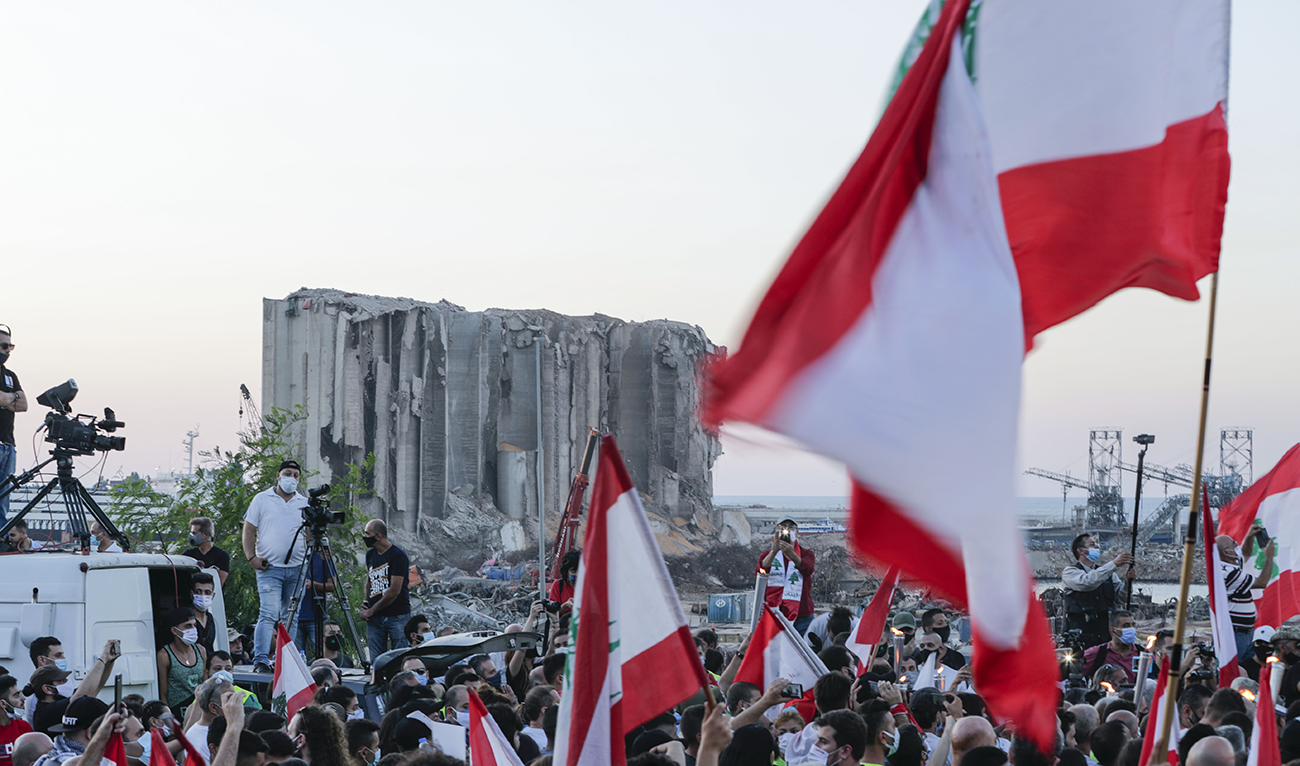
Lebanese spy chief tests positive for virus in US
Author:
Wed, 2020-10-21 01:28
BEIRUT: Lebanon’s security chief has been forced to delay his return from an official visit to the US after testing positive for coronavirus following a series of White House meetings.
Maj. Gen. Abbas Ibrahim, director-general of the Lebanese Public Security, met with US officials, including David Hale, the undersecretary of state for political affairs; CIA director Gina Haspel; and national security adviser Robert O’Brien during his recent visit to Washington.
Hale, as well as several other employees from the State Department and other executive branch divisions, are now self-isolating for 14 days, US officials said.
Lebanon’s General Directorate of Public Security said that Ibrahim is in “good health,” but will postpone his return to Beirut following the PCR test.
The Lebanese intelligence chief also held talks with senior US security officials in Washington. He was scheduled to hold meetings in Paris before his return to Beirut.
In Lebanon, the number of coronavirus infections during October rose to more than 24,000, climbing past the September total of 22,000.
Since the outbreak began in February, more than 63,000 cases have been reported in the country, with 525 fatalities.
Firas Abyad, director of the Rafic Hariri University Hospital, said: “The situation is unacceptable. If we continue on this path, we will soon reach a point where the number of critical coronavirus cases outweighs the number of available intensive care beds. This will coincide with winter, when the demand for intensive care beds increases for pneumonia cases, for example.”
Abyad told Arab News: “One of the most difficult cases that doctors can face is the death of a mother after giving birth, due to the repercussions of her infection with the coronavirus, and this happened a few days ago in Tripoli.”
Abyad pointed to a “state of denial” among those infected with the virus, saying some “consider it as just a regular flu, and do not think about the consequences of the disease.”
He added: “We have 215 cases that need intensive care in Lebanon. We are not fully occupied yet, but we may be shortly.”
Almost 80 Lebanese towns have been placed in lockdown by the Ministry of Interior after recording high rates of infection.
The one-week lockdown decree issued on Tuesday included the southern Beirut neighborhoods of Ghobeiry, Haret Hreik, Burj Al-Brajneh, Tahwitet Al-Ghadeer and Al-Laylaki.
According to the Mount Lebanon Governorate, some suburbs “failed to abide by individual and collective preventive measures to limit the spread of active infection chains.”
The lockdown includes a ban on “social events, parties and gatherings of all kinds.”
Cafes, gaming lounges, amusement parks, sports clubs and public parks will also be closed under the restrictions.
Lebanon’s president postpones talks on nominating new prime ministerLebanese top cleric urges leaders to stop delays in forming government
For Middle East children, pandemic adds to misery of displacement
Tue, 2020-10-20 22:00
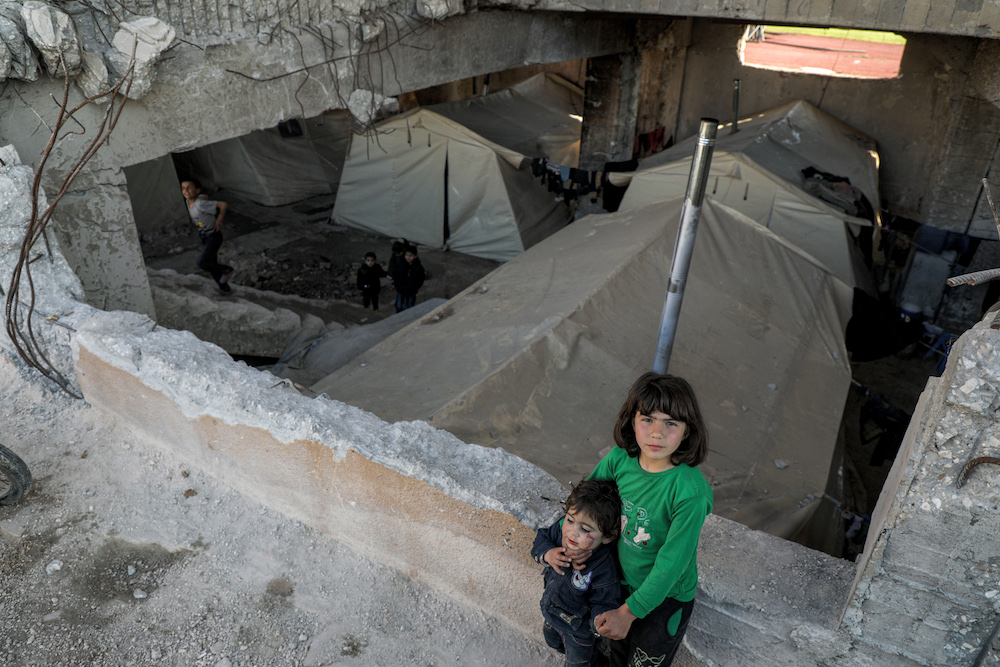
DUBAI/ERBIL: Millions have been displaced by recent wars in the Middle East and North Africa (MENA) — a significant number of them children. Cut adrift in an unfamiliar world in search of safe harbor, the trauma of losing their homes is often compounded by the brutalizing experience of displacement.
According to the UN’s World Migration Report 2020, there are an estimated 31 million child migrants worldwide. Roughly 13 million of them are refugees, 936,000 are asylum seekers, and 17 million have been forcibly displaced inside their own country.
Individual tragedies have occasionally drawn the attention of the international community. When photographs emerged of Alan Kurdi, the drowned Syrian toddler lying face down in the Mediterranean surf, the issue of child migration appeared, for a time, to take center stage.
Syrian children displaced by the war gather at a makeshift camp at Idlib football stadium on March 3, 2020 in the city of Idlib in northwestern Syria. (AFP/File Photo)
The world soon moved on, though, and initial pangs of sympathy and charity reverted to earlier anxieties about security. Now the coronavirus disease (COVID-19) pandemic has left jealously guarded borders bolted tight.
Of course, it is not just war and terror that drives civilians from their homes. Political and cultural persecution, the loss of economic opportunities, and the ravages of climate change have also contributed to this vast nation of stateless people.
But it is the recent spate of conflicts in the Middle East that has specifically fed the phenomenon of child migration. As Ramzy Baroud, author and editor of the Palestine Chronicle, says, the cause of child migration in the Arab region is the direct result of “violent” conflict.
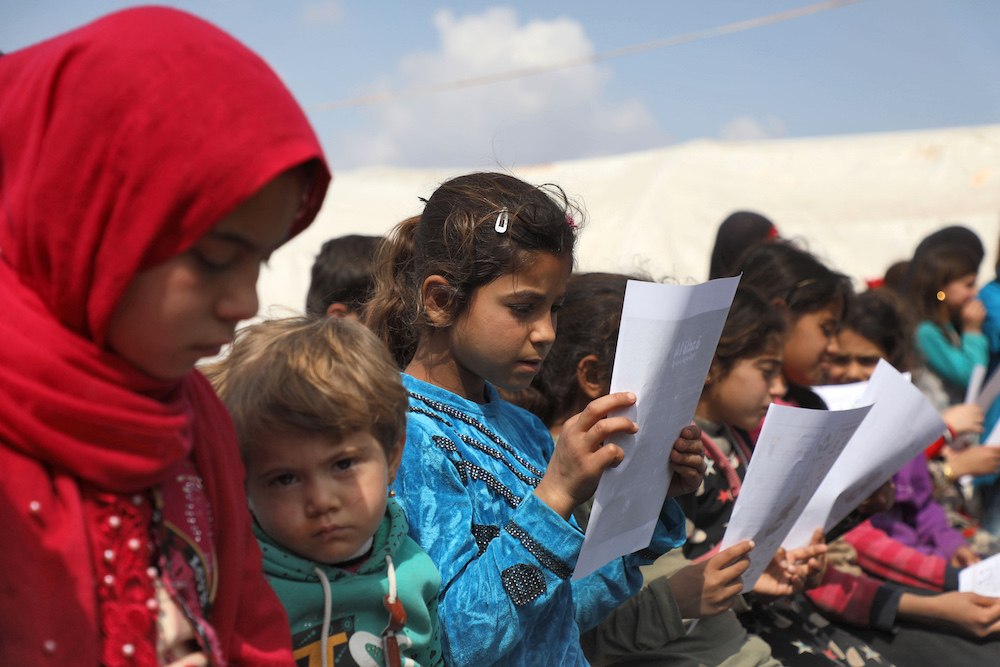
Displaced Syrian children attend a workshop aimed at spreading awareness about COVID-19 coronavirus disease and precautions for its prevention, at a camp near the Syrian town of Atme close to the border with Turkey in Idlib on March 16, 2020. (AFP/File Photo)
“Unlike economic hardship, which often evolves over prolonged periods of time, war is decisive and often leaves people with no other option but to flee,” he told Arab News. “We have seen this trend taking place in the early months of upheaval in the Arab world, starting in 2011 in Libya and continuing in Syria as well.”
Turkey hosts the largest number of refugees in the MENA region, while Lebanon hosts the largest number of refugees per capita, according to the UN High Commission for Refugees’ (UNHCR) regional spokesperson, Rula Amin.
“The situation in Syria continues to drive the largest refugee crisis in the world. There remain over 5.5 million registered refugees from Syria in the main hosting countries — Turkey, Lebanon, Jordan, Iraq and Egypt, and 2.6 million are children,” she told Arab News.
INNUMBERS
Children in the Pandemic
* 31 million – Total child migrants worldwide.
* 48% – Total refugee children out of school.
Syrians are by far the largest forcibly displaced population in the world — 13.2 million of them by late 2019, including 6.6 million refugees and more than six million internally displaced persons, according to the UNHCR.
Bombs and bullets no doubt drive the initial wave of displacement. But Baroud said the waves that follow are the result of the economic deterioration caused by conflict.
“This is important, because quite often war refugees and economic migrants are delinked, while in reality they are escaping the same threat, either that of war or its disastrous outcomes,” he said.
This can be seen in the case of Libyan and Syrian children, who fled the immediate danger with their families to become internally displaced persons — known in the humanitarian glossary as IDPs. It was predominantly the young and physically fit who dared to venture over land and sea to Europe.
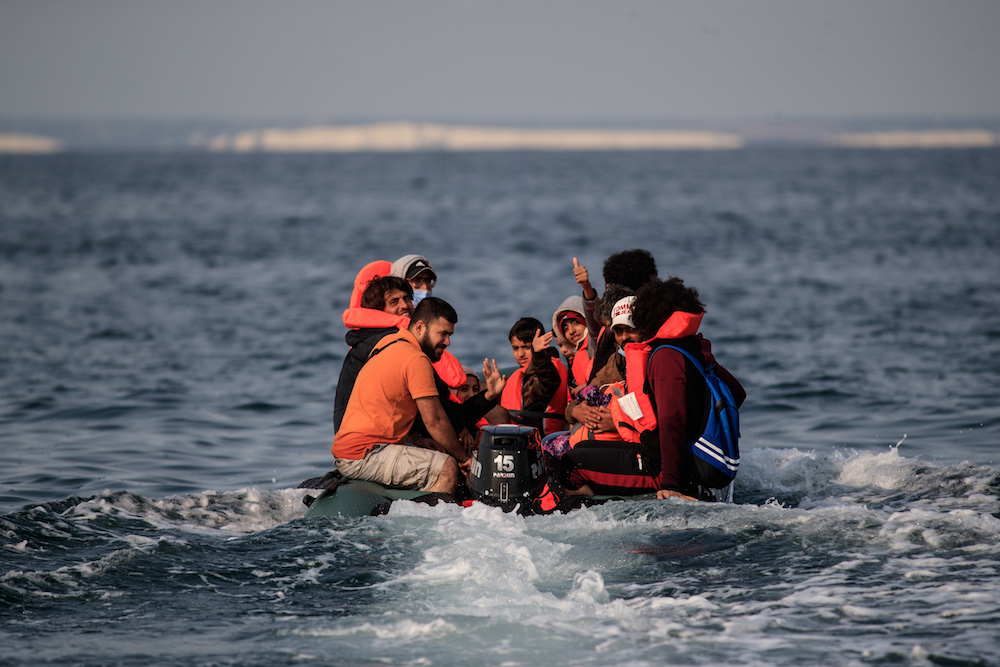
Migrants, including women and children, in a dinghy, react as they approach the southern British coastline as they illegally cross the English Channel from France on September 11, 2020. (AFP/File Photo)
However, as these conflicts dragged on, families with children increasingly lost hope in ever returning home and began contemplating far riskier options. As of January this year, Mediterranean crossings in rickety boats have killed at least 19,164 migrants since 2014, according to the International Organization for Migration.
“With time, whole families were escaping on long and arduous journeys together. In many cases, children were not even accompanied by adults, for their parents might have either been killed or separated from their children during the war,” Baroud said.
This trend was made clear in 2019, when UNICEF reported more than 33,000 child refugees crossed into Greece, Malta, Cyprus, Italy, Spain and Bulgaria, most of them from the Middle East and North Africa.
“These first countries of asylum often serve as a gateway to other destinations in Europe, where refugees hope to reach a different country, which might be Germany, Sweden, or any other,” said Baroud.
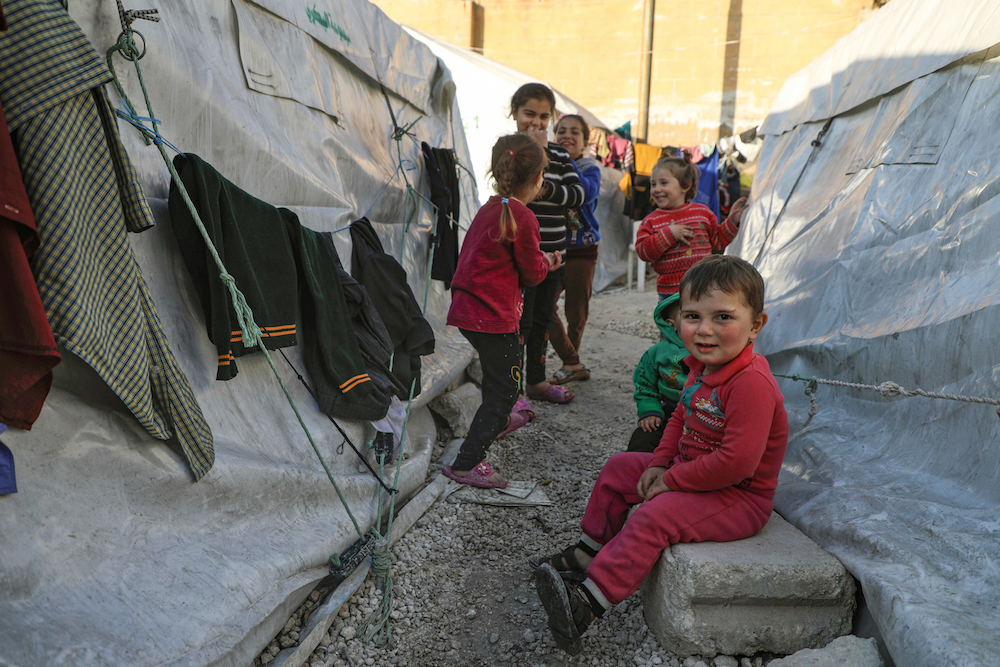
Syrian children displaced by the war stand at a makeshift camp at Idlib football stadium on March 3, 2020 in the city of Idlib in northwestern Syria. (AFP/File Photo)
“So quite often, once a refugee arrives in Greece, for example, where he or she is granted some kind of refugee identification, they hope to continue with their journeys past Greece to somewhere else where they can permanently settle.”
Keeping families together is a “concern and a priority” for aid agencies, says Amin. Key to this is obtaining civil documentation, such as birth, marriage and death certificates. With these, refugees and IDPs are able to access services, move freely and have their rights respected.
The COVID-19 has complicated matters. According to the UNHCR, lockdown measures have pushed displaced populations even deeper into poverty and uncertainty, with children bearing the brunt.
“Refugees have lost their incomes and livelihoods, they are suffering from serious historic disruption to the education of their children, deteriorating economies in their host countries add to their challenges and expose them to increased risks of child labor, early marriage and school drop-out,” Amin said.
Children sit on the ground in the burnt camp of Moria on the island of Lesbos after a major fire broke out, on September 9, 2020. (AFP/File Photo)
In fact, 50 percent of refugee girls worldwide are at risk of dropping out of school entirely because of COVID-19. With classes moving online, many displaced children simply don’t have access to computers, consistent internet, or a stable learning environment.
“The pandemic is threatening to erase years of progress made to ensure that refugee children get a proper education,” Baroud said.
“Today, 48 percent of all refugee children globally are out of school, 77 percent are enrolled in elementary education, 31 percent are enrolled in schools at secondary education, and only 3 percent get a chance to enroll for higher education.”
And the longer these children are out of school, the harder it will be to go back. Baroud added the economic realities of displacement effectively rob them of their childhoods, pushing them into the world of work.
“Families have to make a choice between turning their children into providers or having them enlist in long-term education,” he said.
UN steps up COVID-19 measures at Syrian refugee camps in JordanUNRWA appreciates Saudi Arabia’s support for Palestinian refugeesFund in partnership to help refugee children in LebanonPalestinian refugee agency warns of instability amid crisis