A ‘Saad’ day for Lebanon: Hariri’s fourth term as PM met with skepticism

Thu, 2020-10-22 21:47

BEIRUT: The decision to name Saad Hariri as Lebanon’s next prime minister on Thursday was met with anger, derision and ridicule from jaded Lebanese.

Hariri will hold the position for the fourth time despite months of widespread protests calling for a radical change to how the country is governed.

The massive August explosion in Beirut, which was blamed on corruption among officials, added to the anger towards Lebanon’s ruling class – a patchwork of sectarian, dynastic fiefdoms.

However, it appears the weeks of wrangling to find a new government after the previous one stood down in the aftermath of the blast has not produced the sea change many in the country had hoped for. 

Opinion

This section contains relevant reference points, placed in (Opinion field)

The sight of Hariri, who leads the Sunni Future movement, sitting grim-faced next to 85-year-old President Michel Aoun and the Hezbollah aligned parliament speaker Nabih Berri, did little to bring hope to Lebanese suffering under a dire economic meltdown.

“Hariri’s return as PM is a serious slap in the face to all victims of Aug. 4,” Fatima Al-Mahmoud, a freelance journalist, wrote on Twitter in reference to the explosion that killed almost 200 people.

“Their blood has gone in vain and no one will pay the price.”


Myriam Sassine, a Beirut-based film producer, said Hariri’s return showed there is nothing but “disappointment and heartbreak” in Lebanon.

“A year after October’s revolution and the resignation of Saad Hariri, Saad Hariri comes back as PM and savior,” she said. “The only change that happened is that we got robbed, violated and murdered while they’re stronger than ever.”


Even the UN’s Special Coordinator for Lebanon Jan Kubis expressed his disappointment at the move.

He said the decision to bring back Hariri was taken by the country’s traditional political forces “regardless of their numerous failures in the past and deep skepticism about the future.”

“It is up to them to help Hariri, the designated PM rapidly create an empowered, action-oriented government, to start delivering the well-known reforms. Do not count on miracles, foreign elections or external donors – the rescue must start in Lebanon, by Lebanon,” Kubis said.


Amid the anger there was also ridicule, as many took to social media to mock Hariri’s return.

“Hariri is like every ex that cheats on you and then cries for a second chance,” wrote one Twitter user.

Others played a game of “spot the difference” with the official photo released today of Hariri, Aoun and Berri, compared to the images used during his previous appointments.


Hariri, 50, stepped down as prime minister almost a year ago as anti-government protests against economic conditions and calling for an overhaul of the system of government raged across the country.

Hariri was replaced by Hassan Diab, whose ineffectual tenure came to an end days after the explosion. The relatively unknown Mustapha Adib lasted for just a month after he took the position from Diab.

The pressure on Lebanon’s leaders has not just come from within. French President Emmanuel Macron set a series of conditions to make sure any new government enacted reforms to stop Lebanon’s slide to financial ruin.

Hariri was returned to the post after he secured the backing of a majority of MPs.

He said he would form a cabinet of “non politically aligned experts with the mission of economic, financial and administrative reforms contained in the French initiative roadmap.”

Main category: 

Saad Hariri begins consultations with MPs to form Lebanon governmentHariri in line to lead next Lebanese government


Turkey confirms NATO fears over testing of Russian S-400 missile defense system

Author: 
Thu, 2020-10-22 21:18

ANKARA: Turkey on Thursday officially confirmed the fears of its NATO allies that it had carried out testing of its controversial Russian-made S-400 missile defense system.

Trials of the $2.5 billion anti-aircraft weaponry bought last year from Moscow took place last week in the northern Turkish province of Sinop, just across the Black Sea from Russian territory.

In a Bloomberg interview, Turkish Defense Minister Hulusi Akar said that the S-400 would not be integrated into NATO’s command-and-control infrastructure, but would instead be “used as a standalone system similar to the use of Russian-made S-300 weapons that exist within NATO.”

With this comparison, Akar implicitly referred to Athens, currently the top challenger to Turkey, which possesses the Russian-produced missiles in its arsenal.

Experts believe that the official statement on Turkey’s testing of the Russian air defense system could stoke tensions between Ankara and Washington, which claims that the missiles pose a serious threat to alliance military equipment.

Meanwhile, NATO defense ministers met on Thursday to discuss issues affecting the alliance’s security.

Ozgur Unluhisarcikli, Ankara office director of think tank The German Marshall Fund of the US, said Turkey’s argument that the S-400 would be a standalone system not connected to NATO’s radar network had been made several times but had failed to reassure the Americans.

The main concern of the NATO allies is that the S-400 could be used to gather sensitive intelligence via systems linked to the F-35 stealth fighter, the next-generation warplane of the alliance.

But Ankara has said that its acquisition of the Russian missiles was necessary to defend itself against current and emerging security threats in its region.

Turkey’s participation in the co-production of the F-35 system was suspended by Washington last year as punishment for buying the Russian military hardware. However, the US had held back from imposing sanctions while the missiles remained in crates, but harsh economic measures are expected to kick in once the missiles are activated.

US Senate Foreign Relations Chair Jim Risch said this week that further sanctions against Turkey, as part of the Countering America’s Adversaries Through Sanctions Act (CAATSA), for testing the S-400s still topped his agenda for initiation after the presidential election.

New Jersey Sen. Bob Menendez also issued a statement last week in which he said: “Turkey must be sanctioned immediately.”

Unluhisarcikli told Arab News: “The S-400s being used as a standalone system is unlikely to prevent CAATSA sanctions being imposed on Turkey.”

Ankara has been delaying the activation of the system since April, the planned date for its operationalization. Last month, during a visit to Turkey, NATO Secretary-General Jens Stoltenberg repeated that the S-400 system could not be integrated into the NATO air and missile defense system.

But Unluhisarcikli believes that the efficiency of the S-400 as a standalone system is highly dubious.

Joe Macaron, a Middle East foreign-policy analyst at the Arab Center, said the US did not trust Turkey to block any Russian attempt to infiltrate the F-35 system.

“The Turkish message about not integrating them into the NATO system is being met with suspicions because Turkey has been playing both the US and Russia for a while and benefiting from their bilateral tensions,” he said.

He felt that Turkey had a two-fold objective. “The first is linked to US domestic politics with Turkish President Recep Tayyip Erdogan struggling to get his US counterpart Donald Trump’s attention in the middle of his campaign or he is using the election season to force new preconditions for a potential Joe Biden presidency.

“And second, Erdogan feels a shifting US policy toward Turkey and testing the Russia defense system is a signal that he wants to talk with Washington. Whether Trump or Biden wins, there is no easy recipe for US policy toward Turkey,” Macaron added.

Main category: 

Video shows missile fired where Turkey cleared way for S-400 test, prompting US warningTurkey tests the controversial S-400 defense system next week. What then?


Iraq PM in talks with UK’s Boris Johnson on security, political reforms

Thu, 2020-10-22 17:14

LONDON: Iraqi Prime Minister Mustafa Al-Kadhimi and his British counterpart Boris Johnson discussed security challenges in the Middle East on Thursday.
A-Khadimi met the UK leader at Downing Street as part of an a European tour. 
Johnson expressed his strong support for the Iraq government as they discussed economic reforms, the coronavirus pandemic and the continued effort to defeat Daesh.
The Twitter account of Al-Kadhimi’s office said both leaders discussed issues of bilateral interest, and discussed recent political and security issues in Iraq and the region. 
They also agreed on more cooperation in the fight against terrorism.
“It was agreed to increase more cooperation in the field of combating terrorism, as well as in the political and economic sectors, in light of the economic challenges that Iraq faces,” his office said.
Prior to his UK trip, Al-Kadhimi met with French President Emmanuel Macron in Paris and German Chancellor Angela Merkel in Berlin.
During these visits, Al-Kadhimi discussed Iraq’s main challenges such as the fight against terrorism and foreign interference in its affairs.
The Iraqi leader, who became prime minister in May, has a particularly affinity with the UK, having lived there for many years after fleeing Iraq in the 1980s.

Main category: 

Iraq PM arrives in UK on official visit For Iraq’s persecuted Yazidis, return plan is fraught with risk


Protesters back on Sudan streets

Author: 
Thu, 2020-10-22 01:28

CAIRO: Sudanese protesters took to the streets in the capital and across the country on Wednesday over dire living conditions and a deadly crackdown on demonstrators in the east earlier this month.

The protests came on the anniversary of a 1964 uprising that ended six years of military rule. Sudan is currently ruled by a joint civilian-military government, following the popular uprising that toppled longtime president, Omar Bashir, last year.

The demonstrations came a week after at least 15 people were killed and dozens were wounded in tribal clashes and a government crackdown against protesters in eastern Sudan. The violence broke out after Prime Minister Abdalla Hamdok earlier this month sacked Saleh Ammar, governor of the eastern Kassala province.

Footage circulating online showed protesters marching on Wednesday in Khartoum and its twin city, Omdurman, as well as in other cities across the country. Protesters set tires ablaze in some areas in the capital. There were no immediate reports of violence.

Security forces blocked off major roads, bridges and streets leading to the presidential palace and the military’s headquarters in Khartoum ahead of the demonstrations. The state-run SUNA news agency said the city center was in complete lockdown.

The “million-man march” was called by the so-called Resistance Committees, which were instrumental in the protests against Bashir and the generals who removed him from office and briefly held power. Other political parties and professional unions took part in the demonstrations.

The protesters are calling for the formation of a legislative body, which is supposed to happen as part of a power-sharing agreement they reached with the military last year.

They also demand results from an independent investigation into the crackdown against protests last year, including the deadly breakup of the main Khartoum protest camp in June 2019. The probe was supposed to have been completed by February, but investigators asked for an extension in part due to the coronavirus pandemic.

The transitional government has been struggling to revive Sudan’s battered economy amid a huge budget deficit and widespread shortages of essential goods, including fuel, bread and medicine.

Annual inflation soared past 200 percent last month as prices of bread and other staples surged, according to official figures.

Sudan’s economy has suffered from decades of US sanctions and mismanagement under Bashir, who had ruled the country since a 1989 Islamist-backed military coup.

The country has more than $60 billion in foreign debt, and debt relief and access to foreign loans are widely seen as its gateway to economic recovery. But access to foreign loans is linked to the removal of sanctions related to the country’s listing by the US as a state sponsor of terror.

President Donald Trump recently said Sudan will be removed from the blacklist if it follows through on its pledge to pay $335 million to American terror victims and their families. Sudanese officials welcomed Trump’s announcement which is widely seen as a key incentive for the east African country to normalize relations with Israel.

The terror designation dates back to the 1990s, when Sudan briefly hosted Osama bin Laden and other wanted militants.

Main category: 

Sudan imposes a curfew in the cities of Port Sudan and Suakin due to ethnic clashes  Four more Sudanese protesters killed in Omdurman, as army and opposition meet


Iran rights lawyer Sotoudeh moved to jail out of Tehran

Author: 
Thu, 2020-10-22 02:01

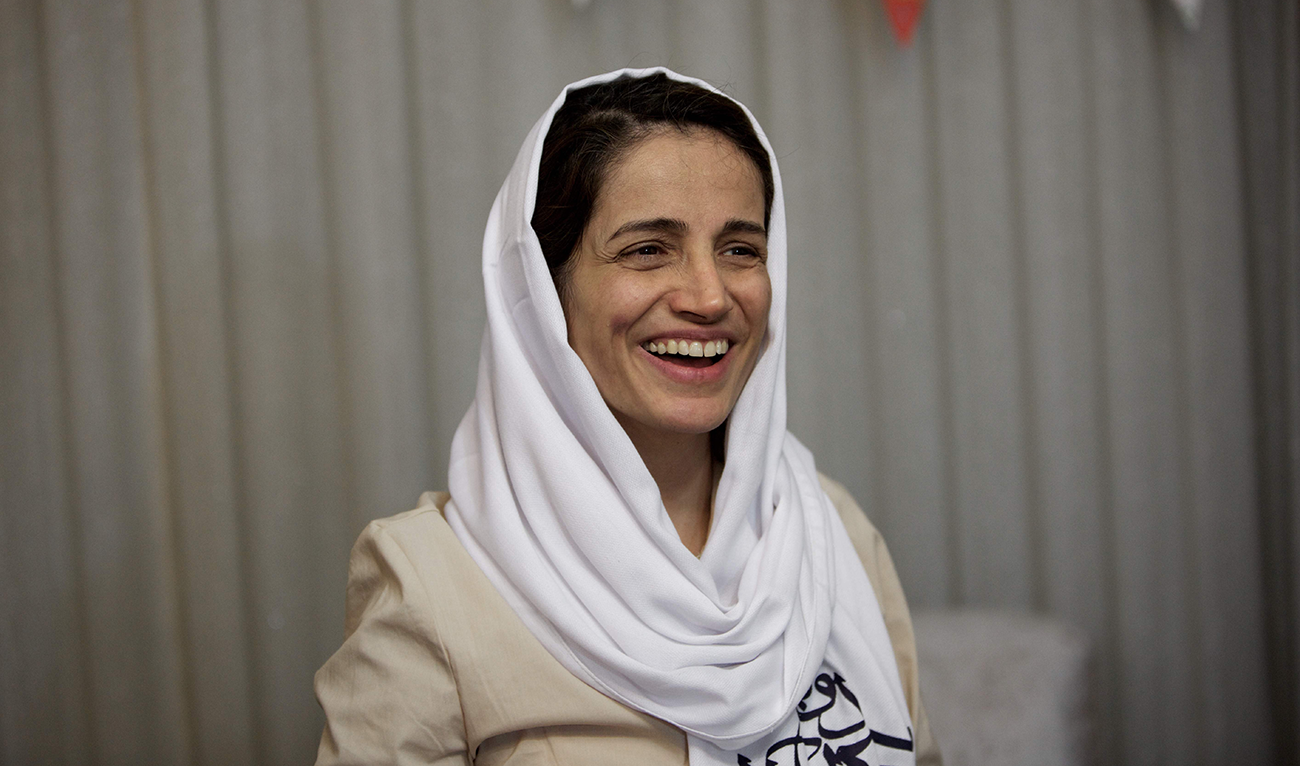
TEHRAN: Jailed Iranian human rights lawyer Nasrin Sotoudeh has been moved to a women’s detention center outside the capital Tehran instead of receiving the hospital treatment she needs, her husband said on Wednesday.

The UN has called on Iran to free Sotoudeh, a winner of the European Parliament’s Sakharov prize, and other political prisoners excluded from a push to empty jails amid the coronavirus pandemic.

“Nasrin called me yesterday (Tuesday) to tell me she’s been transferred straight (from Tehran’s Evin jail) to the one in Qarchak,” more than 30 km away, her husband Reza Khandan told AFP.

“We had been expecting her to be sent to hospital for an angiogram” as decided by “the medical commission at Evin prison,” he said.

Khandan has said that health issues prompted Sotoudeh, 57, to end a hunger strike lasting more than 45 days to push for the release of political prisoners during the pandemic.

The lawyer was sentenced in 2019 to serve 12 years in jail for defending women arrested for protesting compulsory headscarf laws in the Islamic republic.

UN human rights chief Michelle Bachelet on Oct. 6 expressed deep concern over the deteriorating situation of rights activists, lawyers and political prisoners held in Iran as a result of the coronavirus crisis.

“People detained solely for their political views or other forms of activism in support of human rights should not be imprisoned at all, and such prisoners, should certainly not be treated more harshly or placed at greater risk,” she said.

“I am very concerned that Nasrin Sotoudeh’s life is at risk,” Bachelet said.

A system of temporary releases to reduce the populations in severely overcrowded prisons, introduced by Iran in February to rein in transmission of Covid-19, has benefited some 120,000 inmates, although a number have since been required to return, her office said.

But it said that prisoners sentenced to more than five years for “national security” offenses were excluded.

The pandemic has cost more 31,000 lives in Iran out of 545,000 declared cases, according to official figures released on Wednesday.

Main category: 

Jailed Iranian rights lawyer Nasrin Sotoudeh hospitalized amid hunger strikeIran rights lawyer Nasrin Sotoudeh sentenced to 7 years in jail