New truce in Abyan brings peace to southern Yemen

Sat, 2020-10-24 21:20

AL-MUKALLA: Yemen’s soldiers and separatists agreed on Friday to put into place a “comprehensive and permanent” truce in the southern province of Abyan and other contested areas, local army commanders said on Saturday.

The fresh announcement about halting hostilities comes as Maeen Abdul Malik Saeed, prime minister-designate, is closing in on announcing the formation of a new shared government agreed under the Saudi-brokered Riyadh Agreement.

Military units loyal to the internationally recognized government received on Friday orders from the government to immediately put into place a truce, ending military alerts that have been in place in the province of Abyan for months.

“We have received orders to end combat standby state and put into place a comprehensive and permanent truce in the province,” a local government military officer in Abyan, who preferred to remain anonymous, told Arab News on Saturday. “It seems that the politicians in Riyadh reached an agreement,” the officer said, referring to the continuing new government consultation between Yemeni rivals.

Forces from the pro-independence Southern Transitional Council (STC) said that they received similar orders from their commanders to end hostilities in Abyan.

The Yemeni government and separatists have been at war during the past couple of years.

Aimed at ending the STC’s unilateral self rule in southern provinces, the government launched a military offensive in May in Abyan that has claimed the lives of dozens on both sides.

In July, Saudi Arabia, which brokered the Riyadh Agreement in late 2019, proposed a new mechanism for accelerating the implementation of the agreement which led to Yemen’s President Abed Rabbo Mansour Hadi mandating Maeen Abdul Malik Saeed to form a new government and the naming of a new governor and chief of security for Aden.

On the ground, the Kingdom has deployed military officers to monitor a truce between the rivals and the implementation of military and security arrangements under the deal. 

The premier-designate is putting the final touches on his consultations with Yemeni parties on a new government as major ministries were distributed between Yemen’s big and small parties, two sources told Arab News on Saturday.

“A new government might see light this week as combat forces will simultaneously pull out of contested areas and join fighting against the Houthis,” a senior STC source in Riyadh, said preferring anonymity.

Military and security arrangements under the deal, such as the STC withdrawal of military units from Aden, the country’s interim capital, and Abyan, have long blocked the formation of a new government as the legitimate government insists on the implementation of the security and military side of the agreement before announcing the agreement.

To end the impasse, the rivals agreed to announce the government this week, coinciding with the withdrawal of forces from Aden and Abyan, sources told Arab News. 

Government and STC sources in Riyadh said that under the current consultations, Yemen’s president would pick names for four “sovereign” ministries — defense, interior, finance and foreign affairs.

The STC was given the ministries of transport, social affairs and labor, civil service and insurance, agricultural and fisheries, as well as the ministry of public works and highways.

The remaining ministries were distributed between the General People’s Congress that has ruled Yemen for three decades, the Islamist Islah Party, the Socialist Party, the Islamist Rashad Party and Hadramout Inclusive Conference. 

Reacting to the news of a new government announcement and the halt of hostilities in their province, people in the contested areas in Abyan voiced hope that the factions would this time become serious and end fighting in their areas. “We are tired of fighting. We want to return to our normal life,” a man from Abyan’s Shouqra, who asked to remain anonymous, told Arab News.

Main category: 

Fighting resumes in Abyan as separatists pull out of talksYemen army troops briefly capture major city in Abyan
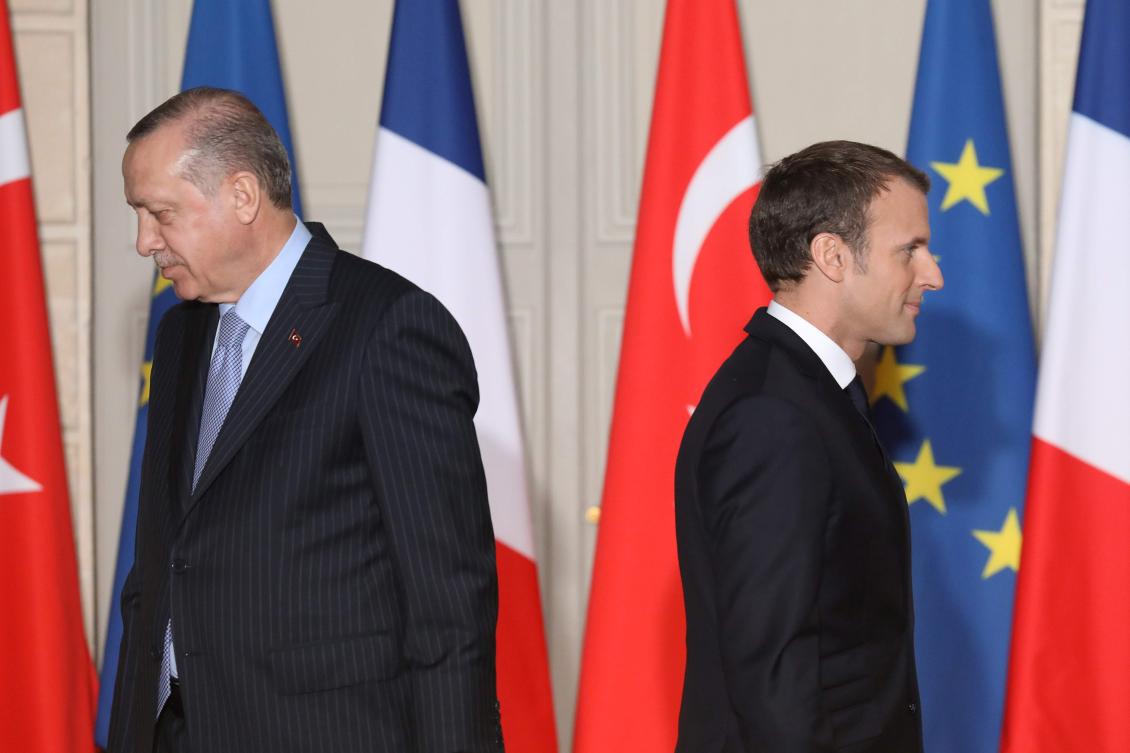



France recalls Turkey envoy after Erdogan ‘mental health’ jibe at Macron

Author: 
Fulya OZERKAN and Laurence BENHAMOU in Paris | AFP
ID: 
1603562693573673300
Sat, 2020-10-24 17:51

ISTANBUL: France on Saturday said it was recalling its envoy to Turkey for consultations after comments by Turkish President Recep Tayyip Erdogan suggesting French counterpart Emmanuel Macron needed a mental health check-up that Paris condemned as unacceptable.
France and its NATO ally are at loggerheads over a range of issues including maritime rights in the eastern Mediterranean, Libya, Syria and the escalating conflict between Armenia and Azerbaijan over Nagorno-Karabakh.
But Ankara has now been particularly incensed by a campaign championed by Macron to protect France’s secular values against radical Islam, a debate given new impetus by the murder this month of a teacher who showed his class a cartoon of the prophet Mohammed.
“What can one say about a head of state who treats millions of members from different faith groups this way: first of all, have mental checks,” Erdogan said in a televised address in the central Anatolian city of Kayseri.
“What’s the problem of the individual called Macron with Islam and with the Muslims?” Erdogan asked.
“Macron needs mental treatment,” Erdogan added, while indicating he did not expect the French leader to win a new mandate in 2022 elections.
In a highly unusual move, a French presidential official said that the French ambassador to Turkey was being recalled from Ankara for consultations and would meet Macron to discuss the situation in the wake of Erdogan’s outburst.
“President Erdogan’s comments are unacceptable. Excess and rudeness are not a method. We demand that Erdogan change the course of his policy because it is dangerous in every respect,” the official told AFP.
The Elysee official, who asked not to be named, also said that France had noted “the absence of messages of condolence and support” from the Turkish president after the beheading of teacher Samuel Paty outside Paris.
The official also expressed concern over calls by Ankara for a boycott of French goods.
Macron this month described Islam as a religion “in crisis” worldwide and said the government would present a bill in December to strengthen a 1905 law that officially separated church and state in France.
He announced stricter oversight of schooling and better control over foreign funding of mosques.
But the debate over the role of Islam in France has hit a new intensity after the beheading of Paty, which prosecutors say was carried out by an 18-year-old Chechen who had contact with a jihadist in Syria.
Turkey is a majority Muslim but secular country which is a part of NATO but not the EU, where its membership bid has stalled for decades over a range of disputes.
“You are constantly picking on Erdogan. This will not earn you anything,” said the Turkish leader.
“There will be elections (in France) … We will see your (Macron’s) fate. I don’t think he has a long way to go. Why? He has not achieved anything for France and he should do for himself.”
The other new rift between the two leaders is over Nagorno-Karabakh — a majority ethnic Armenian breakaway region inside Azerbaijan, which declared independence as the USSR fell, sparking a war in the early 1990s that claimed 30,000 lives.
Turkey is strongly backing Azerbaijan in the conflict but has denied allegations by Macron that Ankara has sent hundreds of Syrian militia fighters to help Azerbaijan.
Erdogan on Saturday accused France — which along with Russia and the United States co-chairs the Minsk Group tasked with resolving the conflict — of “being behind the disasters and the occupations in Azerbaijan.”
He also repeated previous claims that France, which has a strong Armenian community, is arming Yerevan. “You think you will restore peace with the arms you are sending to Armenians. You cannot because you are not honest.”
But the Elysee official said that Erdogan had two months to reply to the demands for a change in stance and that it ends its “dangerous adventures” in the eastern Mediterranean and “irresponsible conduct” over Karabakh.
“Measures need to be taken by the end of the year,” said the official.

Main category: 

Turkish Cypriots elect Erdogan’s candidate amid east Med tensionsMacron says beheaded teacher was victim of stupidity, hate


Algerian president, 75, self isolates as pandemic spreads

Author: 
Reuters
ID: 
1603555251822851000
Sat, 2020-10-24 15:48

ALGIERS: Algeria’s 75-year-old President Abdelmadjid Tebboune is self isolating because some officials in “upper ranks of the government” are sick with COVID-19, he said in a Tweet on Saturday.
Tebboune took office in December in an election that came amidst months of mass protests which forced his predecessor Abdelaziz Bouteflika from power after 20 years.
“I assure you, my brothers and sisters, that I am well and healthy and that I continue my work,” he said, saying his decision was taken on the advice of medical staff.
The global pandemic struck Algeria’s economy as it faced long-term challenges posed by the decline of the oil and gas revenues that finance its historically lavish state spending.
So far, Algeria has officially confirmed more than 55,000 cases of the coronavirus with nearly 2,000 deaths.
Though the pandemic forced an end to the weekly mass protest marches through Algiers and other cities that lasted for more than a year, the political challenges remain.
Tebboune has pushed for changes to Algeria’s referendum to limit presidential terms while expanding the powers of the parliament and judiciary.
However, many people in the leaderless protest movement believe their core goals of replacing the old ruling elite and forcing the army to stay out of politics remain unmet.
Algerians will vote in a referendum on the new constitution on Nov. 1, with Tebboune and the country’s powerful army generals seeking a high turnout in order to turn a page on the protests.

Main category: 

Algerian actresses call foul on femicide Algeria confirms Tebboune as new president, despite protests


Algerian actresses call on femicide

Sat, 2020-10-24 01:34

TUNIS: Algerian actresses angered by murders and violence targeting women have launched a campaign to fight the phenomenon — but not everyone has welcomed their initiative.
After the gruesome rape, torture and murder of a 19-year-old woman sparked angry demonstrations earlier this month and calls for a return to capital punishment, 22 actresses published a photo of themselves dressed in black.
“We, Algerian actresses, unite today to say enough to violence and killings of women. We are calling for more awareness and a general mobilization to stop this violence,” said a statement by the women, many of them household names in Algeria.
The North African country, like its neighbors Tunisia and Morocco, does not publish official nationwide figures on murders of women.
But campaign group Femicides Algeria recorded 75 such killings in 2019, with a further 41 so far this year.
The group says the actual figure is much higher.
And while the government last year registered some 7,000 complaints of violence against women, activists say it has done little in response — prompting the actresses to launch their own initiative.
“This campaign is aimed at everyone, men and women. It’s not to accuse Algerian men but to make everyone responsible,” said Salima Abada, a popular actress in the North African country who is among those involved. She said it was already having an impact.

NUMBER

75 women were murdered in 2019 with a further 41 so far this year, according to the campaign group Femicides Algeria.

“There’s debate, anger, people are fed up — but it’s already a beginning,” she said. But a video of one of the actresses has already triggered a bitter backlash on social media.
Mounia Benfeghoul published a video on Instagram early this month following the news of the grim killing of the 19-year-old, identified as Chaima.
In an angry monologue, Benfeghoul slammed people who had made excuses for the killer: “There are no excuses for rapists! It was a rape! She didn’t consent!”
Well-known as a TV presenter, Benfeghoul said she was against the death penalty — but favored castrating sex offenders.
She also criticized a culture of street harassment and called for children to be provided with “a good example.”
Her outburst set loose a wave of insults on social media, with men mocking her dress, calling her a “whore” and one man publishing a video in which he threatened her with physical violence.
Those reactions were simply “because she’s a woman,” said Abdellah Benadouda, founder of the US-based Radio Corona Internationale.
“She said nothing new. She confirmed what we already know: That taboos in Algerian society are at the source of the silence around rape, incest and paedophilia,” he wrote on Facebook. “The truth hurts.”

Main category: 
Tags: 

US drone strike kills 14 militants in NW Syria Two-decade court battle over West Bank area nears end


US drone strike kills 14 militants in NW Syria

Sat, 2020-10-24 01:18

BEIRUT: The US Army said Thursday it carried out a drone strike against Al-Qaeda leaders in northwest Syria near the border, killing 14 militants, according to a war monitor.
The Syrian Observatory for Human Rights (SOHR) said the casualties included five foreigners and six commanders.
“US Forces conducted a strike against a group of Al-Qaeda in (AQ-S) senior leaders meeting near Idlib, Syria,” said Major Beth Riordan, the spokeswoman for United States Central Command (CENTCOM).
“The removal of these AQ-S leaders will disrupt the terrorist organization’s ability to further plot and carry out global attacks threatening US citizens, our partners and innocent civilians,” Riordan said in a statement.
She did not specify the number of deaths from the strike.
According to the SOHR, a British-based NGO, the strike targeted a dinner meeting of militants in the village of Jakara in the area of Salqin.
The strike hit in Syria’s last major rebel bastion of Idlib, which is dominated by the Hayat Tahrir Al-Sham (HTS) group led a former Al-Qaeda affiliate, but other jihadist groups are also present in the area.
Observatory chief Rami Abdel Rahman said that five non-Syrian jihadists were among those killed, but their nationalities were not immediately known.
Among the six Syrian leaders killed, two were from HTS, he said.

SPEEDREAD

The strike hit in Syria’s last major rebel bastion of Idlib, which is dominated by the Hayat Tahrir Al-Sham (HTS) group led a former Al-Qaeda affiliate.

Ebaa, the media mouthpiece of HTS, said a strike targeted a “tent belonging to one of the dignitaries” in Jakara, killing several people.
A US-led coalition is present in the east of the country, where its airstrikes have backed Kurdish-led forces battling the Daesh group.
Thursday’s strike came after it emerged that the 18-year-old who killed a school teacher in France last week for showing cartoons of the Prophet Muhammad in class had been in contact with a Russian-speaking jihadist in Syria.
But the source close to the case said the identity of the Russian-speaking jihadist was not yet known.
After a string of military victories backed by key ally Russia, the Syrian government has regained control of around 70 percent of the country, the Observatory says.
Syria’s war has killed more than 380,000 people and displaced millions from their homes since starting in 2011 with the repression of anti-government protests.
Israel has carried out hundreds of strikes in the war-torn country, but these tend to target Iranian and Lebanese Hezbollah forces as well as government troops.

Main category: 
Tags: 

Two-decade court battle over West Bank area nears end Organization of Islamic Cooperation body urges to end Israeli prison violations