Iran reports COVID-19 death every five minutes, hospitals struggle

Author: 
Tue, 2020-10-27 00:06

DUBAI: Hospitals in many Iranian provinces are running out of capacity to handle COVID-19 cases, health authorities say, with novel coronavirus now killing around 300 people a day or one person every five minutes.

Authorities have complained of poor social distancing, and Deputy Health Minister Iraj Harirchi said the pandemic could cause 600 daily deaths in coming weeks if Iranians failed to respect health protocols in the Middle East’s hardest-affected country.

A caption that ran on state television news said an Iranian died of novel coronavirus every five minutes, a rate that corresponds to daily death tallies reported by the authorities of just above or below 300 over the past 20 days.

Health Ministry spokesman Sima Sadat Lari told state TV on Sunday that 32,616 people had died of the disease and the number of confirmed cases had reached 568,896.

Some experts have doubted the accuracy of Iran’s official coronavirus tolls. A report by the Iranian parliament’s research center in April suggested that the coronavirus tolls might be almost twice as many as those announced by the health ministry.

The report said that Iran’s official coronavirus figures were based only on the number of deaths in hospitals and those who had already tested positive for the coronavirus.

Schools, mosques, shops, restaurants and other public institutions in Tehran have been closed since Oct. 3. As COVID-19 cases and deaths continued to hit record levels, the closure was extended until Nov. 20, state TV reported.

Officials said “extreme measures and limitations” will be imposed in at least 43 counties across the country for one week, where the infection rates have been alarming. TV reported that 21 one of Iran’s 31 provinces were on a coronavirus red alert.

Iran has blamed US sanctions for hampering Tehran’s efforts to tackle the outbreak. Washington, accusing Iran of “incompetent and deadly governance,” has refused to lift sanctions that were reimposed after 2018 when Trump exited Iran’s 2015 nuclear deal with six powers.

Main category: 
Tags: 

Iran’s top leader says fighting virus trumps other concerns Iran coronavirus death toll tops 20,000



People in Arab countries want US to relax travel restrictions: survey

Tue, 2020-10-27 00:01

BEIRUT: In the wake of the uprisings that shook the Arab world starting in 2011, political unrest and economic hardship across the Middle East and North Africa have left many clamoring to leave the region in search of safety and better opportunities elsewhere.
The US, long known as the land of opportunity, has always been high on the list for aspiring immigrants. Predictably enough, as many as three quarters of respondents to the Arab News/YouGov pan-Arab survey said they want the next US administration to make it easier for people from Arab countries to travel to the US.
“Many of the young generation of Lebanese want to leave the country today. It feels like history is repeating itself. It’s exactly what happened 36 years ago when I left. Anybody who could afford to leave would leave,” said Rania Matar, a Lebanese-Palestinian photographer currently on a visit to Beirut from Boston.
“However, unless people have American citizenship, the Lebanese and Arabs alike don’t seem as interested in the US as before. They seem more interested in going to Canada or Europe, and perhaps that’s due to the stringent travel restrictions that the US has placed many Arab nations under.”

Indeed, over the past three years it has become increasingly difficult for people from Arab countries to travel to the US, especially after President Donald Trump, who is up for re-election on Nov. 3, imposed sweeping travel bans on people from a number of Muslim-majority countries in 2017.
Executive Order 13769 placed tight restrictions on citizens of Iraq, Iran, Libya, Somalia, Syria and Yemen. Plaintiffs challenging the order said the move was unconstitutional and broke federal statutes.
As a result, Trump issued Executive Order 13780, which amended some provisions of the first order, including the removal of Iraq from the list.
“Of course, they should ease up restrictions, especially for the younger generation, as they have zero opportunities in this part of the world,” Basel Dalloul, a tech entrepreneur who lives in Beirut, told Arab News.

“The US is still the land of opportunity for people in this part of the world. If you work hard and are tenacious in the US, chances are that you will make it and that’s what the US means to people here.”
For the 18 countries polled by the survey, 75 percent of respondents agreed that the US should make it easier for people from Arab countries to enter. The corresponding figure for Lebanon was even higher, 79 percent.
“The Lebanese are leaving Lebanon in droves,” said Dalloul. “Everyone and anyone who has the means to leave is leaving. The banking system here has collapsed. You can take out only 2 million Lebanese pounds now per week ($270 at the black-market rate). How does a family survive on that when they need to pay for rent, food, electricity and education?”


READ: The methodology behind the Arab News/YouGov Pan-Arab Survey


Lebanon has been rocked by mass anti-government protests since Oct. 2019, which began in response to new taxes. The protests soon escalated into expressions of rage against the entire political establishment.
Matters were made even worse on Aug. 4 when a port fire ignited a warehouse full of ammonium nitrate. The resulting blast devastated the city, leaving 203 dead and 6,500 injured.

The disaster seemed to underscore the perceived corruption and ineptitude of Lebanese officials and compounded public anger. With coronavirus containment measures already squeezing the job market, many young Lebanese have simply had enough.
According to this year’s Arab Youth Survey, two in five young Arabs are thinking about emigrating due to the lack of economic prospects brought on by the coronavirus pandemic, conflict and corruption.
Some 15 percent of 18-24-year-old respondents said they are actively trying to leave.
“There’s not many opportunities for Arab youth in the Middle East now,” said Mohamed Tahir, a Lebanese entrepreneur from Beirut. “It’s not just Lebanese but Arab youth across the region, including the Gulf.”

Twitter: @rebeccaaproctor


Main category: 


Arabs see Iran among top three threats to US interests: poll

Mon, 2020-10-26 23:45

NEW YORK: In just a couple of weeks, Americans will cast their ballots against a backdrop of civil unrest, racial tensions, political polarization and an economy crumbling under the stress of the world’s worst coronavirus outbreak.
In the run-up to the Nov. 3 presidential election, the Arab News/YouGov survey asked what the Arab world thinks are the greatest threats facing the US. Given the turbulence, it is difficult perhaps to settle on which of these challenges is the most pertinent.
However, for 32 percent of the respondents, white nationalism topped the list. China came in second place, with 22 percent of Arab respondents identifying the world’s second biggest economy as among the biggest threats facing the US today.

Iran occupied third place, with 9 percent highlighting Tehran as America’s greatest threat, followed by cybercrime, radical Islamic extremism, climate change and finally intrusive federal government as America’s chief woes.
“The survey results reflect the way Americans themselves view these threats,” said Khalil Jahshan, executive director of the Washington DC-based Arab Center, a think tank focusing on US foreign policy in the Middle East.


Extreme, right-wing groups were seen as the biggest threat to the US; respondents had great concerns about the malign influence of Iran.  (AFP)

“It shows that the Arab population is better informed about different issues here in the US.”
Arab respondents do seem to have their finger on the US political pulse.
Just recently, 13 members of an armed white militia were charged with plotting to kidnap Gretchen Whitmer, the Democratic governor of Michigan, and to overthrow the state government.
It also follows months of growing concern at the apparent spread of “alt-right” views, clashes between Black Lives Matter protesters and white supremacists, and Donald Trump’s failure to denounce the far-right Proud Boys during the first presidential television debate with his rival Joe Biden.

“The threat of racist, extreme, right-wing groups is the number one threat in terms of terrorism committed on American soil,” Jahshan said. “It has replaced a threat that was for a while, after 9/11, perceived as coming from radical Islamic sources.”
Although the US president has had Iran in his crosshairs, it is hardly surprising that the Arab public see China as America’s greater foe. Over the course of his presidency, Trump’s anti-Chinese rhetoric has swung from that of a mere trade war to implying Beijing deliberately unleashed the “Chinese virus” (COVID-19) to weaken the US economy.


READ: The methodology behind the Arab News/YouGov Pan-Arab Survey


“That didn’t play well in Peking (Beijing). And, of course, that relationship has fallen into disarray,” said Jahshan.
Despite their concerns about Iran’s malign influence in their own Middle East neighborhood, only 9 percent of the Arab News/YouGov pan-Arab poll respondents felt Tehran posed more of a threat to Washington than China.
“That low number reflects the gap between Arab and American public opinion (on the question of the Iranian threat). The typical Arab is not convinced that the US is on his side when it comes to Iran,” Jahshan said. “That is the general sentiment, particularly in the Gulf, a category that tends to view Iran as the principal enemy, with the US as a main ally.”

Beyond geopolitics, Arab respondents appear to have read the mood well on climate change, reflecting the view that Trump has rolled back much of the recent progress on environmental protection. “The fact that 5 percent of Arab females and 9 percent of Arab males see that issue as a vital threat to the US is correct,” Jahshan said. “I only wish the numbers were higher.”
As a longtime Middle East observer who has dealt with several Arab governments over the past four decades, Jahshan says that he is pleased to see Arab public opinion being taken into consideration for the first time.
“It is encouraging and instructive to see these surveys. I hope that will make Arab public opinion become a factor in foreign policy, be it here in the US or in the Arab countries,” he said.

Twitter: @EphremKossaify


Main category: 


Pan-Arab poll: Biden better for region, but must shun Obama policies

Mon, 2020-10-26 00:30

RIYADH: Nearly half the respondents in an Arab News/YouGov poll conducted in 18 Middle East and Africa (MENA) countries believe neither candidate in the upcoming US elections will necessarily be good for the region.
Of the rest, 40 percent said Democratic Party candidate Joe Biden would be better for the region while 12 percent said the same thing about incumbent President Donald Trump. But a key takeaway of the poll is that if Biden, who served as vice president to Barack Obama until 2017, wins the White House race, he would be well advised to shed the Obama administration baggage.
When asked about policies implemented in the Middle East under the Obama administration, the most popular response (53 percent) was that the Democratic president left the region worse off, with another 58 percent saying Biden should distance himself from Obama-era policies.
The study surveyed a sample of 3,097 respondents online to find out how people in the MENA region feel about the Nov. 3 US elections.

Opinion

This section contains relevant reference points, placed in (Opinion field)

Containing Iran was found to be one of the top four issues that respondents wanted the next US president to focus on. Strong support for Trump both maintaining a war posture against Iran and imposing strict sanctions against the Tehran regime was noticed in Iraq (53 percent), Lebanon (38 percent) and Yemen (54 percent), three countries that have had intimate regional dealings with Iran.
President Trump’s 2017 decision to move the US Embassy in Israel to Jerusalem proved overwhelmingly unpopular, with 89 percent of Arabs opposing it. Surprisingly, in contrast to most other Arabs, Palestinian respondents inside the Palestinian Territories indicated a greater desire for the US to play a bigger role in mediation with Israel.
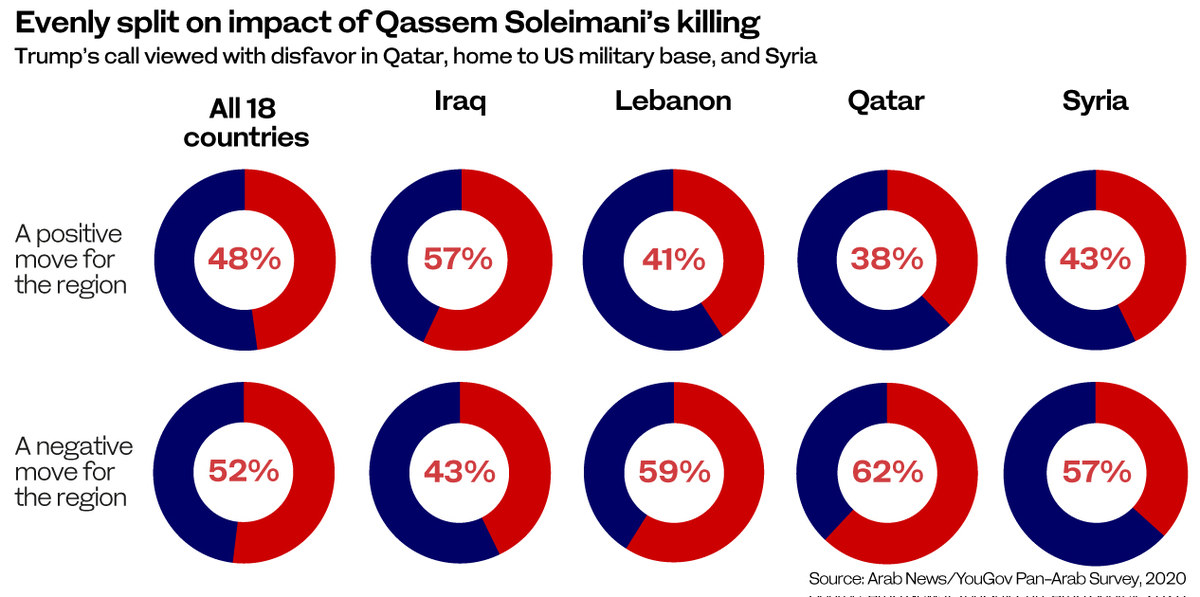
Arab opinion was largely split on the elimination this year of Iran’s regional “satrap” Gen. Qassim Soleimani, with the single largest proportion of respondents from Iraq (57 percent) and Lebanon (41 percent) seeing it as a positive move, as opposed to those in Syria and Qatar, where most respondents — respectively 57 percent and 62 percent — saw it as negative for the region.

Iran also figured in the list of perceived threats to US interests, although well behind white nationalism (32 percent) and China (22 percent). The other critical challenges for the US as viewed by Arabs were cybercrime, radical Islamic terrorism and climate change.
For a country that touts itself as an ally of the US, public attitudes in Qatar were found to be surprisingly out of sync with US objectives in the Middle East. The perception of radical Islamic terrorism, Iran and Islamist parties as the “three biggest threats facing the region” was much softer in Qatar compared with the region as a whole.
It came as little surprise that three quarters of respondents want the next US administration to make it easier for people from Arab countries to travel to the US. The figure for Lebanon, for instance, was even higher, 79 percent, underscoring concerns that many young Arabs are actively trying to leave the region.
Among other findings, Arabs remain overwhelmingly concerned about such challenges as failed government (66 percent) and the economic slowdown (43 percent).
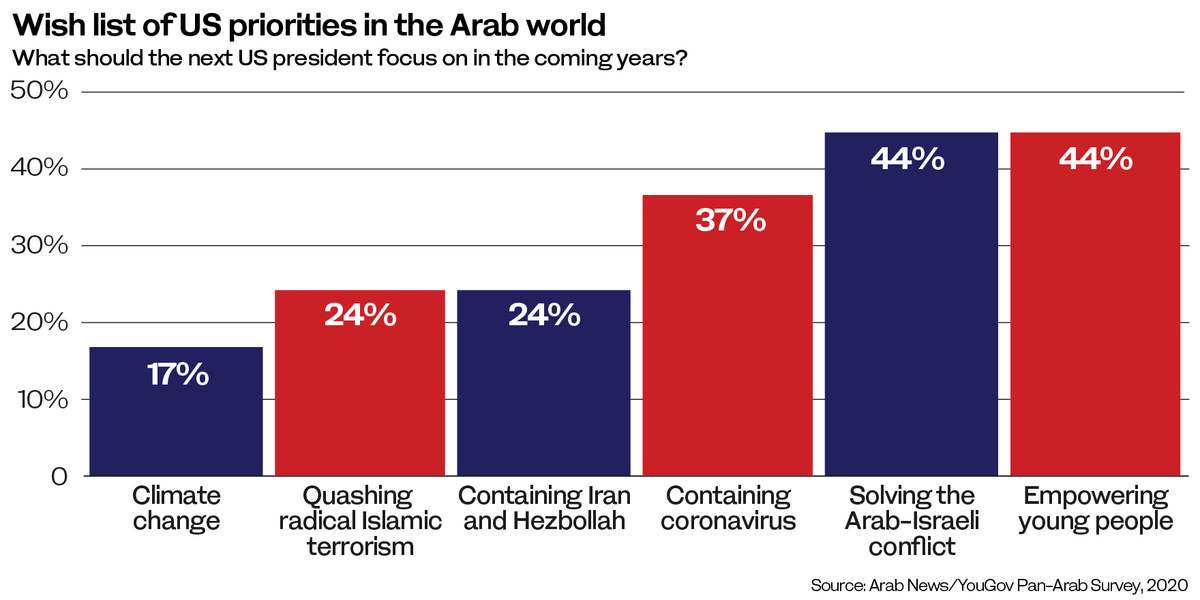
Close to half of the respondents (44 percent) would like to see the next US president focus on empowering young people in the Arab region and solving the Arab-Israeli conflict (44 percent), followed by containing COVID-19 (37 percent), reining in Iran and Hezbollah (24 percent), quashing radical Islamic terrorism (24 percent) and tackling climate change (17 percent).


Main category: 

Public attitudes in ‘ally’ Qatar at odds with US Middle East priorities: pollNext US president should back Arab youth empowerment: surveyPalestinians in occupied territories want US to solve conflict with Israel: surveyPoll: Arabs support Trump on Iran, but not on Jerusalem embassy moveThe methodology behind a new Arab News/YouGov pan-Arab survey


Public attitudes in ‘ally’ Qatar at odds with US Middle East priorities: poll

Sun, 2020-10-25 23:54

DUBAI, ERBIL: For a country that advertises itself as a close ally of the US, hosting America’s biggest military contingent in the Middle East at Al-Udeid air base near Doha and spending billions of dollars on US military hardware, public attitudes in Qatar are conspicuously out of sync with the thinking in Washington on Middle East issues.
That is according to the findings of the Arab News/YouGov pan-Arab survey. From the killing on Jan. 3 of Iranian General Qassem Soleimani to US President Donald Trump’s role in the fight against extremism in the Middle East, respondents in Qatar belonged to that segment of Arab opinion most critical of Washington’s recent actions.
The question — to what extent has Trump has helped or hindered the fight against extremism — was put to 1,960 people in 18 Arab countries. Overall, 56 percent of the respondents felt he had hindered the fight. Among respondents from Qatar, this view soared to 79 percent.
Respondents in Qatar also disapproved of Trump’s May 2018 withdrawal from the Joint Comprehensive Plan of Action (JCPOA) — better known as the Iran nuclear deal — and his reimposition of economic sanctions on Tehran, with 33 percent of the people polled in the Gulf country saying the move made the Middle East less safe.
Admittedly, a similar proportion of the full complement of 2,187 people — 35 percent — who were asked the same question for the pan-Arab survey agreed with the view that the US pullout and sanctions regime had made the region less safe.
“Despite the official relationship between Qatar and the US, every single Qatari media outlet, especially Al Jazeera, is bombarding Qatari public opinion and the Arab world with anti-Trump talk,” said Dr. Abdulkhaleq Abdulla, former chairman of the Arab Council for Social Sciences.
“They are the ones that shape public opinion and it seems that this is fine with the Qatari government, despite the fact that they have a vast relationship with the Trump administration. So, this shows a kind of contradiction at the official level with public opinion.”
Since the Arab boycott of Qatar began on June 5, 2017, the gas-rich Gulf state has taken a number of steps to strengthen its relations with the US in order to assuage the effects of diplomatic isolation. But it has also continued its manifold engagement with a country viewed by many in the US foreign-policy establishment as a “malign actor,” Iran. The two countries happen to share the world’s biggest natural-gas field, South Pars.
The upshot is that public opinion in Qatar is somewhat softer on Iran than elsewhere in the Arab region, if the Arab News/YouGov survey findings are any guide. The killing of Soleimani was viewed as “negative for the region” by 52 percent of respondents overall, but feelings were especially strong in Qatar, where 62 percent saw it that way.
By contrast, the strike was viewed as “positive for the region” in Saudi Arabia, Yemen and Iraq respectively by 68 percent, 71 percent and 57 percent of respondents. Soleimani, who headed the Islamic Revolutionary Guard Corps’ Al-Quds Force from 1998 until his death, was killed in a US drone strike near Baghdad Airport alongside the commander of Iran’s paramilitary proxies in Iraq, Abu Mahdi Al-Muhandis.
The disparity was also apparent when people in Qatar were asked what the next US president should do about relations with Iran. A substantial (55 percent) number called for the nuclear deal to be revived, while a smaller amount (16 percent) favored the continuation of sanctions and for Washington to maintain a war posture.

Again, by comparison, of 1,949 respondents in the wider MENA region, just 34 percent said they want to see the JCPOA revived and 33 percent said they want to see the sanctions continued and the US to maintain a war posture.
Given the apparent opposition in Qatar to the Trump agenda on Iran — and the expectation that his Democratic rival Joe Biden may revive the nuclear deal he helped draft in 2015 — it is perhaps unsurprising that just 6 percent of the respondents in Qatar said they would vote for Trump if given the opportunity, while 57 percent said they would vote for Biden.
Granted the wider region also appears to favor Biden over Trump — with 12 percent saying they would vote for the Republican incumbent and 40 percent signaling they would back the Democratic challenger — but the antipathy in Qatar seems particularly stark.
For Varsha Koduvayur, senior research analyst at the Foundation for Defense of Democracies, the results of the new Arab News/YouGov survey reflect public awareness of the sharp geopolitical tensions in the region since Soleimani’s death.
“This tit for tat we saw between Washington and Tehran was certainly a factor in how respondents viewed this question,” Koduvayur told Arab News.
She said Doha’s relationship with Tehran was one of the “straws that broke the camel’s back” when the GCC countries chose to impose their embargo. “Qatar has always been this outlier, not always in a positive sense, in the GCC,” she said.
The Arab News/YouGov survey results seem to confirm this difference of opinion. “This response underscores that notion to me,” Koduvayur told Arab News. “Qatar has its own independent policies at times but this doesn’t always gel well with what the rest of the GCC is thinking, nor is it always comfortable with what the US is thinking or with US interests in the region.”
Finally, for a country accused by three fellow GCC members and Egypt of supporting extremism through its backing of the Muslim Brotherhood, the Qatar data offered few surprises. “Containing Iran and Hezbollah,” “Weakening Islamist parties” and “Quashing radical Islamic terrorism” received respectively 17 percent, 6 percent and 6 percent support from respondents in Qatar to the question “What would you want the next US president to focus on in the coming years?”
Presumably for the same reasons, the perception of “radical Islamic terrorism,” “Iran” and “Islamist parties” as the “three biggest threats facing the Arab world” garnered respectively 22 percent, 11 percent and 7 percent from respondents in Qatar, in contrast with the relatively higher regionwide figures — 33 percent, 20 percent and 16 percent.

Twitter: @CalineMalek


Main category: 

Next US president should back Arab youth empowerment: surveyPalestinians in occupied territories want US to solve conflict with Israel: surveyPoll: Arabs support Trump on Iran, but not on Jerusalem embassy moveThe methodology behind a new Arab News/YouGov pan-Arab survey