‘Made-in-Gaza’ device fights coronavirus spread

Author: 
Fri, 2020-10-30 02:06

GAZA CITY: Entering a Gaza City restaurant, customers are welcomed by a multi-tasking disinfection machine designed by a Palestinian businesswoman to curb the spread of the coronavirus in the crisis-hit enclave.
Spraying hand sanitizer while taking the person’s temperature, the 2-meter-high device offers an all-in-one disinfection experience.
If the body temperature is too high, a red signal will light up. Otherwise the restaurant door opens automatically to allow the customer in.
“In Gaza, we have basic devices imported from abroad to measure temperatures, and others to disinfect, but our devices combine multiple technologies in one,” creator Heba Al-Hindi told AFP.
The densely populated Palestinian coastal enclave, under an Israeli-enforced blockade since 2007, was initially largely spared by Covid-19 when the pandemic broke out.
But dire economic conditions, a poor health care system and chronic electricity shortages, partly caused by the blockade, made Gaza especially vulnerable to the virus.
Confirmed infections in the enclave have topped 5,440 with 31 deaths.
“When Covid-19 reached the Gaza Strip, I told myself I had to find a way to fight its spread,” said Hindi.
“Then came the idea of creating a sanitiser and I designed these smart machines.”
The 37-year-old mathematics graduate heads Innovation Makers, a company that has created eight anti-Covid products, including a blue and yellow robot-like machine to appeal to children.
She said the project makes money but that “our focus is not on the profit.”

HIGHLIGHT

Spraying hand sanitizer while taking the person’s temperature, the 2-meter-high device offers an all-in-one disinfection experience.

“We’re focusing on a Palestinian product and a Palestinian invention from within the siege in the Gaza Strip, to show this invention to the world.”
Innovation Makers has sold dozens of machines to supermarkets, bakeries and restaurants, for between $550 and $1,500 depending on the technology used.
The products have been patented by the Ramallah-based Palestinian Economy Ministry, in the Israeli-occupied West Bank.
The company finds spare parts for the devices on the local market but is barred by Israel from exporting the “Made in Gaza” creations, slowing down Hindi’s ambitions.
Management at the Taboun restaurant is delighted with the disinfecting machines they bought.
“The device is remarkable,” said Matar Matar, hospitality manager at the Gaza eatery, adding that he found out about it on social media.
Customers are happy to see that “something new is being developed in Gaza,” he said.
Computer engineer Mohammad Natat, 23, said he was proud to be part of the team that created the machine.
“I had the opportunity to take part in this work and be creative in my field,” he said. “It was a huge chance to have some work.”
Around half of Gaza’s population is out of work, two-thirds of them young people, according to the World Bank, and more than two thirds of residents depend on humanitarian aid.

Main category: 
Tags: 

Israel warplanes strike Gaza following rocket fireIn crowded Gaza, public embraces mask-wearing to fight COVID-19


A Lebanese nonprofit helps refugees develop confidence through the creative arts

Thu, 2020-10-29 23:49

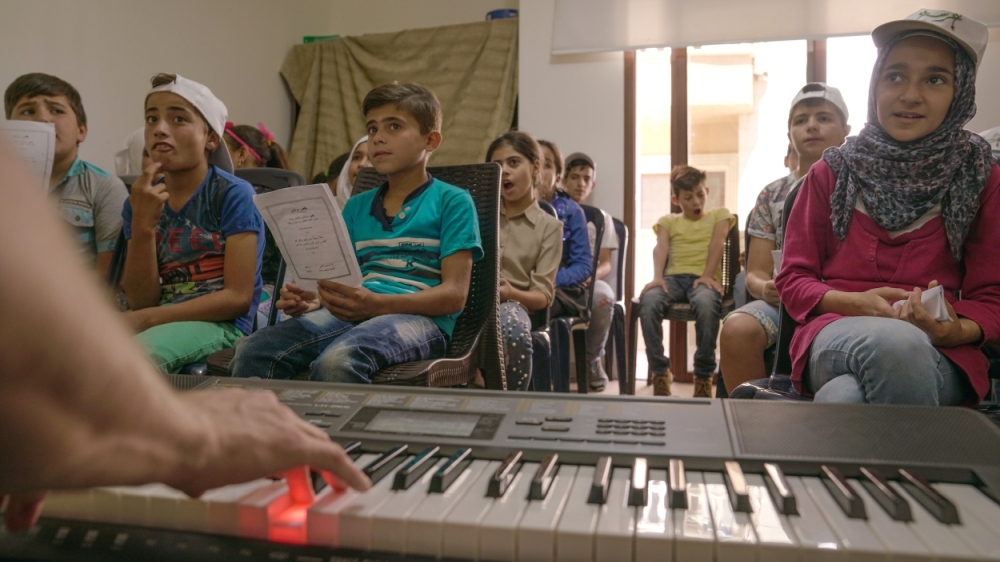
BEIRUT: Lebanese theatrical nonprofit Seenaryo teaches drama, dance and song to marginalized communities, building confidence and self-esteem through the creative arts, while its teacher-support app has brought imaginative new learning techniques to hundreds of classrooms across Jordan and Lebanon.

Founded in 2015 by British expat duo Victoria Lupton and Oscar Wood, Seenaryo’s five-day intensive theater workshops are still operating despite the coronavirus pandemic, with the group’s most recent — socially distanced — project staged at Beirut’s Dar Al-Aytam Al-Islamiya orphanage in September.

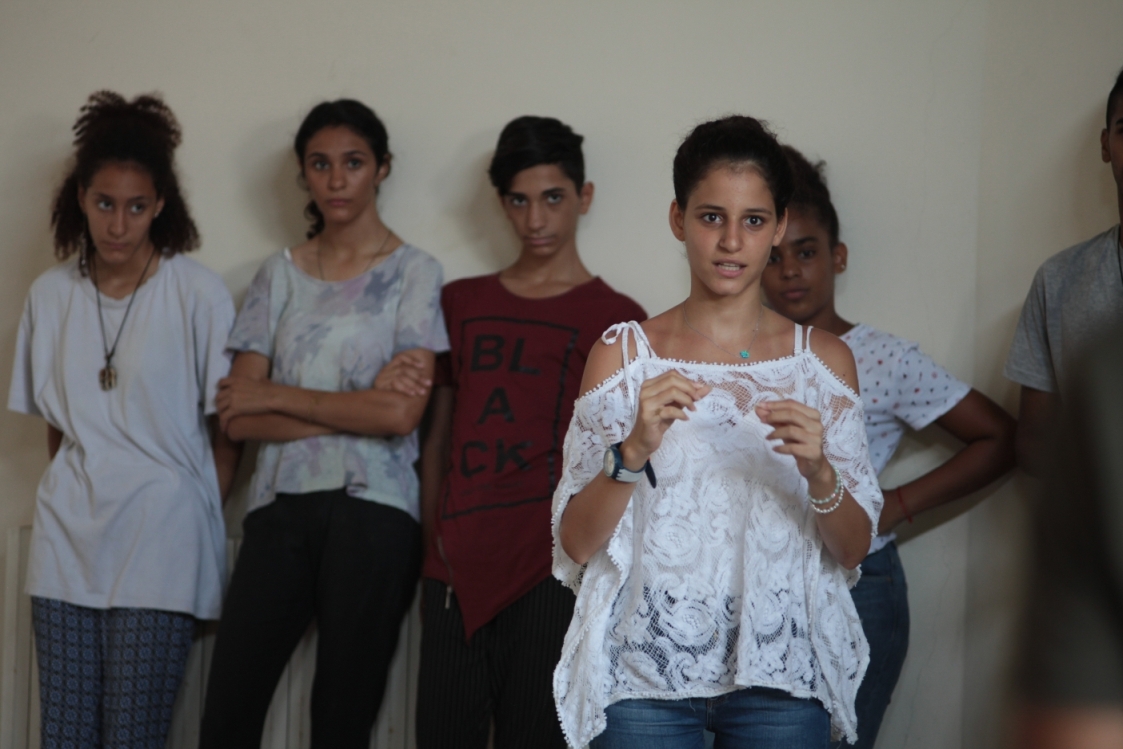
Up to 30 boys and girls, or even a group of adults, participate in each workshop where, through improvisation exercises, they brainstorm ideas to create a musical play, write a script and song lyrics, and master dance routines. Each play includes five original songs set to professionally made backing tracks. The group then performs its play to a local audience.


Up to 30 boys and girls, or even adults, participate in each workshop where, through improvisation exercises, they brainstorm ideas to create a musical play, write a script and song lyrics, and master dance routines. (Supplied)

“What we’re trying to do is support our participants to feel a sense of agency and ownership over their own lives, to feel that they can contribute to their communities and have an impact on their own lives and those around them,” Lupton said. “Play-based learning and theater does that by building life skills — that might be communication skills and empathy or building confidence and a sense of self-worth.”

Initially, Seenaryo worked solely with Syrian and Palestinian refugees. “Very quickly, within a year, we realized it was neither particularly helpful in terms of existing tensions between communities nor reaching the neediest beneficiaries if we just focused on refugees, so we widened the focus to work with all marginalized people regardless of nationality,” Lupton said.

“Theater has the power to bring a community together and feel like a family.”

In 2019 alone, Seenaryo staged 15 original theater productions in Jordan and Lebanon. Aside from the co-founders, most staff are from the local community. The non-profit also runs several choirs for children and women singing music from around the world as well as original songs written by participants in two-part harmony.

The influx of refugee children has strained the education systems of Lebanon and Jordan, with low quality teaching causing children to drop out of school, while stressed teachers often quit. In response, Seenaryo created a teacher training book that this year launched as an app, Playkit, to support educators teaching children aged three to eight.

“We fit into the national strategies of dealing with this new population by helping to increase teaching quality, Lupton said. “The Playkit is a shortcut to 21st century learning techniques. Just this small intervention can have a transformative impact on classrooms and helps keep children in school.”

On the app, there are hundreds of play-based activities available including games, songs, interactive stories and tools to help classroom management. These take the form of how-to videos, flashcards, music tracks and step-by-step teaching instructions. Among the subjects covered are languages, mathematics, health, the natural and human worlds, and social and emotional learning. The app is available in Arabic, English and French.


Caption

As of early September, 113 schools were using the app along with 1,075 teachers and 28,875 children.

Usually, teachers would first undertake a three-day training course before incorporating the app into their classroom activities, but the coronavirus pandemic has halted in-person instruction as schools shut. So, Seenaryo created short, instructive three-minute videos that it sends to parents and caregivers via WhatsApp to help them home school children.

This distance-learning program, “I Learn from Home,” dispatches three new videos each week to around 2,500 families. “These lesson plans needed to be accessible to even people who are illiterate or have low educational attainment, which is why we went for video,” said Lupton. “These are a very engaging set of instructions as to how to teach that day’s lesson, whether it’s on health or maths or whatever was in the curriculum that day.”

Seenaryo is funded through various government and non-government agencies, while the organization hopes subscriptions to Playkit will enable it to provide the app to schools. Now, with Lebanon facing new hardships and traumas, Seenaryo’s community-building projects are needed more than ever and Lupton’s team is ready and determined to help.

——————–

This report is being published by Arab News as a partner of the Middle East Exchange, which was launched by the Mohammed bin Rashid Al Maktoum Global Initiatives to reflect the vision of the UAE prime minister and ruler of Dubai to explore the possibility of changing the status of the Arab region.

Main category: 

Take your seat in the theatre of happinessStartup of the Week: Oh My Pinz! Expressing one’s personality in a fun and creative way


UK govt: British women strip-searched in Qatar

Author: 
Thu, 2020-10-29 22:55

LONDON: British authorities have formally registered concerns with Qatar following reports that two women who are UK nationals were strip-searched in Doha.

The forced medical examinations were carried out in Doha airport after authorities discovered a newborn baby in a bin.

This, it is claimed, prompted them to conduct “urgently decided” intrusive examinations, described as “absolutely terrifying” by one of 13 Australian women on a flight to Sydney who were subjected to them.

The British women were part of a group that was forced to disembark flights before having their underwear removed for a female medical professional to carry out an examination assessing if they had recently given birth.

The complaint was registered by the UK’s Foreign and Commonwealth Office, which said in a statement: “We are providing ongoing support to two British women following an incident in Doha. We have formally expressed our concern with the Qatari authorities and Qatar Airways and are seeking assurances an unacceptable incident like this cannot happen again.”

Australian officials said passengers from 10 flights leaving Doha on Oct. 2 were subjected to the ordeal.

“The advice that has been provided indicates that the treatment of the women concerned was offensive, grossly inappropriate, and beyond circumstances in which the women could give free and informed consent,” said a spokeswoman for the office of Australia’s foreign minister.

Sources familiar with the incident have said the newborn is alive and in care, and the mother has not been identified.

Main category: 

Australian MPs boycott Qatari envoy over Doha airport incidentAustralian recalls ‘terrifying’ moment female passengers strip-searched in Qatar


Lebanon sets out its claim in maritime border talks

Author: 
Thu, 2020-10-29 01:12

BEIRUT: Lebanese negotiators laid out their claim to maritime territory on Wednesday as they began a second round of talks with Israel over their disputed sea border.
The contested zone in the Mediterranean is an estimated 860 square kilometers known as Block 9, which is rich in oil and gas. Future negotiations will also tackle the countries’ land border.
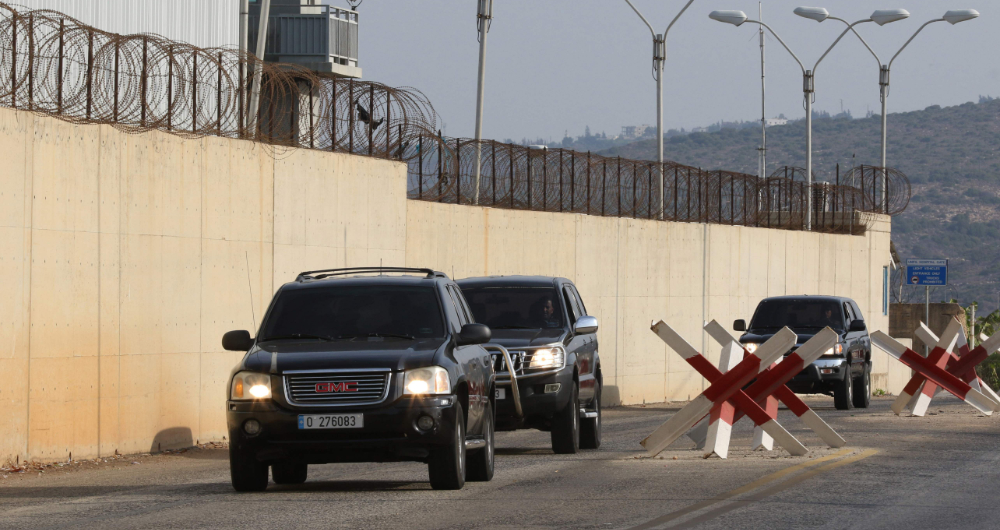
Wednesday’s meeting took place at the headquarters of the UN Interim Force in Lebanon (UNIFIL) amid tight security. An assistant of the UN special coordinator for Lebanon chaired the session, and the US Ambassador to Algeria, John Desrocher, was the mediator.
A military source told Arab News: “The Lebanese side considers that Israel, through the border line it drew for itself, is eating into huge areas of Lebanese economic waters.”
The Lebanese delegation produced maps and documents to support their claim to the disputed waters.
In indirect talks between Lebanon and Israel in 2012, US diplomat Frederick Hoff proposed “a middle line for the maritime borders, whereby Lebanon would get 58 percent of the disputed area and Israel would be given the remaining 42 percent, which translates to 500 square kilometers for Lebanon and 300 square kilometers for Israel.”
On the eve of Wednesday’s meeting, Lebanese and Israeli officials met to discuss a framework to resolve the conflict through the implementation of UN Resolution 1701.
UNIFIL Commander Maj. Gen. Stefano Del Col praised the “constructive role that both parties played in calming tensions along the Blue Line” and stressed the necessity of “taking proactive measures and making a change in the prevailing dynamics regarding tension and escalation.”

Main category: 
Tags: 

Lebanon, Israel hold first round of talksLebanon, Israel set to hold first maritime talks


US accuses Syria of delaying constitution ahead of election

Thu, 2020-10-29 01:05

NEW YORK: The US and several Western allies on Tuesday accused the Syrian regime of deliberately delaying the drafting of a new constitution to waste time until presidential elections in 2021, and avoid UN-supervised voting as called for by the UN Security Council.

US Deputy Ambassador Richard Mills urged the Security Council to “do everything in its power” to prevent Bashar Assad regime from blocking agreement on a new constitution in 2020. The Trump administration believes Assad’s hope is to “invalidate the work” of UN special envoy Geir Pedersen who has been trying to spearhead action on a constitution, and the council’s call for a political transition.

The Security Council resolution adopted in December 2015 unanimously endorsed a road map to peace in Syria that was approved in Geneva on June 30, 2012 by representatives of the UN, Arab League, EU, Turkey and all five permanent Security Council members — the US, Russia, China, France and Britain.

It calls for a Syrian-led political process starting with the establishment of a transitional governing body, followed by the drafting of a new constitution and ending with UN-supervised elections. The resolution says the free and fair elections should meet “the highest international standards” of transparency and accountability, with all Syrians — including members of the diaspora — eligible to participate.

At a Russian-hosted Syrian peace conference in January 2018, an agreement was reached to form a 150-member committee to draft a new constitution. That took until September 2019, and since then only three meetings have been held with little progress.

Pedersen, the UN envoy, told the Security Council on Tuesday he was unable to convene a fourth meeting in October because the government wouldn’t accept a compromise agenda which the opposition agreed to. During his just concluded visit to Damascus, he said there was “some valuable narrowing of the differences” that could enable consensus on agendas for the next two meetings.

“If we are able to find agreement in the next two days, it should be possible to meet in Geneva sometime in the month of November,” Pedersen said, dropping the Nov. 23 date in his prepared speech.

Mills, the US envoy, urged Pedersen “to take any measures he thinks are appropriate to facilitate the parties’ efforts … and also to identify to the council who is blocking progress.”

“Syria is wholly unprepared to carry out elections in a free, fair and transparent manner that would include the participation of the Syrian diaspora,” Mills said. “This is why we need the constitutional committee to work, and why we need the UN to accelerate its planning to ensure Syria’s upcoming elections are credible.”

German Ambassador Christoph Heusgen called Assad’s “delaying and obstruction tactics” on the constitutional committee’s work “just detestable.”

He said Russia, Syria’s most important ally, “should finally use its influence by, for instance, just cutting military aid and stopping its support, so that the Syrian regime finally plays ball.”

Syria’s tactics are clear, Heusgen said. “They want to waste time until the presidential elections in 2021. The regime should not have any illusions. The elections will not be recognized if they are held under the present circumstances.”

French Ambassador Nicolas De Riviere also criticized Assad’s “refusal to engage in good faith” and called for preparations to begin for UN-supervised elections that include the diaspora. France won’t recognize results that don’t comply with these provisions, he said, stressing: “We will not be fooled by the regime’s attempts to legitimize itself.”

Russia’s ambassador, Vassily Nebenzia, made no mention of the April presidential election and countered that Syrians must have “the opportunity to negotiate without interference from the outside.”

“The work of the constitutional committee should not be subject to any deadlines,” he said, expressing hope that Pedersen’s mediation will enable the committee’s work to continue “in line with the agenda agreed by the Syrians.”

Russia also sparred with Western ambassadors over its veto threats that led to the closure of two border crossings to deliver aid to Syria — one in the northeast and one in the northwest — leaving only one crossing to Idlib in the northwest.

The US, Germany, France, Britain, Belgium and others criticized the border crossing closures.

UN humanitarian chief Mark Lowcock told the council that Syrian government deliveries across conflict lines to the northeast are “not delivering at the scale or frequency required to meet the current health needs.” He said one hospital received only 450 gowns in April, and another received nothing for its maternity wing.

Lowcock also said “the situation of families across Syria is truly desperate,” citing food prices more than 90 percent higher than six months ago.

Russia’s Nebenzia responded, noting “with satisfaction the progress in UN humanitarian deliveries from inside Syria including through cross-line routes,” saying this “proves” the government is providing aid to people including in areas not under its control.

Main category: 

Syrians spruce up famed Crusader castle after years of war Syria’s Bashar Assad cuts tax for low-income workers