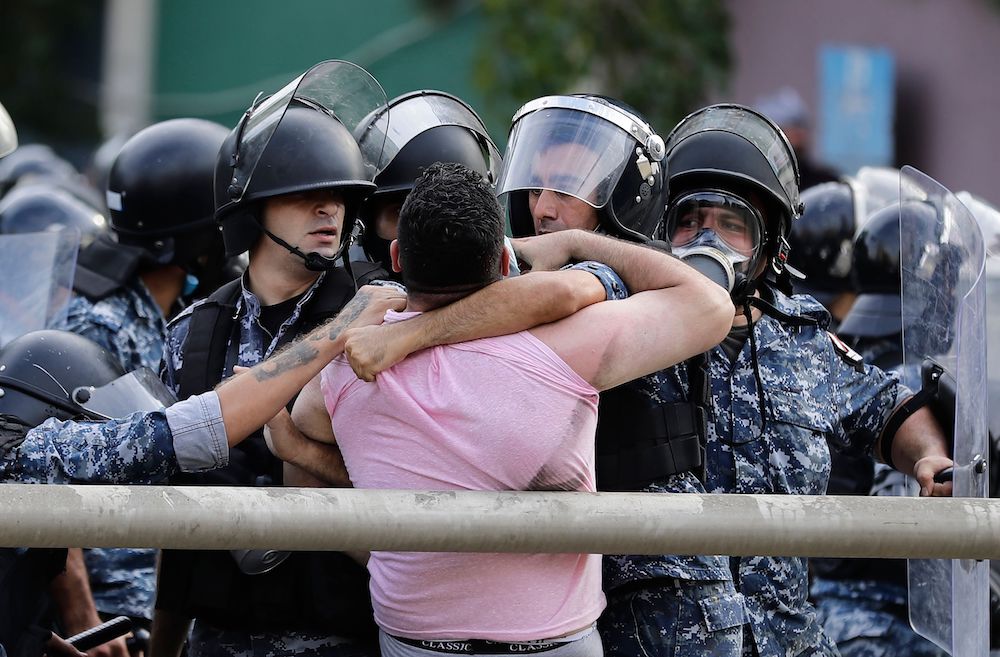
Security forces keep radical protesters away from French Embassy in Beirut

Fri, 2020-10-30 22:27

BEIRUT: Lebanese security forces prevented the arrival of hundreds of protesters at the French ambassador’s residence and the French Embassy in Lebanon on Friday.

They feared the recurrence of riots similar to the ones that erupted in front of the Danish Embassy in Ashrafieh, Beirut, in 2006, and led to 28 people being injured, damage to storefronts, and the burning of the consulate building and terrorizing of people.

A few hundred worshippers left mosques after Friday prayers and marched to defend the Prophet Muhammad.

Calls for a demonstration by radical Islamic groups spread on social media platforms.

Khaldoun Qawwas, Dar Al-Fatwa’s media spokesperson, told Arab News: “These groups have nothing to do with Dar Al-Fatwa, which has already announced its position regarding what happened in France in two separate statements.”

Sheikh Abdul Latif Deryan, the grand mufti of Lebanon, in a statement issued a week earlier, said that “freedom of opinion and expression does not entail insulting the beliefs and symbols of others, and this requires a reconsideration of the concept of absolute freedom.”

He stressed the “renunciation of violence and confrontation of radicalism and terrorism that has no religion or race.”

Security forces had anticipated Friday’s protest and tightened security in the heart of Beirut, since the embassy and the French ambassador’s residence are located where roads leading to the city’s western and eastern neighborhoods intersect. This led to a huge traffic jam in the capital.

The protest’s starting point was the Gamal Abdel Nasser Mosque in Al-Mazraa, situated only a few kilometers from the Residence des Pins (Pine Residence).

Three major security checkpoints — one set up by the riot police — separated the Residence des Pins and protesters, some of whom were transported by buses from the north of Lebanon to Beirut.

Protesters held Islamic signs and chanted slogans denouncing France, its President Emmanuel Macron and its former colonization of the country. Some protesters tried to remove barbed wire and threw stones, water bottles and batons at the security forces. Another group burned the French flag. Security forces responded by throwing tear gas canisters, leading to the retreat of the protesters.

In a statement, Lebanon’s Supreme Council of the Roman Catholic condemned “the terrorist attack in the French city of Nice.”

The council considered that “this terrorist crime has nothing to do with Islam and Muslims. It is an individual act carried out by terrorists haunted by radicalism, obscurantism and the rejection of the French people’s historical civilizational values. Through their acts, they abuse the spirit of tolerance, coexistence, acceptance of the other and the freedom of thought and belief which all religions call for.”

The council called for “staying away from defaming religions and beliefs and inciting hate and resentment among people, raising the voice of moderation, wisdom and reason, working together in the spirit of the Document on Human Fraternity for World Peace and Living Together announced by Pope Francis and the Grand Imam of Al-Azhar, Sheikh Ahmed Al-Tayeb from the UAE last year.”

During the Friday sermon, Grand Jaafari Mufti Sheikh Ahmad Kabalan condemned “any criminal act against any people, including the French people.” He added: “We categorically reject what happened in Nice yesterday, strongly condemn it and consider it a blatant and insolent attack on Muslims before others.”

He simultaneously condemned “the official French position that affronted the Prophet, took lightly and made light of the feelings of millions of Muslims.”

Main category: 

Leader of banned charity seeks asylum from Turkey amid Macron-Erdogan row‘Fake news’: Paul Pogba denies quitting France team over Macron commentsEU condemns Erdogan’s Macron comments as ‘unacceptable’Macron says beheaded teacher was victim of stupidity, hate
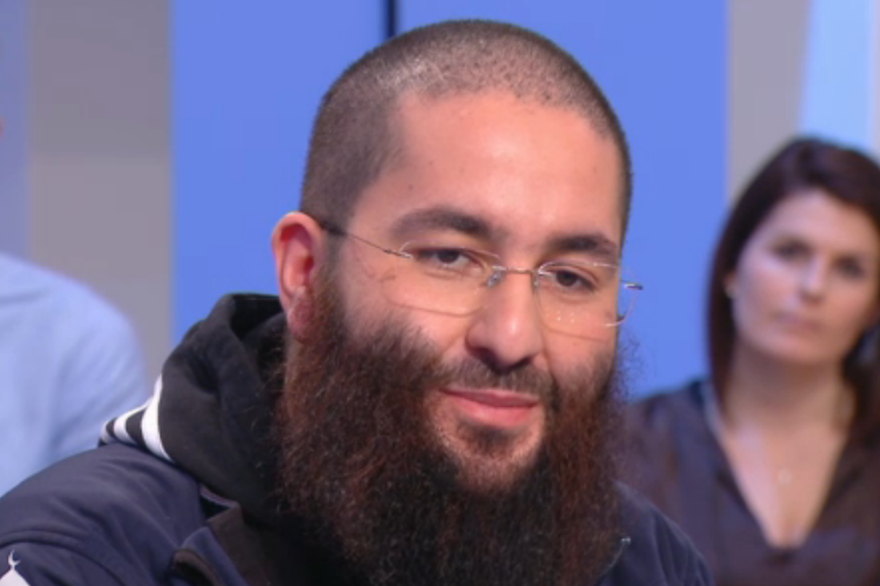


Leader of banned charity seeks asylum from Turkey amid Macron-Erdogan row

Fri, 2020-10-30 22:20

ANKARA: The prospect of granting asylum to Idriss Sihamedi, the founder of a Muslim charity that has been shut down in France over his alleged ties to the “radical Islamist movement,” stirred debate about the potential repercussions amid the already escalating French-Turkish spat.

The Turkish interior ministry announced on Oct. 29 that Ankara will assess Sihamedi’s request for himself and his team after receiving his official application.

Sihamedi, the founder of the BarakaCity NGO, claimed that he no longer felt safe in France. His NGO was closed officially on Oct. 28 on the grounds that it “incites hate, has relations with the radical Islamist movement and justifies terrorist acts.”

He posted his asylum request on his official Twitter account in both French and Turkish, tagging Turkish President Recep Tayyip Erdogan. He also alleged he had received death threats.

His post received a quick reply from the Turkish interior ministry’s migration management department: “Hello Sihamedi. If you and your colleagues were to personally apply to our institution with your surname, first name, identity information, petition for an asylum request and your passport number, your request will be assessed.”

However, experts think that proceeding with the asylum request of such radicals means playing with fire.

“I think Erdogan is continuing to play a dangerous game by courting relationships with radical figures and in some cases jihadists,” Colin Clarke, senior research fellow on terror-financing networks at the Soufan Center, told Arab News. “Turkey is already viewed as a hot spot for jihadists given its proximity to Iraq and Syria.”

Sihamedi is accused of inciting hatred, encouraging people to violent acts, maintaining relations within the radical Islamist movement, money laundering in the name of Salafi organisations and expressing support for Hitler and the Nazis. He is also blamed for organizing suicide attacks and supporting Daesh.

According to Clarke, if Turkey grants asylum to Sihamedi and his team, it may create trouble, both domestically but also with NATO allies.

“Moving forward with actions like this could easily backfire on Turkey and cause considerable blowback. I find these overt flirtations with radical Islamists counterproductive and short-sighted,” he said.

Sihamedi was deported from Turkey last year in May at France’s request and his passport was confiscated at Istanbul airport.

BarakaCity was founded in 2010 in Evry-Courcouronnes (Essonne). The Islamic humanitarian NGO has been closely monitored by French intelligence since 2014. Its buildings were raided several times in 2015 and 2017, and it was investigating for “terrorist financing” and “terrorist criminal association” for three years.

The NGO has said it wants to move its headquarters to another country. At a time when relations between Paris and Ankara are more strained than ever, the Turkish branch of the NGO is headed by a Franco-Turkish national known for his Salafi credentials.

“The French government dissolved BarakaCity also because in the past the NGO received money from Samy Amimour, a member of the Bataclan terrorist commando group in  2015, and from Larossi Abballa, who in 2016 killed a policeman and his wife in Magnanville,” said Matteo Pugliese, associate research fellow at Milan-based think tank ISPI.

“According to the French government, BarakaCity provides a sort of ideological justification for violent radicals, especially when it calls for the punishment of those who publish cartoons or criticize Islam. I think that we are talking about a grey zone, where non-violent extremism meets violent radicalization.”

Sihamedi was released under judicial supervision and is due to face trial in December.

French government also announced plans to dissolve other associations suspected of supporting extremist ideologies.

“If Turkey grants asylum to Sihamedi, France will use this to accuse the country of sheltering Islamists who radicalize people with online propaganda,” Pugliese said. “This is part of the verbal escalation between Macron and Erdogan and will be used by both for political internal goals.”

Main category: 

Asylum seekers suing UK over illegal detentionHalf of Aquarius migrants ‘seek asylum in France’: Spanish govt


UK summons Iran envoy as Nazanin Zaghari-Ratcliffe faces return to jail

Author: 
AFP
ID: 
1604081211010416400
Fri, 2020-10-30 09:51

LONDON: Britain on Friday warned Iran against throwing detained woman Nazanin Zaghari-Ratcliffe back in jail, after hauling in Tehran’s envoy for a dressing-down over her emotive case.
The Foreign Office summoned Ambassador Hamid Baeidinejad on Thursday to hear renewed demands from a senior official for an end to the British-Iranian captive’s “arbitrary detention.”
Foreign Secretary Dominic Raab told BBC radio Zaghari-Ratcliffe was in a “horrific position,” after her husband said Iran has ordered her to report to court for a new trial on Monday and then back to jail.
Britain has made it clear to Iran “that is entirely unjustified and totally unacceptable and must not happen,” Raab said.
Zaghari-Ratcliffe, who will turn 42 on Boxing Day, has been on temporary release from Tehran’s Evin prison and under house arrest since earlier this year because of the coronavirus pandemic.
She has spent more than four years in jail, or under house arrest, since being detained in the Iranian capital in April 2016 while visiting relatives with her young daughter.
Zaghari-Ratcliffe, who worked for the Thomson Reuters Foundation — the media organization’s philanthropic arm — denied charges of sedition but was convicted and jailed for five years.


Nazanin Zaghari-Ratcliffe has spent more than four years in jail, or under house arrest, since being detained in the Iranian capital in April 2016. (AFP)

Her husband Richard Ratcliffe said this week that the Foreign Office’s handling of the case “seems disastrous,” and that “the UK is dancing to Iran’s tune.”
Raab told the BBC: “We’ve made it very clear we want to try to put the relationship between the UK and Iran on a better footing.
“If Nazanin is returned to prison, that will of course put our discussions and the basis of those discussions in a totally different place. It is entirely unacceptable.”
Richard Ratcliffe linked the latest development to the postponement of a hearing that was due to take place on Tuesday in London to address Iran’s longstanding demand for the repayment by Britain of hundreds of millions from an old military equipment order.
“As Nazanin’s husband, I do think that if she’s not home for Christmas, there’s every chance this could run for years,” he said, accusing Iran of “hostage diplomacy.”

Main category: 

UK-Iranian ‘hostage’ Zaghari-Ratcliffe due back in Tehran jailZaghari-Ratcliffe devastated after court case postponed


Iranians awaiting US election results with bated breath

Author: 
Fri, 2020-10-30 02:14

DUBAI: Top officials in Iran say the upcoming US election doesn’t matter, but nearly everyone else there seems to be holding their breath.
The race for the White House could mean another four years of President Donald Trump’s “maximum pressure” campaign. Or it could bring Joe Biden, who has raised the possibility of the US returning to Iran’s 2015 nuclear deal with world powers.
In the upper levels of Iran’s Islamic republic, overseen by 81-year-old Supreme Leader Ayatollah Ali Khamenei, anti-Americanism is as deeply entrenched as at any time since the 1979 Islamic revolution, with presidents from both parties seen as equally repugnant.
“America has a deep-rooted enmity against the Iranian nation and whether Trump is elected or Biden, it will not have any impact on the US main policy to strike the Iranian nation,” parliament speaker Mohammad Bagher Qalibaf said in September, according to the semiofficial Fars news agency.
But noticeably, Khamenei himself hasn’t commented on the election, even as public interest has soared. State-run radio rebroadcast a BBC Farsi-language service simulcast of the presidential debates live — even as Iran continues to target journalists for the British broadcaster.
That interest allegedly includes Iran’s security apparatus as well. US officials accuse the Islamic republic of sending emails to voters seeking to intimidate them into voting for Trump. It may have been an attempt to link the president to apparent election interference in order to sow chaos, like Russia’s interference in America’s 2016 election. Tehran denies being involved.
The Iranian public is paying attention. The state-owned polling center ISPA said this month that 55 percent of people believe the outcome of the election will affect Iran “a lot.” Over half expected Trump would win, while a fifth said Biden. ISPA said it surveyed over 1,600 people by telephone, and did not provide a margin of error.
Trump’s reelection would mean the extension of his pressure campaign, including sanctions on Khamenei and other senior officials. Some of the sanctions are largely symbolic — Khamenei has only once traveled to America and does not hold any US bank accounts — but others have devastated the economy and sent the local currency into freefall. As a hedge, Iranians have poured money into foreign currency, real estate, precious metals and the stock market — which hit a record high in August.
Trump on the campaign trail has hit on that and his decision to launch a drone strike that killed a top Iranian general in January — a move that led Tehran to launch a retaliatory ballistic missile strike, wounding dozens of American troops.
To cheers, Trump has described the general, Qassem Soleimani, as “the world’s No. 1 terrorist,” likely due to him being blamed for the improvised explosive devices that maimed US troops in Iraq and for supporting Syria’s Bashar Assad. Many Iranians revered Solemani for fighting against Daesh and in the Iran-Iraq war in the 1980s, and millions flooded the streets for his funeral processions.
“The first call I get when we win will be from the head of Iran, let’s make a deal. Their economy is crashing,” Trump told a campaign rally in Allentown, Pennsylvania, on Monday. “They will call and I want them to do well, but they cannot have a nuclear weapon.”
Biden has left open the possibility of returning to the nuclear deal, in which Tehran agreed to limit its uranium enrichment in exchange for the lifting of economic sanctions. The other signatories — Britain, France, Germany, Russia and China — have remained committed to the agreement and allowed a UN arms embargo to expire as part of the deal, despite a White House push to keep it in place.
After Trump withdrew from the deal in 2018 and restored crippling sanctions, Iran began publicly abandoning the agreement’s limits on enrichment. It now has at least 2.32 tons of low-enriched uranium, according to a September report by the International Atomic Energy Agency (IAEA). Experts typically say 1.15 tons of low-enriched uranium is enough material to be re-enriched for one nuclear weapon.
Iran insists its nuclear program is peaceful and still allows IAEA inspectors to monitor its atomic sites. But experts say the “breakout time” needed for Iran to build one nuclear weapon if it chooses to do so has dropped from one year under the deal to as little as three months.
Iran in the past also has threatened to abandon a nuclear nonproliferation treaty or expel international inspectors. It recently began construction at an underground nuclear site, likely building a new centrifuge assembly plant after a reported sabotage attack there earlier this year.
“’America First’ has made America alone,” Biden said at a televised ABC town hall this month, playing on a longtime Trump slogan. “You have Iran closer to having enough nuclear material to build a bomb.”
What a return to the deal means, however, is in question. Biden’s campaign website says he would use “hard-nosed diplomacy and support from our allies to strengthen and extend it.” One criticism of the accord was its narrow focus on the nuclear program, despite concerns by the US, Israel and its Gulf Arab allies over Iran’s ballistic missile program and its presence in Iraq, Lebanon and Syria.
Iran maintains that its ballistic missile program is vital for deterring potential attacks and non-negotiable. It is also unlikely to cease its military activities in Syria and Iraq, where it spent considerable blood and treasure in the war against Daesh.
But ensuring the survival of the Islamic republic, particularly amid the coronavirus pandemic, may require the same flexibility that saw Iran agree to negotiations with the US in the first place. Iran will hold a presidential election in June, but any decision to re-engage with Washington would have to be made by the supreme leader.
“Khamenei’s revolutionary path actually leads to America — that is, by seeking a stable, safe, and meticulously measured relationship with the United States, he believes he can guarantee the survival of both the regime and its revolutionary content and orientation,” wrote Mehdi Khalaji, a Qom-trained Shiite theologian who is an analyst at the Washington Institute for Near East Policy.
“Tehran’s objective is therefore a scandalous paradox: Deal with America to remain anti-American.”

Main category: 

US seizes Iranian missiles, slaps Iran-related sanctions on 11 entities


Algeria to vote on a constitution dismissed by protest movement

Author: 
Fri, 2020-10-30 02:10

ALGIERS: Algerians are set to vote on Sunday in a constitutional referendum the government touts as heralding a “new republic,” but a long-running protest movement rejects the exercise as window-dressing.
Observers see the constitution as the centerpiece of now-hospitalized President Abdelmadjid Tebboune’s strategy to neutralize the Hirak movement, which staged vast demonstrations last year and forced his predecessor from office.
Despite Abdelaziz Bouteflika’s fall from power, the Hirak has failed to achieve its goal of a full overhaul of Algeria’s sclerotic political system, in place since independence from France in 1962.
In a key setback for the protest movement, Tebboune, widely seen as the army’s preferred candidate, was elected in a December 2019 presidential poll, despite the Hirak urging root-and-branch reform ahead of any elections.
Then it was forced to suspend its protests in March as the coronavirus pandemic struck.
But Tebboune, who took power after a poll marred by record low turnout, has sought legitimacy by ostensibly reaching out to the Hirak.
He has promised a new constitutional settlement he presents as meeting the movement’s demands.
But the lack of radical change in the document, which strengthens the president and the army, has left many skeptical.
“The referendum will have no impact in terms of offering a political alternative or a change in how the country is governed,” said Louisa Dris-Ait Hamadouche, a political science professor at the University of Algiers.
Algeria, with a population of 44 million on the doorstep of Europe, has escaped the violence and severe repression triggered by most of the 2011 Arab uprisings.
But with its oil-reliant economy in crisis and its young people desperate for work, the government is under pressure, also exacerbated by the coronavirus pandemic.
Tebboune himself was transferred from hospital in Algiers to Germany on Wednesday, officials said, days after the 74-year-old went into self-isolation following reports of suspected Covid-19 cases among his staff.
Politically, Tebboune was already “in a delicate situation,” said Algeria expert Hasni Abidi, pointing to the army’s resurgent political role since Bouteflika’s departure after two decades in power.
“Even if (Tebboune) is tempted to gain more legitimacy via the ballot box, he is far from having full room to maneuver,” Abidi said.
The proposed constitutional changes refer to a string of rights and freedoms, including guaranteeing the right to form parties and unions, while even praising the Hirak in a preamble.
But Zaid Al-Ali, an expert on constitutions in the Arab world, has warned that the document “lengthens the list of rights while at the same time making sure that most of those rights are devoid of meaning.”
And counter to the Hirak movement’s goals, the constitution would further enshrine a presidential system and bolster the army’s powers.
Since taking power, Tebboune has vowed to push through a revision that would rein in his own powers.
But despite limiting the president to two five-year terms, the revised constitution would still mandate the head of state to appoint an array of key officials including the prime minister, regional governors, judges and security service chiefs.
A vaguely worded article extending the role of the military has also rung alarm bells.
“It’s a genuine invitation for the army to get involved in politics, but also a poke in the eye for the Hirak, which has demanded a civilian rather than military state,” said constitutional law expert Massensen Cherbi.
The document has been carefully marketed by the government, which has led a campaign to “explain” the constitutional reform and how it lays the foundations of a “new republic.”
Few, if any, voices from the “No” camp have been heard in state media outlets.
The date of the vote is highly symbolic: November 1 was when Algeria’s eight-year war for independence from France began.
“November 1954: Liberation. November 2020: Change,” runs the slogan of the official “Yes” campaign.
If it passes, the constitution will be another serious blow for the Hirak, which has faced a slew of arrests and trials in recent months.
Activists and journalists have been handed heavy prison sentences, all in a context where the coronavirus pandemic has made it very difficult to maintain pressure against the authorities.
Amnesty International has welcomed the constitution’s inclusion of stronger language on women’s rights and economic and social rights.
But, the rights group warned in June: “The Algerian authorities’ relentless campaign of mass arbitrary arrests and a crackdown on activists and protesters risk undermining the credibility of Algeria’s constitutional reform process.”

Main category: 
Tags: 

Algeria’s president transferred to Germany for treatmentAlgeria to inaugurate Bouteflika-era mega mosque