Syrian refugee’s joy at Georgetown admission goes viral

Mon, 2020-11-02 23:36

LONDON: A Syrian refugee tortured at the hands of the Assad regime is going viral after sharing a video of his elated reaction to being accepted into a prestigious US university.

Omar Alshogre’s 9-second video on Twitter has been viewed roughly 140,000 times. “I made it into Georgetown!” he exclaims in disbelief.

The 25-year-old refugee’s acceptance is an uplifting end to a long and tragic journey that began in the early days of the Syrian uprising.

When pro-democracy protests swept through the country in 2011, Alshogre was arrested multiple times for taking part in them, and when Syria descended into civil war, he spent three years in a regime prison.

There, he said, he was subjected to daily torture and starvation, which killed his two cousins arrested alongside him. While inside, he lost his father and brother to a regime massacre in his home village.

While imprisoned, Alshogre was forced to remove the bodies of dead prisoners and mark their foreheads.

He was among the roughly 128,000 Syrians who disappeared after their arrest by the regime, 14,000 of whom were tortured to death, according to the Syrian Network for Human Rights.

Alshogre was released after his mother saved up enough money to bribe officials for his release. He then fled to Sweden.

He quickly progressed through the school system after learning English and Swedish, and aimed to fulfil his father’s dream of continuing his education. 

“I grew up in a family where my father was really serious about education. He wanted me to go to the best school and have the top school in everything,” Alshogre said. 

“I had to choose between fulfilling my father’s dream of finishing my education and going to the US.”

He chose to travel to Washington, where he testified to German lawyers and European war crimes investigators building cases against the Assad regime.

He also became a public speaker, human rights activist, and director for detainee affairs at the Syrian Emergency Task Force. But he worried he was not fulfilling his late father’s expectations.

“Every time I went home and saw my father’s picture it told me I had to study, and I felt guilty,” Alshogre said. 

With his acceptance to Georgetown’s Business Administration and Entrepreneurship course, he hopes to one day return to Syria and help rebuild his homeland.

“I am one of few survivors who is really enjoying his life and benefiting from everything I went through,” he said.

“Now I got into one of the best universities. At every step I am taking, I am showing the Syrian regime that they could not break me. And that’s an honor for me and the (other) survivors.”

Main category: 

Syrian refugee in UK uses catering business to highlight Assad atrocitiesA Syrian refugee whose fridge was stolen from his home in Homs finds it in Beirut


UAE confirms 1,234 new COVID-19 cases, 1 death

Mon, 2020-11-02 21:00

DUBAI: The UAE on Monday recorded 1,234 new COVID-19 cases and one death.
The Ministry of Health and Prevention said the total number of cases since the pandemic began has reached 135,141, with the death toll at 497.
The ministry added that 1,516 people recovered over the previous 24 hours, bringing the total number of recoveries to 132,024.
Dubai’s economic authority said for the second consecutive day, no establishments were closed and no fines or warnings issued regarding adherence to anti-COVID-19 measures.
Meanwhile, the Mohammed bin Rashid Medical Research Institute of the Al-Jalila Foundation awarded 2.5 million dirhams ($680,652) in financial grants to five Emirati medical researchers in support of COVID-19 research and to help enhance the UAE’s capacity to address this and other viral diseases.

The grants in the fields of genetics, therapies and diagnostics are the first of their kind to be offered through the foundation, a member of the Mohammed bin Rashid Al-Maktoum Global Initiatives, a charitable institution dedicated to improving the lives of individuals through education and research in the medical field.
“At a time when the world is racing against time to find solutions for eradicating the virus, well-funded research efforts are critical to mitigate current and future health and economic challenges,” said Sheikh Ahmed bin Saeed Al-Maktoum, chairman of the board of trustees of the Al-Jalila Foundation.
In the emirate of Ajman, the Crisis, Disaster and Emergency Team announced that it is relaxing a ban on weddings and other social events in hotels, halls and houses from Nov. 1.

It is permitting up to 200 people in hotels and halls, and a maximum of 50 people in homes, but social distancing measures and other preventive guidelines must be implemented.
Elsewhere, Kuwait recorded 759 new COVID-19 cases, bringing the total to 127,293. The death toll reached 786 after four new fatalities were registered.

Oman’s Health Ministry said the total number of cases had reached 116,152, with the death toll at 1,256.

In Bahrain, one death was reported, bringing the death toll to 322, while 210 new infected cases were confirmed.

Main category: 

Saudi health ministry records 381 new coronavirus casesUAE reports 1,278 new COVID-19 cases


Four years down, two to go: Lebanese president enters tough final stretch in office

Author: 
Mon, 2020-11-02 21:07

BEIRUT: On Oct. 31 Lebanese President Michel Aoun completed four years in office with another two remaining before his term ends, amid the country’s ever-plummeting fortunes. Aoun himself recently warned that Lebanon was going to hell if a new government could not be formed to resolve the nation’s many woes.

The Lebanese pound has collapsed and living conditions have nosedived. The percentage of the population suffering from extreme poverty increased from 8 percent in 2019 to 23 percent in 2020. A devastating explosion in Beirut in August and the ongoing coronavirus health crisis has compounded the nation’s problems.

The middle class is increasingly shrinking due to the loss of bank savings and the rising migration of young Lebanese and families, especially from the Christian community.

Weekly calls from the Maronite Patriarch Bechara Al-Rai to preserve Lebanon’s neutrality and the vision behind the country’s establishment fall on deaf ears.

In Lebanon, the president’s mandate is divided into three parts. The first part is usually known as the “golden period” for every leader. The second part is usually characterized by calm and a decline in production momentum.

The last two years turn into a difficult period due to the increase in political disputes and the competition of candidates to succeed.

However, despite the criticisms directed at Aoun’s era, loyalists believe he has “made strength from weakness and restored prestige to the presidency.”

They list his achievements as including the preparation of an annual budget after a 12-year hiatus, combating corruption by preparing various draft laws, Lebanon’s accession to the UN Convention, approving the law on the right to access information, dealing with oil and gas exploration in regional waters, and tackling the issue of Syrian refugees.

The approval of a new electoral law based on proportional representation is hailed as another achievement which, according to these loyalists, led to the representation of political forces and parties according to their true size.

But MP Mohammed Al-Hajjar, from the Future bloc, said that Aoun’s past four years had not lived up to expectations.

“The election law did not pass without it being approved by the Future Parliamentary Bloc because the bloc and the Future Movement are concerned with holding parliamentary elections,” he told Arab News. “As for the talk about fighting corruption, it is just nonsense, because the reality shows horrific practices. Moreover, the obstacles that have been placed and are still facing the formation of governments and causing a vacuum were not in the interest of the administration.”

He said the administration had not built strong external relations and that it was attempting to create new norms that were far from the constitution.

The secretary-general of the Progressive Socialist Party, Zafer Nasser, said that the first four years of Aoun’s era were characterized by political instability and an economic and social collapse.

“The political process that the administration practiced and is now practicing appears as if it does not want to learn from the lessons of the past four years,” he told Arab News. “Lebanon’s foreign relations are severed with the Arabs and the West, and Aoun has been doing the opposite of what he promised. It seems that nothing is going to change in the next two years.”

There had been full cooperation since the start of Aoun’s era, he added, but “political maliciousness” had disrupted everything. “The administration doesn’t have to raise buzzing slogans about fighting corruption and reform while it is practicing the opposite. The reality on the ground is a sign of failure, and the Lebanese in the next two years will live the path of Golgotha.”

Naufal Daou, a member of the Lady of the Mountain opposition gathering, said it was “shameful” that Aoun’s loyalists had spoken about the achievements made by his administration during the past four years.

“There is no stone, pound, human, hospital, group, company, and bank left in Lebanon,” Daou told Arab News. “Administrations are usually evaluated according to their internal, economic and foreign policies. Foreign policy was a disaster, and domestic politics was full of conflicts. As for economic policy, it is a complete collapse.”

He said that Aoun had come to power with near-unanimous backing but that this consensus and support, which was meant to be for the benefit of the whole country, had been handed over to Hezbollah.

He added that settlements and understandings had been interwoven with quotas over portfolios and positions, with no clear rules for domestic and foreign policy.

“Hezbollah told Aoun: ‘You take the presidential seat and we run the country’s foreign and defense policy.’ Prime Minister (Saad) Hariri told him: ‘You take the presidency and I take the premiership.’ And the Lebanese Forces agreed with him on parity in the Christian seats in the government, parliament, and the public administration.”

Daou said there was no need to anticipate what awaited the Lebanese in the next two years. “Aoun, who has the data, told us that we are going to hell.”

Main category: 

Lebanon locks down 115 areas, imposes new curfew hours as coronavirus cases continue riseDeal on horizon after Lebanon maritime border talks


New law passed to dismiss extremists from state institutions in Egypt

Mon, 2020-11-02 20:54

CAIRO: The Egyptian Parliament has approved, in principle, a draft law requiring the dismissal of employees of state agencies without taking disciplinary measures, in order to confront the spread of extremist ideologies.

Speaker Ali Abdel-Aal postponed taking a final decision on the bill, in order to present it to the State Council for review.

The new law aims to exclude employees and workers who are intellectually affiliated with terrorist organizations from working for state entities, according to the explanatory notes for the new amendments to the law.

The first article of the draft stipulates that it will not be permissible to dismiss employees or workers, depending on the circumstances, in any of the state’s administrative apparatus units, unless they violate the duties of the job in a way that would seriously harm production or the economic interests of the state or the bodies stipulated in the article, and if serious evidence had been established tying the employee to violating the security and safety of the state.

Ali Badr, who presented the bill, confirmed in press statements that the aim of it was to rid the state’s administrative apparatus of terrorist elements in order to preserve the Egyptian state.

Badr stressed that the law was a continuation of a series of laws issued by Parliament to dry up sources of terrorism and deter anyone tempted to break the law.

Earlier this year, the Egyptian Minister of Education Tarek Shawki decided to dismiss 1,070 teachers because of affiliations with the Muslim Brotherhood group.

“It is a small percentage of 1.5 million teachers, to protect our children,” Shawki said at the time.

Main category: 

Egyptian Armed Forces’ Chief of Staff arrives in Sudan to discuss security and military cooperationEgyptian label Toroz incorporates local embroidery techniques into its contemporary clothing


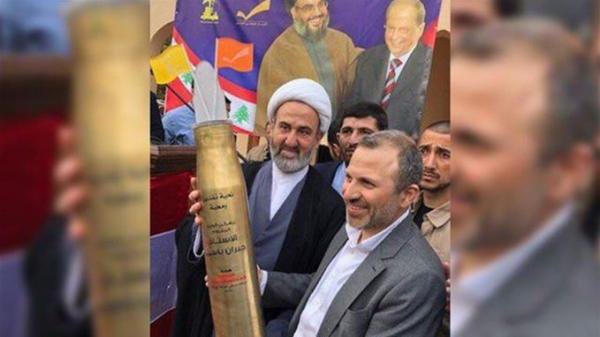
Hezbollah, Gebran Bassil under fire over Lebanese government paralysis

Author: 
Mon, 2020-11-02 02:27

BEIRUT: Frustration mounted in Lebanon on Sunday amid continuing paralysis in the formation of a new government, with fingers pointed at the Iran-backed Hezbollah group and Free Patriotic Movement leader Gebran Bassil as the source of the blockage.

Eleven days after former prime minister Saad Hariri was asked to resume office and assemble an administration of non-party technocrats, no date has even been set for a meeting with President Michel Aoun.

“We do not know if the obstructing parties actually want to form a government. It is about party quotas again, regarding the number of ministers and the rotation of portfolios,” senior Hariri adviser Hussein Al-Wajh told Arab News.

Dr. Mustafa Alloush, a leading figure in Hariri’s Future Movement, told Arab News: “The main obstacle to forming a government is Gebran Bassil, who has returned to his old demands.”

Hariri resigned as prime minister in October 2019 amid a wave of public protests over financial corruption, government ineptitude and a collapsing economy. Neither of his successors, Hassan Diab and Mustapha Adib, was able to restore stability, and Lebanon has been without a government since September.

At the prompting of French President Emmanuel Macron, Hariri offered to lead a technocratic Cabinet in an initiative seen as opening the door to desperately needed international aid and a bailout from the International Monetary Fund.

Former minister Ahmed Fatfat told Arab News: “Hariri’s project is a mini-government of specialists, which would not be against anyone or against the country, but Hezbollah stands behind the play of Gebran Bassil.”

Health chiefs fear the government stalemate is compromising Lebanon’s ability to combat the spread of the coronavirus, which has infected more than 80,000 people and killed 637. Caretaker Interior Minister Mohammed Fahmy on Sunday rejected a recommendation by the government’s National Health Committee for a national lockdown, and instead imposed restrictions in 115 towns.

The head of the Doctors Syndicate, Sharaf Abu Sharaf, called for a “complete shutdown similar to the one that took place at the beginning of the virus outbreak.”

He said: “The capacity of hospitals to absorb patients has reached its limit, and the health, recovery and financial situation is very poor. The medical and nursing sector is witnessing a large migration out of Lebanon, and there are no incentives to persuade them to stay.”

Main category: 
Tags: 

US sanctions 2 senior members of Lebanon’s HezbollahHow Hezbollah bullied a Lebanese journalist after Israeli media carried her tweet