UN launches new Libya talks amid cautious optimism

Author: 
Tue, 2020-11-10 01:18

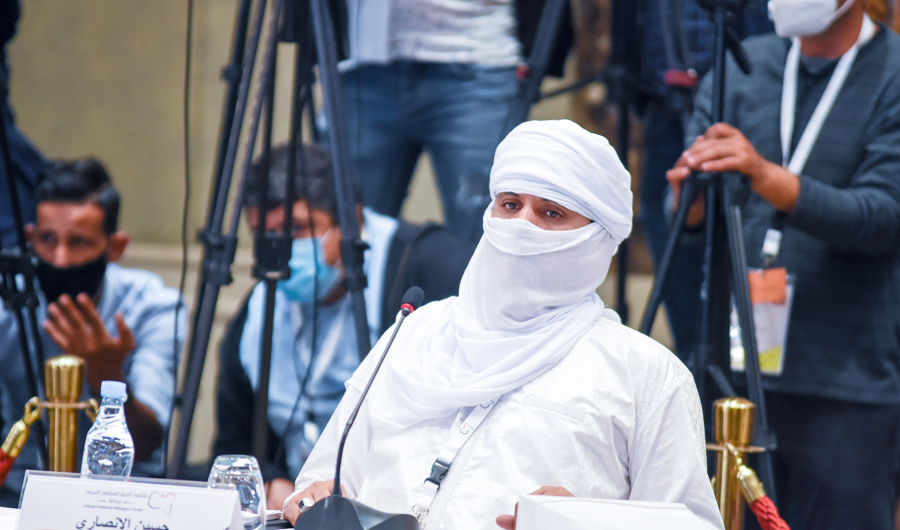
GAMMARTH, TUNISIA: Rival Libyan factions met Monday for UN-led talks aimed at bringing a lasting peace to their war-torn North African country and preparing for elections.
The meeting in neighboring Tunisia follows months of relative calm and a key cease-fire deal in October between the two major camps in the long-running conflict.
“You have the opportunity to end a tragic conflict,” UN Secretary General Antonio Guterres told delegates in a video message at the opening ceremony.
“Now it’s your turn to shape the future of your country.”
Libya has seen a decade of violence since the 2011 toppling of Muammar Qaddafi in a NATO-backed uprising, with a complex web of regional conflicts exacerbated by foreign intervention.
But October’s cease-fire agreement has allowed for vital oil production to resume and for progress on efforts to end years of political deadlock.
This week’s talks in Gammarth, near the Tunisian capital Tunis, aim to unify the country under a single executive and pave the way for national elections.
The 75 Libyan delegates, selected by the UN, have given up the right to play a role in the resulting political body. As well as preparing for national polls, the interim executive will face the daunting challenges of providing basic services in a country wracked by economic woes and the coronavirus pandemic.
Libya is dominated by two rival administrations: The Government of National Accord (GNA) in Tripoli, which resulted from previous UN-backed talks in 2015 and a rival administration in the east, backed by military strongman Khalifa Haftar.
Peter Millett, a former British ambassador to Libya, warned on the first day of talks that “if potential spoilers like Haftar and the militias don’t see themselves benefitting, hostilities could break out again.”
“The most important thing is a timeline for elections,” he said.
“It needs to be short, maximum nine months, with key milestones for implementing and a clear message from the international community that they will impose sanctions on anyone who obstructs it.”
Guterres urged world powers to support peace efforts and to respect a long-standing UN arms embargo, words echoed by the host of the talks, Tunisian President Kais Saied.
“This is a historic moment,” Saied told delegates at the opening ceremony.
“We are able to overcome all difficulties and obstacles … when there is no interference from outside powers.”
Media in both eastern and western Libya voiced cautious optimism about the talks.
Some described the dialogue as the last chance to avoid the partition of Libya and bring an end to a decade of violence.
Others said that by trying to redraw the transitional period without direct elections first, it would lay the ground for further armed clashes.
 

Main category: 
Tags: 

Libya’s rivals start UN-led talks to reach political accordLibyan parliamentarians meet for peace talks in Morocco

US plans sanctions on Iranians for violence against protesters

Author: 
Reuters
ID: 
1604955233924665500
Mon, 2020-11-09 20:37

WASHINGTON: The US is expected to impose sanctions as early as next week on Iranians involved in a violent crackdown against anti-government demonstrations in Iran a year ago, three sources familiar with the matter said on Monday.
The sources, who spoke on condition of anonymity, said the sanctions announcement was timed to the one-year anniversary of what may have been the bloodiest repression of protesters in Iran since the Islamic Revolution in 1979.
One source said next week’s designations would be a major action covering multiple individuals as well as several dozen Iranian entities.
Neither the State Department nor the Iranian mission to the United Nations immediately responded to a request for comment on the sanctions likely to be imposed next week.
Citing three Iranian Interior Ministry officials, Reuters previously reported about 1,500 people were killed during less than two weeks of unrest that started on Nov. 15, 2019. The toll included at least 17 teenagers and about 400 women as well as members of the Iranian security forces and police.
Iran’s Interior Ministry has said around 225 people were killed during the protests, which erupted after state media announced that gas prices would rise by as much as 200% and the revenue would be used to help needy families.
The sources, who included one US official and two people familiar with the matter, said the sanctions have been in the works for months and are the latest in a long series of US penalties imposed on Iran by US President Donald Trump.
Trump two years ago abandoned the 2015 Iran nuclear deal struck by his predecessor, Barack Obama, and has since restored harsh US economic sanctions designed to force Tehran into a wider negotiation on curbing its nuclear program, development of ballistic missiles and support for regional proxy forces.
One source said Washington would blacklist people involved in the killing of civilians, while a second source said those targeted would include government and security officials.
Several sources played down a media report that the Trump administration planned a flood of sanctions before President-elect Joe Biden takes office on Jan. 20. Biden, who was Obama’s vice president, defeated Trump in last week’s US election.
Biden has previously said he will return to the 2015 Iran nuclear deal under which Tehran agreed to restrict its nuclear program in return for relief from US and other sanctions, if the Iranian government resumes compliance.
“We’ve been sanctioning Iranian entities nearly every week for the past six months. There’s no reason we would put our foot on the brake now, but we’re not pushing it down on the gas pedal any further either,” a Trump administration official said on condition of anonymity.
Two weeks ago, the US Treasury slapped counterterrorism sanctions on key players in Iran’s oil sector for supporting the Quds Force, the elite paramilitary arm of the Islamic Revolutionary Guard Corps.
Analysts said that action, taken ahead of the November 3 US presidential election, was among Trump administration moves seeking to make it harder to lift sanctions if Biden won the White House.

Main category: 

US imposes Syria-related sanctions on individuals, entitiesLebanon’s Bassil rejects US sanctions as unjust and politically motivated


Al-Azhar grand imam threatens legal action against those who insult prophet

Author: 
Mon, 2020-11-09 23:56

CAIRO: The grand imam at Egypt’s top religious authority promised to prosecute those who insult Prophet Muhammad.

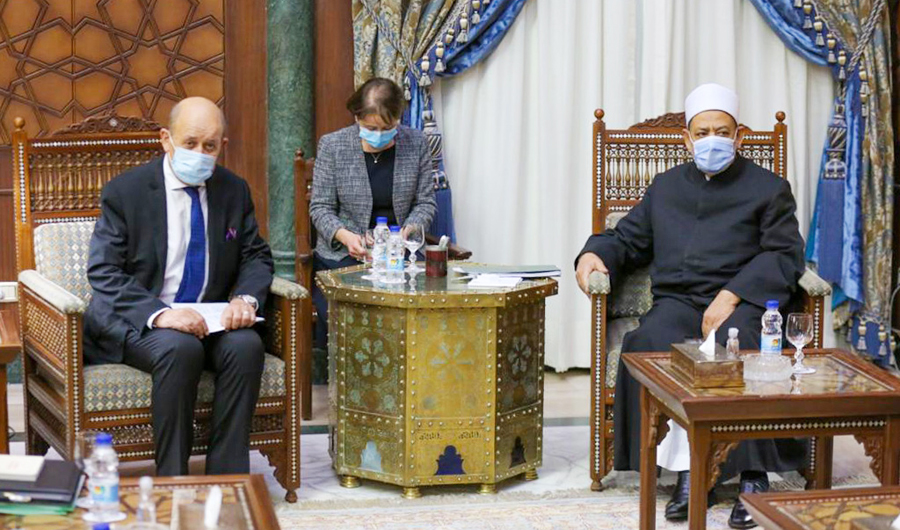
Sheikh Ahmed Al-Tayyeb, who is the most senior cleric at Al-Azhar, made the remark after meeting the French Foreign Minister Jean-Yves Le Drian.

“We will track those who insult our noble prophet in international courts, even if we spend our whole life doing that,” the sheikh said on Sunday.

“We refuse to describe terrorism as Islam. Everyone should stop using that description immediately because it hurts the feelings of Muslims around the world, and it is a description that contradicts the truth that everyone knows.”

Le Drian was visiting Egypt at a time of increased tension following French President Emmanuel Macron’s comments on Islam. The European leader had described the religion as a “faith in crisis all over the world” and defended the publication of cartoons mocking the prophet.

Le Drian, in a press conference with his Egyptian counterpart Sameh Shoukry, expressed his country’s “deep respect” for Islam and that Muslims in France were part of the nation’s history and identity.

In his meeting with the sheikh he said that France believed in the importance of Al-Azhar and the grand imam in calling for tolerance and moderation.

“We must fight with the great Al-Azhar against hate and delusions of extremists.”

Al-Tayyeb described Le Drian as the “voice of reason and wisdom” and welcomed his statements. “Muslims around the world reject terrorism that acts in the name of religion and they affirm the innocence of Islam and its prophet from any terrorism.”

Terrorists did not represent Muslims and Muslims were not responsible for terrorists’ actions, he added.

“We wanted the officials in Europe to be aware that what is happening does not represent Islam and Muslims, especially since Muslims are the ones who pay the price for this terrorism more than others.

“Transgressions exist among the followers of every religion and in the various systems. If we say that Christianity is not responsible for the New Zealand incident, then we must also say that Islam is not responsible for the terror of those who fight in its name,” he said, referring to the Christchurch mosque shootings of 2019.

Egyptian President Abdel Fattah El-Sisi received Le Drian and the French ambassador to Cairo.

El-Sisi stressed the urgent need to uphold the values of coexistence and tolerance among all religions and to extend bridges of understanding.


Main category: 
Tags: 

France FM in Egypt affirms ‘deep respect for Islam’France proposes ‘European Act’ to fight terrorism, tighten borders


Lebanon heading for total lockdown as health sector buckles

Mon, 2020-11-09 23:36

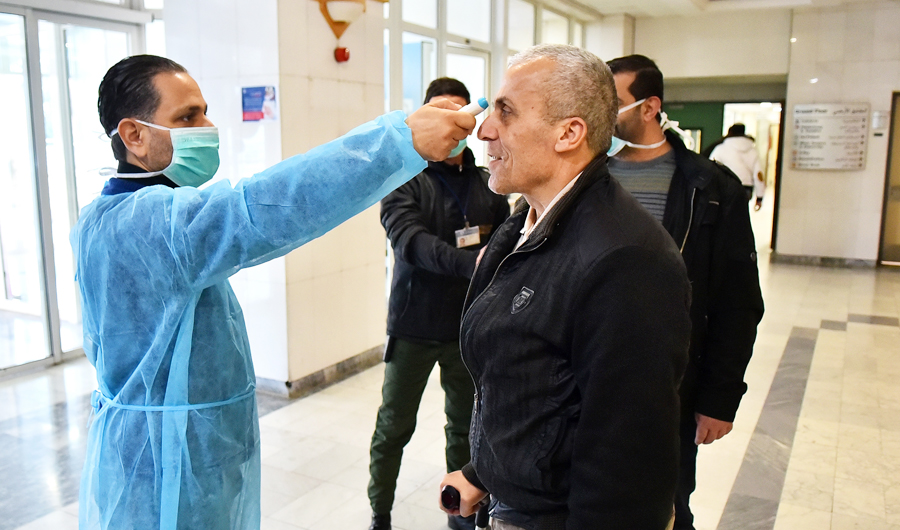
BEIRUT: Lebanon is expected to head into a total lockdown again as the health sector buckles under the pressure of soaring coronavirus cases, with the head of a doctors’ syndicate warning that the spread of the disease among medical professionals meant there would be nobody left to treat infected patients.
The Supreme Defense Council meets on Tuesday, under the chairmanship of President Michel Aoun, to take decisive action about a lockdown in light of increasing complaints from doctors and hospital owners that their resources have been depleted.
On Monday, the total number of people infected with the virus was more than 95,000, with daily rates sometimes exceeding 2,000, while the number of deaths has reached 725.
The number of COVID-19 cases during the first week of November alone hit 13,000, while the total number of cases in October exceeded 42,000 cases, the highest number recorded since the virus was first detected in Lebanon in February.
Sharaf Abu Sharaf, who heads the Doctors’ Syndicate, warned: “Lebanon’s continued abandonment of taking strict measures to contain the spread of coronavirus will mean that no one will remain to treat those infected with the virus in hospitals.”
He said 17 doctors were in intensive care units, three doctors had died, and that 100 doctors were under home quarantine.
Mirna Doumit, who is head of the Order of Nurses in Lebanon, said the number of people infected in the medical and nursing body had reached 1,500.
On Monday it was announced that the director of Tripoli Governmental Hospital was infected with coronavirus.
Hariri Governmental Hospital specializes in receiving coronavirus cases. Its general director, Dr. Firas Al-Abyad, said that one infection in every 125 in Lebanon led to death and that this figure rose to one in 10 among the elderly.
“Lebanon will enter a new phase of complete lockdown,” he predicted.
“Without a complete lockdown, the economic situation will worsen in light of the spread of the virus.”
But the idea of a complete lockdown for two weeks, or even a month, has provoked a negative reaction among the Lebanese public. The consensus is that a lockdown is useless without a clear strategy for the next steps.

HIGHLIGHTS

• Lebanon’s Supreme Defense Council meets on Tuesday to take decisive action about a lockdown.

• On Monday, the total number of people infected with the coronavirus was more than 95,000.

• The number of COVID-19 cases during the first week of November alone hit 13,000. • The total number of cases in October exceeded 42,000.

Dr. Abdul Rahman Bizri, an infectious disease specialist and member of the emergency committee on coronavirus, said that the trend on Tuesday was to lock down.
“But we do not know the duration or procedures that will accompany the closure, and the goal is to give the medical and nursing staff a chance to catch a breath,” he told Arab News.
“There are many reasons for the state’s inability to confront the virus in its second wave and not being prepared for it. The hospital sector is 80 percent private and 20 percent public.”
The private hospital sector during the first wave was just a bystander, he added.
“But now, with the reduction in the capacity of the public sector to receive patients in government hospitals, what is required of the private sector has become the performance of the public sector job. How can this be done in light of the state’s inability to pay its accumulated bills to private hospitals?”
He stressed that a complete lockdown, if it happened, would be of no benefit unless it was accompanied by a clear plan for the phased reopening of Lebanon.
“Otherwise, the randomness that the state practiced in the first stage and may practice at this stage may increase the disaster rather than mitigate it.”
The health minister, Hamad Hassan, told a news conference on Monday that a complete lockdown was an opportunity for the health sector to “gather its strength and raise the readiness that was long overdue.”
The partial closure that was followed during the previous period did not give the desired result, he said.
The president of the Syndicate of Private Hospitals, Suleiman Haroun, said that 30 hospitals were capable of receiving coronavirus patients, while 100 others were not ready.
“The internal design of about 60 percent of these hospitals does not allow for isolating a ward or floor and establishing a separate entrance for coronavirus patients, and then there is a shortage of nursing staff, in addition to the financial difficulties. Some hospitals can barely continue.”
Lebanon has in recent weeks isolated towns and villages that recorded an increase in the number of COVID-19 cases, while educational institutions have adopted blended learning to reduce the spread of the virus.
Bechara Asmar, head of the General Labor Union, feared that the results of a complete lockdown would be catastrophic for workers and the economy.
“The devastating repercussions on the Lebanese economy must be discussed if the decision of a total lockdown is made. How are workers going to be compensated?”
Lebanon is suffering from a severe economic and financial crisis that has caused high unemployment rates and rising living costs due to the collapse of the Lebanese pound and low levels of infrastructure.
Economic bodies announced their “absolute rejection” of any possible government decision to shutter Lebanon for four weeks to confront the outbreak, warning of “enormous negative repercussions” for closing the private sector that could not be contained at social and economic levels.
They called for “a careful study” of the measures that would be taken to confront the pandemic in light of the “harsh conditions” that Lebanon and its national economy was going through.
Pierre Al-Achkar, head of the Syndicate of Hotel Owners in Lebanon, said: “The complete lockdown decision in Lebanon is taken without a specific plan or study, while we see in other countries the concerned authorities provide a package of aid and implement several measures to reduce the negative aspects of the lockdown.”
He added that the tourism sector had been in “intensive care” since the Beirut Port explosion of Aug. 4.

Main category: 

Lebanon’s Bassil rejects US sanctions as unjust and politically motivatedLebanon’s president seeks evidence behind US sanctions on son-in-law


Jordan faces virus-era elections in crisis mode

Author: 
Mon, 2020-11-09 01:22

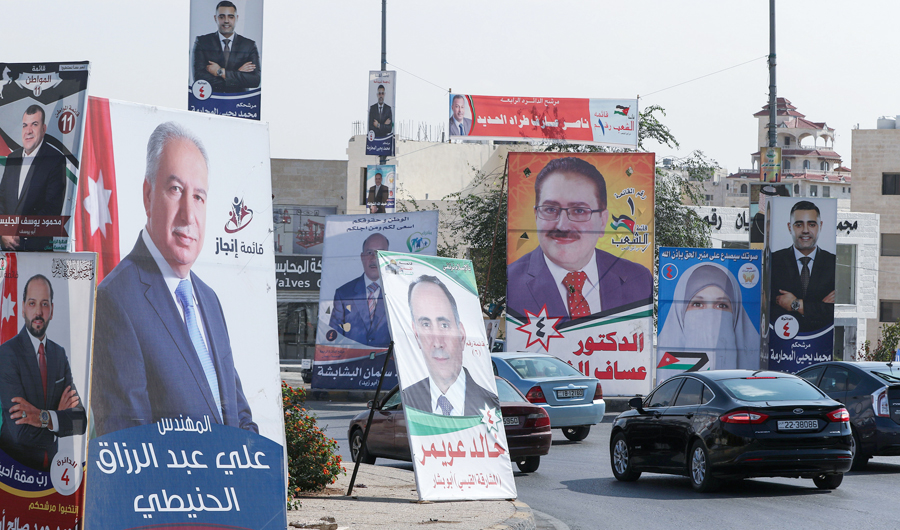
AMMAN: Voters in coronavirus-battered Jordan go to the polls on Tuesday in an election focused on the Arab country’s economic crisis which has been heightened by the devastating pandemic.
Resource-poor and dependent on foreign aid, in particular from the International Monetary Fund (IMF), public debt in the small country of 10 million people — which is also hosting more than 1 million Syrian refugees — exceeds 100 percent of its GDP.
And unemployment was running at 23 percent in the first quarter of 2020.
“This vote is different, with people in greater distress because of the epidemic,” said Oraib Rintawi of the Al-Quds Center for Political Studies. Coronavirus has claimed more than 1,180 lives from over 104,800 cases in Jordan, according to Health Ministry data.
However, Rintawi doubted there would be a high turnout because “most Jordanians think parliament plays a marginal role in the political system,” as the formation of governments in the Hashemite kingdom is not party-based or dependent on the outcome of the vote.
There have been some calls on social media to postpone the elections, but the government has said the vote will go ahead.
Parliament was already dissolved in late September ahead of the vote, and under the law new elections must be held within four months.
Jordanian Minister of Political and Parliamentary Affairs Musa Al-Maaytah insisted on Friday it would be better to hold the vote now than in a few months’ time.
“Economic, political and social life must continue,” he added.
King Abdullah last month named veteran diplomat Bisher Al-Khasawneh as prime minister ahead of the vote, after parliament reached the end of its term.
“People will vote along tribal lines, for a candidate from their clan or for representatives who will provide them with services,” not for political reasons, Rintawi told AFP.
Some 4.5 million people eligible to vote will cast their ballots for candidates to fill 130 seats in parliament, 15 of them reserved for women, from a field of 1,674 candidates running on 294 lists.
Security forces are also expected to fan out across the country’s 1,880 polling stations.

NUMBER

4.5m people eligible to vote will cast their ballots for candidates to fill 130 seats in parliament, 15 of them reserved for women.

But virus curbs banning gatherings of more than 20 people have put paid to traditional shows of patronage such as candidates’ tents offering Arabic sweets and coffee.
The Islamic Action Front, political branch of the Muslim Brotherhood and the main opposition force in Jordan, has vowed “to work to defend people’s rights, dignity and livelihood, and to confront corruption.”
Also in the running for four-year terms in parliament are representatives of the country’s main tribal clans, independents, leftists and a large number of wealthy businessmen.
Jordan has taken an economic hammering from COVID-19 with some $3 billion lost in vital tourism revenues in the first nine months of 2020.
Campaigning for the legislative elections was also forced to switch to videos posted on social media platforms, especially Facebook.
Saleh Al-Armouti, a former deputy, put the focus squarely on economic hardships in a campaign video.
“Our poor country can no longer feed itself because of the hegemony” of the IMF, he said.
Official statistics show the poverty rate has increased to 15.7 percent, a rate which the World Bank forecasts will rise sharply because of the novel coronavirus.

Main category: 
Tags: 

Jordan to reimpose night curfew after parliamentary electionsIsraeli army destroys Palestinian village in Jordan Valley