Grand Ethiopian Renaissance Dam talks resume as political tensions mount
Author:
Sat, 2020-11-21 01:02
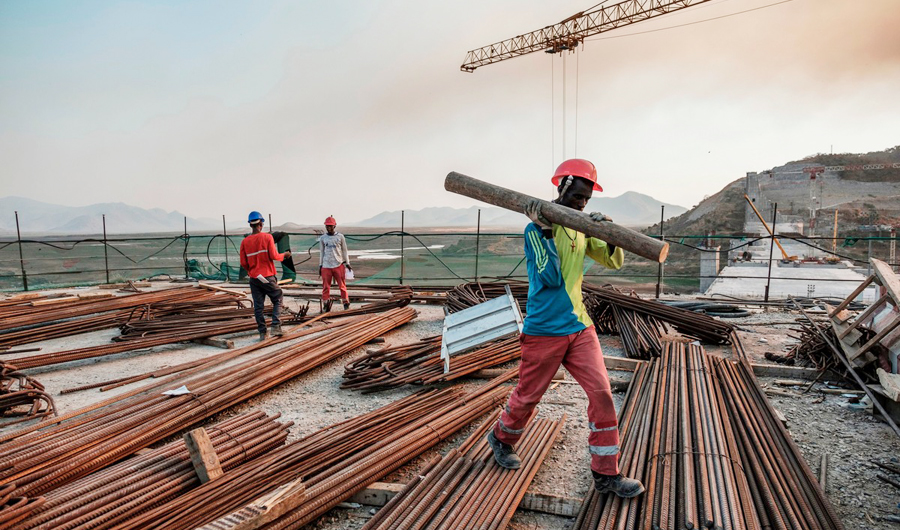
CAIRO: Ministers from Egypt, Sudan and Ethiopia launched a new round of talks on the Grand Ethiopian Renaissance Dam (GERD) this week amid growing political tensions in Ethiopia’s Tigray region.
The resumption of negotiations follows a failure by the three countries to reach an agreement on a workable mechanism for the talks earlier this month.
The latest discussions are part of efforts mediated by South Africa, current leader of the African Union (AU), to reach a legally binding agreement on filling and operating the controversial dam.
Egypt said in an official statement that it wanted negotiations to resume as soon as possible in order to reach a “fair and balanced agreement” that preserves the water rights of all three countries.
However, Yasser Abbas, Sudan’s irrigation minister, announced that “the Renaissance Dam negotiations are paused indefinitely.”
“The request to extend the negotiations for 10 days is of no use,” he added.
Abbas said that the GERD will have a greater impact on the Roseires Dam in Sudan than on Egypt’s High Dam.
“Sudan is adhering to the African Union’s condition of changing the methodology. We do not aim to stop the negotiations in order to negotiate in closed circles. There is insistence not to complete the negotiations in the absence of experts,” Abbas added.
Ethiopia confirmed that the meeting reached an understanding on the need to continue talks on the rules for the first mobilization and the annual operation of the Renaissance Dam.
“The president of the Executive Council concluded the meeting and urged the parties to develop a text that could be presented to the meeting of heads of state and government,” it said.
The Ethiopian statement indicated that the tripartite technical meeting chaired by the minister of water, irrigation and energy affairs of Ethiopia is expected to resume.
Sudan insists on a change in the previous negotiation approach and that time limits be set to reach understandings on any negotiation issue.
The discussions held this month ended without an agreement between the three countries on the methodology for completing the negotiations in the next phase.
The three countries agreed that each will submit a report to South Africa on the course of the meetings and the implementation of AU decisions made on June 26 and July 21.
The delegations from the three countries had presented their vision to complete the negotiations in the previous round. During the meeting, Egypt stressed the need to implement the decisions of the AU bureau’s meetings, by reaching a binding legal agreement on filling and operating the dam in a way that achieves the common interests of the three countries and secures their water interests.
Sources concerned with the Nile water issue confirmed that the current negotiations face a number of challenges, including the difficulty of agreeing on a mechanism for resolving disputes stipulated in the Declaration of Principles signed between the leaders of countries in 2015, and the careful coordination and exchange of information regarding the operation of water dams in Egypt, Sudan and Ethiopia, which may lead to major technical problems in the absence of a rapid and compatible mechanism for coordination and exchange of information between the two sides.
Ethiopia’s Tigray rebels fire rockets into Bahir Dar cityEthiopia accuses WHO chief Tedros of backing Tigray rebels
‘Wasta’ makes mockery of cronyism fair game for Lebanese
Fri, 2020-11-20 22:36
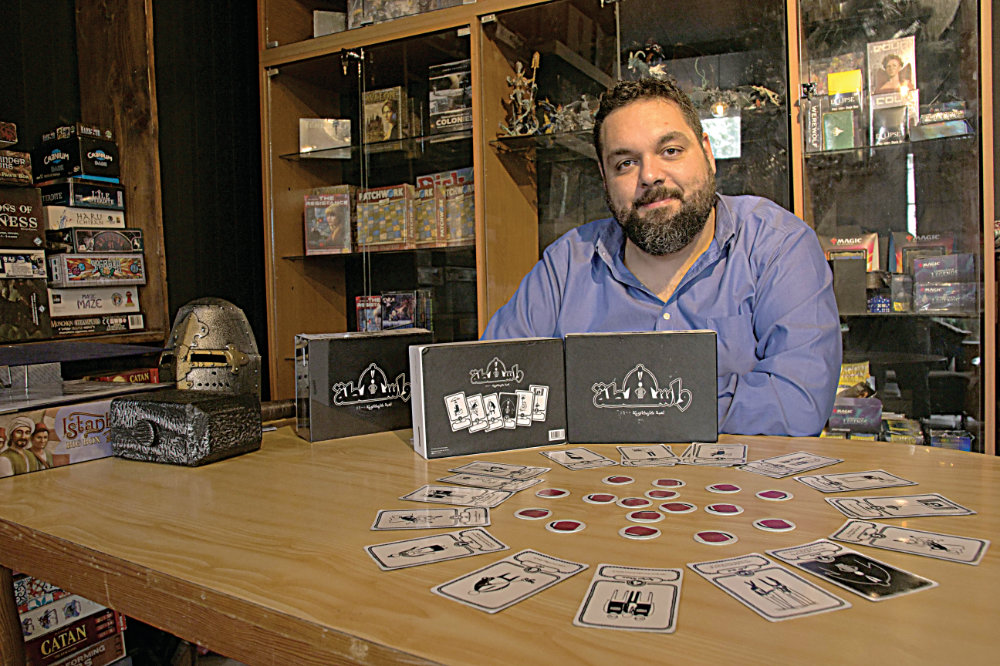
BEIRUT: In the Zero 4 shopping hub in Antelias, a small town just 5 kilometers outside Beirut, Elie Kesrouwany sits at a table sipping his morning coffee, surrounded by stacks of board games. With Lebanon’s economy on the rocks and the coronavirus outbreak forcing stores to close, Kesrouwany’s business, On Board, is one of the few here that remain open.
Lying sprawled across the table is a deck of comically illustrated cards from his latest creation: Wasta.
The board game, inspired by the anti-government protests that swept Lebanon in October 2019, is an exercise in witty seriousness and black humor. The illustrations, by popular cartoonist Bernard Hage, highlight what many Lebanese view as the bane of their lives: corruption, clientilism and nepotism.
Elements of this entrenched culture have also been held responsible for the Beirut port blast on Aug. 4, when nearly 3,000 tons of improperly stored ammonium nitrate exploded, killing more than 200 people and leaving 300,000 homeless.
“I wanted to criticize society, particularly present Lebanese society,” said Kesrouwany, who lost several friends in the blast. “We are in huge pain every day. My entire generation has been suffering from our present predicament and these warlords in the government have been there for years sucking the blood of this country.”
Wasta, which takes its name from an Arabic word for political and social influence or sway, is commonly used to denote an individual’s powerful connections used to rig opportunities in their favor.
The game was first released in June, two months before the port explosion, and sold out its first batch of 500 units in just two weeks.
Illustrations by popular cartoonist Bernard Hage. (Supplied)
It has been so popular, particularly among the Lebanese diaspora, that Kesrouwany is now creating an English-language version and an expanded second edition, with new illustrated characters to correspond with the country’s latest travails.
Kesrouwany, who worked as a librarian for 17 years before establishing his business, says he has long been a lover of these humble tabletop games — a vanishing pastime in the age of smartphones and gaming consoles.
“I began collecting board games in the trunk of my car and would go into coffee shops and offer games for people to play,” Kesrouwany told Arab News. “I then organized board game nights. It was a side gig at the time and one I was greatly passionate about.”
Kesrouwany was inspired to establish his own premises following a visit to London, where he encountered an avid community of board gamers. And so, on Dec. 22, 2019, at the height of Lebanon’s revolution — known in Arabic as the “thawra” — he opened On Board, a coffee shop for board-game lovers.
“It was my dream to create a game community in Lebanon open to all ethnicities and different religious affiliations under the umbrella of having fun,” he said. “It was an anti-sectarian space.”
It was during Lebanon’s coronavirus lockdown earlier this year that the inspiration for Wasta struck. Here was a creative and enjoyable way to speak out. “Having fun is a clever way to slip ideas into the minds of people that are hard to talk to,” Kesrouwany said.
Wasta players compete using points-weighted cards, each depicting a different facet of Lebanese society. Among the characters are the sectarian thug, the banker, the mother, the journalist, the soldier and the sheep (who blindly follow the government).
While the symbolism of each card offers a crash course in the different characters that make up Lebanese society, the genius of the game lies in the way the cards interact with one another when played.
IN NUMBERS
89% Lebanese who reported corruption in government as a big problem in 2019.
68% Lebanese who thought most or all government officials are involved in corruption.
28/100 Lebanon’s score in 2019 Corruption Perceptions Index, which measures public-sector corruption.
The starting player (obviously a Lebanese person) is the last person who managed to withdraw “fresh money” or US dollars from the banks. “This is a sardonic twist to the start, as recently the banks weren’t parting with US dollars anymore,” said Kesrouwany.
Since April of this year, Lebanese banks have forced customers with dollar accounts to withdraw Lebanese pounds at a fraction of the black-market rate. Now the Lebanese, ever creative in their response to sudden change and instability, must exchange their “fresh money,” when they have it, on the black market to get the best value, as the Lebanese pound continues to slide.
“The game is based on kicking other players out of the game and the objective is to either have the highest number or be the last man standing at the table. The most powerful card in the game is the Lebanese flag, which is number 8. So, if you have this card in your hand and the whole deck is done, then you win the game.
“However, on the card there is a small sentence that reads that if you throw the Lebanese flag from your hand, then you lose your dignity and are out of the game.”
Cartoonist Bernard Hage in his studio. (Arab News photo by Firas Haidar)
Some aspects of the game mirror Lebanon’s system of political patronage. “The player who has the sheep picks his political leader (another player) and he follows him blindly. And if that leader wins the game, the player that played the sheep also wins a round and gains a tarboosh,” he said.
When players win a hand, they win a tarboosh — the iconic Middle Eastern felt hat. The first player to get three tarbooshes wins.
There is even an “external political influence” card — another echo of Lebanon’s entrenched clientelism, which allows you to swap cards between players. “Because both players then have information about each other’s cards, they are now pitted against each other,” he said.
If you get the “political immunity” card, then you become immune to the influence of other cards. “This is a reference to how Lebanese politicians are abusing power today to hide away from law and justice because of their political immunity,” Kesrouwany said.
And of course, there’s the “wasta” card. “Wasta can illegally copy a card that was already played on the field. It’s like a cheat card.”
Given the in-your-face style of Wasta, some amount of backlash was perhaps inevitable.
The view outside On Board restaurant in Antelias, a small town just 5 kilometers outside Beirut. (Supplied)
“Bernard (the cartoonist) has enough guts to do whatever is needed through his art and relay the right message,” said Kesrouwany, who has also caught some flak. “It was troublesome for some people. I got some calls too, but I didn’t answer.”
As with so many other things in Lebanon, Kesrouwany’s board game injects charm and humor into an otherwise bleak situation, but with a kernel of hope.
“In the expanded version (created after the Beirut explosion), I focused on the fact that the game should still be fun and that makes people forget a little bit of the pain that they went through,” he said. “At the same time, the game needs to raise awareness, but always with some positivity. This is why I made cards representing the Lebanese diaspora.”
The new version does not go into detail about the explosion, the deaths, the destruction and the broken homes. “It was too painful — we Lebanese already feel like we’ve been going through a funeral for the past month,” he said.
“Lebanon is in a very messy situation now, but we will get through it and will overcome it with time by the sheer will to live.”
Finance ministry fears plunge into ‘abyss’ as Lebanon’s reserves shrinkFrance urges speedy government formation in Lebanon
Ankara sanctions loom ahead of EU summit
Fri, 2020-11-20 23:18
ANKARA: Turkey is facing a renewed threat of EU sanctions over its controversial drilling activities in the eastern Mediterranean after European leaders lined up to condemn Ankara’s “provocations” in the region.
The latest salvo of criticism comes ahead of a major EU summit in December when Brussels will discuss punitive measures against Turkey over its natural gas exploration in the contested waters.
Statements by European leaders, including German Chancellor Angela Merkel, show that Brussels is unlikely to step back from its threat to impose curbs following Turkey’s insistence on carrying out drilling in disputed zones.
“Things haven’t developed the way we would have wished,” Merkel said following a meeting with EU leaders late on Thursday.
Earlier in the day, German Foreign Minister Heiko Maas said that the EU could consider imposing sanctions against Turkey in December if Ankara failed to halt its “provocations” in the region.
“If we see no positive signals coming from Turkey by December, only further provocations such as Turkish President Recep Tayyip Erdogan’s visit to Northern Cyprus, then we are heading for a difficult debate,” he said.
On the same day, EU foreign policy chief Josep Borrell also warned Ankara that it is “widening its separation from the EU,” adding that the bloc was “approaching a watershed moment in our relationship with Turkey.”
The EU leaders’ summit will take place on Dec.10-11 in Brussels.
Turkey’s recent statements regarding Cyprus also have been criticized by the EU as contrary to UN resolutions.
During a visit earlier this week condemned as “provocative and illegal” by the Cypriot government, Erdogan called for a “two-state” solution in Cyprus.
Experts believe that Brussels is likely to introduce specific sanctions, including the ban on entering European ports for some individuals and companies.
However, Charles Ellinas, a Cypriot energy analyst and senior fellow at the Global Energy Center at the Atlantic Council, said that limited EU sanctions are unlikely to deter Erdogan.
According to Ellinas, the Turkish leader is pursuing an aggressive agenda in the eastern Mediterranean to bolster support at home.
“With the deteriorating economy, the pandemic and the shock resignation of his son-in-law and finance minister Berat Albayrak, he is trying to deflect public opinion,” Ellinas told Arab News.
France, Austria and Greece are pushing the EU to take tough measures, including the suspension of the customs union with Turkey.
However, Ellinas said Brussels is unlikely to take stronger action.
“We will need to wait and see what Biden does once he takes over the US presidency. Erdogan’s sway over Trump will no longer help him,” he added.
The new US administration under Joe Biden is expected to focus on the eastern Mediterranean — a potential flashpoint in US-Turkey relations.
Madalina Sisu Vicari, an independent expert on energy geopolitics, said that relations between the EU and Turkey are likely to become “more bellicose and strained.”
She said that Turkey will be reluctant to enter negotiations with the EU if sanctions are introduced since this would be seen as a capitulation.
“The best option is to avoid missteps that would lead to escalation and an activation of the sanctions agenda,” she said.
Turkey has not renewed the Navtex for the seismic research activities of its Oruc Reis survey vessel in the eastern Mediterranean since Nov. 14.
Gabriel Mitchell, a policy fellow at the Mitvim, Israeli Institute for Regional Foreign Policies, said “appropriate” sanctions would target the Turkish energy industry, ports and shipping.
“The question will be whether the affected industries will get Erdogan to listen. With the changes at the finance ministry and the comments about a possible reset with the US, there is a possibility that this will push Turkey toward negotiations, but it could just as easily be used by the Turkish government to paint the EU as the villain,” he told Arab News.
Turkey’s behaviour ‘widening its separation’ from EU, Borrell saysPompeo says Europe, US need to work together to address Turkey
LAU’s incoming president talks Lebanon crises, education, coronavirus
Author:
Fri, 2020-11-20 23:15
LONDON: While Lebanon grapples with economic, healthcare and political crises, brighter days are still on the horizon, the Lebanese American University’s (LAU) incoming President Dr. Michel Mawad said on Friday during a webinar hosted by media partner Arab News.
“You have to believe in this country, stay the course, have faith in the country, have faith in the past, the future, the mission of this country. Being Lebanese isn’t a passport, it’s a state of mind that can withstand these difficulties,” he added.
“We need to survive. There’s no better description for this than survival for those in Lebanon.”
On Aug. 4, a huge blast at the Port of Beirut — largely blamed on government negligence — rocked the capital and left at least 200 dead and thousands injured. More than 300,000 people lost their homes.
Meanwhile, an unprecedented financial crisis has left thousands of Lebanese higher education staff unemployed, and many others opting to leave the country out of sheer desperation,
Mawad said the LAU is doing all it can to retain its best and brightest from what is being described as a second brain drain — the first coming decades earlier during the civil war.
“We accept the fact that we’re going to have some erosion, but at the same time we’re constantly thinking of ways to retain our faculty,” he added.
Mawad also spoke of the LAU’s hybrid online / on-campus teaching model during the coronavirus pandemic, which has forced Lebanon into its second lockdown after a recent spike in cases.
“The main challenge is the healthcare crisis in Lebanon because of the COVID-19 pandemic. There’s a challenge in taking care of our sick people, of securing basic medical care for COVID-19 victims, of protecting our constituents both on and off campus,” he said.
“We’re taking all precautions for the courses that need to be taught on campus, and we’re keeping our curriculum and classes going within a combination of online and in-class learning.”
Amid the financial toll on the LAU, Mawad spoke of rises in tuition fees, but with parallel increases in financial support for many students.
Taking questions from the audience, he was repeatedly asked about the incentive for students and staff to stay in a country reeling from what seems to be blow after blow. “Stay here because we’re here next to you,” he said.
Lebanon begins 2-week lockdown as COVID-19 cases surge Lebanon’s Basecamp sets the pace for citizens’ initiatives in fragile states
Egyptian startup creates potentially lifesaving medical e-ID system
Fri, 2020-11-20 00:20
CAIRO: When Andrew Saad was faced with an elderly patient on his hospital ward, complaining of vague abdominal pain but with no medical history on hand to guide a working diagnosis, the freshly graduated Egyptian doctor realized just how scary it can be for patients and medical providers when details are scarce during an emergency.
The incident motivated Saad to search for an inventive way to get health records into the hands of medical professionals quickly during an emergency — particularly in cases where a patient is unconscious, in a poor mental state or is unaccompanied.
“Health records are either electronic or paper-based. Both are usually kept at the hospital and are not typically available with the patient whenever he or she presents to another medical provider in case of an emergency,” Saad said.
The portability of medical records is a problem that extends beyond Egypt and the Middle East and North Africa (MENA) region. Even in developed countries — including the US, where electronic medical recording is far more widely adopted — the exchange of patients’ medical records between different healthcare systems is a complex and inefficient process.
The portability of medical records is a problem that extends beyond Egypt and the Middle East and North Africa (MENA) region. (AFP/File Photo)
In February 2019, Saad and his five business partners joined Egyptian accelerator program Falak Startups and launched Bypa-ss. The company offers a unified medical ID card connected to an online platform where medical records are saved and can be accessed by medical providers.
Prior to the launch, Saad and his team presented the concept at several medical conferences. The idea garnered a positive reception. “The initial market response was very encouraging,” Saad said.
The HealthTag, as the product is called, is a physical card connected to the company’s online platform.
FASTFACT
* Andrew Saad and his business partners joined accelerator program Falak Startups and launched Bypa-ss in 2019.
In addition to basic medical information such as blood type, allergies and chronic medical conditions, Bypa-ss offers free software for medical providers, as well as free technical support to enable them to communicate with the online platform to save patients’ medical data, send lab results and place prescription drug orders. Some providers will also offer discounts for cardholders.
Getting initial support from the medical community for a new-to-market tech product was challenging but also critical if it was to gain the traction needed to move forward.
“For medical providers, personal brands are extremely precious,” Saad said, explaining why it is typically quite difficult to introduce a new product in the medical space.
Even with initial traction, maintaining growth remains a challenge. “Paper is our worst enemy. It was pretty tough to learn how to educate and advocate for a change within clinics and medical institutions,” Saad said.
In addition to basic medical information such as blood type, allergies and chronic medical conditions, Bypa-ss offers free software for medical providers. (AFP/File Photo)
The company currently has more than 1,000 partners among medical care providers, including major laboratories, hospitals, clinics and pharmacies.
The COVID-19 pandemic has affected Bypa-ss in unusual ways. Although its customer base grew faster, its revenues declined as many medical providers, particularly smaller clinics, ceased operations during Egypt’s enforced lockdown period. The company responded by directing more of its efforts to boosting online services.
“We’re looking forward to adding more features by partnering with other digital medical services/platforms, such as appointment booking platforms, drug delivery services and telemedicine platforms,” Saad said.
The company is already in talks with telemedicine providers to offer such services to its HealthTag cardholders.
Saad and his team are also moving their network beyond Cairo and Alexandria.
———————
This report is being published by Arab News as a partner of the Middle East Exchange, which was launched by the Mohammed bin Rashid Al Maktoum Global Initiatives to reflect the vision of the UAE prime minister and ruler of Dubai to explore the possibility of changing the status of the Arab region.