Zarif ‘desperate’ to blame Saudi Arabia for anything negative that happens in Iran: Al-Jubeir

Tue, 2020-12-01 19:54

JEDDAH: Iran’s parliament on Tuesday approved a bill requiring the government to boost uranium enrichment by 20 percent and end UN inspections of its nuclear facilities.

The move is being viewed by analysts as a show of defiance after the recent killing of prominent Iranian nuclear scientist Mohsen Fakhrizadeh, an assassination for which Tehran has accused other countries of masterminding.

Saudi Arabia’s Minister of State for Foreign Affairs Adel Al-Jubeir said on Tuesday that Iranian Foreign Minister Mohammed Javad Zarif was “desperate” to blame the Kingdom for anything negative that happened in Iran.

“Will he blame us for the next earthquake or flood?” he tweeted. “It is not the policy of Saudi Arabia to engage in assassinations; unlike Iran, which has done so since the Khomeini Revolution in 1979.

“Ask us and ask many other countries who have lost many of their citizens due to Iran’s criminal and illegal behavior,” Al-Jubeir added.

The latest bill would require another parliamentary vote to pass, as well as approval by the Guardian Council, a constitutional watchdog. Moreover, Supreme Leader Ayatollah Ali Khamenei has the final say on all nuclear policies.

“There is no doubt that this step constitutes a threat, raising it to 20 percent means that it is close to building a nuclear bomb,” political analyst and international relations scholar Dr. Hamdan Al-Shehri told Arab News. “The region is promised with a dark and unstable period.”

He said that the move indicated the Iranian regime’s insistence on destabilizing the region, and its determination to win the race to obtain nuclear weapons.

Enriching uranium to 20 percent is below the threshold needed for nuclear weapons but higher than that required for civilian applications. It would also commission new centrifuges at nuclear facilities at Natanz and the underground Fordo site.

“Iran’s acquisition of nuclear weapons or its proximity to achieving that goal will be a great danger to the region, and countries will seek to protect themselves, which will mean that everyone will resort to obtaining nuclear weapons. Fakhrizadeh’s death suggests that Iran was waiting for this opportunity to escalate,” Al-Shehri added.

The official IRNA news agency said 251 lawmakers in the 290-seat chamber voted in favor, after which many began chanting slogans against the US and Israel.

The bill would give European signatories to the 2015 nuclear deal three months to ease sanctions on Iran’s key oil and gas sector, and to restore its access to the international banking system.

“Many technical issues related to the nuclear bomb creation were not closely followed up by P5+1 (the UN Security Council’s permanent members of China, France, Russia, the UK, and the US, plus Germany),” said Al-Shehri.

“We also should not forget that Iran was not clear and was preventing and limiting inspections at its nuclear facilities, moreover, the International Atomic Energy Agency did not do its work properly so that the world could breathe easily.

“Iran may have the nuclear bomb by now without the international community taking any action against it.

“The assassination of a scientist will not change the equation, even the strikes on Iranian facilities would not affect the real Iranian infrastructure.

“Iran wasn’t confronted the way that would make the world comfortable, nor the way that a terrorist rogue state should have been treated as it distributed terrorism through its militias, ballistic missiles, and drones in the region,” he added.

Saudi Arabia's Minister of State for Foreign Affairs Adel Al-Jubeir. (Reuters/File Photo)
Main category: 
Tags: 

UAE condemns killing of Iranian scientist, calls on all parties to exercise self-restraint Saudi Arabia’s Al-Jubeir: Iran should stop targeting Kingdom with missiles and militias



Friends or foes? Syrian refugees divided on fate of defectors

Tue, 2020-12-01 18:42

GERA, Germany: Should former members of the Syrian security forces who have defected from President Bashar Assad’s government be prosecuted for war crimes, or should they serve as key witnesses in an effort to bring senior officials to justice?
The question has divided Syrian refugees and exiles who have fled a civil war in which hundreds of thousands of people have been killed and that has been marked by atrocities since it broke out in 2011.
In Germany, home to 600,000 Syrian refugees, prosecutors have used universal jurisdiction laws that allow them to prosecute crimes against humanity committed anywhere in the world to seek justice for victims of alleged torture and extrajudicial killings by Assad’s forces.
In the first case to be brought to a German court, the trial opened in April of two former Syrian intelligence officers on charges of torture and sexual assault.
The two suspects had defected in 2012 and were granted asylum in Germany. Many of the Syrians now in Germany are asking if the defectors are friends or foes.
“The trial in Germany is wrong, strategically and morally. Defectors risked their lives to join the opposition and discredit the regime,” said Fawaz Tello, a veteran Syrian dissident.
“Who in their right mind is going to defect now when they see that people who had defected in the first months of the revolution are being put on trial?“
The Syrian government has regularly rejected reports of torture and extrajudicial killings documented by international human rights groups.
Mahmoud Alabdulah, a former colonel in the Syrian army’s elite 4th Division, is one of hundreds of defectors who have given testimonies to German and French judicial officials collecting evidence of alleged war crimes by the Syrian government during the still-unresolved war.
He says a military card identifying his rank is the most valuable item of the few belongings he carried when he left Syria six years ago.
The pink, plastic-covered piece of paper has given more credence to testimonies he delivered in France and Germany against the Syrian government, he says.
“I saw soldiers being executed for refusing to open fire on protesters and heavy artillery fired toward civilian areas,” said Alabdulah, a 56-year-old father of five, rolling a cigarette in a modest apartment in the eastern German city of Gera where he lives with his wife.
“I remember the night I decided to defect: February 13, 2012,” Alabdulah said. “I was praying in my room, lights off, at the Saboura military base (west of Damascus) and I said, ‘God, I don’t want to take part in such crimes, please help me get out of here’.”
Campaigners have hailed the process in Germany as a first step toward justice for thousands of Syrians who say they were tortured in government facilities after attempts to establish an international tribunal for Syria failed.
“No one has the right to tell victims they should not seek justice,” said Anwar Al-Bunni of the European Center for Constitutional and Human Rights (ECCHR) which is representing victims in the torture trial.
“Ignoring suspected war criminals is equivalent to white-washing the Assad regime.”
The main defendant in the trial, Anwar R., is charged with 58 murders in a Damascus prison where prosecutors say at least 4,000 opposition activists were tortured in 2011 and 2012. He has denied all the charges.
He was an intelligence colonel in Assad’s security apparatus but defected in 2012 to Turkey, where he became active in the opposition Free Syrian Army. He came to Germany in 2014 and was granted asylum.
The dissident Tello said Anwar R. was a member of an opposition delegation at UN-sponsored talks in Geneva six years ago aimed at ending the conflict, which makes his trial a “humiliation” for opposition groups marred by infighting.
Former army colonel Alabdulah questioned whether it was realistic for everyone who committed a crime to face justice.
Asked if he feared charges could be filed against him, Alabdulah told Reuters his conscience was clear. He fought against Assad’s forces and Daesh militants before he fled to Turkey, he said.
“We are not even close to winning the war. Even if we did, there should be some kind of a general amnesty,” he said. “The Assad family and its most loyal lieutenants should be tried.” 

Main category: 

Merkel critic holding out for cap on refugees Germany acceptsGermany repatriates Daesh children from Iraq


Bahrain praises US partnership as ‘cornerstone’ of Gulf security

Tue, 2020-12-01 15:28

Bahrain’s Foreign Minister Abdullatif bin Rashid Al-Zayani praised on Tuesday his country’s partnership with the as the “cornerstone” of Gulf security.

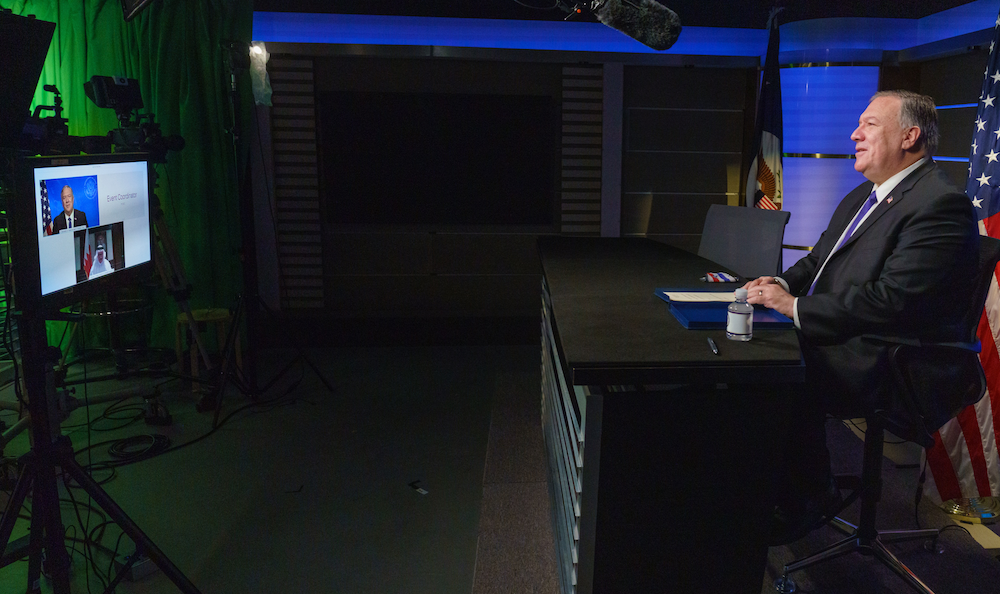
The Bahraini minister spoke during the virtual opening of the first US-Bahrain Strategic Dialogue that focused on defense cooperation, regional security and economic development and trade.

US Secretary of State Michael Pompeo - who was hosting the dialogue – said that Washington was looking to cooperate with Bahrain to fight terrorism.

Sanctions had deprived Iran of financing terrorist groups, Pompeo said.

During the virtual dialogue, Zayani called on the international community to continue pressure on Iran as he viewed Tehran as a security challenge for countries in the region.

Iran has malicious intentions towards regional states, the Bahraini minister said.

US Secretary of State Michael Pompeo - who was hosting the dialogue – said that Washington was looking to cooperate with Bahrain to fight terrorism. (Twitter: @SecPompeo)
Main category: 
Tags: 

Bahrain to send ministerial delegation to Israel Bahrain condemns Qatar’s interception of 2 coastguard boats in its waters


Turkey, Russia seal deal for Karabakh ‘peacekeeping center’

Author: 
AFP
ID: 
1606814134172105800
Tue, 2020-12-01 08:45

ANKARA: Turkey and Russia have agreed to monitor a truce over the disputed Nagorno-Karabakh region from a joint peacekeeping center, Ankara’s defense ministry said on Tuesday.
The deal comes after days of talks between Turkish and Russian officials about how the two regional powers would jointly implement a Moscow-brokered cease-fire signed this month between Armenia and Azerbaijan.
Technical details for setting up the joint center were concluded and an agreement was signed, the defense ministry said in a statement, adding that it would begin work “as soon as possible.”
Turkey is a staunch ally of Azerbaijan and has fervently defended its right to take back the Nagorno-Karabakh lands Baku lost to ethnic Armenian separatists in a 1988-94 war.
The truce deal ended more than six weeks of fighting that claimed more than 1,400 lives and saw ethnic Armenians agree to withdraw from large parts of the contested region of Azerbaijan.
The Turkish parliament voted this month to deploy a mission to “establish a joint center with Russia and to carry out the center’s activities.”
The deployment is set to last a year and its size will be determined by President Recep Tayyip Erdogan.
Russia has said repeatedly that Turkey will have no troops on the ground under the truce deal’s terms.

Main category: 

Turkey, Russia discuss involving other countries in Nagorno-Karabakh cease-fire effortsArmenia appoints new defense minister after Nagorno-Karabakh cease-fire


Turkish opposition politician investigated for criticizing Qatar military deal

Tue, 2020-12-01 01:33

ISTANBUL: A Turkish opposition politician who is being investigated for criticizing a military deal with Qatar has defended his remarks.

MP Ali Mahir Basarir, from the Republican People’s Party (CHP), said the Turkish army had been sold to the Qataris under a series of deals that were signed between the two governments on Nov. 26.

“We have reached a point where the state’s army is sold to Qatar in a first for the country’s history,” he said during a TV interview.

He criticized a contract that was signed last year with military vehicle producer BMC, a Turkish-Qatari joint venture, for the mass manufacture of the Altay tank, Turkey’s first new generation main battle tank.

The Ankara Chief Public Prosecutor’s Office on Nov. 29 launched a probe into the opposition politician for “humiliating the Turkish government and the army.”

But Basarir denied his remarks were critical of the army. “I stand behind my words,” he tweeted on Sunday. “Selling a military factory of our army to another country is treachery. It is betrayal.”

There have been strongly worded statements from government officials, and even accusations of him of being “a lover” of Syrian President Bashar Assad.

“This deputy is not worthy of representing our sacred nation,” Mahir Unal, deputy leader of the ruling Justice and Development Party (AKP), tweeted. “He should quickly apologize.”

AKP spokesman Omer Celik blamed Basarir for “using poisonous language devoid of morals about the heroic Turkish army.”

The Turkish Defense Ministry is expected to file a complaint about the MP for “insulting the army and Turkish soldiers,” while Turkey’s media watchdog will investigate the broadcast.

Turkey’s top tank factory was transferred to a Turkish-Qatari private venture in 2019 to produce armored vehicles.

The Turkish partner of BMC, Ethem Sancak, is known to be a close confidant of Turkish President Recep Tayyip Erdogan.

The plant was leased by BMC, which will operate the national tank factory for 25 years, but the lease price has never been made public.

The deal was criticized by opposition figures at the time, and they emphasized the strategic importance of such a factory for Turkey’s defense capabilities.

Qatar also signed a billion-dollar contract last year to buy about 100 tanks from Turkey.

But Germany is reluctant to share its engine expertise technology – which is critical for making these tanks – with Turkey due to political concerns.

“This government likes Qataris more than Turkish people,” CHP lawmaker Alpay Antmen tweeted. “It is totally ‘emotional.’”

Main category: 
Tags: 

Turkey condemns Iran scientist killing as ‘terrorism’Alarm bells sounding louder over outbreak in Turkey