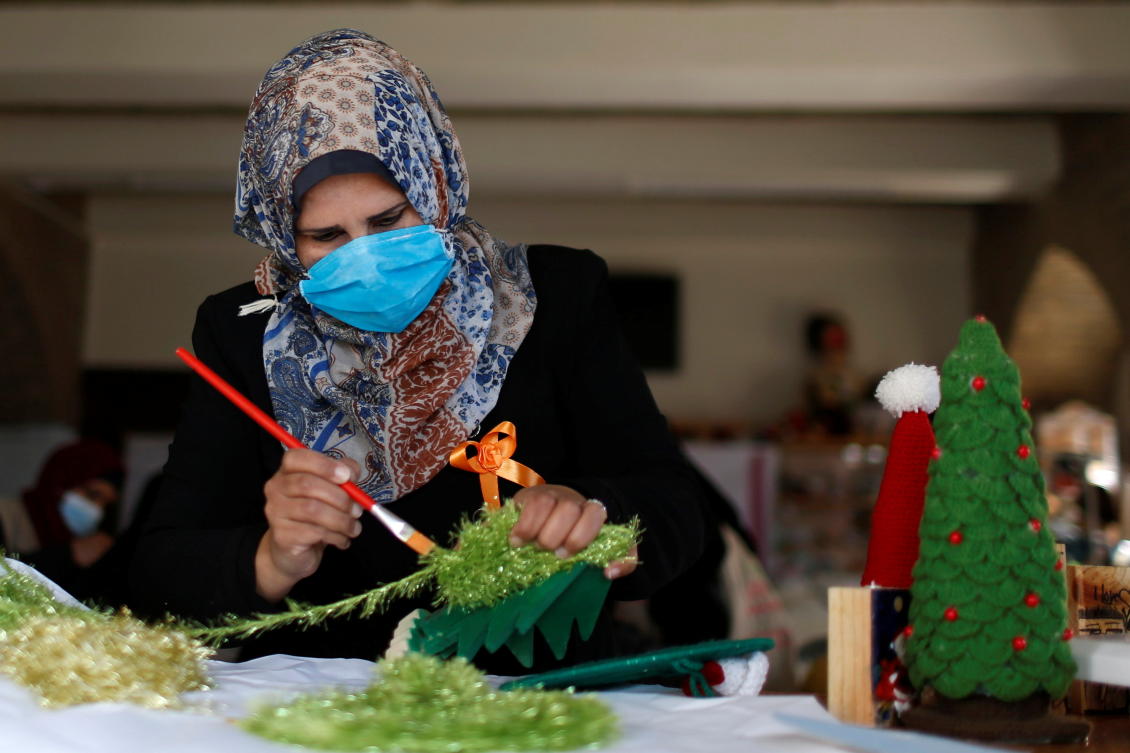
Gaza imposes tighter virus restrictions, extends curfew

Author: 
AFP
ID: 
1607026804890472100
Thu, 2020-12-03 19:59

GAZA CITY: New measures to counter the spread of the novel coronavirus in the Gaza Strip were announced on Thursday by the interior ministry of Hamas, which rules the Palestinian enclave.
Mosques, schools, universities and kindergartens will be closed from Saturday in the Gaza Strip, excluding high schools and nurseries, the interior ministry said in a statement.
A night-time curfew was also set to start from Saturday, lasting from 6:00 p.m. to 8:00 am, while a full lockdown will be imposed on Fridays and Saturdays from December 11 through to the end of the month.
Shops and other premises must close by 6:00 p.m. and people must be home by 6:30 pm, compared to 8:00 p.m. under the previous curfew rules.
Medical and political sources warned last week of a spike in Covid-19 cases in the Gaza Strip, saying the situation was “out of control.”
The enclave, a small, densely populated territory with two million inhabitants under an Israeli blockade, closed its borders early in the pandemic and only allowed a limited number of people to enter, requiring them to isolate for three weeks in quarantine centers.
Up until mid-August, authorities in Gaza had only recorded around 100 Covid-19 cases.
But in the past two weeks, containment of the virus has deteriorated in Gaza, with hundreds of new infections announced per day, resulting in a total of 23,023 cases and 122 deaths.
Hamas leader Yahya Sinwar is among those who have recently been infected by the virus, the movement said Tuesday.

Main category: 
Tags: 

Life in Gaza ‘extraordinarily difficult’ for disabled: HRWGaza gets vital medical aid as hospitals struggle with rising infections


Israel warns Iran may target its facilities abroad

Thu, 2020-12-03 22:23

JERUSALEM: Israel warned on Thursday that its facilities abroad could be targeted by Iran, which has been issuing new threats against Israel since the killing of a prominent Iranian nuclear scientist.
In its warning, Israel’s counter-terrorism bureau said Iran could try to carry out attacks in nearby countries, including Georgia, Azerbaijan and Turkey.

“In light of the threats heard recently by Iranian officials and in light of the involvement in the past of Iranian officials in terror attacks in various countries, there is a concern that Iran will try to act in this way against Israeli targets,” said a statement issued by the prime minister’s National Security Council.

Iran’s clerical and military rulers have blamed Israel for the killing of its top nuclear scientist last week. A top adviser to Iran’s supreme leader has said that Iran will give a “calculated and decisive” response. 

Main category: 
Tags: 

US imposes fresh Iran-related sanctions targeting individual, entityIran waging Moore-Gilbert ‘disinformation campaign’ 


Egypt seeks to free citizens kidnapped by pirates off Nigerian coast

Author: 
Thu, 2020-12-03 21:46

CAIRO: Egypt’s Foreign Ministry said it was coordinating with Nigerian authorities to free two of its citizens after they were kidnapped by pirates.

According to media reports, Saad Shawky and Kyrolos Samir were taken while they were on board a cargo ship off the coast of Nigeria’s southernmost state of Bayelsa.

There are also three Lebanese, four Indians and a Cameroonian in the crew.

The ministry said it had contacted the Egyptian consulate in Abuja about the circumstances and with the latest updates, and that instructions had been issued “to communicate with all officials at the highest level to follow up on ensuring the safety of kidnapped Egyptians.”

Egyptian media reported the two men were on board a Lebanese cargo ship called “Milan-1” that was heading from Nigeria to Cameroon. They also said the ship was owned by a Lebanese national, Adnan El-Kot.

El-Kot said in statements that he had rented the ship to a man called Tavo Lawrence and that the vessel was raising the flag of Saint Kitts. He learned about the kidnapping last Thursday, receiving a call from a Thuraya mobile phone from the pirates who demanded a $1.5 million ransom to release the ship.

The ransom dropped to $300,000, and El-Kot explained that he had told the kidnappers that the ship had been rented to another person living in Nigeria after he made sure all the ship crew were safe.

Maria Samir, Samir’s sister, said her brother was last contacted as he was about to move from Nigeria to Cameroon.

She said in an interview that contact with him was lost a few hours after he moved from Nigeria, adding that it naturally happened due to being in the open seas. She was following up the ship’s route through an app that revealed the vessel had stopped in the middle of the sea and did not move.

She said her brother graduated from university a year ago and that it was his first job for six months. She added he was working on a ship on the Red Sea route and moved to work on board “Milan-1.”

Sherouk Shawky, who is Shawky’s sister, said: “My brother and his colleague Kyrolos Samir have been working together onboard the ship for two years and a half.”

She said her brother left Nigeria en route to Cameroon and they had last contacted each other last Wednesday.

She added: “By Saturday, as he didn’t contact us, we became extremely worried about him since the route from Nigeria to Cameroon is only two days. So we contacted Adnan El-Kot, the ship owner, who told us that pirates from Nigeria kidnapped the ship’s 10-member crew, which includes officers, engineers and cooks. He said the pirates kidnapped 10 crew members and left one to inform Adnan of the kidnapping.”
 

Main category: 
Tags: 

Six killed in building collapse in northern EgyptEgypt’s 14-fold population rise in 135 years a ‘national problem’: government minister


People disabled by Beirut explosion stage protest

Author: 
Thu, 2020-12-03 21:33

BEIRUT: People disabled by the Aug. 4 Beirut Port explosion staged a sit-in on Thursday to protest against “injustice, corruption and marginalization.”

The protest took place in the Basta Al-Tahta neighborhood, where a disabled 87-year-old man called Tawfiq Khawam had set himself alight due to the poverty and neglect he faced. Protesters said they did not want “another Tawfiq Khawam.”

They gave vivid testimonies of the deprivation caused by their disabilities, calling for social protection that guaranteed them “basic rights and a decent living in light of the economic collapse.”

One woman said the port explosion was a “real crime, yet officials act as if nothing has happened.”

She urged the “inclusion of fixed standards for the rights of the injured who have suffered a physical disability in the process of rebuilding the destroyed buildings of Beirut,” and for the need to include the issues of the disabled in the reform plan and to treat people who were disabled as a result of the explosion and the army’s wounded equally without discrimination.”

The spokeswoman for the protesters said Lebanon had issued a law about the rights of disabled people 20 years ago, but that parliament had not yet ratified the International Convention on the Rights of Persons with Disabilities despite 14 years passing since it was issued.

This, she added, was a sign of how Lebanese officials dealt with this category of citizens, who had become “victims of extreme poverty, dreaming of food and medicine and access to public places.”

The protest coincided with an official announcement that President Michel Aoun had signed a law to provide compensation and salaries to the families of the port explosion victims, and “enabling those who were disabled to benefit from health benefits from the National Social Security Fund and from the law related to the rights of people with special needs.”

A study from Beirut Arab University, in cooperation with the Lebanese Army Engineering Directorate and published on Thursday, showed that the blast resulted from the explosion of only 20.5 percent of the 2,750 tons of ammonium nitrate that were stored near grain silos.

The study said the exploded amount of ammonium nitrate was “much less than the total original quantity, which is equivalent to 220 tons of TNT or the equivalent of 564 tons of ammonium nitrate.”

The judicial investigator has not issued his report, which is expected to reveal the reasons for the explosion.

The blast killed 202 people and injured more than 6,500, some of whom are still in hospital. It destroyed Beirut’s waterfront and inner residential neighborhoods, and came as the country was dealing with a financial crisis and COVID-19.

A British government minister warned on Thursday that Lebanon was on the verge of not being able to feed itself.

James Cleverly, the Foreign Office minister for the Middle East, called the situation “a man-made problem which could have been prevented.”

“The most pressing danger is the risk to food security: Lebanon is on the verge of not being able to feed itself,” said Cleverly, who met Lebanese officials in Beirut on Thursday. “Four months on from the blast, Lebanon is threatened by a silent tsunami. Lebanon’s leaders must act.”

During a second international conference in support of Beirut and the Lebanese people, held on Wednesday at the invitation of French President Emmanuel Macron and UN Secretary-General Antonio Guterres, the international community expressed concern about the delay in the investigation of the port explosion.

Participants said the commitments made regarding emergency aid since Aug. 4 had been fulfilled, in terms of quality and quantity, in all priority areas identified by the UN at the time.

The conference announced a multi-donor trust fund prepared by the World Bank, the UN and EU, to continue funding after the emergency humanitarian aid allocated after Aug. 4, provided that “an important role is given to civil society actors to identify priority areas of action, such as good governance, health, education, social protection, housing, culture and heritage.”

Participants also expressed their concern about the “deterioration of all economic, financial, monetary and social indicators, as the poverty rate increased from 28 percent to 55 percent within a 12-month period, which has now pushed many Lebanese to emigrate.”

They said that while Lebanon was in a state of financial bankruptcy, it could still be a successful country if the reforms that the population and international community expected were implemented quickly.
 

Main category: 
Tags: 

Hunger threatens Lebanon if leaders don’t act, UK minister warnsLebanon indicts 8 retired military figures over alleged graft


Egypt’s 14-fold population rise in 135 years a ‘national problem’: Govt. minister

Author: 
Wed, 2020-12-02 23:57

CAIRO: Egypt’s 14-fold population increase between 1882 and 2017 had created a “national problem” that required urgent attention, a government minister has said.

Deputy Minister of Health and Population Tarek Tawfik revealed that over the 135-year period the number of people living in the country had shot up from 6.7 million to 94.8 million.

The rise had impacted on each individual’s share of education, health, and available resources, affecting overall demographics, he added.

“(The population increase) is a national problem that needs to be solved through the collaboration of efforts between all the ministries, governmental, and non-governmental institutions, and the civil society,” Tawfik said.

He pointed out that the Egyptian National Population Council was currently drafting public policy documentation in collaboration with The American University in Cairo (AUC) aimed at resolving some of the country’s population-related issues.

Plans in the pipeline included awareness campaigns on family sizes, food and water security, and sustainability.

The council’s former rapporteur, Dr. Amr Hassan, said that a family planning project due to be launched early next year, would help to cut the birth rate in Egypt by 1 million.

Egyptian Minister of International Cooperation Dr. Rania Al-Mashat, US Agency for International Development (USAID) Mission Director Leslie Reed, AUC President Francis Joseph Ricciardone, and Tawfik recently launched the Strengthening Egypt’s Family Planning Program (SEFPP) youth competition, part of a $31 million initiative previously signed with the USAID to improve population health results.

Al-Mashat said that improving general healthcare, reproductive health, and family planning services were key to achieving economic empowerment for men and women.

She pointed out that the SEFPP youth competition was aimed at paving the way for the implementation of new and effective solutions to the issues and involved the Egyptian government, educational institutions and universities, youth, and civil society organizations represented by the USAID.

The program was designed to tackle the over-population problem through innovative techniques, developing youth ideas on family planning schemes, and raising awareness throughout the country.
 

Main category: 
Tags: 

Egypt sets new shop hours amid second virus wave fearsEgyptian tourism records 21.6% decline, halting reform efforts