Pandemic teaches Kuwait’s fitness industry a healthy business lesson

Author: 
Sat, 2020-12-05 01:29

KUWAIT: The COVID-19 outbreak has had devastating effects on almost all aspects of business in the region, and the gym and fitness sectors are no exception. In response to this unprecedented challenge, some operators have come up with innovative ways to stay afloat and continue serving their customers.

Before the virus hit, the fitness market in Kuwait had achieved a steady annual growth rate of around 6 percent between 2012 and 2017. This expansion was fueled by an increasing expatriate population, widespread obesity, and a rise in health consciousness that has led to a shift in lifestyle. The growth rate was expected to hit around 10 percent in 2022, based on a report by Research And Markets.

“The COVID-19 pandemic has affected our business greatly over the past six months and will continue to do so until people feel safe to return to the normality of life,” said Anthony Brown, operations manager at Elite Fitness, a facility in Kuwait that offers personal training, group fitness classes and aerial yoga, among other fitness activities.

Gyms and fitness clubs in Kuwait were forced to shut down in mid-March. As part of the government’s reopening plan, the sector was not allowed to resume operations until the end of August with certain restrictions in place to limit the spread of the disease among gym-goers.

“You put people together in a closed environment, particularly where they engage in strenuous activity that may involve them producing droplets, heavy breathing, shouting, whatever else,” Dr. Mike Ryan, an epidemiologist and the executive director of the World Health Organization’s Health Emergencies Program, said in a Q&A session on COVID-19.

With six full months of complete business shutdown, Elite Fitness — as other fitness businesses in Kuwait — had to innovate to remain afloat and ensure their staff of almost 70 people can survive.

“We immediately went online, offering classes and personal training sessions to be conducted through apps such as Zoom and Instagram,” Brown said.

According to him, that was not enough because a gym’s main source of revenue is people walking through the door and buying a membership. Thus, Elite Fitness and some of its peers decided to move the gym to customers’ homes.

“We are very fortunate in that we have a huge stockpile of equipment, so we were able to do this without compromising any equipment which we use in our facilities on a day-to-day basis,” Brown said.

IN NUMBER

6% Annual growth rate of Kuwait’s fitness sector in 2012-2017.

Over this period, the maintenance workers, receptionists and management team successfully rented out various gym equipment to over 100 customers. Most of the gear was delivered and unloaded in homes to ensure it arrived safely and in proper working order.

“People are now in the habit of (exercising) at home; they have seen the ease with which it can be done and the time and money they can potentially save,” Brown said.

While this shift might not be in the best financial interest of the gym industry, adapting to the new reality has helped Elite Fitness deal partly with the devastation the pandemic has caused.

Furthermore, current restrictions on the number of people allowed into fitness facilities increase the burden on the industry as it tries to recover. “We have over 3,500 square meters (of space). For our business to be functioning and profitable, we need to keep it busy,” Brown said.

Before COVID-19, Elite Fitness delivered over 200 sessions of personal training daily. Limits on how often members can come to the gym and the fact that classes can no longer be back to back to allow for cleaning have significantly impacted the number of training sessions the company can currently offer.

Brown, however, is not worried about the long-term prospects of his industry. “I think, with time, more people will start coming back. Gyms in Kuwait are very social and give people an outlet to interact, so inevitably they will again want to do this,” he said.

“As the market begins to recover and the population starts to regain confidence in getting out and (being) social, the industry will again start to boom, as it has over the past 10-15 years.”

_________________________

ª This report is being published by Arab News as a partner of the Middle East Exchange, which was launched by the Mohammed bin Rashid Al Maktoum Global Initiatives to reflect the vision of the UAE prime minister and ruler of Dubai to explore the possibility of changing the status of the Arab region.

 

Main category: 

Kuwait says low COVID-19 mortality rate due to strong treatment protocolsIran surpasses one million coronavirus cases


New report shows extent of Turkey’s oppression of free press

Author: 
Sat, 2020-12-05 01:29

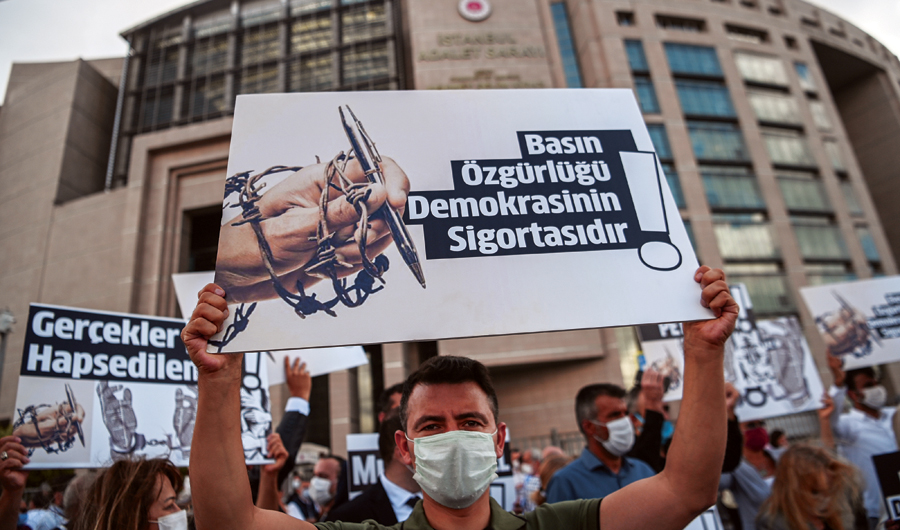
ANKARA: An exhaustive new report published by the joint international press freedom mission to Turkey that took place in October reveals the extent of the country’s crackdown on media freedom in the country and calls for coordinated action from the international community to address the challenge.

The report, entitled “Turkey’s Journalists on the Ropes,” was funded by the EU and supported by 11 international organizations that focus on freedom of speech and human rights.

The mission took place against the backdrop of ongoing targeting of dissident media by the Turkish authorities, increased assaults on journalists critical of President Recep Tayyip Erdogan’s regime, and a newly introduced restrictive social-media law that is likely to further hamper the last remaining bastion in of independent reporting in the country.

The mission’s previous visit to Turkey, in September 2019, focused on the changes in trial proceedings, pre-trial detentions, the abuse of anti-terror laws to imprison dissident journalists, and potential changes that could be brought about by the Judicial Reform Strategy.

At the start of October 2020, 77 journalists were still in prison, one of the highest numbers in any country in the world. This year’s report drew attention to the controversial amnesty law announced earlier this year to ease overcrowding in Turkish prisons, which excluded journalists from its scope.

“Turkey’s press freedom crisis is worsening amid growing state capture of media, the lack of independence of regulatory institutions, and a new social media law designed to clamp down on the remaining spaces for free comment,” the report stated, adding that the lack of judicial independence in Turkey encourages the government’s crackdown on the press.

The report also criticized the new social media law, predicting that it would increase online censorship and cripple critical journalism in a space that had previously been open to the kind of independent reporting stymied by the government’s takeover of mainstream media.

HIGHLIGHT

The report, titled “Turkey’s Journalists on the Ropes,” was funded by the EU and supported by 11 international organizations that focus on freedom of speech and human rights.

One concern about the new law is that it could push companies to comply with the government’s censorship trend by removing content upon request and handing over user data to the highly politicized authorities and courts of the country — opening the way for further arrests of journalists who express dissident views online.

Last year, a total of 61,049 website domains were blocked in Turkey.

The politically motivated targeting of critical broadcasters in Turkey remains a significant problem, with regulatory bodies stepping up fines and broadcast bans on dissident TV channels and threatening to revoke their licenses if they receive a second ban, while pushing for advertising bans on critical newspapers.

“Growing authoritarianism, with the Turkish authorities trying to establish full control over the flow of information, is our main concern. They do this by different means — from jailing journalists to changing legislation to make it more difficult for journalists and media outlets to operate freely in Turkey,” Gulnoza Said, press freedom advocate and head of the Europe and Central Asia Program at the Committee to Protect Journalists, told Arab News.

Between March and August alone, there were 13 incidents of arrest or investigation of dissident journalists reporting on COVID-19 cases. Since the beginning of this year, at least 22 journalists have been arrested.

Their trials are not being held publicly, nor are lawyers permitted to attend the hearings. The authorities claim this is because of the COVID-19 pandemic, but observers have called for the government to uphold the principle of fair trials.

In November, at least 30 press-related trials were held in eight Turkish provinces, with some 40 journalists being prosecuted. Nine of those journalists were accused of insulting state officials.

“The international community must step up its bilateral and multilateral efforts to bring Turkey back into the club of countries that respects the rule of law. Human rights issues, including press freedom, must not be held hostage to geopolitical developments,” the report said.

According to Said, international leverage should still be used, but there are fewer levers now than there were years ago when Turkey aspired to become a member of the EU.

“Today, there is disenchantment with the West — both the EU and the US — in Turkey. That was coupled with the US distancing itself from playing (a central) role in defending democracy and human rights, including press freedom around the world, over the last four years. I hope the new US administration will be more vocal defending free press and independent journalists in Turkey and elsewhere,” she said.

The mission’s report welcomed some positive rulings by the Turkish Constitutional Court concerning the protection of freedom of expression online and offline. “However, lower courts increasingly ignore these rulings; for example, they have refused to lift website blockings in some cases,” the report noted.


Demonstrators hold posters reading ‘Journalism is the insurance of democracy,’ in front of a courthouse in Istanbul, before a trial of jailed journalists. (AFP)
Main category: 
Tags: 

US lawmakers target Turkey in $740bn defense billEU weighs options as Turkey stand-off grinds on


Top diplomats from Jordan and Israel hold rare meeting on Palestine issue

Author: 
Sat, 2020-12-05 00:51

AMMAN: Jordanian Foreign Minister Ayman Safadi has held a rare meeting with his Israeli counterpart to press for the restart of stalled negotiations between the Palestinians and the Jewish state.
Thursday’s meeting came days after Palestinian Authority leader Mahmoud Abbas visited Jordan as part of an Arab tour to raise support for the Palestinian cause after Joe Biden beat Donald Trump in last month’s US presidential election.
During the meeting at the King Hussein (Allenby) Bridge crossing between Jordan and the Israeli-occupied West Bank, Safadi said the creation of an independent Palestinian state was key to ending the conflict with Israel.
“There is no alternative to a two-state solution” between Israel and the Palestinians, he told Israeli Foreign Minister Gabi Ashkenazi, quoted by the official Petra news agency.
“It is necessary to return to the negotiating table according to international law in order to find a real solution to achieve a just peace,” Safadi said.
Thursday’s meeting was a rare encounter between officials from the two countries and the first officially reported between Safadi and Ashkenazi since the latter, a former army chief of staff, become foreign minister in May.
Jordan and Israel have been bound by a peace treaty since 1994, but relations between the two neighbors are often tense.
Safadi said resuming talks between Israel and the Palestinians was timely, “particularly in light of the Palestinian Authority’s decision to resume security cooperation with Israel.”
Last month the Palestinians announced they were restoring coordination with Israel that they had stopped in May over to Israeli plans to annex parts of the West Bank.
Israel put on hold its annexation plans, in return for an agreement to normalize ties with the United Arab Emirates announced in August.
Abbas held talks in Jordan last week with King Abdullah II ahead of visits to Egypt, where he met separately with President Abdel Fattah El-Sisi and Arab League chief Ahmed Aboul Gheit.
During the tour, the Arab leaders he spoke to called for stepped-up international efforts for a solution to the Palestinian-Israeli conflict based on a two-sate solution.
Talks between Israel and the Palestinians have been frozen since 2014, and a US peace plan announced in January has been welcomed by Israel but rejected outright by the Palestinians as biased.
The plan was among moves pushed by Trump — including recognition of Jerusalem as Israel’s “undivided capital” that has angered the Palestinians.
The Palestinians, who want to set up an independent state with east Jerusalem as its capital, broke ties with the Trump administration, and are now hoping to improve relations with Biden’s incoming administration.

This combination of pictures created on December 4, 2020 shows a file photo taken on June 10, 2020 of Israel's Foreign Minister Gabi Ashkenazi (L) during a press conference in Jerusalem and another one dated January 13, 2020 of his Jordanian counterpart Ayman Safadi at a news conference in Jordan's capital Amman. (AFP)
Main category: 

Israeli defense minister calls on Palestinians to return to negotiationsJordan urges Israel to stop undermining peace opportunities with Palestine


Lebanese security services warn of terror plot to destabilize country

Fri, 2020-12-04 22:27

BEIRUT: Lebanon’s security services revealed on Thursday that they had received information regarding a plot to destabilize the country through the assassination of public figures over the coming holiday period.

During a meeting of the Supreme Defense Council, the director-general of Lebanese General Security, Maj. Gen. Abbas Ibrahim, and his counterpart at State Security, Maj. Gen. Tony Saliba, said the information had been obtained from more than one security and intelligence service. They did not reveal the names of those believed to have been targeted for assassination.

Supreme Defense Council meetings are usually confidential, but several local media outlets published reports of Thursday’s meeting the next day, along with a story claiming that Hezbollah had thwarted a plot targeting its leaders, particularly Secretary-General Hassan Nasrallah.

The information revealed in the council meeting included suggestions that the operations could target places of worship, commercial venues and tourist destinations. It also reportedly included details of a smuggling ring that has traditionally operated between Iraq and Syria but that now seems to be widening its reach into Lebanon.

The meeting concluded with a decision to develop a pre-emptive security plan to be carried out during the holiday period.

Also on Friday, Hezbollah filed lawsuits against former MP Fares Souaid and the website of the Lebanese Forces for “accusing Hezbollah of being involved in the Beirut port blast on Aug. 4.”

HIGHLIGHT

Hezbollah files lawsuit against the Lebanese Forces and a former MP, and is preparing to sue Bahaa Hariri.

Ibrahim Al-Mousawi, a member of the Loyalty to Resistance parliamentary bloc, said to the media outside Beirut Justice Palace: “A lawsuit is also being prepared against Bahaa Hariri as well as other lawsuits that will soon be registered based on legal articles condemning those who try to sow discord.”

Al-Mousawi added: “Accusations of Hezbollah’s involvement in the explosion are false and constitute a continuation of the crime. When the real perpetrator is lost and the finger of blame is pointed at a party without any evidence, this conceals the real criminal, misleads public opinion, stirs hatred, incites sedition, and threatens civil peace.”

Souaid told Arab News: “I do not recall directly accusing Hezbollah of the Beirut port blast. It does not matter that the party has resorted to the law to sue me — the most important issue is why it has resorted to the judiciary now, and what is behind the lawsuit?”

He went on to suggest that Hezbollah’s public display of initiating legal proceedings against him could be a ruse to cover up its true intentions.

“Hezbollah’s announcement that it will file a lawsuit against me when I am a permanent political opponent of the party is a step that intersects with security information about possible assassinations in Lebanon,” he said. “Does Hezbollah want to clear its name of any assassinations that might take place in Lebanon by saying that it has resorted to the judiciary to prosecute its opponents? Does the party want to clear its name and tell us that it is not a murderer?”

Charles Jabbour, head of the Lebanese Forces’ Media and Communication Service, said: “We hope that Hezbollah will constantly resort to institutions and the judiciary, and that its commitment to institutions and resorting to the law will be an entry point to hand over its weapons to the state.”

However, former minister May Chidiac, who is affiliated with the Lebanese Forces, described Hezbollah’s move as “rude.” She said: “You have no right to complain before the courts about defamation when everyone knows your crimes. You have no regard for the International Tribunal and consider accusing you of involvement in the port blast a false accusation. You have no shame.”

Meanwhile, the British Embassy in Lebanon released a statement in which the UK Minister of State for the Middle East and North Africa James Cleverly — who just finished a two-day visit to Beirut — said, “The people of Lebanon deserve a better future. Accountability, transparency and taking responsibility are key for Lebanon to rise again.”

He added: “The UK is a proud partner of the Lebanese Armed Forces, Lebanon’s sole legitimate defenders.”

The EU delegation to Lebanon announced in a press conference on Friday the launch of its “Lebanon Reform, Recovery and Reconstruction Framework,” which was prepared by the EU, the UN, and the World Bank Group in response to the Beirut port blast and is intended to be implemented within 18 months.

Najat Rochdi, UN resident and humanitarian coordinator and deputy special coordinator for Lebanon, renewed the call for the formation of a new government that bears responsibility for its people. She added: “We have communicated this to those concerned.”

Hezbollah legal representative Ibrahim Mussawi, right, walks outside the Justice Ministry as he arrives to speak with journalists in Beirut, Lebanon, Friday. (AP)
Main category: 
Tags: 

Lebanon investigates death of former customs officialBusinessman Ziad Takieddine arrested in Lebanon


In Iraq, virus revives traumas of Daesh survivors

Author: 
Fri, 2020-12-04 01:47

BAJET KANDALA CAMP, Iraq: For half a decade, Zedan suffered recurring nightmares about militants overrunning his hometown in northern Iraq. The 21-year-old Yazidi was just starting to recover when COVID-19 revived his trauma.
Zedan had lost several relatives when Daesh stormed into Sinjar, the rugged heartland of the Yazidi religious minority in Iraq’s northwest.
The militants killed Yazidi men, took the boys as child soldiers and forced the women into sexual slavery.
Zedan and the surviving members of his family fled, finding refuge in the Bajet Kandala camp near the Syrian border where they still live today.
“We used to be farmers living a good life. Then IS (Daesh) came,” he said, wringing his hands.
In a pre-fabricated building hosting the camp’s mental health clinic, Zedan shared his traumas with Bayda Othman, a psychologist for international NGO Premiere Urgence. Zedan refers to the violence of 2014 vaguely as “the events.”
The UN says they may constitute something much more serious: Genocide.
“I started having nightmares every night. I would see men in black coming to kill us,” Zedan said, telling Othman that he had attempted suicide several times. He has been seeing her for years, learning how to cope with his Post-Traumatic Stress Disorder (PTSD) through breathing exercises that she taught him.
Earlier this year, his nightly panic attacks stopped. Finally, he could sleep again. But only for a few months.
In March, Iraq declared a nationwide lockdown to try to contain the spread of Covid-19. Zedan broke down.
“I fear that my family could catch the virus or give it to me,” he said. “It obsesses me.”
As lockdown dragged on, Zedan’s brother lost his job at a stationery shop on the edge of the camp.
“There’s no more money coming into the family now. Just thinking about it gives me a panic attack,” he said.
“The nightmares returned, and so did my desire to die.”
Out of Iraq’s 40 million citizens, one in four is mentally vulnerable, the World Health Organization says.
But the country is in dire shortage of mental health specialists, with only three per 1 million people.

HIGHLIGHT

The Daesh extremists killed Yazidi men, took the boys as child soldiers and forced the women into sexual slavery.

Speaking about trauma or psychological problems is widely considered taboo, and patients who spoke to AFP agreed to do so on the condition that only their first names would be used.
In camps across Iraq, which still host some 200,000 people displaced by violence, the pandemic has pushed many people with psychological problems into remission, Othman said.
“We noticed a resurgence of PTSD cases, suicide attempts and suicidal thoughts,” she told AFP.
In October, there were three attempted suicides in Bajet Kandala alone by displaced people, who said their movements outside the camp were restricted by the lockdown, or whose economic situation had deteriorated even further.
A tissue factory who fired people en masse, a potato farm that shut down, a haberdashery in growing debt: Unemployment is a common thread among Othman’s patients.
“It leads to financial problems, but also a loss of self-confidence, which rekindles trauma,” she said.
According to the International Labor Organization (ILO), about a quarter of Iraqis who were employed prior to lockdown have been permanently laid off.
Youth were particularly hard hit: 36 percent of 18-24 years old who had been employed were dismissed, the ILO said.
A new patient in her forties walked toward the clinic, her hair covered in a sky-blue veil.
Once settled in a faux-leather chair, Jamila revealed that she, too, feels destabilized by the pandemic.
The Yazidi survivor lives in a one-room tent with her son and four daughters. But she doesn’t feel at home.
“I have totally abandoned my children. I feel all alone even though they’re always at home. I hit them during my panic attacks — I didn’t know what else to do,” she said.
Othman tried to soothe Jamila, telling her: “Hatred is the result of untreated sadness. We take it out on relatives, especially when we feel devalued — men prey on women, and women on children.”
But the trauma is not just an issue for the displaced, specialists warn.
“With the isolation and lack of access to care, children who have lived a genocide develop difficulties as they become adults,” said Lina Villa, the head of the mental health unit at a hospital run by Doctors Without Borders (MSF) in northern Iraq.
“We fear suicide rates will go up in the years to come.”

Zedan, a patient suffering from post-traumatic stress disorder, is in medical consultation at the mental health center, 430 km from Baghdad. (AFP)
Main category: 
Tags: 

Air strike kills IRGC commander at Iraq-Syria borderRocket hits small oil refinery in Iraq’s north, no casualties -officials