Egyptian security delegation in Gaza to hold talks with Hamas

Author: 
Thu, 2020-12-10 22:40

CAIRO: An Egyptian security delegation has arrived in the Gaza Strip to hold talks with the leadership of Hamas about developments in the territory and the truce understanding with Israel.

Palestinian sources said a delegation from the Egyptian intelligence service arrived in Gaza through the Beit Hanoun checkpoint, which is under the control of Israel, on a visit that would last for several hours.

Hamas spokesman Hazem Qassem said the visit of the Egyptian security delegation was in the context of continuous communications between Hamas and Cairo to discuss many issues, the most important of which is arranging the Palestinian house to achieve reconciliation with Fatah.

“We are interested in achieving reconciliation, and we welcome the Egyptian effort in this issue and we are working to make it a success,” Qassem said.

“The Egyptian delegation is discussing the file of lifting the siege on the Gaza Strip and confirming understanding with those occupying it in light of the disavowal of their implementation, in addition to discussing bilateral relations between Egypt and Hamas,” he said.

“We welcome any international or regional visit that would help lift the siege on Gaza and take over the difficult humanitarian conditions that the residents of the Strip are experiencing due to the ongoing Israeli blockade for 14 years,” he said.

“Everyone is required, whether at the international or regional level, to move toward pressuring the occupation to stop the siege on Gaza, which has worsened in an unprecedented way in light of the spread of the coronavirus.”

Sources said that the issue of the Palestinian reconciliation between Fatah and Hamas was at the top of discussions between the two sides. They said that the Egyptian security delegation also discussed current relations between Hamas and Israel, especially with Israel disavowing its pledges to bring in Palestinian merchants and workers and establish projects to employee youths. This was in addition to discussing the prisoner exchange issue, especially as Hamas had stipulated that Israel release all prisoners of the Shalit prisoner exchange deal who were rearrested by Israel.

Egypt is intensifying its efforts to end the Palestinian division between the Fatah and Hamas movements, and it is also seeking calm between the occupation authorities and the Palestinian movements to defuse the escalation and tension between the two sides.

The last visit of the Egyptian security delegation to the Gaza Strip was on Sept. 10, during which the delegation discussed with Hamas the indirect understandings about the occupation and some common issues between the two parties.

On Aug. 31, Hamas announced that an understanding to contain escalation had been reached with Israel in the Gaza Strip after three weeks of tension.

Egypt is brokering an indirect cease-fire understanding between the Palestinian factions in Gaza and Israel, and also to introduce facilities for the Israeli blockade imposed on the Strip since mid-2007.

Recently intensive talks have taken place between Hamas and Fatah in Cairo headed by Fatah Movement Secretary-General Jibril Rajoub and by Hamas Deputy Head of the Political Bureau Salah Al-Arouri. However, after the Palestinian Authority resumed security coordination with Israel, it led to a communication crisis.

The health crisis in Gaza in recent days due to COVID-19 has led to an increase in contact between mediators, Hamas and Israel.

Palestinian men wear protective face masks in Rafah, Gaza Strip, on Dec. 10, 2020. An Egyptian security delegation visited Gaza on Thursday to hold talks with the leadership of Hamas. (AFP / SAID KHATIB)
Main category: 

Israel strikes Hamas positions after rockets fired from GazaRevealed: How a bank in Turkey funded Hamas terror operations


Israel, Morocco agree to normalize relations in latest US-brokered deal

Thu, 2020-12-10 19:25

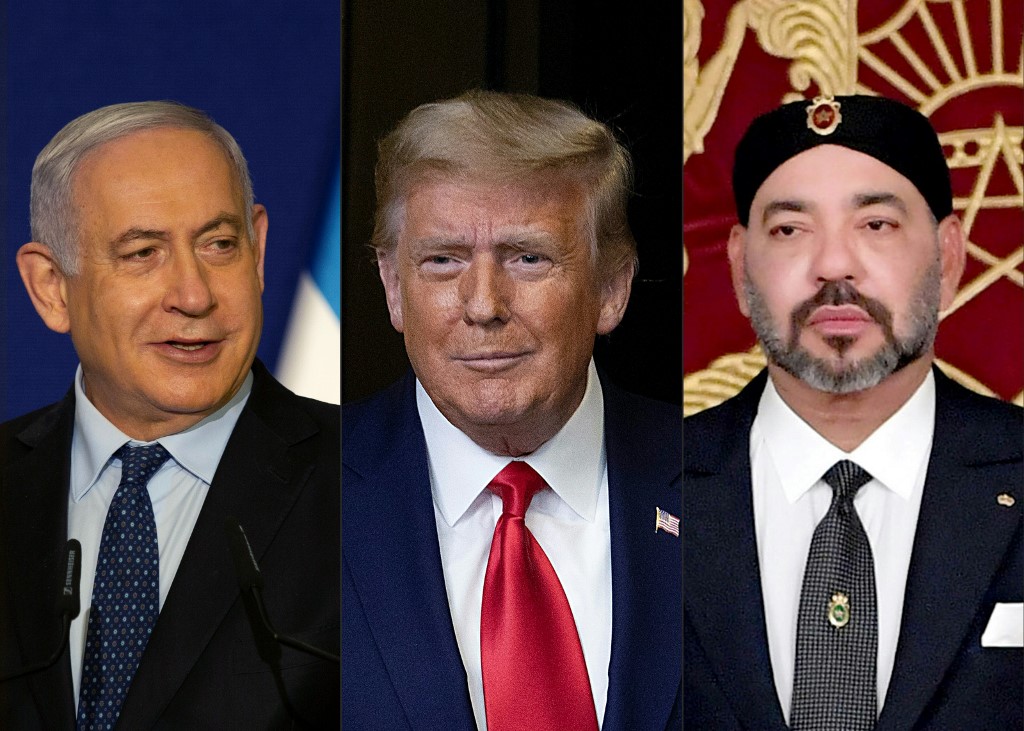
WASHINGTON: Israel and Morocco agreed on Thursday to normalize relations in a deal brokered with US help, making Morocco the fourth Arab country to set aside hostilities with Israel in the past four months.

As part of the agreement, US President Donald Trump changed longstanding US policy and recognized Morocco’s sovereignty over the Western Sahara.

The Western Sahara is a desert region where a decades-old territorial dispute has pitted Morocco against the Algeria-backed Polisario Front, a breakaway movement that seeks to establish an independent state in the territory.

Trump sealed the agreement in a phone call with Morocco’s King Mohammed VI on Thursday, the White House said.

“Another HISTORIC breakthrough today! Our two GREAT friends Israel and the Kingdom of Morocco have agreed to full diplomatic relations – a massive breakthrough for peace in the Middle East!”

Trump tweeted. Israeli Prime Minister Benjamin Netanyahu welcomed President Donald Trump’s announcement of a normalisation deal between Israel and Morocco as an “historic peace between us”. Netanyahu said it would lead to direct flights between Morocco and Israel and that the fourth U.S.-brokered deal between Israel and an Arab country in recent months would be a “very warm peace”.

In a televised address, he said: “I’ve always believed that this historic peace would come. I’ve always worked for it.”

Thanking Trump, he added: “I want to thank, too, the king of Morocco, King Mohammed the Sixth, for taking this historic decision to bring an historic peace between us.”


Morocco is the fourth country since August to strike a deal aimed at normalizing relations with Israel. The others were the United Arab Emirates, Bahrain and Sudan.

Much of the momentum behind the deal-making has been to present a united front against Iran and roll back its regional influence.

Palestinians have been critical of the normalization deals, saying Arab countries have set back the cause of peace by abandoning a longstanding demand that Israel give up land for a Palestinian state before it can receive recognition.

With Trump due to leave office on Jan. 20, the Morocco deal could be among the last his team, led by White House senior adviser Jared Kushner and US envoy Avi Berkowitz, will negotiate before giving way to President-elect Joe Biden’s incoming administration.

Under the agreement, Morocco will establish full diplomatic relations and resume official contacts with Israel, grant overflights and also direct flights to and from Israel for all Israelis.

“They are going to reopen their liaison offices in Rabat and Tel Aviv immediately with the intention to open embassies. And they are going to promote economic cooperation between Israeli and Moroccan companies,” Kushner told Reuters.

Trump’s agreement to change US policy toward the Western Sahara was the linchpin for getting Morocco’s agreement and a major shift away from a mostly neutral stance.

In Rabat, Morocco’s royal court said Washington will open a consulate in Western Sahara as part of Morocco’s deal with Israel.

A White House proclamation said the United States believes that an independent Sahrawi State is “not a realistic option for resolving the conflict and that genuine autonomy under Moroccan sovereignty is the only feasible solution.”

“We urge the parties to engage in discussions without delay, using Morocco’s autonomy plan as the only framework to negotiate a mutually acceptable solution,” it said.

Washington had supported a 1991 ceasefire between Morocco and the Western Sahara’s Polisario Front independence movement that called for a referendum to resolve the issue. Last month, after a border incident, the Polisario pulled out of that deal and announced a return to armed struggle. 

US President Donald Trump announced on December 10 that Morocco is now the fourth Arab state this year to recognize Israel. (AFP/File Photos)
Main category: 
Tags: 

Pompeo: Other Arab countries will normalize relations with IsraelUS official predicts Qatar will eventually normalize ties with Israel


US accuses Houthis in Yemen of ‘behaving like a terrorist organization’

Thu, 2020-12-10 18:10

LONDON: Yemen’s Houthi militia behaves like a terrorist organization and is deepening its relationship with Iran’s elite military units, a senior US official said on Thursday.

The comments came as the US issued new sanctions against Houthi officials for human rights abuses and the Trump administration continued its deliberations on whether to designate the militants as a terrorist group.

The militia sparked the Yemen conflict in 2014 when it seized the capital Sanaa from the internationally recognized government and now controls much of northwest Yemen.

Timothy Lenderking, deputy assistant secretary of state for Arabian Gulf affairs, said he could not comment on internal deliberations about a possible designation, but added: “The Houthis do things that are akin to the behavior of a terrorist organization.”

Speaking at a press briefing for regional media, Lenderking listed the Houthi actions that the US sees as most terrorist in nature and warned that Iran’s Islamic Revolutionary Guard Corps (IRGC) was increasingly helping fund and train the militants.

“They target civilians and civilian infrastructure, they use kidnapping as a tool of war and, if anything, they seem to be deepening their relationship with the IRGC, which from our point of view is a designated terrorist organization,” he said.

Lenderking added that the Houthi’s use of child soldiers, the barring of experts seeking to assess a stricken oil tanker, and the obstruction of aid operations in Yemen were “highly distasteful activities but not specifically terrorist.”

He said these activities would have to stop if the Houthis wanted to be seen as a legitimate political actor inside the country.

Some aid agencies have warned that designating the Houthis as terrorists would further hamper their operations in Yemen, which is suffering one of the world’s worst humanitarian disasters.

Lenderking’s comments come after a flurry of diplomatic activity between the US and Arab Gulf states in recent months.

He said the US is working with Gulf countries to counter the Iranian threat in the region, which includes fueling the war in Yemen.

Officials have also been looking to reassure parties in the region amid concerns that the switch to the Joe Biden administration next month will lead to an easing of the “maximum pressure” campaign against Iran.

Under Donald Trump, the US pulled out of a landmark deal to curtail Tehran’s nuclear program and ramped up sanctions. Many in the region believe the 2015 agreement gave the Iranian regime political and financial muscle to pursue an expansive and aggressive foreign policy across the Middle East.

Biden was a key part of the Barack Obama government that oversaw the deal, known as the Joint Comprehensive Plan of Action, and it is expected he will attempt to revive it.

Responding to Arab News, Lenderking said he could not speculate on how the new administration will tackle the “Iran problem,” but added that any administration would want to see a change in behavior.

“The goal of the Trump administration’s maximum pressure campaign has not been to destroy Iran or bring down the leadership. It has been to try to force a change in behavior,” Lenderking said.

“Any US administration would want to see different behavior from Iran because so much of that we see is very concerning. When you look at their support for various conflicts — I mentioned Yemen — but one could look at Syria, their support for proxy forces in Iraq, I mean all of these areas where Iranian influence has been brought to bear is destabilizing to our interests and also to the region.”

Lenderking also welcomed as “very reassuring” recent signs of an easing of tensions between Qatar and its Gulf neighbors Saudi Arabia, the UAE and Bahrain.

All four countries are key US allies and Washington has been pushing to resolve the dispute, which erupted in 2017 and led to a boycott of Qatar.

Saudi Arabia’s Foreign Minister Prince Faisal bin Farhan hinted at a resolution to the dispute, saying at the weekend that a breakthrough would come “soon.”

“It’s imperative that the GCC unites against regional threats,” Lenderking said.

Main category: 

US sanctions five Houthi figures involved in torturing women, children US announces terror sanctions against Iran’s ‘ambassador’ to Houthis in Yemen


US sanctions five Houthi figures involved in torturing women, children

Thu, 2020-12-10 18:26

RIYADH: The US Treasury has imposed sanctions on five Yemeni citizens and Houthi members  in Yemen said to be involved in torturing women and children. 

The statement said the figures are designated for “seniors human rights abuses.” 

The sanctions were imposed on several officials including Mutlaq Amer Al-Marani, deputy head of the Houthi security office; Abdul Qader Al-Shami, a leader in the Houthi militia;  Abdul Hakim Al-Khawani, head of the security apparatus of the Houthi militia. 

Main category: 
Tags: 


Iran faces UN probe into dissident massacres covered up for 30 years

Thu, 2020-12-10 00:23

JEDDAH: Iran faces a UN investigation into massacres of imprisoned dissidents that the regime in Tehran has tried to cover up for more than 30 years.

Thousands of mainly young people were executed without trial in Iran in 1988, as the war with Iraq was ending. Those killed were mainly supporters of the People’s Mujahedin Organization of Iran (MEK), which had backed Baghdad in the conflict.

A group of seven special UN rapporteurs wrote to the Iranian government to say they were “seriously concerned by the continued refusal to disclose the fate and whereabouts” of those killed.
They demanded a “thorough and independent investigation” and “accurate death certificates” to be provided to family members.
“We are concerned that the situation may amount to crimes against humanity,” the UN experts said. They warned that if Iran continued “to refuse to uphold its obligations” it would face an international investigation.

The UN team wrote their letter in September but it has only now been made public.

Diana Eltahawy, Amnesty International’s deputy director for the Middle East and North Africa, said the letter was a “momentous breakthrough” that sent a message the killings could “no longer go unaddressed and unpunished.”
Amnesty, which described the massacres as crimes against humanity in a 2018 report, wants the UN Human Rights Council to set up an international mechanism to investigate.
Activists say thousands were killed in the executions personally ordered by Ayatollah Ruhollah Khomeini that took place without proper trials inside prisons across Iran from late July 1988. The National Council of Resistance of Iran, the country’s dissident “government in exile,” puts the figure as high as 30,000.
Activists accuse officials who still hold top positions in the Iranian government of being involved in the killings. In its 2018 report, Amnesty said Iran’s judiciary chief Ebrahim Raisi and former interior and justice minister Mostafa Pour Mohammadi took part in so-called “death commissions” that decided the executions.
The issue has remained taboo inside Iran, although in 2016 an audio clip was released of a meeting between Ayatollah Hossein Ali Montazeri, then Khomeini’s designated successor, and the officials on a “death commission.”

The Iranian-American political scientist Dr. Majid Rafizadeh told Arab News the UN intervention was “a step forward toward justice.”

He said:  “For decades, the Iranian regime has tried to systematically cover up one of its greatest crimes. As the regime struggles to curb growing protests and unrest linked to a disintegrating economy, the world must act to prevent future massacres.

“The foundations of the current regime’s power structure, with Ali Khamenei as its head, were built on the 1988 massacre. The world must know that the authorities now in charge of Iran showed their true allegiance and unwavering fealty to the fundamentalist regime and its goals by having no qualms about ordering and implementing one of the greatest political crimes of the 20th century.

“That should be an indicator that the world must side with the Iranian people and their organized opposition, which seek to overthrow the perpetrators of crimes against humanity.”
 

Main category: 
Tags: 

UN experts: Iran must release lawyer Nasrin SotoudehHassan Rouhani: Iran ready for snap return to nuclear deal compliance