Lebanon’s collapse is like the Titanic’s sinking, only without the music — Le Drian

Author: 
Reuters
ID: 
1607890084784916900
Sun, 2020-12-13 19:42

PARIS: French Foreign Minister Jean-Yves Le Drian said Lebanon’s political and economic collapse was like the sinking of the Titanic, only without the music.
“Lebanon is the Titanic without the orchestra,” Le Drian told the daily Le Figaro in an interview published on Sunday. “The Lebanese are in complete denial as they sink, and there isn’t even the music.”
Le Drian’s remarks set a pessimistic tone a little over a week before President Emmanuel Macron makes his third visit to Beirut since a massive port blast destroyed swathes of the city and killed 200 people in August.
Macron is losing patience with Lebanon’s politicians as rival politicians mired in turf battles stand in the way of sweeping reforms that donors say are imperative for badly-needed financial aid to be released.
It is believed the Titanic’s orchestra kept playing for as long as it could as the liner went down in the Atlantic Ocean in 1912, trying to help keep passengers calm amid impending doom. All the musicians perished.

Main category: 

Lebanese judge charges caretaker PM Diab, ex-ministers over Beirut port blastEvents in Beirut expose public distrust of Lebanese authorities


Egypt, Jordan and Iraq discuss peoples’ movement by land

Author: 
Sun, 2020-12-13 22:19

CAIRO: The 75th General Assembly of the Arab Bridge Maritime Company, held on Saturday in Cairo, brought together transportation ministers from Egypt, Jordan and Iraq to discuss the establishment of a means to transport passengers by land between the three countries. The meeting was attended by Egyptian Minister of Transportation Kamel Al-Wazir, his Jordanian and Iraqi counterparts and the company’s board of directors.

During the meeting, they discussed organizing the movement of passengers by land between their respective countries, whether through the establishment of the Arab Bridge Land Transport Company or through the integration of already existing land transport companies with the Arab Bridge Maritime Company. The goal is to reach a model system that would facilitate the transportation of passengers between the three countries with a unified ticket.

The general assembly reviewed the technical condition of the maritime company’s ships, the effects of the pandemic on the company’s activity, recent business and financial results, as well as mechanisms that have been employed to ensure the continuity of the company’s activity, which represents an important trade link between Egypt, Jordan and Iraq.

The Egyptian minister said that the directives of the political leadership in Egypt are always based on increasing cooperation and trade exchange between Egypt, Jordan and Iraq. He pointed out that the Arab Bridge Maritime Company represents a pioneering model for cooperation between Arab countries in the field of transport.

Al-Wazir praised the company’s role in enhancing intra-Arab trade and increasing the volume of Arab-Asian-African trade exchanges. Among the points discussed during the meeting was how to ease procedures for the entry of goods, drivers and travelers in order to help smooth the trade movement. The Jordanian minister of transportation affirmed that this would help achieve economic integration between the three countries.

Main category: 
Tags: 

Egypt, Iraq move forward with oil-for-reconstruction planTop diplomats from Jordan and Israel hold rare meeting on Palestine issue


Erdogan’s recitation of ‘sensitive poem’ angers Tehran

Author: 
Sun, 2020-12-13 21:58

JEDDAH: The latest row between Turkey and Iran over the controversial poem that was recited by President Recep Tayyip Erdogan during his visit to Azerbaijan continues to escalate.

Iranian lawmaker Ali Asgar Hani threatened the Turkish president by posting a picture of Saddam Hussein hanging on Twitter with the caption: “Mr Erdogan, this was the fate of the last person who coveted Iranian land.” The image was later deleted.

On Saturday, Ankara reprimanded Tehran for “offensive language” aimed at Erdogan about the poem, that refers to Iran’s northwestern provinces as belonging to Azerbaijan. Tehran considers some verses of the poem as promoting separatist ideas among Iran’s Azeri minority.

Ethnic Azeris, who speak Turkish, live in Iran’s three northwestern provinces of West Azerbaijan, East Azerbaijan and Ardabil.

The disagreement added another layer to an already tense relationship between the two countries, whose geopolitical interests clash in several Middle Eastern countries.

Iran is concerned with Azerbaijan’s recent victory in Nagorno-Karabakh over Armenia, as it fears an Azeri awakening within Iran, and views Turkey as a regional competitor.

“They didn’t tell Erdogan that the poem he ill-recited in Baku refers to the forcible separation of areas north of Aras from the Iranian motherland,” Iranian Foreign Minister Mohammad Javad Zarif tweeted.

In the meantime, Iran’s Foreign Ministry said on its website on Friday: “The Turkish ambassador was informed that the era of territorial claims and expansionist empires is over.”

Iranian authorities also summoned the Turkish ambassador to Tehran to protest about Erdogan’s “interventionist and unacceptable remarks.” Turkey retaliated by summoning the Iranian ambassador to Ankara over the “groundless” claims.

Turkish Foreign Minister Mevlut Cavusoglu also called his Iranian counterpart on Saturday to criticize the “heavy statements aimed at Erdogan,” calling them unacceptable.

Erdogan’s communication director, Fahrettin Altun, condemned Tehran’s use of “offensive language” over the “emotional poem, whose meaning has been deliberately distorted.

“It does not include any references to Iran. Nor is that country implied in any way, shape or form,” he added. Some experts believe the spat will soon blow over.

“The recent controversy over a poem recited by Turkey’s president as part of aggressive victory celebrations in Baku appeared to lead to Iranian concerns that Ankara was stoking ‘expansionist’ ideas,” Seth J. Frantzman, executive director of the Middle East Center for Reporting and Analysis, told Arab News.

“However, the controversy was quickly patched up and even Iran’s foreign minister was quickly excusing the Turkish leader’s comments, claiming he simply was not informed about the poem’s origins. It shows that the real desires of Tehran and Ankara are to cultivate a closer working relationship, including between each other and Russia,” he added.

“Clearly, Iran and Turkey’s current leadership value each other and do everything possible not to cause any missteps. This can be seen in the warm embrace that Iran receives whenever there are official visits,” he said.

“Turkey’s ruling party, which tends to use bluster and threats against other countries in the region, such as Egypt, Israel, the UAE and Greece, is quick to not condemn Iran, and to work towards (an) amicable understanding with Tehran,” Frantzman added.

“The overall assessment of the Erdogan government is that Iran is a partner in the region, and that more authoritarian regimes, that jail journalists, can work together against Europe, the West, and moderate states in the southern part of the Middle East.”


Main category: 
Tags: 

Turkey rebukes Iran’s ‘offensive language’ against ErdoganIran summons German, French envoys after Ruhollah Zam execution outrage


Iran jails British-Iranian researcher Kameel Ahmady for 9 years

Author: 
Reuters
ID: 
1607886201954593900
Sun, 2020-12-13 18:52

DUBAI: A court in Iran has handed a nine-year jail sentence to British-Iranian anthropologist Kameel Ahmady, after convicting him of conducting “subversive” research work, the semi-official news agency Tasnim said on Sunday.
Ahmady was also fined 600,000 euros ($727,000) — the sum Iranian authorities said he received for his research from institutions accused of seeking to topple Iran’s Islamic government, Tasnim reported.
There was no immediate official confirmation of the sentence, which was also reported by other Iranian news agencies and a human rights groups.
“Ahmady was accused of acquiring illicit property from his cooperation in implementing subversive institutions’ projects in the country,” Tasnim said.
Ahmady, an ethnic Kurd who had researched controversial issues such as child marriage and female genital mutilation (FGM) in Iran, was detained in August 2019 but released on bail three months later, according to human rights groups.
After his arrest, his wife told the New York-based Center for Human Rights in Iran that his work was independent and published with government approval.
Rights activists have accused Iran of arresting dozens of dual nationals to try to win concessions from other countries — a charge that the Islamic republic has regularly dismissed.

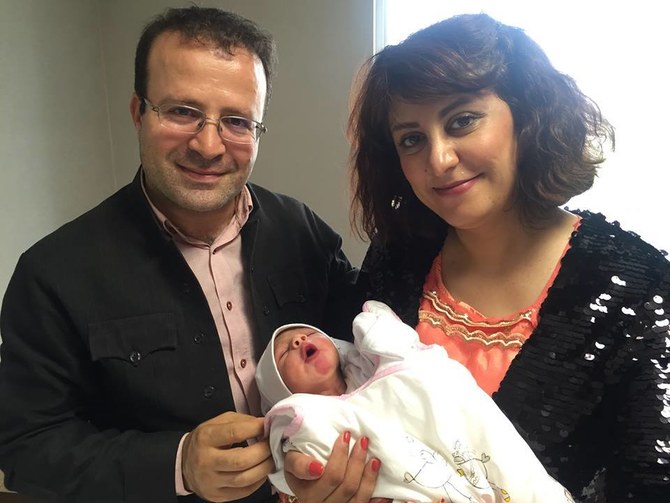
Kameel Ahmady was convicted for conducting “subversive” research work. (Photo/Kameel Ahmady Facebook account)
Main category: 

Iran arrests British-Iranian academic Kameel AhmadyIran summons German, French envoys after Ruhollah Zam execution outrage


Bigger role for Arab women urged in scientific research and innovation

Author: 
Sat, 2020-12-12 23:56

DUBAI: When the pandemic is finally defeated, the scientists who devised vaccines in record time will no doubt be hailed as the paladins of coronavirus prevention. So too will the tech experts who through the lockdowns helped move jobs and infrastructure into the digital space. There will be no shortage of heroes, but can the same be said about heroines?

In spite of recent progress, women remain a minority in the science, technology, engineering and mathematics (STEM) professions, especially in the Middle East and North Africa (MENA). Now experts in the region are calling on schools, governments and employers to do more to fix the imbalance.

Speaking during a recent L’Oreal-UNESCO For Women in Science webinar, in partnership with the speakers’ platform She Is Arab, experts from across the Gulf stressed the central role women have to play in research and innovation.

“I can see the passion in women in science,” said Dr. Maha Al-Mozaini, an infectious diseases specialist and educator at King Faisal Specialist Hospital and Research Center in Saudi Arabia. “It’s changing dramatically and quickly, and I believe they can bring a brighter future.”

According to 2018 figures from the UNESCO Institute for Statistics, just 28.8 percent of the world’s researchers are women. Female enrolment in engineering, manufacturing and construction courses stands at just 8 percent worldwide, while in natural sciences, mathematics and statistics it is 5 percent. For information and communications technology (ICT), the figure drops to a paltry 3 percent.

“These numbers are alarming,” said Dr. Anna Paolini, director of the UNESCO Office in Doha and representative for the Gulf and Yemen. “They call for action to close the gender gap in science, technology and innovation and equip the future generation with adequate skills and competencies, and harness the power of emerging new technology, such as artificial intelligence, robotics, virtual reality, and augmented reality, just to name a few.”

In these unprecedented times of disruption, particularly in education where 1.5 billion students have missed out on learning, Paolini says the contributions of men and women to the sciences, technology, problem-solving and decision-making cannot be underestimated.

“Research and innovation are catalysts for achieving our goals to live on a healthier, sustainable and prosperous planet,” Paolini said. “However, the world urgently needs more scientists to tackle the global challenges we are facing today. And we cannot afford to let half of the world’s population, which are women, go unnoticed behind their remarkable achievements.”

THENUMBER

28.8%

* Proportion of the world’s researchers who are women (UNESCO).

Female teachers, doctors, nurses and researchers have all been at the forefront of the battle against COVID-19. In the case of Al-Mozaini’s team in Saudi Arabia, a remarkable 99 percent of her researchers are women.

“When I advocate for women’s empowerment in STEM, the challenges that we face as women are different from country to country,” said Al-Mozaini, who is a winner of the L’Oreal-UNESCO for Women in Science Middle East Regional Young Talents Program.

“We have seen that, in the United States, the numbers of graduate women in science are there but they tend to decrease in the workforce. In our case, it is very promising. We only have one man on the team.”

Many factors have contributed to their success, including career support from their families, Al-Mozaini said. “So, we have advantages compared to other countries in the Middle East, and especially in the GCC,” she said.

“They all come from different backgrounds, from molecular biology and genetics to virology and immunology. They were working 24/7 during the lockdown, leaving their families behind. And because little was known about the virus, we all had to take precautionary measures to protect our families.”

The work was arduous. Early in the pandemic, the Saudi research center had to spread its resources across many different aspects of the outbreak. “Our team, which was (focused on the) immunocompromised, was trying to establish testing, because the early signs of the virus showed that it was transmitted at very high levels,” she said. “So, in order to stop the cycle of the virus spreading, you needed to do testing.”

“We cannot afford to let half of the world’s population, which are women, go unnoticed behind their remarkable achievements.”

Dr Anna Paolini, UNESCO representative for GCC and Yemen

Their efforts involved establishing a mode of in-house viral testing as a back-up diagnostic test. “The test is very sensitive, reliable and fast,” Al-Mozaini said. “Best of all, in developing and low-income countries that don’t have the opportunity to get these expensive kits; they can use our protocol and do the testing.”

Al-Mozaini is heartened to see a growing number of women in the Gulf entering the sciences. Women in the Middle East now account for almost half of the total STEM student population and they will no doubt play a prominent role in the post-pandemic world.

In the UAE, 61 percent of university students in the field are women, 71 percent in Oman and 55 percent in Bahrain. However, women are still underrepresented in the research community. Although 38 percent of Saudi graduates in the field are women, only 17 percent of them work in STEM sectors.

Al-Mozaini says the best way to support women entering careers in science is to provide them with appropriate mentorship and good role models. “We, as scientists, should give that to younger generations,” she said.

“I pursued STEM because I was exposed to it early in my schooling. I had a really nice professor who was retired and teaching biology at school, and he inspired us. So that gives you good mentorship and role models and exposure to STEM.”

In September, the Organization of Islamic Cooperation (OIC) discussed plans to step up the provision of STEM education for women and girls at a meeting in Jeddah. During a virtual workshop, members of the OIC’s general secretariat looked at ways of improving access to learning for women and girls in member countries.

In the host country of the OIC, Saudi Arabia, women’s participation in the workforce and the wider economy and having more women in leadership positions is one of the key goals of the Vision 2030 reform strategy. A growing number of Saudi women are already holding high-ranking positions even as new government policies aim to increase the employment of women in all fields.

Al-Mozaini says Saudi Arabia and the GCC countries at large are fortunate, thanks to a strong support system at various levels of education, including scholarships.

“In the workforce, we need to create the right environment for them,” she said. “They are mothers, they have kids, so they need to have the best childcare system within their working institute to leave their kids and go to work.

“They need to have the best mentorship program at an early age and most important of all is providing them with a leadership opportunity, and this is why the Vision 2030 of Crown Prince Mohammed bin Salman is promoting women in leadership.”

For Paolini, the key to promoting women in science is inspiring girls at school and in the home. “It really shaped all of us,” Paolini said. “We all have a story that inspired how we are today and this is why this network and platform are so important.

“Everywhere in the world, we need more science and we need more women in science.”

————-

Twitter: @CalineMalek

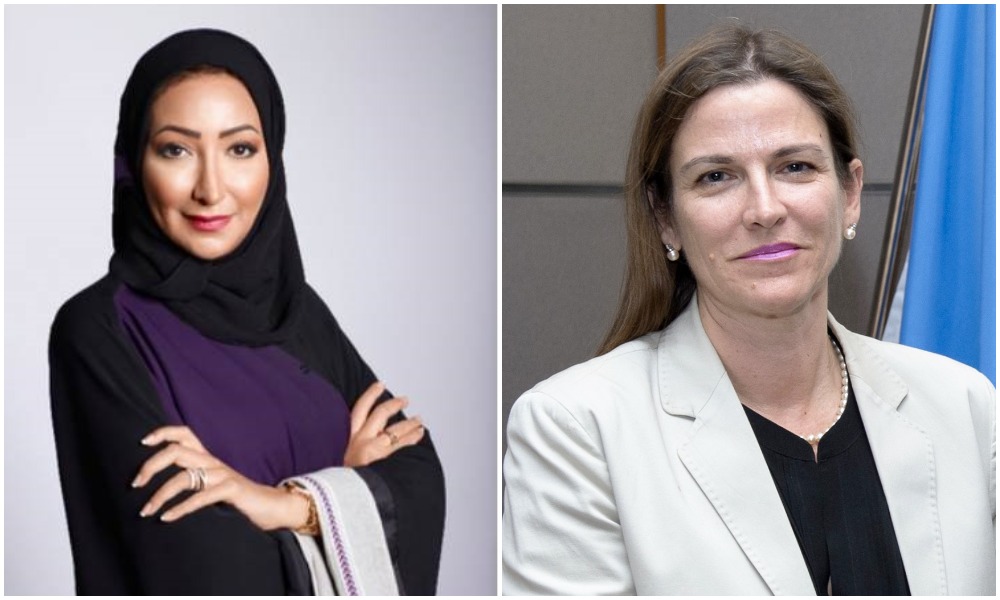
Speaking during a recent L’Oreal-UNESCO For Women in Science webinar, in partnership with the speakers’ platform She Is Arab, experts from across the Gulf stressed the central role women have to play in research and innovation. Left: Dr. Maha Al-Mozaini. Right: Dr. Anna Paolini. (Supplied)
Main category: 

Women in Saudi Arabia are reaping rewards of reforms, envoy tells UNSaudi Arabia’s Hadaf to train 1,200 women in beauty businessWusool transport program extends support for women in Saudi ArabiaOIC discusses ways to empower women in STEM education