Israel’s Netanyahu, top US military discuss Iranian threat

Author: 
Fri, 2020-12-18 23:34

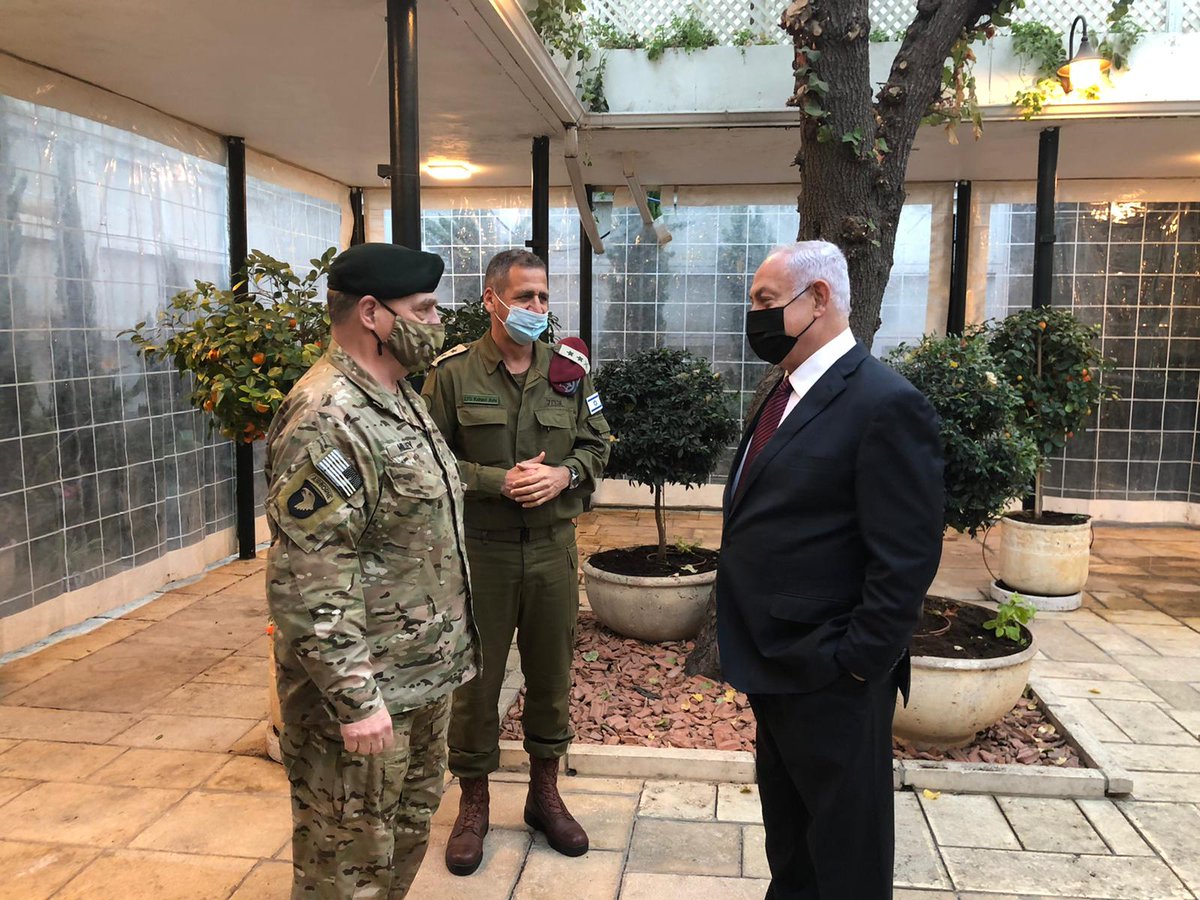
LONDON: Israeli Prime Minister Benjamin Netanyahu met Gen. Mark Milley, chairman of the US joint chiefs of staff, on Friday to discuss regional threats, especially Iranian aggression.
They also “discussed the ongoing military cooperation between the two countries and the opportunities that currently lie in the region,” Ofir Gendelman, the premier’s spokesperson, told the Arab media.
Netanyahu thanked Milley for the military cooperation, which has deepened in recent years, and expressed his desire to continue to deepen it, Gendelman added in a tweet.
Earlier on Friday, Netanyahu held a video conference with Milley, who is currently on a two-day visit to Israel.
The top army official said “on behalf of the entire US military, we thank Israel for their strong commitment to our partnership.”
Milley is on a whirlwind world tour, visiting Saudi Arabia, the UAE and Afghanistan to discuss the threats from Iran.
On Friday he met Defense Minister Benny Gantz, where they stressed the importance of continued pressure on the Iranian regime to halt its nuclear program.
“During the meeting, they (also) discussed the challenges and different changes in the operational situation in the Middle East,” the defense minister’s office said.
During his visit, Milley also met the Israeli Defense Forces (IDF) Chief of Staff Aviv Kohavi and other defense and military officials.

Israel’s Prime Minister Benjamin Netanyahu meets Gen. Mark Milley, chairman of the US joint chiefs of staff in Tel Aviv, Israel on Dec. 18, 2020. (Twitter/@ofirgendelman)
Main category: 

Netanyahu: ‘Business as usual with Iran’ will be mistakeIran builds at underground nuclear facility amid US tensions


Algerians impatient for change with president still out sick

Fri, 2020-12-18 23:18

ALGIERS: Algerian President Abdelmadjid Tebboune’s first appearance since being hospitalized in Germany with COVID-19 in October was intended to reassure a country where big political decisions are long overdue.
But on the streets of Algiers, people voiced growing impatience after the five-minute video message he gave on Sunday saying he would still be away for up to three weeks.
“Most of our demands are still awaiting a response,” said Ahmed Abbachi, a member of the leaderless protest movement known as Hirak.
The major energy producer has been in turmoil since early last year when mass protests pushed the old president, Abdelaziz Bouteflika, from power along with many of his clique, but left much of the ruling elite at the helm.
The period of unrest, and this year’s pandemic, have delayed Algeria’s efforts to address systemic frailties looming over the economy as declining oil and gas revenue threaten lavish social spending.
The 75-year-old, a heavy smoker, appeared gaunt in his video message, the first sight that Algerians had had of their president since he went to Germany.
The absence of any photographs or videos spurred rumors that his condition was worse than the official news bulletins proclaiming his good health were letting on.
It reminded many Algerians of the long years when Bouteflika was incapacitated by illness, leaving the government largely rudderless while rival power blocs in the ruling elite jostled for influence.

HIGHLIGHT

The absence of any photographs or videos spurred rumors that his condition was worse than the official news bulletins proclaiming his good health were letting on.

“Bouteflika was completely unable to speak, to walk, and we were told over and over again that he was capable of leading the country,” said plumber Antar Aissaoui, before Tebboune’s video appearance.
The president will have a full in-tray when he finally returns to Algiers. The government is pushing a program of economic reforms seen as necessary to avert a looming fiscal crunch after burning through more than half its foreign currency reserves in five years.
The Hirak street protest movement remains unconvinced by Tebboune’s efforts to turn a page on last year’s unrest.
While demonstrations have not taken place since a COVID-19 lockdown began in March, the referendum he pushed in November on constitutional changes had turnout of only a quarter of registered voters.
“Algeria faces one of the most difficult periods of its history. Threats are surrounding us from all directions,” said schoolteacher Rachid Chalabi, referring to the internal political crisis, looming economic threats and conflicts in neighboring countries.
“Tebboune will face his biggest challenges after recovering. Everything indicates that the path to stability is still long,” said 37-year-old engineer Djamel Taibi.

Main category: 
Tags: 

Thousands hit streets of Algiers on protest movement anniversaryNeighbours to meet in Algiers on Libya crisis


Turkey’s promise to send weaponry to Somali draws criticism

Fri, 2020-12-18 22:53

ANKARA: Somalia’s opposition has urged Ankara not to send a shipment of weapons to a special police unit because they fear that Somali president could use them for “rigging” the approaching national elections. The call has put Turkey’s engagement in a country torn apart by civil war for decades under the spotlight.

Opposition candidates wrote to Turkey’s ambassador in Somalia and expressed their concern about these weapons coming into the country in such a “sensitive election period.”

Turkey trained Harama’ad police, a special Somali unit that is known for its violent suppression of peaceful protests in the Horn of Africa country.

On Dec. 15, four protesters were wounded in Mogadishu during a peaceful protest when the troops opened fire on them, while two others were arrested. The Council of Presidential Candidates condemned the use of live bullets by the Harama’ad forces against Somali people.

Ankara is planning to send 1,000 G3 assault rifles and 150,000 bullets to Harama’ad this month.

The opposition was already furious after the elections due for this month were postponed over political disagreements.

“With the national elections approaching, a season for foreign meddling is wide open,” said Jędrzej Czerep, senior analyst at Middle East and Africa Programme of the Polish Institute of International Affairs (PISM).

“For Turkey, in the last decade Somalia’s most visible and dedicated development and humanitarian partner, the game is about not losing its primacy before the oil concessions are divided,” he told Arab News.

SPEEDREAD

Opposition fears it will be used by special police forces to control forthcoming elections in the war-torn country.

Ankara has not commented yet on the Somalia opposition’s call but in recent years Turkish rulers have deepened their engagement in the African country by building infrastructure and providing scholarships for Somalis.

Three years ago, Turkey opened its biggest overseas military base in Somalia to have a military leverage in hotspots in the region. Apart from its forward-basing, Ankara also trains Turkish-speaking Somali soldiers and has transferred tactical arms to the arsenal of Somali military.

“In the run-up to elections, Somali President Mohamed Abdullahi Farmajo adopted an all-or-nothing mode to consolidate power. This affected growing politicization of the – theoretically neutral and professional – Turkish-trained Gorgor troops and Harama’ad police units,” Czerep said.

Separately, the United States recently decided to withdraw hundreds of troops deployed to fight Al-Shabab terrorists in Somalia, which has been torn by a nearly 20-year civil war.

According to Czerep, while the US-trained Danab forces had been on the front lines of the fight against Al-Shabab throughout 2020, Gorgor and Harama’ad were probably more often used against the opposition in the federal member states.

“Their deployment in Galmudug in February affected the climate of the local elections in that state and it was boycotted by the opposition,” he said. “Turkish-trained troops also clashed with Ahlu Sunna Wal Jamaa, a Sufi militia who was a key government ally against Al-Shabab but apparently grew too strong. In Gedo, Gorgor and Harama’ad fought against forces of the Jubaland region, which the central government wants to pacify.”

Main category: 
Tags: 

YouTube falls in line with ‘draconian’ social media law, opens office in TurkeyTurkey quits more observation posts in Syria’s Idlib


Lebanese patriarch in talks to break political deadlock

Fri, 2020-12-18 22:02

BEIRUT: Lebanon’s leading Christian cleric has intervened in a last-ditch bid to break the stalemate over the formation of a new government in the country, warning that the Lebanese are “hungry and losing hope.”

The move by Maronite Patriarch Bechara Boutros Al-Rai follows a series of fruitless meetings between President Michel Aoun and Prime Minister-designate Saad Hariri that have failed to resolve the political impasse despite a mounting economic crisis and appeals from the international community.

More than a week has passed since the 13th meeting between the two political rivals with Hariri yet to receive a response from Aoun on the proposed Cabinet lineup of 18 ministers he had submitted.

Al-Rai, the highest spiritual authority in the Maronite community, visited Aoun on Friday, a day after Hariri held talks with the patriarch. The cleric then met with the head of the Free Patriotic Movement (FPM), Gebran Bassil, who faces accusations of obstructing the formation of the government by insisting on naming Christian ministers.

Bassil said after the meeting: “When there is an intention to adopt the same standards, the government will be formed.”

However, a source close to Hariri told Arab News that the FPM leader “is holding on to the obstructing third in the Cabinet, and this means the government will not be formed in the near future.”

Speaking at Baabda Palace, the president’s residence, Al-Rai said that a final understanding between Aoun and Hariri was urgently needed.

“The Lebanese people are hungry, unemployed and without hope or confidence. They cannot bear it anymore,” he warned.

The senior cleric added: “People in Beirut are suffering as a result of the Aug. 4 (Beirut port) explosion, and this is a fundamental reason for us to have a government — an executive authority that shoulders its responsibilities. It is one of the constitutional institutions that must be in place. We cannot continue with a caretaker government that might last for six months because the country is paralyzed.”

SPEEDREAD

The move by Maronite Patriarch Bechara Boutros Al-Rai follows a series of fruitless meetings between President Michel Aoun and Prime Minister-designate Saad Hariri that have failed to resolve the political impasse

Al-Rai said that the region’s future is “hanging in the balance.”

“If there are solutions, Lebanon cannot be absent, and if there are no solutions, Lebanon cannot continue to bind itself to others. If there is war, we must also have a government that knows how to think and act. The door to all institutions is the government. Lebanon cannot live like this while it loses its institutions one after the other,” he said.

During their meeting on Thursday Hariri outlined to Al-Rai the circumstances related to forming a new government, saying that the Cabinet lineup suggested to Aoun includes 18 names of non-partisan specialists.

“These are people of integrity and competence who are able to carry out the agreed reforms,” he said.

Hariri told the patriarch that “the goal is not to form a government as we agree, or for me to be the prime minister. The goal is to stop the collapse and rebuild Beirut. This can only be achieved by undertaking the reforms agreed upon to restore the flow of funds to Lebanon.”

After his meeting with Al-Rai, Bassil said: “The discussion took place against the desire for having a government, and we agreed on all issues and the need to form the government quickly. To this day, we have not set any condition or demand except to deal equally and form the government on the basis of the constitution and national consensus.”

Al-Mayadeen TV reported on Thursday that a virtual meeting between Bassil and Hezbollah chief Hassan Nasrallah focused on “developing the existing understanding between the two sides.”

Lebanon was pinning its hopes on a scheduled visit by French President Emmanuel Macron next Tuesday to accelerate France’s initiatives regarding the formation of a rescue government.

However, Macron’s positive test for coronavirus led to the postponement of the visit and, with it, any hopes for an end to the government crisis in the next two weeks.
 

Main category: 
Tags: 

Turkey will not step back on S-400 missile systems despite US sanctionsTurkey, Iraq draw closer over terror threat


Protests against detention of Lebanese activist Kinda Al-Khatib

Fri, 2020-12-18 00:16

BEIRUT: The Lebanese Army formed a tight security cordon around the vicinity of the Military Court in Beirut on Thursday as family and friends of Lebanese activist Kinda Al-Khatib protested outside. On December 14, Al-Khatib was sentenced to three years in prison with hard labor and the removal of her civil rights for collaborating with Israel.

The protesters carried pictures of activist Al-Khatib and banners quoting her anti-Hezbollah stance, including: “There is no weapon but Lebanese weapons.” The protesters allege that Al-Khatib’s sentence is politically motivated “because she revolted against the dictatorship of the ruling authority and parties in power.”

Al-Khatib’s attorney, Joceline Rahi, said Al-Khatib would appeal her sentence, adding that her client is innocent of any crime.

Al-Khatib said in her testimony that a person called Roy Qaisi had contacted her on Twitter, saying he was a journalist working for Israeli Channel 11, and that when she found out he was Israeli, she informed the Lebanese security forces.

Asked why she had not blocked him, Al-Khatib said she believed her phone would be “under security surveillance,” and that there was nothing suspicious about her. All her accounts were public, she added.

Al-Khatib denied travelling to Israel, meeting with any Israelis, or providing Israel with any security information.

On Wednesday the Permanent Military Court, headed by Brig. Gen. Munir Shehadeh, issued two sentences in absentia against the famous singer Fadl Shaker, sentencing him to 22 years in prison with hard labor and stripping him of his civil rights.


Singer Fadl Shaker sentenced to 22 years in prison with hard labor for ‘involvement in acts of terrorism’

The first ruling sentenced Shaker to 15 years in prison for “involvement in acts of terrorism committed by terrorists with his knowledge by providing logistical services to them.” The second ruling sentenced him to seven years in prison and fined him 5 million Lebanese pounds for financing Ahmed Al-Assir’s militant group.

Shaker was sentenced in 2017 to 15 years in prison with hard labor as part of the sentences against Ahmed Al-Assir for the Abra battles of 2013. Al-Assir and his supporters in Sidon had fought at the time against the Lebanese Army.

Shaker has been in hiding since, but has spoken several times to the media to claim that he was innocent. If Shaker surrenders himself to the judiciary, he will be retried while present at the trial.

Meanwhile, Judge Fadi Sawan, the judicial investigator in the Beirut port blast, suspended all investigations related to the case for a period of 10 days, pending the ruling of the Court of Cassation after two former ministers, Ghazi Zaiter and Ali Hassan Khalil, refused to appear before him and requested his removal from the case after Sawan accused them of negligence and causing the deaths of dozens.

On the same day, a delegation of the victims’ families met with Interior Minister Brig. Gen. Mohammad Fahmy to demand that the case not be politicized.

In a new scandal linked to Beirut port, the Lebanese army has discovered around 700 containers that have been in the port since 2005 and have no identifying documents or description of their contents. The Ministry of Finance has decided to have those containers inspected by the army and the customs authority.

French President Emmanuel Macron had called off his scheduled visit to Lebanon next week, having tested positive for COVID-19.

Hossam Zaki, Assistant Secretary-General of the League of Arab States, visited Lebanon on Thursday and met with several of officials. He said that resolving the political and economic complications facing Lebanon was the responsibility of Lebanese officials “because the Arab League will not be a substitute for any Lebanese party, but it will be a supportive party if the Lebanese desire.”

Kinda Al-Khatib was arrested in June and charged with “collaborating with the enemy.” (Twitter)
Main category: 
Tags: 

Lebanon jails activist Kinda Al-Khatib for ‘collaborating’ with IsraelLebanon to get first batch of COVID-19 vaccines in two months, minister says