EU welcomes formation of Yemeni government, praises role of Saudi Arabia
Author:
Zaynab Khojji
ID:
1608410431208398900
Sat, 2020-12-19 23:39
LONDON: The EU welcomed the formation of a Yemeni government on Saturday and praised Saudi Arabia’s efforts to achieve the Riyadh Agreement.
“The announcement of a new Yemeni government within the framework of implementing the Riyadh Agreement is a positive step toward a comprehensive political solution for the country,” a spokesperson for the European External Action Service said.
The new government will face difficult tasks and it will need to take important and courageous decisions for the sake of Yemen and all of its people, the spokesperson added.
The spokesperson stressed the importance of having more women in political positions and the effective participation of women in governance.
“The EU appreciates facilitation efforts made by Saudi Arabia, and encourages all actors to ensure the prompt and full implementation of all stipulations of the Riyadh Agreement,” the European spokesman said.
France also praised the role played by the Kingdom to facilitate the Riyadh Agreement and implement it.
A statement issued by the foreign ministry said that the formation of a new government in the war-torn country is an important step that would contribute to preserving Yemen’s unity and territorial integrity.
The ministry stressed the importance of ending the conflict in Yemen which requires a cessation of hostilities and the resumption of discussions under the auspices of the UN to reach a comprehensive political agreement.
Implementation of Riyadh Agreement praised, raises hopes of ending Yemen conflictYemen will fight corruption and currency woes, says prime minister
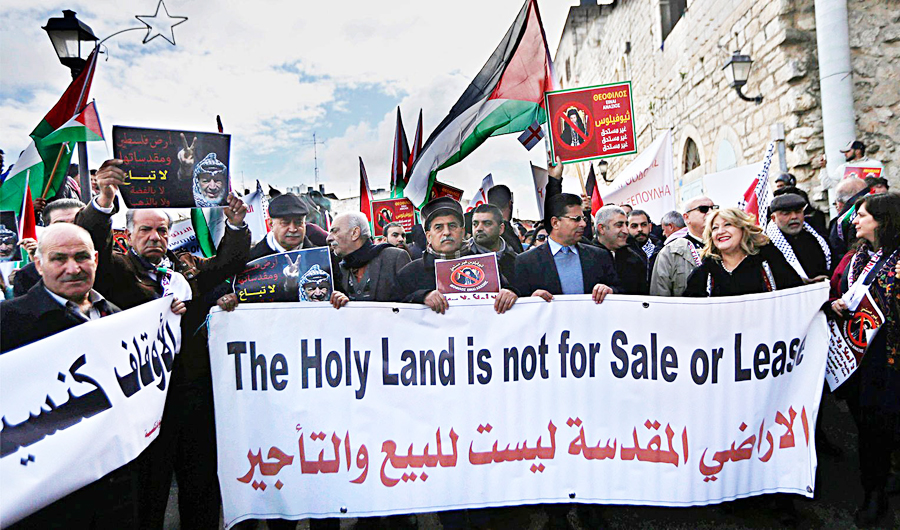
Armenian church leasing land to Israelis causes Palestinian worry
Author:
Sat, 2020-12-19 23:21
AMMAN: A previously unknown agreement to turn sensitive land in the old city of Jerusalem into a parking lot — largely for the exclusive use of Jewish residents of the old city — is causing concern for the Palestinian leadership and members of the tiny Armenian community.
The contract, a copy of which is with Arab News, will take effect on Jan. 1, 2021.
Officials of the Armenian Patriarchate confirmed the agreement but insisted that the contract with the Israeli Jerusalem municipality and the Jewish-centric Jerusalem Development Authority (Harali) does not constitute selling or leasing land but is simply a financial operation.
The Armenian Patriarchate said that removal of all earth from the plot of land, which will cost about $2 million, was “a financial obligation that the Patriarchate by itself doesn’t have the capacity to undertake,” according to a statement by the real estate department of the Armenian Patriarchate. The statement said that efforts to get support from “multiple governmental bodies” had run “into obstacles.” In return, the municipality and Harali will have access to 90 parking spots.
But the five-page contract notes (Article 2a) that the cost of lifting the rubble will be considered “a loan” that the church will have to pay back.
The Higher Presidential Committee of Church Affairs in Palestine wrote to Armenian Patriarch Nourhan Manoogian reminding him that the Armenian quarter is part of occupied Palestinian territories where UN resolutions, including the 2017 UNSC Resolution 2334, apply. The letter also noted that the agreement between Jordanian King Abdullah and President Abbas in 2013 was set to regulate Christian and Muslim holy places in Jerusalem.
The letter, signed by Ramzi Khoury, the director of the committee, called on the Armenian Patriarchate “to abide by international law” and said that Israel has “expansionist ambitions,” especially in the area of the Omar Bin Khatab Square and the Armenian quarters” in the old city. Palestinian sources have said that President Arafat refused to concede the Armenian quarter during the 2000 negotiations at Camp David.
FASTFACT
The Higher Presidential Committee of Church Affairs in Palestine wrote to the Armenian Patriarch Nourhan Manoogian reminding him that the Armenian quarter is part of occupied Palestinian territories where UN Resolutions, including the 2017 UNSC resolution 2334, apply.
A well-respected Palestinian source from the Armenian community said that he “smells a rat,” adding that the current Armenian Patriarchate is not to be trusted. “I think that this is not the first time that the Armenian Patriarchate has tried to sell land and the people of Jerusalem to the Israelis and the people of the city stood up to him,” said the Palestinian leader, who spoke on condition of anonymity.
The Palestinian/Armenian source denied claims that the church had no choice but to go to the Israelis after repeated requests for financial support from the Palestinian government and others were turned down: “This is not true. The EU was interested in fixing the parking lot in a way that would allow its parking lot income to support the church while allowing all the people of the old city to use it but the church refused the offer. A 10-point official statement issued by the real estate department of the Armenian Patriarchate states that the parking lot will remain private and that the management, ownership of the parking lot will remain in the hands of the Patriarchate.”
The statement also highlights that “within the next 10 years, once the Patriarchate has finalized and received all construction permits, in agreement with the municipality, the Patriarchate will begin a new construction that will benefit the Armenian community.” The Patriarchate is hoping to get permission to build a hotel.
Armenian clergy have frequently complained about religious Jews spitting on them. In March 2020 the Israeli police, and for the first time since 1967, fined a young Jewish man 1,500 Israeli shekel ($463) for spitting at an Armenian bishop a year earlier.
Palestinians have boycotted the “unified” Jerusalem municipality since 1967 and consider the Jerusalem Development Authority an arm of radical Jewish groups that intend to Judaize the old city of Jerusalem at the expense of the indigenous Arab Palestinians.
Egypt demands Italy hands over ex-diplomats who smuggled antiquities
Author:
Sat, 2020-12-19 22:25
CAIRO: Egyptian Interpol has asked the Italian government to hand over former members of its embassy in Cairo after they were convicted of smuggling Egyptian artifacts.
Interpol demanded the extradition of Ladislav Otakar Skakal, former honorary consul in Luxor, who was sentenced to 15 years’ imprisonment in absentia and a fine of 1 million Egyptian pounds for the smuggling of nearly 22,000 artifacts to Italy from 2016 to 2018 through the containers of the diplomatic mission, with the participation of Massimiliano Sponzilli, former trade commissioner to Egypt.
The case involves other defendants, including the brother of former Finance Minister Youssef Botros Ghaly, who was sentenced in February to 30 years in prison and given a 6 million Egyptian pound fine.
The Egyptian Public Prosecution had ordered the referral of Ghali and others to the International Criminal Court, with the speedy arrest and summoning of the Italian consul and his inclusion on the Interpol Red Notice.
The case dates to May 2018, when Italian media revealed that antiquities found in diplomatic containers in the port of Salerno, Italy, were from Egypt, and Egyptian officials were suspected of smuggling them.
The artifacts consisted of a group of pottery vessels from different periods, parts of coffins and coins, and a few pieces belonging to the Islamic civilization.
The Egyptian Ministry of Foreign Affairs said the Italian side revealed that their contacts with the Customs Department at Alexandria Port indicated that the antiquities and the shipment were not of an Egyptian diplomat but rather related to an Italian citizen who later turned out to be Skakal.
The public prosecutor ordered that all the accused — Medhat Michel Gerges Salib, his wife Sahar Zaki Ragheb, and Boutros Raouf Ghali — be prevented from disposing of their money, and issued a decision to include Skakal on watch lists.
Egypt recovered the smuggled pieces, which consisted of 21,000 coins, 195 artifacts, 11 pottery vessels, 5 mummy masks — some of them gilded — a wooden coffin, two small wooden compounds, two canopy heads and three colored ceramic tiles from the Islamic era.
Egypt ministry halves workforce to curb virus surgeEgyptian designer creates bold looks for modest fashion lovers
Lebanon police scuffle with students protesting tuition hikes
Author:
AFP
ID:
1608400193357642600
Sat, 2020-12-19 17:48
BEIRUT: Lebanese riot police on Saturday scuffled with students protesting a decision by top universities to adopt a new dollar exchange rate to price tuition — equivalent to a major fee hike.
Near the entrance of the American University of Beirut (AUB) in the city’s Hamra district, security forces fired tear gas to disperse protesters who were trying to approach the main gate.
Students responded by throwing water bottles and other objects at riot police blocking their path.
It was not immediately clear if there were any injuries.
The protest came in response to a decision by AUB and the Lebanese American University (LAU), another top private institution, to price tuition based on an exchange rate of 3,900 Lebanese pounds to the dollar.
The nosediving currency is still officially pegged at around 1,500 pounds to the greenback.
The move has prompted fears that other universities could follow suit, potentially leading to an exodus of students from private institutions while public universities remain underfunded and overstretched.
Hundreds of students had gathered in Hamra earlier Saturday in a protest they billed a “student day of rage.”
They chanted anti-government slogans and called for affordable education in a country mired in its worst economic crisis since the 1975-1990 civil war.
Later in the evening, some torched dumpsters to block the street and vandalized banks before security forces pushed them out.
Over the past year, the Lebanese pound has lost up to 80 percent of its value on the black market, where on Saturday the dollar was selling for at least 8,200 pounds.
Universities have struggled to adapt to the de facto devaluation as prices nationwide have soared.
Commercial banks have halted dollar transactions and restricted withdrawals of Lebanese pounds, in moves that have starved many of their savings.
According to the United Nations, more than half of Lebanon’s population is now living in poverty.
Lebanon to get first batch of COVID-19 vaccines in two months, minister saysLebanon’s battered economy spurs smuggling across Syrian border
Egyptian designer creates bold looks for modest fashion lovers
Fri, 2020-12-18 23:08
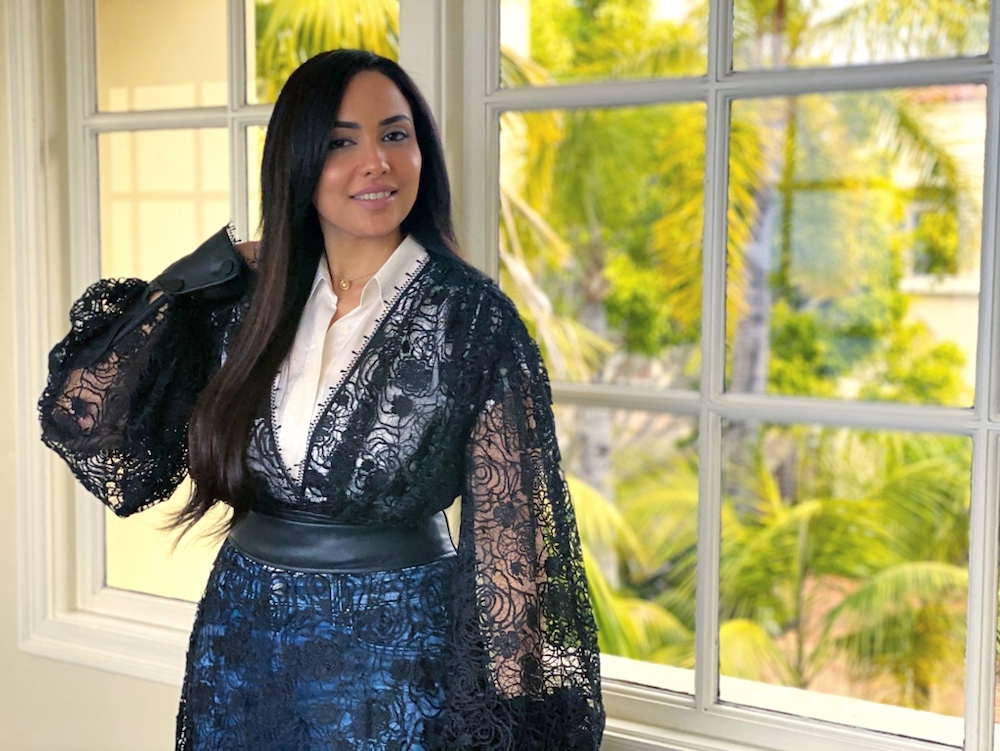
DUBAI: The story of the self-made designer and entrepreneur behind the e-store Nomad Story began while she was in high school. Tired of being dressed like everyone else, Shay Jaffar started sketching modest designs.
“Despite being an Egyptian growing up in the UAE, I still couldn’t find clothes that spoke to me as a conservative teen who liked to dress modestly,” Jaffar said. “I remember getting a lot of compliments in college on my chic modest wear to the extent that I teamed up with a bespoke tailor in my neighborhood and started creating designs for friends and family.”
Having studied computer science and later pursued a master’s degree in entrepreneurship at Babson College in the US, Jaffar decided to start an eponymous clothing brand for modest evening gowns made in New York and sold worldwide.
Despite being in the business for only six months, Jaffar has learned a lot more than she expected. (Supplied)
“Shay Jaffar the brand catered to a very niche market. At the time, the brand was made in New York at a small scale; the price point was suitable only for a certain high-paying segment, so we weren’t really quite known back then,” she said.
“After I graduated from Babson, I joined the Fashion Institute of Technology (FIT) in New York to study fashion styling. I wanted to combine entrepreneurship, fashion and technology in one career, which empowered me to start Nomad Story.”
Having the necessary technical knowledge and a multicultural background helped Jaffar launch Nomad Story in December 2019. It brings enchanting designs and bold looks to modest fashion lovers all over the world. “We called it Nomad Story because we wanted to make it a platform that sells modest styles but also tells the stories of women who break barriers and embrace the world,” Jaffar said.
According to Edited, the retail-market intelligence platform, the demand for modest fashion “is expanding outside of the UAE and seeing growth in the Western world with a 15 percent increase since 2017.”
THENUMBER
8,000
* Monthly Google searches in the US for ‘modest clothing.’
The data analytics company notes in a report that “modest clothing” receives about 8,000 Google searches monthly in the US. According to the researchers, “Religion isn’t the only reason women are opting to cover up. For some, it’s a personal preference; they find modesty empowering. With the #MeToo movement, women are dressing for themselves rather than for the male gaze.”
Nomad Story had that vision, too. “Our goal is to be the online go-to place for girls who love versatile, contemporary, exquisite modest looks, irrespective of their religion, background or beliefs,” Jaffar said. “Now is the time for these girls to find one place that represents their persona and understands their needs. We also want to take our customers on a journey of discovery by exploring new emerging designers brought to them from around the world.”
While luxury and high-street brands shifted towards more modest looks and created serious competition in this market niche, Jaffar saw it as “education to the world about diversity and inclusion.”
“These brands helped remove the stigma that modest fashion has to be old and dowdy,” she said. “In fact, they showed that modesty is also stylish and fashion-forward like every other style. Because of that, these brands actually helped us deliver our message.”
Having studied computer science, Jaffar decided to start an eponymous clothing brand for modest evening gowns made in New York and sold worldwide. (Supplied)
Despite being in the business for only six months, Jaffar has learned a lot more than she expected. “Although it looks like a short period of time (especially with the coronavirus and all), we learned a number of things about our business and our customers,” he said.
“Most girls need help in their overall modest style. It is not only about selling them one or two items but also putting together a full modest look that fits their budget, aesthetic and the occasion they’re shopping for.”
“This is mainly what we have in mind as the next step for Nomad Story. We want to help our customers put together full modest looks and find their own true style. Moreover, since we carry emerging brands, we’re thinking up of ways for customers to try before they commit.”
Choices for modest wear have always been there, but they have never been compiled in a way where it is easily accessible for women and girls, especially in the West. Luckily, brands like Nomad Story aim to make modest fashion available to women around the world.
———————–
*This report is being published by Arab News as a partner of the Middle East Exchange, which was launched by the Mohammed bin Rashid Al Maktoum Global Initiatives to reflect the vision of the UAE prime minister and ruler of Dubai to explore the possibility of changing the status of the Arab region.