Cold weather working: Helping staff stay safe and warm
Employers are being reminded of their responsibilities to keep workers safe as the first spell of cold weather is set to hit the country.
Great Britain’s workplace regulator, the Health and Safety Executive, is stressing the importance of protecting workers during the cold weather. It comes as the Met Office has issued a yellow weather warning for ice and snow for parts of the UK.
John Rowe, Head of Operational Strategy, said: “We’re calling on all employers to take a sensible approach during the cold weather that is coming our way. There are lots of jobs that will be more difficult in the these conditions. Most employers will recognise this and make appropriate accommodations for their staff. That is the right thing to do.
“It’s also important employers ensure staff are working in a reasonable temperature. People working in uncomfortably cold environments are less likely to perform well and more likely to behave unsafely because their ability to make good decisions deteriorates.”
Temperatures in indoor workplaces are covered by the Workplace (Health, Safety and Welfare) Regulations 1992, which place a legal obligation on employers to provide a “reasonable” temperature in the workplace.
All employers are expected to ensure indoor workplaces are kept at a reasonable temperature. The Approved Code of Practice suggests the minimum temperature should normally be at least 16 degrees Celsius. If the work involves rigorous physical effort, the temperature should be at least 13 degrees Celsius.
John Rowe added: “Complying with the code of practice is the right thing for an employer to do. By maintaining a reasonable temperature, employers are likely to maintain the morale and productivity of their staff as well as improving health and safety.”
Ends
New regulator sets out strategic plan to drive positive change for building safety in England
The Building Safety Regulator (BSR) has published its first three-year strategic plan
The strategy is a significant step forward, underlining BSR’s overarching direction and vision to galvanise positive culture change
Collaboration is key to driving up safety and standards
BSR is leading a critical change in culture and behaviours across industry and the whole built environment. The strategic plan establishes a vision to create a built environment where everyone is competent and takes responsibility to ensure buildings are of high quality and are safe. This represents the most significant change to regulation of building safety for a generation and means residents and other building users can be confident that industry is working together to make sure the tragedies of the past will never be repeated.
The Building Safety Regulator will:
improve the safety and standards of all buildings
make sure residents of higher-risk buildings are safe and feel safe in their homes
help restore trust in the built environment sector
We will do this by:
delivering consistent standards within the building control profession
overseeing and driving improvements across the whole built environment
regulating the planning, design, and construction of new higher-risk buildings
ensuring those who are responsible for occupied higher-risk buildings manage risk so that residents are safe
working in partnership with co-regulators
Commenting in the foreword to the strategic plan, Secretary of State for Levelling Up, Housing and Communities, Michael Gove, said:
“The system that regulates our buildings must be practical and comprehensible. The Regulator must lead the sector in creating a built environment fit for the future.
“This first three-year strategic plan is a significant moment in this mission. It looks forward and lays out a solid foundation on which the Regulator can build its ambition in future years.
Philip White, HSE’s Director of Building Safety, said:
“This strategic plan sets out the guiding principles we have put in place to keep us focused on our priorities in delivering the new regime, and we will keep it under continuous review. We will ensure we have the right capability and capacity to meet this challenge as our remit continues to evolve, working with others sharing knowledge, expertise, and data.
“Our focus is clear and resolute as we oversee a culture of higher standards, putting building safety first. Our regulatory activities will be conducted in a way which is transparent, accountable, proportionate, and consistent.
“Throughout the next three years, BSR will continue to work across all sectors to ensure that those working in the building sector engage fully with the new regime. Our aim is that people will see fundamental changes to the safety and standard of all buildings and increased competency among industry professionals that raises those standards year on year.”
Chair of the Health and Safety Executive, Sarah Newton, said:
“This is a strong, coherent strategy built on collaboration with all BSR’s stakeholders, with a keen focus on ensuring industry takes ownership and responsibility for delivering a safe system throughout the life cycle of a building. This must be front of mind for everyone. And everyone must be aware of their legal responsibilities. Collaboration and collective responsibility are key for delivering better standards.”
The BSR’s Strategic Plan for 2023-2026 is available to view here
Notes to Editors:
About BSR: The Building Safety Regulator (BSR) is an independent body established by the Building Safety Act, 2022, and is part of the Health and Safety Executive (HSE). BSR will raise building safety and performance standards and oversee a new stringent regime for high-rise residential buildings, as well as overseeing the wider system for regulating safety and performance of all buildings and increasing the competence of relevant regulators and industry professionals.
About HSE: The Health and Safety Executive (HSE) is Britain’s national regulator for workplace health and safety. We prevent work-related death, injury and ill health through regulatory actions that range from influencing behaviours across whole industry sectors
Lift maintenance company fined after engineer fatally crushed
A lift maintenance company has been fined after an employee died while working at a factory run by Muller Yogurt and Desserts.
Lift Monitoring Systems Limited, previously known as RJ Lift Services Limited, was fined £200,000 on Monday following a Health and Safety Executive (HSE) investigation into the death of 24-year-old Lewis McFarlin, a lift engineer employed by the Staffordshire company.
Muller was not prosecuted by HSE.
Mr McFarlin was fatally crushed when attempting to repair a goods lift at Muller’s Market Drayton factory on 14 January 2020.
Mr McFarlin’s mother has said “no one should go to work and not return.”
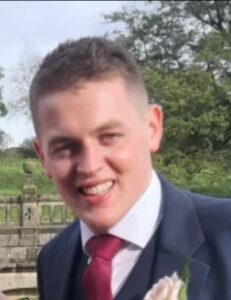
Lewis McFarlin
He and two other lift engineers at Lift Monitoring Systems were on site to work on a different lift before being asked to resolve an issue with the door-opening mechanism on one of the lift landing doors.
While attempting to resolve the issue, Mr McFarlin was on top of the lift car with one engineer in the lift itself and the other outside on the landing. The lift had been placed in inspection mode enabling Mr McFarlin to control the lift from the lift’s rooftop. This mode enabled him to assist his colleague, inside the lift, to rectify the issue.
As the work progressed, the lift unexpectedly shifted from inspection mode to normal mode while Mr McFarlin was still on top. This sudden transition caused the lift to move at its normal speed, trapping him in a void between the lift car and the structural elements of the lift shaft.
Mr McFarlin’s colleagues tried to release him but were unable to. He had already lost his life by the time the emergency services arrived at the scene.
A Health and Safety Executive (HSE) investigation found that there was a failure to cover the void in which Lewis became trapped. Had the void been sheeted, the incident could not have happened.
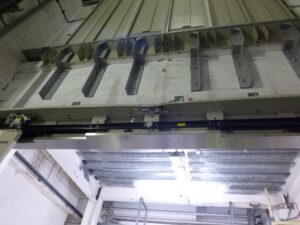
The lift shaft wall
Mr McFarlin’s mother, Leah Salt, said: “Hearing all the evidence this last week has been extremely difficult. Hearing how Lewis’ death was easily and reasonably preventable, is heart-breaking. No one should go to work and not return.
“As a family, losing our lovely Lewis and his future, has had a massive impact on all of our lives. Nothing can bring my son home, however, if future lives and families can be protected as a result of this outcome, then Lewis’ death hasn’t been in vain.”
Lift Monitoring Systems Limited, formerly known as RJ Lift Services Limited, of Galveston Grove, Oldfield Business Park, Stoke-On-Trent, Staffordshire, pleaded guilty to failing to discharge the duty imposed upon it by Section 2(1) of the Health and Safety at Work etc. Act 1974. The company was fined £200,000 at Stoke-on-Trent Crown Court on 27 November 2023. Costs will be decided at a later date.
HSE inspector Andrew Johnson said: “This tragic and entirely preventable incident led to the loss of a much loved son. The risks associated with working on lifts and the necessary safety measures were well-known to the company.
“Sadly, in this case, the employer failed to meet its responsibilities to put in place simple and well established reasonably practicable measures such as covering the void in which Lewis became trapped in. Had the company fulfilled its duties, this tragic incident simply would not have happened.”
Notes to Editors:
The Health and Safety Executive (HSE) is Britain’s national regulator for workplace health and safety. We prevent work-related death, injury and ill health through regulatory actions that range from influencing behaviours across whole industry sectors through to targeted interventions on individual businesses. These activities are supported by globally recognised scientific expertise. hse.gov.uk
More about the legislation referred to in this case can be found at: legislation.gov.uk/
Manchester firm fined after it put workers at risk with unsafe scaffolding
A rendering company in Manchester has been fined £3,000 after a HSE inspector noticed unsafe scaffolding on a house renovation as he happened to be driving past.
The company had been issued with a Prohibition Notice after a HSE inspector drove through the area on 17 February 2022 and spotted the scaffolding its workers were using at the property.
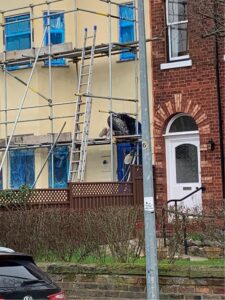
HSE inspector Phil Redman noticed unsafe scaffolding when driving passed the site on 17 February 2022
RS Rendering Specialists Limited disregarded the notice while carrying out rendering works on a house in Belgrave Crescent, Eccles, Manchester.
The HSE inspector noted there were gaps in the scaffolding, putting the company’s staff at risk from falling at height. RS Rendering Specialists had also failed to plan the work safely at the property and a mandatory weekly inspection of the scaffolding had not been carried out.
The subsequent Prohibition Notice banned the company from using the unsafe scaffolding.
However, on 23 February 2022, the same HSE inspector drove past the property again and noticed that two workers from the company were operating on the scaffolding it had been prohibited from using.
The company ignored a prohibition notice served on them by HSE and carried on working on the unsafe scaffold
The colour of the house had changed since the inspector’s previous visit, indicating that the company had continued to use the same scaffolding and had completely disregarded the Prohibition Notice.
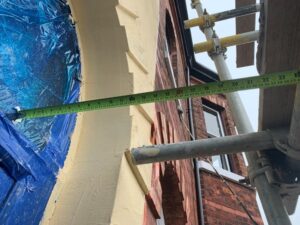
There was a large gap to which workers were at risk from falling between scaffold and front door
RS Rendering Specialists Limited, of Athol Road Manchester, pleaded guilty to breaching Sections 4(1) and 6(3) of the Work at Height Regulations 2005 and Section 33(1)(g) of the Health and Safety at Work etc. Act 1974. The company was fined £3,000 and ordered to pay costs of £1,000 at Manchester Magistrates’ Court on 24 November 2023.
HSE inspector Phil Redman said: “We will not hesitate to prosecute companies who choose to ignore enforcement notices issued to prevent risks from falls from height or any other health and safety related matters.
“This case highlights how such actions will not be tolerated under any circumstances.”
Notes to Editors:
The Health and Safety Executive (HSE) is Britain’s national regulator for workplace health and safety. We prevent work-related death, injury and ill health through regulatory actions that range from influencing behaviours across whole industry sectors through to targeted interventions on individual businesses. These activities are supported by globally recognised scientific expertise.
More information about the legislation referred to in this case is available.
Company fined as stunt performer sustains life-changing injuries during filming of Fast and Furious movie
A production company has been fined after a stunt performer was injured during the filming of Fast and Furious 9: The Fast Saga.
Joe Watts, from Surrey, sustained life-changing injuries after he fell approximately 25 feet at Warner Bros. studios in Leavesden, Hertfordshire on 22 July 2019.
He had been filming a fight scene for the action movie.
Mr Watts fell 25 feet onto the concrete floor below when the line on his stunt vest became detached.
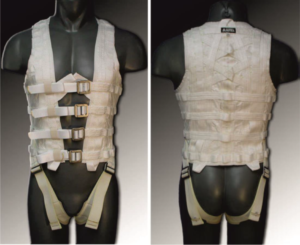
The stunt vest Mr Watts was wearing
As a result of his fall, Mr Watts suffered a fractured skull and a severe traumatic brain injury, which has resulted in permanent impairment and disability.
A Health and Safety Executive (HSE) investigation found several failings by FF9 Pictures Limited. FF9 Pictures Limited’s risk assessment failed to address the potential issue of a rope snap or a link failure, there was no system for double checking that the link had been properly engaged and tightened. There was also no system for checking the link for signs of deformation or stretching between takes, the manufacturer’s website stated that the link used was forbidden for use as PPE and shock loading should be avoided. On top of that, six-monthly inspections of harnesses were required but Mr Watts’ harness had not been inspected in the last six months and FF9 Pictures Limited did not extend the crash matting needed to mitigate the consequences of an unintended fall following changes to the set and the sequence of the stunt.
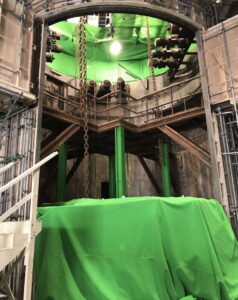
The incident took place at Warner Brothers’ studios in Leavesden
FF9 Pictures Limited, of St. Giles High Street, London, pleaded guilty to breaching Section 3(1) of the Health and Safety at Work etc. Act 1974. The company was fined £800,000 and ordered to pay £14,752.85 in costs at Luton Magistrates’ Court on 24 November 2023.
HSE inspector Roxanne Barker said: “Mr Watts’ injuries were life-changing and he could have easily been killed. In stunt work, it is not about preventing a fall but minimising the risk of an injury.”
This prosecution was brought by HSE enforcement lawyer Rebecca Schwartz and supported by HSE paralegal officer Gabrielle O’Sullivan.
Sentencing, district judge Talwinder Buttar stated Mr Watts is fortunate to be alive and added that she was astonished that the crash matting was not adequate.
Notes to Editors:
The Health and Safety Executive (HSE) is Britain’s national regulator for workplace health and safety. We prevent work-related death, injury and ill health through regulatory actions that range from influencing behaviours across whole industry sectors through to targeted interventions on individual businesses. These activities are supported by globally recognised scientific expertise. hse.gov.uk
More about the legislation referred to in this case can be found at: legislation.gov.uk/