Arriva and cleaning firm fined after worker killed at bus depot
A national bus company and a commercial cleaning firm have been fined after a “much loved young man” was killed at a depot in Hemel Hempstead.
Albin Trstena, from Tottenham, was working for Cordant Cleaning Limited, when he was hit by a reversing bus being driven by a colleague on 5 November 2019.
The 25-year-old had been working in the yard of Arriva’s Hemel Hempstead bus depot when the vehicle was reversed out of the wash down area. He sustained fatal injuries.
Twenty-five-year-old Albin Trstena was killed by a reversing bus at Arriva’s bus depot in Hemel Hempstead
In a statement read at St Albans Magistrates’ Court, Albin’s sister Albina said how his death had been ‘devastating’ for their family.
“When we received the news Albin had died, we were left devastated and our whole world came crashing down around us,” she said.
“His presence at home was so alive.
“Albin would always do lots for the family, but not just for the family, he gave of himself and would always help other people where he could.
“He was a brother and son to be proud of.”
An investigation by the Health and Safety Executive (HSE) found that Arriva failed to properly assess the risk of vehicle-pedestrian conflict, and both they and Cordant Cleaning Limited, subsequently known as C.L.C Realisations Limited, failed to implement a suitable system of work to control this risk.
There were also insufficient measures in place to protect pedestrians from vehicles being moved around the depot and to ensure that walkways within the perimeter of the yard were being utilised.
C.L.C Realisations Limited of Wellington Street, Leeds (in administration) offered no plea but was found guilty of breaching Section 2(1) of the Health and Safety at Work Act 1974 and fined a nominal £1,000.
Arriva Kent Thameside Limited of Doxford International Business Park, Sunderland, pleaded guilty to breaching Section 3(1) of the Health and Safety at Work Act 1974 and have been fined £32,000 and ordered to pay costs of £22,392.
HSE inspector Roxanne Barker said: “This tragic incident led to the avoidable death of a much loved young man.
“There was a failure to undertake safety measures to segregate vehicles and pedestrians.
“They also failed to properly consider who was responsible for determining and implementing suitable measures to ensure safe working practices when contracting out some of the activities performed within a shared workplace.”
Notes to Editors:
The Health and Safety Executive (HSE) is Britain’s national regulator for workplace health and safety. We prevent work-related death, injury and ill health through regulatory actions that range from influencing behaviours across whole industry sectors through to targeted interventions on individual businesses. These activities are supported by globally recognised scientific expertise.
More information about the legislation referred to in this case is available.
The final month of the year has seen the Health and Safety Executive (HSE) conclude complex prosecutions against two care settings. December also saw cases relating to two frightening offshore incidents that resulted in fines totalling more than £1million. Another prosecution came about after a member of the public captured shocking footage on their mobile phone of a dangerous disregard to safety while working at height.
Care home fined £125,000 after teenager’s death
James and Melissa Mathieson
A care home in Bristol was fined for not doing enough to keep people safe from vulnerable patients who posed a danger to themselves and others.
The complex HSE investigation and prosecution followed the death of Melissa Mathieson at Alexandra House on 12 October 2014. Jason Conroy murdered the 18-year-old and was jailed for life the following year, following a Crown Prosecution Service case.
Both Melissa and Jason were fairly new residents at the home having both moved there in August 2014, Melissa from Crawley, and Jason from a school in Shropshire.
Construction fined after failing to provide basic facilities to workers
A Cheshire construction company was fined £5,000 after it failed to provide workers with adequate welfare facilities.
C.B. Homes Limited was carrying out work at a site on Bunbury Lane in Alpraham when it was visited by the Health and Safety Executive (HSE) on 23 March 2023. The proactive inspection found the company had failed to provide workers with adequate facilities for workers to wash their hands.
It wasn’t the first time the Tarporley-based company had failed to provide such facilities with enforcement action being taken by HSE on three other occasions. It is a legal duty for companies to provide workers with suitable welfare facilities.
Roofing firm and company business partner sentenced following HSE investigations
A roofing company was fined a total of £881,000 after two workers were seriously injured during two separate incidents.
Billy Hewitt, a worker at Mitie Tilley Roofing Limited, fractured his pelvis after falling through a factory roof in Newcastle. Meanwhile, a 24-year-old labourer employed by RM Scaffolding broke his femur after falling through the roof of a building in Swansea while working on a project run by Mitie Tilley Roofing Limited.
The HSE investigated both incidents and prosecuted Mitie Tilley Roofing Limited. Paul Robinson, a business partner at RM Scaffolding, was also prosecuted following the incident in Swansea.
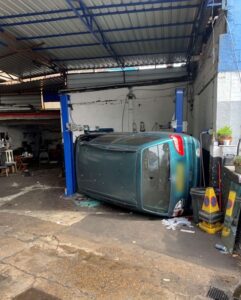
Fines for repair firm and its director after man crushed at London garage
Company director Seyit Dilek left him standing under the vehicle while it was raised on a vehicle lift
A garage was fined £12,000 after a customer was crushed by his own vehicle at a garage in North London.
Tottenham resident Mahmut Emanet is “lucky to be alive”, according to HSE inspector Michelle Morphy.
The 62-year-old spent six days in a critical care unit after he sustained serious crush injuries in the incident. He has been left with permanent and life changing injuries.
Leading textiles firm hit with £100,000 fine after worker loses hand
A linen services company has been fined £100,000 after a man’s hand had to be amputated.
Scott Drummond, from Rhyl, North Wales, suffered serious injuries to his hand after it became trapped in machinery at the laundry operated by Johnsons Textile Services Limited in Bumpers Lane, Chester, on 24 June 2021. The injuries were so serious that his hand was later surgically amputated above the wrist.
The 45-year-old had been investigating a fault on a large commercial dryer when he was caught by the machine.
Newport City Council fined £2million after death of much loved family man
Stephen Bell was working for Newport City Council when he was killed
Newport City Council was fined £2million after “a hardworking man who loved his family very much” was killed while carrying out road repair works.
Stephen Bell was barrowing tarmac from the back of the local authority’s tipper lorry when he was struck by a farm vehicle passing the road works.
The 57-year-old’s wife Jenny said how the events of 18 July 2019 had changed their family’s life forever.
“I do not have the words to express the pain my family and I felt when we heard the news and losing him so suddenly has taken its toll on us all and has left us all heart broken,” she said.
Offshore companies fined after grandfather injured on North Sea gangway
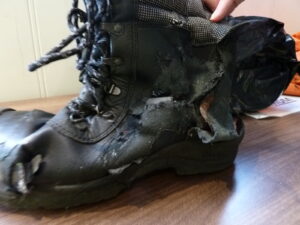
The damaged boot Mr Hill had been wearing at the time of the incident
Two offshore companies were fined a combined total of more than £1.2m after an offshore worker’s feet were crushed while walking along a gangway over the North Sea.
HSE prosecuted both Shell and Ampelmann Operations following the incident off the Norfolk coast on 17 October 2017.
Martin Hill, a grandfather of eight from Norwich, says he now struggles to go on walks and carry out simple DIY tasks as a result of his injuries.
Farming business fined after a walker dies in cattle incident
Marian Clode
A farming business was fined after a member of the public died after being butted several times by a cow in front of two onlooking grandchildren.
Marian Clode, 61, was on a family walk on 3 April 2016 when the attack happened on a public bridleway in Northumberland. She died in hospital three days later.
The family had been staying at a cottage at Swinhoe Farm, Belford and said Marian “was dearly loved and still so sadly missed.”
North Wales health board fined after failings resulted in woman’s death
Dawn Owen
One of the largest health boards in Wales was given a £200,000 fine after a patient died in its care.
Llandudno Magistrates’ Court heard that 46-year-old Dawn Owen was found unconscious at the Hergest Unit – a secure mental health unit – at Ysbyty Gwynedd in Bangor on 20 April 2021.
Dawn’s family have called on Betsi Cadwaladr University Health Board to act on the findings of the HSE investigation, calling her death ‘wholly avoidable’ and ‘completely unnecessary’.
Company fined after worker spotted on pallet raised by forklift truck
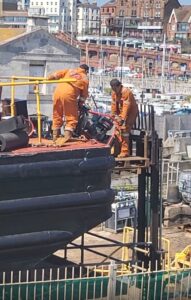
A company has been fined after shocked onlookers spotted an employee precariously working from height while standing on a pallet raised by a forklift truck at Ramsgate Harbour.
HSE was alerted to the activity after it was reported by a member of the public, who managed to capture the terrifying debacle on video.
The worker was part of a team of three at EAP Limited that were removing work equipment from the deck of a boat in the harbour’s slipway.
Offshore drilling company fined after crane boom collapse
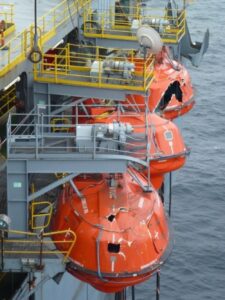
Damage to the lifeboats following the collapse
An offshore drilling company has been fined after a crane boom collapsed catastrophically.
Nobody was hurt in the incident on 31 March 2016 but a chaotic scene ensued after the collapse of the Rowan Gorilla VII’s boom, with flying debris damaging a nearby vessel, whipping a hose out of control before it ruptured, leaving a cloud of cement dust.
It happened offshore in the North Sea as staff were preparing to recover a faulty submersible pump.
HSE inspectors described the incident as an “accident waiting to happen”.
A company in Leicestershire has been fined £900,000 after a father-of-two was crushed to death.
Lee Benham died on 4 November 2021 while attempting to move a scissor lift at Nationwide Platform Limited’s workshop in Liskeard, Cornwall.
The 45-year-old LGV driver had operating a scissor lift from the ground to clear an access path so he could move pieces of machinery out of the workshop and load it onto his lorry in the yard.
Lee’s wife, Kelly Benham, said: “There are no words that can describe when you have had your heart ripped out.”
A company in Leicestershire has been fined £900,000 after a father-of-two was crushed to death.
Lee Benham died on 4 November 2021 while attempting to move a scissor lift at Nationwide Platform Limited’s workshop in Liskeard, Cornwall.
Lee’s wife, Kelly Benham, says her heart has been ripped out after his passing.
Lee Benham and his wife Kelly
The 45-year-old, who was from south east London but lived in Liskeard, was working for Nationwide as an LGV driver when the incident occurred. He was operating a scissor lift from the ground to clear an access path so he could move a pieces of machinery out of the workshop and load it onto his lorry in the yard.
The moveable controls on the scissor lift were in a position meaning that their direction was inverted, and when Lee operated the machinery, it came towards him and crushed him against a static scissor lift.
A Health and Safety Executive (HSE) investigation into the incident found Nationwide Platforms Limited failed to sufficiently consider the dangers of operating machinery via moveable controls, and failed to provide appropriate monitoring and supervision during the morning when drivers were loading machinery onto their lorries.
There were 29 fatalities in 2022/23 caused by contact with moving vehicles or machinery. HSE guidance can be found at: Equipment and machinery – HSE
Lee Benham with his wife Kelly and two children
Lee’s wife Kelly Benham said: “Lee was my soulmate, my best friend, my rock. Now I have nothing apart from my girls. There are no words that can describe when you have had your heart ripped out. Our lives are in pieces, and it is just the three of us now.”
Nationwide Platforms Limited, of Central Park, Lutterworth, Leicestershire, pleaded guilty to breaching Section 2(1) of the Health and Safety at Work etc Act 1974. The company was fined £900,000 and ordered to pay £12,405 in costs at Plymouth Magistrates’ Court on 21 December 2023.
HSE inspector Simon Jones said: “This was a tragic incident and a stark reminder to businesses to be thorough in their risk assessment. The situation which led to Lee’s death would not have arisen had appropriate control measures been in place.”
This HSE prosecution was brought by HSE enforcement lawyer Jonathan Bambro and supported by HSE paralegal officer Helen Jacob.
Notes to Editors:
The Health and Safety Executive (HSE) is Britain’s national regulator for workplace health and safety. We prevent work-related death, injury and ill health through regulatory actions that range from influencing behaviours across whole industry sectors through to targeted interventions on individual businesses. These activities are supported by globally recognised scientific expertise.
More information about the legislation referred to in this case is available.
Offshore drilling company fined after crane boom collapse
An offshore drilling company has been fined after a crane boom collapsed catastrophically.
Nobody was hurt in the incident on 31 March 2016 but a chaotic scene ensued after the collapse of the Rowan Gorilla VII’s boom, with flying debris damaging a nearby vessel, whipping a hose out of control before it ruptured, leaving a cloud of cement dust.
Inspectors from the Health and Safety Executive (HSE) described the incident as an “accident waiting to happen”.
It happened offshore in the North Sea as staff were preparing to recover a faulty submersible pump. As the crane operator raised the boom to clear one of the three legs of the installation it failed catastrophically and collapsed.
HSE found the immediate cause of the crane collapse was that Rowan Drilling (UK) Limited had not checked that a limit switch, designed to prevent the crane boom being raised to the point of mechanical failure, had been correctly set.
Three of the four boom sections fell to sea between the rig and the ‘Solvik Supplier’ supply vessel which was pumping dry cement to the rig via a flexible hose. The crane’s auxiliary hook, cables, components, and rig debris landed on the deck of the Solvik Supplier. The boom tip snagged the flexible hose, dragging it below the sea surface, causing it to rupture and whip back onto the deck of the vessel engulfing it in fine cement dust.
Damage to the lifeboats following the collapse
Although no one was injured by the incident, there were at least five Rowan employees on and around the crane at the time of the collapse. There were thirteen crew onboard the Solvik Supplier.
The HSE investigation found that safety mechanisms, designed to prevent inadvertent operation of the slew, hoist, and boom joystick controls in the port bow crane cabin had all been overridden to prevent them returning to their locked neutral position. An Improvement Notice was served on the company to remedy issues relating to the limit switches and management issues identified.
Rowan Drilling (UK) Limited, of Queens Road, Aberdeen, pleaded guilty to breaching Section 2(1) and Section 3(1) of the Health and Safety at Work etc. Act 1974 .The company was fined £130,000 at Aberdeen Sheriff Court on 21 December 2023.
HSE inspector Brian Kennedy said: “It was pure luck that nobody was seriously hurt or died as a result of these failings.
“As with so many incidents, the circumstances leading to the collapse of the port bow crane on the RGVII were years in the making and symptomatic of a defective safety management system that allowed those conditions to exist and persist.
“This was quite simply an accident waiting to happen and illustrates the vital importance of maintaining and testing crane limit switches to ensure they will always provide the intended level of protection.”
Notes to Editors:
The Health and Safety Executive (HSE) is Britain’s national regulator for workplace health and safety. We prevent work-related death, injury and ill health through regulatory actions that range from influencing behaviours across whole industry sectors through to targeted interventions on individual businesses. These activities are supported by globally recognised scientific expertise. hse.gov.uk
More about the legislation referred to in this case can be found at: www.legislation.gov.uk/
Company fined after worker spotted on pallet raised by forklift truck
A company has been fined after shocked onlookers spotted an employee precariously working from height while standing on a pallet raised by a forklift truck at Ramsgate Harbour.
The Health and Safety Executive (HSE) prosecuted European Active Projects (EAP) Limited for breaching Work at Height Regulations after one of its workers was spotted on the pallet on 8 July 2022. The workplace regulator was alerted to the activity after it was reported by a member of the public, who managed to capture the terrifying debacle on video.
The worker was part of a team of three at EAP Limited that were removing work equipment from the deck of a boat in the harbour’s slipway.
As scaffolding had been removed, the workers raised a pallet to the deck with a forklift truck and used it as a mobile platform to remove items from the boat.
One of the workers was then witnessed climbing from the side of the vessel, beneath the guard rails, and onto the pallet with a heavy, motorised pressure washer. The pressure washer was then lowered to the ground.
The HSE investigation found EAP Limited had failed to plan the work at height associated with the refurbishments and repair work being completed on the boat, leaving workers at risk, with no safe method for removing equipment located on the vessel’s deck.
European Active Projects Limited, of Chatham Docks, Gillingham Gate, Chatham, Kent, pleaded guilty to breaching Section 4(1) of the Work at Height Regulations 2005. The company was fined £100,000 and ordered to pay £5,730.40 in costs at Maidstone Magistrates’ Court on 20 December 2023.
HSE inspector Samuel Brown said: “This incident demonstrates why there is a need to appropriately plan and supervise work at height. Clearly, lessons had not been learnt since the company’s previous prosecution in 2015.
“Falls from height are still the biggest cause of fatal accidents involving workers.
“The risk of workers falling from the pallet and sustaining serious, possibly fatal, injuries should not be ignored. Fortunately, no workers were harmed and the reporting of the incident by a concerned member of public enabled HSE to intervene and prevent any further unsafe work at height on site.”
This HSE prosecution was brought by HSE senior enforcement lawyer Nathan Cook and supported by HSE paralegal officer Cristina Alcov.
Notes to editors:
The Health and Safety Executive (HSE) is Britain’s national regulator for workplace health and safety. We prevent work-related death, injury and ill health through regulatory actions that range from influencing behaviours across whole industry sectors through to targeted interventions on individual businesses. These activities are supported by globally recognised scientific expertise.
More information about the legislation referred to in this case is available.