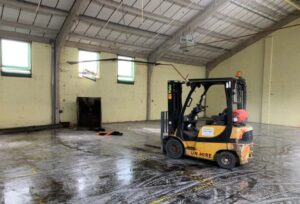
Construction company fined £60,000 after worker falls through unprotected floor opening

  • Worker seriously injured after collapsing wall knocked him through an unprotected floor opening
  • No edge protection, no warning signage, no safety instructions given to workers, and no supervisor present at the time of the incident
  • HSE guidance on working at height is available

A construction company based in the Northwest of England, has been fined £60,000 after a wall collapsed, knocking an employee through an open stairwell onto a concrete floor below.

Ace Infra Ltd pleaded guilty after an incident led to employee, Mark Jones, to spend a month in hospital recovering from his injuries.

The court heard how Mr. Jones, a general labourer, was sweeping up dust and debris on the first floor of the building at the end of the working day. Earlier that day, boards had been delivered and laid across a large opening in the floor where a staircase was to be installed. The boards did not cover the entire opening, and no edge protection had been installed around the remaining gap . There was no signage warning of the danger, and Mr. Jones had received no instructions regarding his safety around this area.

While sweeping along the boards, a newly built wall to the left collapsed, knocking him over the unprotected edge onto the concrete floor 2.5 to 3 metres below.

The incident happened on 25 April 2024 at an Ace Infra site at NW Auctions Milnthorpe, Cumbria.

Mr Jones suffered multiple fractures and a dislocated shoulder, spending a month in hospital.

An investigation by the Health and Safety Executive (HSE) found that the risk of falling through the gap in the floor had not been addressed, as no preventative measures had been taken. Mr Jones had not been made aware of the risks or the safety measures required. No site supervisor or manager was present when the incident occurred.

HSE guidance on working at height states that employers must take precautions to prevent falls from heights that could cause serious personal injury, including falls into floor openings. Employers have a duty to ensure workers are not exposed to risks to their health or safety.

Ace Infra Ltd, of 31 St James Drive, Burton, Carnforth, Cumbria, pleaded guilty to breaching Regulation 6(3) of the Work at Height Regulations 2005 by failing to ensure that suitable and sufficient measures were taken, so far as was reasonably practicable, to prevent any person working at height from falling a distance liable to cause personal injury.

The company was fined £60,000 and ordered to pay £4,799.44 in costs, with a £2,000 victim surcharge at Lancaster Magistrates Court on 23 December.

HSE Inspector, Derek McLauchlan, said: “Everyone working in construction has a responsibility to ensure that people are safe. Any work at height is potentially high-risk and requires proper planning and implementation.

“This incident could have been avoided had appropriate control measures and training been in place.  Despite the serious injuries sustained, a fall of this height and nature could have resulted in far worse outcomes. Lessons must be learned from this case.”

This HSE prosecution was brought by HSE Enforcement Lawyer, Chloe Ward and Paralegal Officer, Zahra Shafique.

Notes to Editors

1.    The Health and Safety Executive (HSE) is Britain’s national regulator for workplace health and safety. We are dedicated to protecting people and places and helping everyone lead safer and healthier lives.

2.    More information about the legislation referred to in this case is available.

3.    Further details on the latest HSE news releases is available.

4.    Relevant guidance can be found here Working at height – HSE.

5.    HSE does not pass sentences, set guidelines or collect any fines imposed. Relevant sentencing guidelines must be followed unless the court is satisfied that it would be contrary to the interests of justice to do so.  The sentencing guidelines for health and safety offences can be found here.



Father and son sentenced for carrying out illegal gas work

  • Work carried out on two properties in Northwich.
  • One boiler illegal installed was found to be dangerous.
  • Failures could have been catastrophic for homeowners.

An unregistered gas installer and his father have been sentenced after carrying out illegal gas work at two houses in Cheshire.

An investigation by the Health and Safety Executive (HSE) found that Scott Lodge, 37, carried out new boiler installations at two addresses in Northwich in April 2022 and December 2022 – doing so while not being registered with Gas Safe Register.

  • Carrying out gas work without registration is illegal and potentially dangerous, as unqualified work can lead to gas leaks, fires, explosions, and carbon monoxide poisoning.

On one of those occasions, his father Brian, 67, who is a registered gas engineer, signed off the work and commissioned the boiler on his son’s behalf. He did this without attending the property to check the boiler for safety.

Defects included a lack of support for the chimney and flue system

When one of the homeowners complained to the Gas Safe Register an inspection was carried out by a qualified engineer. That inspection identified defects resulting in the boiler being classed as at risk and a danger. This included a lack of support for the chimney and flue system, which carried the risk of carbon monoxide poisoning.

Members of the public are reminded that all gas work must be carried out by a Gas Safe registered engineer. The Gas Safe Register is the official list of gas businesses legally permitted to work on gas appliances. Anyone can check whether an engineer is registered by visiting www.gassaferegister.co.uk or calling 0800 408 5500.

Scott Lodge, of Adlington Drive, Northwich, pleaded guilty to breaching Regulation 3(3) of the Gas Safety (Installation and Use) Regulations 1998. He was given a 12-month community order and complete 200 hours of unpaid work. He was also told to pay £2,500 in costs at Chester Magistrates’ Court on 22 December 2025. He must also pay £1,460 to one of the affected homeowners, which covered the cost of the work.

Brian Lodge, of Merriman Avenue, Knutsford, pleaded guilty to breaching section 3(2) of the Health and Safety at Work etc. Act 1974. He was given the same sentence as his son and ordered to pay the same in costs at the same hearing.

Following the hearing HSE Inspector, Ian Betley, said: “This was a deliberate breach of gas safety legislation by Scott Lodge who undertook gas work which he knew he was not registered to do.

“His failures could have led to catastrophic and tragic consequences for the homeowners. To make matters worse, Brian Lodge knowingly signed off the work as safe, despite not examining or testing it.

“All gas work must be undertaken by Gas Safe registered engineers. The public should always ask to see the gas engineer’s identification and check the registration number online to ensure it is valid. Furthermore, registered gas engineers must not circumvent the legislative requirements by signing off unregistered work as their own.”

Gas engineers and consumers can contact the Gas Safe Register in any of these ways:

This prosecution was brought by HSE enforcement lawyers, Sam Crockett and Karen Park, and paralegal officer, Stephen Grabe.


Further information:

  1. The Health and Safety Executive (HSE) is Britain’s national regulator for workplace health and safety. We are dedicated to protecting people and places, and helping everyone lead safer and healthier lives.
  2. More information about the legislation referred to in this case is available.
  3. Further details on the latest HSE news releases is available.
  4. HSE does not pass sentences, set guidelines or collect any fines imposed. Relevant sentencing guidelines must be followed unless the court is satisfied that it would be contrary to the interests of justice to do so.  The sentencing guidelines for health and safety offences in Scotland can be found here.
  5. Guidance is available: The Gas Safety (Installation and Use) Regulations 1998. Relevant guidance can be found at Gas Safety (Installation and Use) Regulations 1998 (GSIUR) as amended. Approved Code of Practice and guidance – HSE


Cornish farmer fined after cow attacks left walkers fearing for their lives

  • A Cornish farmer has been fined for failing to take action after walkers were attacked by cattle with calves on a public footpath.
  • A 75-year-old man suffered serious injuries and required surgery after being trampled while walking his dog.
  • HSE found cattle with young calves, which are known to be protective and unpredictable, had been kept in a field with public access despite safer alternatives being available.

A 75-year-old man said he feared for his life after being attacked by cows while walking his dog on a public footpath in Cornwall.

The farmer responsible has been prosecuted by the Health and Safety Executive (HSE) as a result.

Brian Gregory, aged 75, was on a caravanning holiday at Porthcothan in June 2024. On 30 June 2024, Mr Gregory and his labrador, Molly, were walking along the South West Coast Path at Park Head when he was suddenly attacked by a herd of cattle with calves.

The herd of cows near the South West Coast Path at Park Head

He let go of Molly’s lead and the cattle chased after his dog away from him, but not in time to prevent him being trampled and butted. Mr Gregory was assisted by passing walkers and made it back to his caravan with Molly. When his partner saw his injuries, she immediately called an ambulance and he spent five days in hospital.

He suffered multiple serious injuries including a severed artery, horn marks and gashes down to the bone, and required surgery.

The farmer responsible for the cattle, Beverley Chapman of Tembleath Farm, St Columb Major, was told about the cattle attack on the same day. However, rather than removing the cattle and calves from the South West Coast Path, she added more cattle and calves to the herd to increase its size. Some of the calves were as young as 42 days old.

A month later, two local residents were walking their dogs along the South West Coast Path in the same area of Park Head when they were also attacked by the same herd of cattle and calves. They only escaped serious injury by sheltering in an area of gorse bushes by the cliff edge, but one of their dogs was seriously injured and required surgery.

Again, Beverley Chapman was informed about the incident however only removed the cattle from the South West Coast Path four days later, when instructed to do so by a Cornwall Council public rights of way officer.

The HSE investigation found that cattle with young calves, which are known to be protective and unpredictable, were being kept in a field with a public right of way across it. This can pose a significant risk to walkers, particularly those with dogs. Mrs Chapman had other enclosed fields available which did not contain public rights of way and could have been used to house the cattle and calves.

When farmers are considering putting cattle into fields with public access, they should have regard to HSE guidance AIS17 Cattle and public access in England and Wales’. This guidance sets out a range of controls which should be considered and, where reasonably practicable, implemented, including:

  • Where possible avoid putting cattle, especially cows with calves, in fields with public access
  • Do all that is reasonably practicable to keep animals and people separated, including erecting fencing (permanent or temporary), such as electric fencing
  • Assess the temperament of cattle before placing them in fields with public access
  • Any animal that has shown signs of aggression must not be kept in a field where they have access to the public
  • Clearly signpost all public access routes across the farm and display signage at all field entrances stating what livestock are present, such as cows with calves or bulls.

Beverley Chapman of Tembleath Farm, St Columb Major, Cornwall, pleaded guilty to breaching Section 3(2) of the Health and Safety at Work etc. Act 1974. She was fined £5,260 and ordered to pay prosecution costs of £4,650 and a court surcharge of £2,000 at Bristol Magistrates’ Court on 16 December 2025.

After the hearing HSE inspector, Simon Jones, said:

“Cattle are extremely protective of their calves and even calm cattle can become aggressive if they think their calves may be threatened.

“Given the nature of the cattle attack, it is fortunate that the injuries sustained by Mr Gregory weren’t fatal. On this occasion, Mr Gregory took all the right precautions while out walking.

“Despite being made aware of attacks on walkers on two separate occasions, Mrs Chapman failed to take action to remove the cattle or control risks by separating them from walkers on the South West Coast Path. It was only when officially instructed by a public rights of way officer from the local council that she took action.”

The prosecution was brought by HSE enforcement lawyer, Rebecca Schwartz and Paralegal, Gabrielle O’Sullivan.

 Further information:

  1. The Health and Safety Executive (HSE) is Britain’s national regulator for workplace health and safety. We are dedicated to protecting people and places and helping everyone lead safer and healthier lives.
  2. More information about the legislation referred to in this case is available.
  3. Further details on the latest HSE news releases is available.
  4. Advice for farmers, landowners and other livestock keepers on dealing with Cattle and public access in England and Wales – HSE is available.
  5. HSE does not pass sentences, set guidelines or collect any fines imposed. Relevant sentencing guidelines must be followed unless the court is satisfied that it would be contrary to the interests of justice to do so. The sentencing guidelines for health and safety offences can be found here.



Offshore process isolation failures present major accident hazard risk

Isolation failures are one of the main causes of hydrocarbon releases on offshore installations on the UK Continental Shelf. These are not minor incidents – many have the potential to cause serious injury, fatalities or major accidents if ignited.

The Health and Safety Executive (HSE) continues to find serious failings during inspections and investigations, which has led to significant enforcement action in recent years.

Now the regulator is highlighting the findings from its inspections and investigations to assist operators in improving their safety performance on offshore installations.

A drilling rig and platform used in the oil and gas industry for offshore fuel exploration

Scott Templeton, Principal Specialist Inspector in HSE’s Energy Division – Offshore, said:

“The problem is not the procedures on paper, it is that people are not following them. Most UK operators have isolation procedures that broadly follow HSG 253 (the guidance on safe isolation of plant and equipment).

“Effective and lasting improvement requires everyone involved in isolations, from senior management to those carrying out work on the plant, to share a genuine commitment to achieving and maintaining isolation procedures and practice to the required standard.

“We will soon issue updated inspection guidance, so operators know what to expect they will be assessed on. Safe isolation will remain an inspection priority.”

Findings from inspections and investigations

HSE inspections have identified critical gaps in offshore isolation practices:

  • Company standards failing to meet HSG 253 requirements – some duty holder ‘selection tools’ specify lower isolation standards than HSG 253 requires.
  • Poor hazard identification – risk assessments frequently miss trapped fluids, pressure sources and non-return valves. Electronic systems encourage ‘copy and paste’ approaches which can fail to reflect actual task hazards.
  • Inadequate isolation planning – dutyholders are proceeding with complex isolations (multiple passing valves, extended boundaries) rather than waiting for shutdowns, resulting in risks that are not as low as reasonably practicable (ALARP).
  • Inaccurate piping and instrumentation diagrams (P&IDs) – plant drawings do not reflect actual conditions, leading to incorrect isolation design and implementation issues.
  • Missing or inadequate method statements – step-by-step instructions for applying, testing and removing isolations are either absent, insufficiently detailed or unclear, increasing the risk of human error.

All variations from isolation standards must be risk-assessed and approved by a technically competent, operationally independent person (typically onshore). Control measures identified in risk assessments must be followed.

Questions for your organisation

Procedures

  • Do your isolation procedures align with HSG 253?
  • Do they give clear guidance on venting and depressurising safely?
  • Do they require detailed method statements?

Risk management

  • When do you allow single block and bleed isolations on hazardous fluids, and how do you ensure risks are ALARP?
  • Have you defined an acceptable leakage rate for isolation valve integrity?
  • How do you handle situations where valve integrity is hard to prove, such as flare headers?
  • What are your ‘cleanliness criteria’ before breaking containment?

People

  • How do you minimise human error?
  • Is training and competency assessment suitable for everyone involved in isolations?
  • How effective are you at recognising high-risk activities when multiple jobs are happening simultaneously?

Assurance

  • Is your monitoring and audit system robust enough to catch procedural violations?
  • How do you manage deviations from isolation procedures?
  • Do you have a system to consider plant modifications that would reduce isolation risks?
  • Do you identify problem valves and fix them?

The solution

Isolation risks exist at every stage – from planning through to completion. Good procedures alone are not enough. Everyone from senior management to those doing the work must genuinely commit to following procedures every time.

HSE is engaging with industry to share learning and improve standards. Updated guidance will be issued soon.

These failures are entirely preventable. The question is whether your organisation will prevent them.

Further information

HSE hosted a webinar on process isolations in the offshore oil and gas sector. Essential viewing for all those involved in isolation activities for offshore installations in the UKCS, from design and installation, through to approval and audit.

This is available to watch via Health & Safety matters website. Register here to watch: Offshore UKCS Process Isolations – Regulatory Expectations and Learnings

HSG 253 ‘The safe isolation of plant and equipment’ provides comprehensive guidance on isolation procedures.


Construction company fined after worker crushed by collapsing wall

  • Worker critically injured after wall collapsed into excavation.
  • Temporary works were not designed, planned or managed.
  • HSE guidance on temporary works is available.

A construction company has been fined £100,000 after a steel-fixer was seriously injured when a newly built blockwork wall collapsed at a site in Poole.

Matrod Frampton Limited pleaded guilty at Bristol Magistrates’ Court on Friday 5 December 2025 after the incident left 69-year-old Patrick Grant with life-changing injuries.

The court heard how the breeze block wall had been back-filled too early, before the mortar had properly set. The wall collapsed while Mr Grant was working nearby, crushing him against the concrete floor of the excavation.

The collapsed wall where Mr Grant was working on the excavation

The incident happened on 19 August 2022 at the company’s site on Old Coast Guard’s Road, Poole. Mr Grant and two colleagues had started work at the lower level of the excavation when the wall at the north end gave way at around 8.30am.

Emergency services attended the scene, but there was no emergency rescue plan in place. The use of an unstable ladder to access the deep excavation delayed rescue efforts, and Mr Grant had to be hoisted out by the fire and rescue service before being airlifted to hospital.

An investigation by the Health and Safety Executive (HSE) found that Matrod Frampton Limited had failed to properly assess a foreseeable risk associated with temporary works on site.

The investigation identified that there was no temporary works design for the blockwork wall, nor for any other temporary work structures at the site. The company had failed to appoint either a temporary works coordinator or a temporary works supervisor, despite this being highlighted as a serious concern in a safety report issued eight days before the incident.

Temporary works on construction sites include trenches, excavations, temporary slopes and stockpiles, formwork, falsework, propping, shoring, edge protection, scaffolding, site fencing and signage.

Without a temporary works procedure in place, groundworkers backfilled the wall prematurely, leading directly to its collapse.

Matrod Frampton Limited, of Riverside Park, Wimborne, Dorset, pleaded guilty to breaching Regulations 13(1) and 19(1) of the Construction (Design and Management) Regulations 2015. The company was fined £100,000 and ordered to pay £8,242 in costs and a £2,000 victim surcharge at Bristol Magistrates’ Court on 5 December 2025.

After the hearing HSE inspector, Alexander Ashen, said: “The correct design and execution of temporary works is an essential element of risk prevention in construction.

“This incident illustrates what can happen when temporary works are not properly organised. Matrod Frampton Limited is an established construction company, and a temporary works procedure should have been implemented as a matter of course.

“The fact that the company’s own health and safety consultants raised this issue eight days before the incident makes this wholly avoidable event all the more tragic.

“HSE will not hesitate to take action against companies that fail to properly plan and manage serious risks on construction sites.”

Guidance on temporary works is available on the HSE website.

This HSE prosecution was brought by HSE enforcement lawyers, Iain Jordan and Rowena Goodwin, and paralegal Officer, Hannah Snelling.

Further information:

  1. The Health and Safety Executive (HSE) is Britain’s national regulator for workplace health and safety. We are dedicated to protecting people and places and helping everyone lead safer and healthier lives.
  2. More information about the legislation referred to in this case is available.
  3. Further details on the latest HSE news releases is available.
  4. Guidance on temporary works can be found here: https://www.hse.gov.uk/construction/safetytopics/temporary-works.htm
  5. HSE does not pass sentences, set guidelines or collect any fines imposed. Relevant sentencing guidelines must be followed unless the court is satisfied that it would be contrary to the interests of justice to do so. The sentencing guidelines for health and safety offences can be found here.