Building company fined £234,000 after worker falls from platform

A building company has been fined after a demolition worker suffered serious injuries after falling from a platform in Kensington in London.

Ovidiu Dobra was working for Henry Construction Projects Limited at a building site on Kensington High Street when the incident happened on 2 March 2021.

Mr Dobra suffered serious injuries after the platform he was working on collapsed

Mr Dobra, 51 at the time, was working on the ten-foot high platform when it collapsed. He sustained serious injuries to both legs which has left him with ongoing long-term difficulties with movement, basic functions, and ability to work.

Mr Dobra, who is from Romania, was working on the demolition of a building as part of the construction of a new commercial and residential building.

A Health and Safety Executive (HSE) investigation found Henry Construction Projects Ltd failed to take appropriate precautions to ensure the safety of persons working at height.

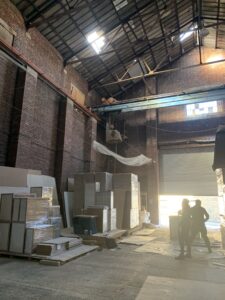
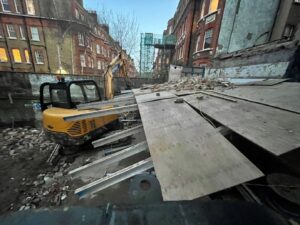
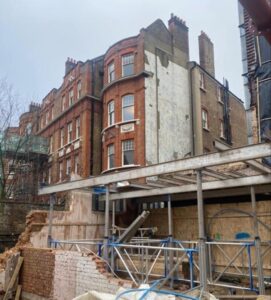
The site on Kensington High Street before the platform collapsed

Henry Construction Projects Limited, of Church Road, Cranford, Hounslow, London, pleaded guilty to breaching Regulation 6(3) of the Work at Height Regulations 2005.  The company was fined £234,000 and ordered to pay £12,369 in costs at Westminster Magistrates Court on 16 May 2023.

HSE inspector Saif Deen said: “Falls from height are one of the biggest causes of workplace fatalities and major injuries.

“This incident was completely preventable.

“Employers must control the risk of working at height to ensure that it is carried out in a manner which is so far as is reasonably practicable safe.”


Notes to editors 

  1. The Health and Safety Executive (HSE) is Britain’s national regulator for workplace health and safety. We prevent work-related death, injury and ill health through regulatory actions that range from influencing behaviours across whole industry sectors through to targeted interventions on individual businesses. These activities are supported by globally recognised scientific expertise.
  2. More information about the legislation referred to in this case is available.
  3. Further details on the latest HSE news releases is available.
  4. HSE guidance on working at height is available.


Birmingham wall collapse deaths: Directors jailed after five men lost their lives

Two company directors have been jailed after a wall collapsed killing five men – with both firms having to pay combined fines of £1.6million.

Wayne Anthony Hawkeswood and Graham John Woodhouse ran a Birmingham metal recycling business where a wall toppled over and killed five workers.

The pair were found guilty on multiple counts after a five-week trial at Birmingham Crown Court in November last year. They were back at the same court on Monday 15 May where they each received nine-month custodial sentences.

• The five men from left: From left to right the five men are: Saibo Sumbundo Sillah, Ousman Kaba Diaby, Almamo Kinteh Jammeh, Bangally Tunkara Dukuray and Mahamadou Jagana Jagana

Ousmane Kaba Diaby, Saibo Sumbundu Sillah, Bangally Tunkara Dukuray, Almamo Kinteh Jammeh and Mahamadou Jagana Jagana were all killed when a 45-tonne wall collapsed on them. They were agency workers working at the site occupied by Hawkeswood Metal Recycling Ltd and Shredmet Ltd (now trading as Ensco 10101 Ltd), in the Nechells area of Birmingham.

At nearly 12-feet high, the Vee block wall was built on site and made up of 30 concrete blocks – each the size of a domestic fridge-freezer and weighing the same as a large family car. The blocks are designed to slot together.

The five men were part of a group of eight agency workers brought to the site on 7 July 2016. At around 8am that morning, seven of them began the process of clearing the bay of swarf – metal filings – to make way for more scrap metal.

Just 15 minutes after starting work, the wall collapsed on the five men, killing them instantly. A sixth man suffered serious leg injuries, while another was fortunate enough to have just stepped outside the bay before the wall came down. The eighth member of the team was not in the bay at all as he had gone to another part of the site to retrieve brooms.

An investigation by the Health and Safety Executive (HSE) found the wall had previously been taken down then reassembled. The adjoining bay was full of around 263 tonnes of scrap metal briquettes – each roughly the size of a large tin of vegetables. The combined weight of the machine-pressed metal briquettes was the equivalent of six fully loaded HGVs.

Following the incident, the defendants appointed structural engineers who carried out an assessment, the result being a reduction in wall heights and bays being clearly marked with maximum fill lines.

Both directors were found guilty of four charges each – failing to discharge the duty to which they were subject by virtue of section 2(1) and 3(1) of the Health and Safety at Work Act 1974.

Hawkeswood Metal Recycling Limited and Ensco 10101 Limited (known at the time as Shredmet) were also found guilty of the two identical counts bringing the total number of convictions to 12.

Hawkeswood Metal Recycling was fined £1million while Ensco 10101 Limited must pay £600,000. The judge also ordered £775,000 to be paid in prosecution costs.

Speaking after the sentencing, HSE Principal Inspector Amy Kalay said: “I hope the families and friends of the men who died find some comfort in today’s sentencing.

“The investigation into this incident was long and complex. Five men lost their lives in the most appalling of circumstances. Their deaths should not have happened. They went to work to earn a wage; that cost them their lives.

“These five men were placed into a working environment that was fundamentally unsafe. The failings of the companies and individuals brought to justice today were responsible for this tragedy.

“Health and safety regulations save lives. We will always take action against those who fail to protect their workers.”

Notes to editors 

  1. The Health and Safety Executive (HSE) is Britain’s national regulator for workplace health and safety. We prevent work-related death, injury and ill health through regulatory actions that range from influencing behaviours across whole industry sectors through to targeted interventions on individual businesses. These activities are supported by globally recognised scientific expertise.
  2. More information about the legislation referred to in this case is available.
  3. Further details on the latest HSE news releases is available.
  4. HSE guidance on scrap and metal recycling is available.


HSE to prosecute Cambridgeshire County Council over busway deaths

A Health and Safety Executive (HSE) prosecution is being brought against Cambridgeshire County Council following the deaths of three people in separate incidents, and the life-changing injuries sustained by a fourth person in a collision, on Cambridgeshire Guided Busway.

Jennifer Taylor, 81, died when she was hit by a bus as she crossed the busway on foot at Fen Drayton on 17 November 2015.

Steve Moir, 50, a cyclist, died after colliding with a bus on the section of the busway between Cambridge railway station and Long Road on 13 September 2018.

Kathleen Pitts, 52, who was on foot, died after being hit by a bus on the section of the busway, also between Cambridge railway station and Long Road on 26 October 2021.

The fourth person, a teenage cyclist, was seriously injured when he collided with a bus in the guided section of the busway parallel to Kings Hedges Road on 9 November 2021.

Cambridgeshire County Council will face a charge under s3(1) of the Health and Safety at Work etc. Act 1974.

The charge follows an extensive investigation by HSE, which is Britain’s workplace regulator.

A first hearing date will be confirmed in due course.

Notes to Editors:

  1. The Health and Safety Executive (HSE) is Britain’s national regulator for workplace health and safety. We prevent work-related death, injury and ill health through regulatory actions that range from influencing behaviours across whole industry sectors through to targeted interventions on individual businesses. These activities are supported by globally recognised scientific expertise.
  2. More information about the legislation referred to in this case is available.
  3. Further details on the latest HSE news releases is available.


HSE targets construction workers’ lung health with nationwide inspection campaign

Failure to prevent life-threatening diseases caused by dust at work is unacceptable, says the Health and Safety Executive (HSE), as it gears up for a summer targeting construction sites across Great Britain.

Supported by HSE’s Dust Kills campaign, which provides free advice to businesses and workers on the control measures required to prevent exposure to dust, the inspections throughout May, June and July will focus on respiratory risks from exposure to dust.

Each year in the construction industry, there are thousands of preventable cases of irreversible lung disease due to past exposure to dust at work. These diseases often have a life-changing impact and can result in an early death.
HSE’s chief inspector of construction, Michael Thomas, said: “Every year we see construction workers die from diseases caused or made worse by their work. This is unacceptable in the 21st century, when occupational lung disease is preventable.

“We are urging employers and workers to take the necessary precautions today to protect their long-term lung health, to avoid them and their families suffering from the devastating impact that can result.”

Starting on Monday, 15 May 2023, the inspections,  part of a respiratory health intervention initiative, will specifically focus on dust control, checking employers and workers know the risks, plan their work, and are using the right controls.

Inspectors will be checking the control measures in place to protect workers from inhaling construction dusts including silica (Respirable Crystalline Silica/RCS) and wood dust.  They will also gain assurances that asbestos containing materials have been identified and removed or managed where necessary to prevent or reduce exposure.

The initiative is supported by HSE’s Dust Kills campaign. This provides simplified advice and guidance on the Work Right website, for employers, small builders and workers, to help everyone understand the risks and how to stay healthy on site.

The primary aim of the inspection initiative is to ensure workers’ health is being protected. However, if safety risks or other areas of concern are identified, inspectors will take the necessary action to deal with them.

Michael Thomas continued: “Our inspectors will visit a range of construction sites to check businesses are taking the necessary action to ensure their workers’ long-term respiratory health is being protected. Through  engaging with those on site, we can make sure they have considered the job from start to finish, have considered the risks at each stage, and are managing the risks with effective measures in line with the broad hierarchy of control options such as water suppression, extraction, and as a last resort Respiratory Protective Equipment (RPE).

For more information visit the Work Right campaign page.

HSE has partnered with construction and occupational health organisations to highlight the control measures required on site to prevent exposure to dust. The network of Dust Kills partners includes Construction Industry Advisory Committee (CONIAC) and Civil Engineering Contractors Association (CECA), Construction Leadership Council (CLC), Health in Construction Leadership Group (HCLG) and Construction Dust Partnership.


Notes to Editors


  1. The Health and Safety Executive (HSE) is Britain’s national regulator for workplace health and safety. We prevent work-related death, injury and ill health through regulatory actions that range from influencing behaviours across whole industry sectors through to targeted interventions on individual businesses. These activities are supported by globally recognised scientific expertise.
  2. Henry Gregg, Chair, Taskforce for Lung Health said: “The HSE’s campaign to improve workplace health is a key part of working toward reducing preventable deaths caused by lung conditions. Lack of awareness around the dangers of dirty air, particularly in some working environments such as construction sites, contributes to thousands respiratory deaths per year in the UK. The Taskforce is proud to support the HSE’s vital work, reducing respiratory risks and preventing occupational lung disease.”
  3. Peter Crosland, National Civil Engineering Director, CECA said: “Construction workers still die every week from respiratory related illnesses brought on by their work and this is clearly not acceptable in the 21st century. The reasons behind these fatalities are, I believe, quite complex as no one intentionally sets out to cause harm to either themselves or others but nevertheless these illnesses are still occurring. Some of the possible reasons include lack of awareness of the legal duties of employers, lack of awareness of the damage dust can actually cause and lack of time on projects to plan work properly, and that’s both at the design stage and on site. Working together with HSE and other stakeholders, we hope to provide valuable advice to those that need it most.”


Bradford man spared jail after father fell through roof

A Bradford man has been given a suspended prison sentence after an employee sustained life-threatening injuries when he fell 30-feet through a fragile roof.

Fazal Subkhan was given the nine-month sentence (suspended for two years) after pleading guilty to health and safety breaches. It related to an incident on 25 March 2020 when Uzaifa Khan, 34, suffered a number of significant injuries including a broken hip and pelvis.

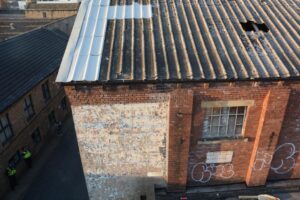
Thirty-four-year-old Mr Khan fell more than 30 feet through the fragile roof

Mr Khan said the incident at a unit in Shipley, left him unable to do ’95 per cent’ of things he did before.

“It’s been a crazy two and a half years,” he said.

“A lot has happened since regarding my physical and mental wellbeing.

“It has impacted me greatly.

“I can’t physically pick up my daughter and she cries that I can’t do so.

“I don’t feel safe going out anymore as I can’t physically look after myself.”

Leeds Crown Court heard that Subkhan was working on the roof of Unit C, Ashely Lane in Shipley, with Mr Khan. However he fell through the fragile roof landing on pallets approximately 36-feet below. His other injuries included broken ribs, a partially collapsed lung, a shattered left wrist and a broken left elbow.

Fazal Subkhan was given a nine-month suspended prison sentence in relation to the incident

“The accident has completely changed my life,” he went on to say.

“The key memory is falling and when I was on the floor and in pain, he came up to me and said ‘make sure you tell the police you went on the roof on your

own accord’.”

An investigation by the Health and Safety Executive (HSE) found that Mr Subkhan had made previous repairs to the roof at the site but returned to undertake further work. No risk assessment was undertaken for working on the fragile roof. Safe access to the roof, and the risk of falling through or from the roof were not considered and no controls of any sort were put in place.

Fazal Subkhan of Rochester Street, Bradford, West Yorkshire pleaded guilty to breaching Section 3 (2) of the Health & Safety at Work etc Act 1974. As well as the suspended prison sentence he must also complete 150 hours unpaid work and was ordered to pay £2,500 in costs.

HSE inspector Chris Tilley said: “Falls through fragile roofs and fragile roof lights cause death and serious injury.  They account for almost a fifth of all the fatal accidents which result from a fall from height in the construction industry.

“It’s better to avoid working on fragile roofs at all but if you have to, always assess the risk and employ safe control measures like installing perimeter edge protection, the use of staging on the roof surface to spread the loads or install safety nets underneath the roof”.

Notes to editors 

  1. The Health and Safety Executive (HSE) is Britain’s national regulator for workplace health and safety. We prevent work-related death, injury and ill health through regulatory actions that range from influencing behaviours across whole industry sectors through to targeted interventions on individual businesses. These activities are supported by globally recognised scientific expertise.
  2. More information about the legislation referred to in this case is available.
  3. Further details on the latest HSE news releases is available.
  4. Guidance on carrying out roof work safely is available.
  5. Additional guidance on working at height is also available.