Health and Safety Executive inspecting chiropractors to assess radiation compliance

  • HSE inspecting compliance under Ionising Radiations Regulations 2017. 
  • Regulator launches video explaining inspection guidance. 
  • Inspections taking place across Great Britain. 

The Health and Safety Executive (HSE) is conducting an inspection campaign targeting chiropractors who use radiation generators.  

The regulator’s inspections will assess dutyholders’ compliance with the Ionising Radiations Regulations 2017 (IRR17), which protect employees and other persons from occupational radiation exposure.  

To help dutyholders understand the requirements of an inspection, the HSE has created an online video outlining the expectations of the visit and the areas inspectors will be assessing compliance on, including: 

  • management of radiation protection 
  • radiation risk assessment 
  • engineering controls and maintenance 
  • contingency plans 
  • training records 
  • designation and monitoring of controlled areas 
  • local rules and radiation protection supervisors 
  • personal dosimetry 

All employers with staff operating radiation generators must register with HSE through the online RADAN system. 

Duncan Smith, Head of the Health and Safety Executive’s Health Unit, said: “The use of radiology and radiography by chiropractors, means that medical ionising radiation is employed widely across the industry. To ensure the safety of staff and members of the public we will be conducting inspections throughout January until the end of March. 

“Our inspections will examine construction, warning devices, safety features and any mobile shielding used. Employers should prepare relevant records, Radiation Protection Adviser reports, critical examination reports and training certificates for review, while operators may be asked to demonstrate equipment and warning systems. 

“We understand that many dutyholders will not have received a visit from HSE before, so to help explain the process we have created a new video explaining our expectations and the employer’s obligations.” 

HSE’s video on what to expect from an inspection:

Ahead of an inspection HSE inspectors will contact registered employers in advance to arrange a mutually convenient inspection time and to provide documentation ahead of the visit. This ensures the radiation responsible person is present, equipment is available for inspection, and disruption to services is minimised and inspectors have had the chance to review documents before arriving on site. 

Following an inspection, HSE will provide a summary of compliance standards found, any material breaches identified, and whether enforcement action will be taken. Where material breaches of the law are identified, HSE has a range of proportionate enforcement options available, from verbal advice through to prosecution. 

The Approved Code of Practice and guidance for working with ionising radiation is freely available for dutyholders on HSE’s website.

Notes to editors: 

  • The Health and Safety Executive (HSE) is Britain’s national regulator for workplace health and safety. We are dedicated to protecting people and places, and helping everyone lead safer and healthier lives.
  • On 1 January 2018, Ionising Radiation Regulations 2017 (IRR17) came into force and replaced Regulations IRR99.   
  • These regulations are concerned the ensuring the safety of staff and members of the public. The safety of patients has separate regulations regarding their safety. 


Director and company fined after failing to comply with enforcement notices

  • A North London construction director and his company were fined for failing to comply with multiple HSE enforcement notices
  • Inspectors identified repeated safety failings at a residential conversion site, including work at height risks and inadequate site management
  • HSE guidance on managing health and safety in construction is available

A construction company director and his firm have been fined after failing to comply with multiple enforcement notices and for failing to suitably plan, manage and monitor construction work.

Vasilis Paraskeva and his London-based company, VNP Constructions Limited, were the appointed contractor for the conversion of a former public house and adjoining building into residential flats on White Lion Street, London.

During a proactive visit to the site on 1 September 2022, Health and Safety Executive (HSE) inspectors identified several issues including work at height risks and concerns about the competence of site management. Prohibition and Improvement notices were served.

Further visits over the following 12 months identified additional breaches, demonstrating a continued failure to suitably plan, manage and monitor the work. Additional Prohibition and Improvement notices were served.

An HSE investigation found that Vasilis Paraskeva and VNP Constructions Limited failed to comply with the requirements of multiple enforcement notices and failed to ensure work was carried out safely.

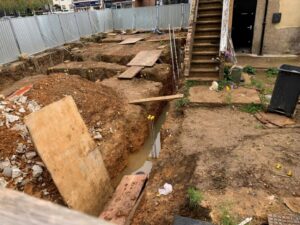
Images from site show poor work at height practices and failures to suitably plan, manage and monitor the construction work.

Contractors have a responsibility to plan, manage and monitor construction work to ensure that it is carried out without risks to health or safety. Further guidance on Managing health and safety in construction – HSE can be found on HSE’s website.

The company, VNP Constructions Limited, of Kings Avenue, Winchmore Hill, London, pleaded guilty to breaching Regulation 15(2) of the Construction (Design and Management) Regulations 2015 and to two counts of failing to comply with a Prohibition Notice contrary to Section 33(1)(g) of the Health and Safety at Work etc Act 1971.

The company was fined £7200 and ordered to pay £900 in costs at the same hearing.

The Director, Vasilis Paraskeva, of Kings Avenue, Winchmore Hill, London, pleaded guilty to three offences on the basis that the company had committed the above three offences and those offences were committed with his consent or connivance or was attributable to his neglect by virtue of S37(1) of the Health and Safety at Work Act 1974

He was fined £10,800 and ordered to pay £900 in costs at Snaresbrook Crown Court on 7 January 2026.

Speaking after the hearing, HSE inspector Andrew Pipe said: “These fines should send a clear message to the construction industry that HSE and the courts take failure to comply with enforcement notices extremely seriously.

“HSE will not hesitate to take action against companies and individuals who fail to keep people safe.”

This HSE prosecution was brought by HSE Enforcement Lawyer Matthew Reynolds and Paralegal Officer Melissa Wardle.

Further Information

  1. The Health and Safety Executive (HSE) is Britain’s national regulator for workplace health and safety. We are dedicated to protecting people and places, and helping everyone lead safer and healthier lives.
  2. More information about the legislation referred to in this case is available.
  3. Further details on the latest HSE news releases is available.
  4. Relevant guidance can be found here Managing health and safety in construction – HSE
  5. HSE does not pass sentences, set guidelines or collect any fines imposed. Relevant sentencing guidelines must be followed unless the court is satisfied that it would be contrary to the interests of justice to do so.  The sentencing guidelines for health and safety offences can be found here.


Graham Farrant appointed to HSE Board

Sir Stephen Timms, Minister of State, has confirmed the appointment of Graham Farrant as a new non-executive director on the board of the Health and Safety Executive (HSE).

Graham will bring a wealth of experience from local government and public sector to help HSE continue to deliver its mission: Protecting People and Places.

On his appointment, Sarah Newton, HSE Board Chair, said:

“I am delighted that Graham Farrant will be joining us on the HSE Board. I’m looking forward to welcoming Graham into our team of effective and committed non-executive directors focused on enabling the delivery of HSE’s vitally important mission, vision and ten-year strategy.”

Graham Farrant

Graham Farrant

Graham has worked over 47 years in or for local government and the private sector, including 25 years as a Chief Executive.

From January 2019, Graham was the Chief Executive at Bournemouth, Christchurch and Poole (BCP) Council, until he retired in August 2025. He formed one of the most complex piece of local government reorganisation in the country for 40 years, absorbing services from Bournemouth unitary authority, Poole unitary authority, Christchurch district council and Dorset County Council.

Prior to joining BCP Council Graham was Chief Executive and HM Chief Land Registrar, running HM Land Registrar. Before that he was the Chief Executive of Thurrock Council; the London Borough of Barking and Dagenham (twice); Brentwood Council; private equity-backed leisure operator Leisure Connection; and national business and sports consultancy pmpgenesis. He first qualified as an Environmental Health Officer working at Westminster City Council and has a degree in Environmental Health and a Master’s Degree in Environmental Pollution Science, alongside a masters-level qualification in Executive Coaching.

Graham replaces Martin Esom, first appointed in 2017, who is due to step down from the Board in March 2026.

About HSE

  1. The Health and Safety Executive (HSE) is Britain’s national regulator for workplace health and safety. We prevent work-related death, injury and ill health through regulatory actions that range from influencing behaviours across whole industry sectors through to targeted interventions on individual businesses. These activities are supported by globally recognised scientific expertise. hse.gov.uk.
  2. HSE is an Executive Non-Departmental Public Body sponsored by the Department for Work and Pensions (DWP).


Engineering firm fined £27,200 after endangering workers

  • HSE inspection found poor control of metalworking fluids on CNC machines.
  • Workers were put at risk of ill-health including dermatitis, asthma and other respiratory conditions.
  • The firm failed to comply with Improvement Notices issued by HSE inspectors.

An engineering firm in Bedfordshire has been fined £27,200 after poor management of safety put employees at risk of ill-health including dermatitis, asthma and other respiratory conditions.

The Health and Safety Executive (HSE) prosecution was the result of a routine inspection in July 2022. HSE inspectors. identified a number of concerns which were brought to the company’s attention, specifically on the use of metalworking fluids in CNC machines.

This led to HSE inspectors serving formal Improvement Notices, which required the company to prepare a suitable risk assessment for the activities, and to have appropriate testing and monitoring arrangements in place.

When HSE conducted a follow-up inspection it found that, despite the requirements of the Improvement Notices, the company had failed to undertake a suitable assessment. Documentation still failed to identify hazards and potential health effects, did not consider measures necessary to reduce the risk of inhalation of metalworking fluid mist, and did not consider or implement suitable arrangements to maintain metalworking fluid quality. Inspectors also found that testing of fluids remained less frequent than recommended in guidance. The company had not complied with the Improvement Notices, and a prosecution was commenced in January 2024.

HSE guidance states that employers must maintain fluid quality and control bacterial contamination of fluids, minimise skin exposure to fluids, prevent or control airborne mists and, where there is exposure to fluid or mist, carry out appropriate health surveillance. Further guidance on Metalworking fluids – HSE can be found on HSE’s website.

Tracel Ltd, trading as The Engineering Quest, of Sand Road Industrial Estate, Great Gransden, Sandy, Bedfordshire, pleaded guilty to breaching Regulation 6 of the Control of Substances Hazardous to Health Regulations and to two charges of breaching Section 21 of the Health and Safety at Work etc. Act 1974. District Judge Sally Fudge fined the company £27,200 and ordered to pay £30,000 in costs at Luton Magistrates’ Court on 8 January 2026.

HSE Inspector Stephen Manley said:
“We are committed to maintaining Great Britain’s record as one of the safest countries to work in, and our inspection activity is central to delivering this.  “This case was entirely avoidable had the company taken appropriate action following our inspection, and I hope it encourages others to review their arrangements.

“Poor management of the use of metalworking fluids still leads to workers developing lung diseases and dermatitis. Employers must consider how these fluids are used and take steps to reduce and control exposure.”

This HSE prosecution was brought by HSE senior enforcement lawyer Jon Mack and paralegal officer Gabrielle O’Sullivan.


Further information:

  1. The Health and Safety Executive (HSE) is Britain’s national regulator for workplace health and safety. We are dedicated to protecting people and places, and helping everyone lead safer and healthier lives.
  2. More information about the legislation referred to in this case is available.
  3. Further details on the latest HSE news releases is available.
  4. Relevant guidance can be found at Metalworking fluids – HSE
  5. HSE does not pass sentences, set guidelines or collect any fines imposed. Relevant sentencing guidelines must be followed unless the court is satisfied that it would be contrary to the interests of justice to do so.  The sentencing guidelines for health and safety offences can be found here.


Glasgow City Council fined £80,000 after military veteran struck by collapsing lamppost

  • Man was struck standing next to colleague
  • Life changing injuries inflicted
  • Lamppost was badly corroded and beyond its expected lifespan

Glasgow City Council has been fined £80,000 after a military veteran sustained life-changing injuries when he was struck by a falling lamppost in the city’s west end in June 2023.

A 50-year-old man was standing at the roadside in conversation with a work colleague when the lamppost collapsed, striking him from behind and pinning him to the ground. Overhead cables attached to the lamppost were then snagged by a passing motor vehicle, which dragged the collapsed lamppost over the man.

The incident occurred just after 4pm, on 20 June 2023, on Bellshaugh Road at its junction with Kirklee Gardens and Cleveden Drive, close to Kelvinside Academy. The area was busy with both adult and child pedestrians, with it being a school day.

Incident lamppost prior to collapse

The man sustained severe, life-threatening and life-changing including multiple spinal, pelvic and rib fractures, an open leg fracture, and a fractured left ankle . He spent seven weeks in hospital and has since undergone multiple surgeries, and continues to receive medical treatment. He now has reduced mobility and significant ongoing pain.

Prior to the incident, the injured person retained a high level of fitness and had a very active lifestyle, including regular hill walking and leading a section of army cadets.

An investigation by the Health and Safety Executive (HSE) established that the lamppost had structurally failed due to severe corrosion at its base. Loss of steel thickness of at least 60 per cent due to corrosion was measured, with many areas showing significantly greater loss. The lamppost, manufactured in the 1950s or 1960s, was well over twice its expected service life of 20-25 years.

HSE Science Division utilised an arm scanner (image above) during their investigation to gain a detailed understanding of the level of corrosion in the lamppost (image below)

During the last Council inspection in March 2022, the column was identified as being in poor condition and scheduled it for replacement in April 2024. However, HSE’s investigation found that the Council’s inspection regime failed to identify the extent of corrosion and the immediate risk of collapse. The visual inspections undertaken were inadequate in correctly identifying the condition of the column, the risk of failure and the action required.

The Council did not follow established industry guidance, issued by the Institution of Lighting Professionals, by not prioritising the removal of lighting columns assessed as being in poor condition relative to the consequence of their failure.

Following the incident, the Council removed other similar lamppost with base embellishments from around Glasgow and has since updated its lighting maintenance procedures.

Image of the corroded lamppost following the collapse

Glasgow City Council, of City Chambers, George Square, Glasgow, G2 1DU, pleaded guilty to breaching Section 3(1) of the Health and Safety at Work etc. Act 1974. The Council was fined £80,000 at Glasgow Sheriff Court on 8 January 2026.

Speaking after the hearing, HSE inspector Hazel Dobb said: “This incident in which a man sustained devastating, life-changing injuries should never have happened.

“The lamppost that struck him had been identified as being in poor condition, yet inadequate inspections failed to recognise that it was severely corroded and at immediate risk of collapse.

“This case is a stark reminder that local authorities and other duty holders must have effective systems in place to properly assess and manage the risks posed by ageing street infrastructure.”

Further information

  1. The Health and Safety Executive (HSE) is Britain’s national regulator for workplace health and safety. We are dedicated to protecting people and places, and helping everyone lead safer and healthier lives.
  2. More information about the legislation referred to in this case is available.
  3. Further details on the latest HSE news releases is available.
  4. Relevant guidance can be found here:
  5. HSE does not pass sentences, set guidelines or collect any fines imposed.