On 9 May regional and local leaders will discuss with citizens how to bring the Conference on the Future of Europe to regions, cities and villages across the EU
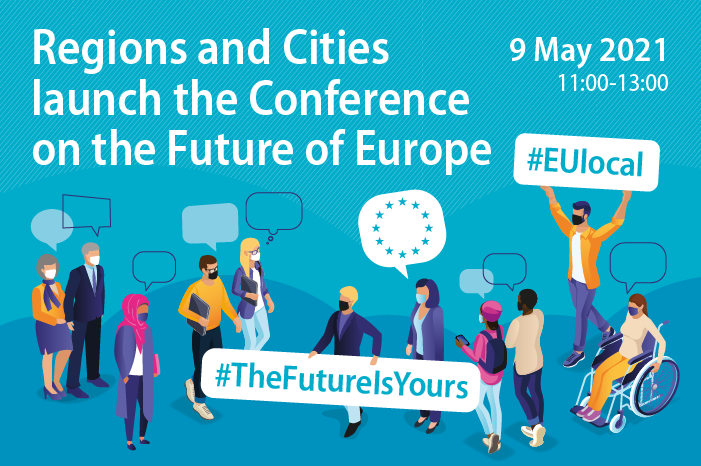
The local dialogue in Strasbourg is organised by the European Committee of the Regions with the French Ministry for territorial cohesion, the City of Strasbourg, the French associations Régions de France, the Assembly of Départements de France and the association of French Mayors.​​​​

The local event will be attended, among others, by Commissioner Šuica, MEP Verhofstadt and Portuguese Secretary of State for European Affairs, Ana Zacarias.

On the occasion of the launch of the Conference on the Future of Europe on 9 May in Strasbourg, the European Committee of the Regions is organising, together with the French government and the main French territorial associations, a local dialogue which will give the floor to local and regional elected representatives from all over Europe and to European citizens. The debate will take place immediately before the official launch of the Conference with the aim of marking its territorial dimension and guaranteeing that it reaches out to people in regions, cities and villages across Europe. Participants will discuss how to best involve local elected politicians and local communities in the Conference and how to ensure a stronger role for local and regional authorities in the Europe of tomorrow.

The event is organised jointly with the French Ministry for territorial cohesion and relations with local and regional authorities, the City and Eurometropole of Strasbourg, the French associations Régions de France, Assembly of Départements de France and the association of French Mayors. The local event will be attended, among others, by Apostolo​s Tzitzikostas, President of the European Committee of the Regions, Dubravka Šuica, Vice-President of the European Commission in charge of Democracy and Demography, Guy Verhofstadt, Co-Chair of the Executive Committee of the Conference on the Future of Europe, and Ana Paula Zacarias, Portuguese Secretary of State for European Affairs. Representatives from prominent EU associations and movements will also join the debate.

The event’s detailed programme is available online and below.

Practical information:

–      Date and time: Sunday 9 May, 11:00-13:00

–      Place: Strasbourg City Hall, Grand Salon and online (Zoom platform)

–      Web-streaming platforms: CoR website CoR Facebook page CoR YouTube channel

–      Interpretation in FR, EN, DE, IT, ES, PL

–     Link to the event: https://euconf-eu.zoom.us/j/96601118862?pwd=dHFnYWt5L3N3d3ZZL1dheCtYaE1oZz09

Meeting ID: 966 0111 8862

Passcode: 711754- Event listed on the Conference multilingual online platform.

Full programme:

The Conference on the Future of Europe: an opportunity to build together the “European House of Democracy” on the foundations of its regions, cities and villages

Moderator: Rebecca Donauer, journalist, ARTE

Introduction (11:00-11:15):

European Anthem

Introduction by Jeanne Barseghian, Mayor of Strasbourg and 1st Vice-President of the Eurometropolis of Strasbourg and André Viola, President of the French delegation to the European Committee of the Regions, Member of the Aude Departmental Council

Panel 1: Engaging in local dialogue with citizens for a more resilient Europe

(11h15-12h00)

Pre-recorded videos of citizens from civil society, academic, economic or cultural spheres answering: What is the CoFE? What is citizens’ place in the EU? The future of Europe in three words?

Debate among speakers:

Apostolos Tzitzikostas, President of the European Committee of the Regions, Governor of the Region of Central Macedonia, Greece

Dubravka Šuica, Vice-President of the European Commission, Commissioner for Democracy and Demography

Guy Verhofstadt, Co-Chair of the Executive Committee of the Conference on the Future of Europe

Ana Paula Zacarias, Portuguese Secretary of State for European Affairs

The contribution of the future French Presidency:

Joël Giraud, Secretary of State in charge of rurality in the Ministry for Territorial Cohesion and Relations with Local Government

Renaud Muselier, President of the French Regions, President of the Provence-Alpes-Côte d’Azur Region

Frédéric Bierry, President of the European Collectivity of Alsace

François Baroin, President of the Association of Mayors of France, Mayor of Troyes Contribution of a European association: 

The contribution of the Council of European Municipalities and Regions (CEMR):

Stefano Bonaccini, President of the Council of European Municipalities and Regions (CEMR), President of the Emilia Romagna region​

Panel 2: Strengthening democratic legitimacy: a Conference for and with citizens – the contribution of the

European Committee of the Regions (12h0012h50)

Pre-recorded videos of citizens from civil society, academic, economic or cultural spheres stating how they see the future of Europe.

Debate among speakers:

The contribution of Youth associations:

Eva Maydell, President of the International European Movement, MEP

Silja Markkula, President of the European Youth Forum

The contribution of CoR members:

Olgierd Geblewicz, President of the EPP Group in the European Committee of the Regions, President of the Western Pomerania Region

Christophe Rouillon, President of the PES Group in the European Committee of the Regions, Mayor of Coulaines François Decoster, President of the Renew Europe Group in the European Committee of the Regions, Mayor of Saint-Omer

Władysław Ortyl, President of the ECR Group in the European Committee of the Regions, President of the Podkarpackie Region

Kieran McCarthy, President of the EA Group in the European Committee of the Regions, Member of Cork City Council Ms Satu Haapanen, Co-Chair of the Greens Group in the European Committee of the Regions, Member of Oulu City Council

Closing remarks by Vasco Alves Cordeiro, First Vice-President of the CoR and Member of the Regional Parliament of the Azores

Contact:

Marie-Pierre Jouglain

mariepierre.jouglain@cor.europa.eu

Mobile: +32 473 52 41 15


Remarks by President Charles Michel after the informal meeting of the members of the European Council and the EU-India Leaders' meeting in Porto

Mes premiers mots sont naturellement pour António Costa, le premier ministre du Portugal. Pour adresser, au nom de tous les collègues, nos remerciements pour l’organisation à la fois hier, d’un premier sommet social qui marque une étape essentielle dans l’histoire de la construction européenne, et pour avoir veillé à ce que l’on puisse travailler de manière sérieuse et intense, sur différents thèmes que nous avons abordés dans des conditions tout à fait optimales. Merci beaucoup, António, pour ton hospitalité. Merci aussi à l’ensemble de tes équipes qui ont été mobilisées pour permettre cet accueil dans cette jolie ville de Porto.

Vous le savez, nous avons eu un moment important, exceptionnel même, qui vient de se terminer à l’instant: cette rencontre avec le Premier ministre Modi, qui partage d’ailleurs des liens particuliers, spéciaux, avec le Premier ministre du Portugal.

First, I would like to thank you for hosting this important EU-India leaders meeting with Prime Minister Modi. We expressed our sympathy to Prime Minister Modi and the people of India as they battle the current COVID surge. The European Union stands in full solidarity with India at this critical time. We already activated our help mechanism and we are ready to provide further support.

COVID is the greatest challenge of global solidarity in generations. The only way out is to immunise the global population. We discussed EU-India cooperation on this matter.

I’m also happy to announce that the EU and India are opening a new important chapter in our relationship. We are the world’s two largest democracies. We are natural partners in many areas. This partnership, based on shared values and convergent interests, will benefit our citizens, the Indo-Pacific region and the wider world. We have today agreed on concrete steps to expand this strategic partnership.

Today, we agreed to launch negotiations on a mutually reinforcing agreement on trade, on investment protection and on geographical indications. This is an important first step. We have also launched our new Connectivity Partnership, and this is a major project that will promote high standards, infrastructure for sustainable and resilient economic growth, and foster exchanges between our people.

We have resumed our human rights dialogue after eight years and this is very good news because human rights, gender equality and equal opportunities are at the heart of our engagement with India.

Our security cooperation is growing in many areas, from securing maritime routes to combating terrorism and fighting cybercrime. Today, we showed the strength of the EU-India relationship and its great potential.

Nous avons aussi eu hier soir un échange de vue sans conclusions écrites sur la question du COVID-19. Je voudrais résumer brièvement les quelques points qui traduisent le débat politique qui est intervenu dans le cadre de cette réunion informelle du Conseil européen.

Premier point: de manière générale, nous constatons des progrès significatifs sur le plan européen en termes de production et de distribution de doses de vaccins. C’est un point qui a été salué par l’ensemble des délégations mentionnant le rôle important joué à cet égard par la Commission européenne.

Deux, nous mesurons bien que nous devons rester vigilants, attentifs, s’agissant de la question des mutations et des variants. Un monitoring permanent est nécessaire. Nous le menons, et la nécessité de continuer à soutenir activement la science et la recherche est nécessaire également sur ce sujet-là.

Trois, nous avons eu un débat sur l’avancement de notre ambition de développer une même approche en termes de « certificat vert européen ». Les trilogues ont démarrés dans le cadre de la responsabilité de la présidence portugaise. Et nous avons considéré que c’était important lors du prochain Conseil européen, qui devrait avoir lieu à Bruxelles le 25 mai, de revenir sur ce sujet pour s’assurer que des progrès auront été réalisés et que l’on pourra tenter de résoudre les quelques difficultés auxquelles nous sommes encore confrontés afin de retrouver progressivement une capacité de circuler en Europe, grâce à cet instrument commun que nous souhaitons mettre en place.

Le quatrième point qui a animé notre débat, c’est bien sûr l’engagement de l’Union européenne pour la solidarité internationale. Nous le savons, vous le savez, personne ne sera en sécurité face à cette pandémie si le monde entier n’est pas protégé, si le monde entier n’est pas en sécurité. C’est la raison pour laquelle depuis le premier jour de cette mobilisation à l’échelle européenne, il y a plus d’un an, contre le COVID-19, nous avons affirmé cette solidarité.

D’abord en mobilisant beaucoup de moyens pour la recherche et contribuer à ce que rapidement les vaccins puissent être disponibles pour l’humanité.

Ensuite, en participant activement à cette initiative COVAX, pour veiller à ce que dans tous les pays du monde des doses puissent être accessibles. L’Union européenne est un contributeur majeur de ce projet COVAX.

Trois, en veillant, et c’est un point essentiel, à ce qu’au départ de l’Union européenne les exportations de vaccins soient possibles. C’est autour de 50% des doses produites sur le sol européen qui sont exportées, ce qui témoigne de la solidarité, de notre engagement à maintenir les chaînes d’approvisionnement ouvertes. Et on encourage tous nos partenaires, y compris les pays producteurs de vaccins, à suivre cet exemple en protégeant et en maintenant les chaînes d’approvisionnement et en faisant en sorte que les exportations soient possibles.

Bien sûr, nous avons eu le débat aussi sur la question de la propriété intellectuelle des vaccins, et de la libéralisation de la propriété intellectuelle de vaccins.

Différents sentiments et opinions ont été exprimés par rapport à cela. Nous sommes déterminés à soutenir tout ce qui peut conduire à augmenter la production sur le plan mondial et la délivrance rapide de vaccins.

Cependant, à court terme, beaucoup d’entre nous autour de la table pensent que ce n’est pas une solution magique qui résoudrait tout. Il va de soi que nous sommes prêts à rester engagés sur des débats extrêmement concrets. C’est par exemple ce que nous faisons en Europe depuis quelque temps déjà, avec des pays Africains, pour tenter de stimuler les partenariats privé-public et le support des institutions européennes pour concrètement augmenter les capacités de production, et veiller à la diversification des chaînes d’approvisionnement dans le secteurs pharmaceutique.

And last but not least, our social commitment and our social ambition. This was a very important meeting yesterday with the very strong participation of many Heads of States or governments, which is a very clear signal and a very clear symbol of our European ambition at the social level.

And we remember, four years ago in Gothenburg, the first important step under the leadership of Stefan Löfven. Four years later, with this very strong commitment of António Costa and the President of the Commission, we are taking one more step in the direction of a more social Europe. 

La réunion d’hier a été une réunion enthousiasmante. Parce que nous mesurons qu’au-delà des différences entre les différents pays européens, entre les différents acteurs de la société économique, sociale, la société civile, les acteurs politiques, il y a de plus en plus une convergence fondée sur cette conviction que la dignité de chaque Européen passe par la capacité à consolider le modèle social. Les débats ont été riches, les débats ont été vifs. La Commission a mis sur la table un plan d’action qui est une épine dorsale et qui va animer le débat démocratique européen au sens noble du terme, tout au long des prochains mois.

Et il y a un élément important que je voudrais souligner.  Pour la première fois, avec une grande clarté, a été exprimée au travers des conclusions validées à l’unanimité ce matin par les chefs d’états et de gouvernement, l’ambition de traiter au plus haut niveau du Conseil européen cette ambition sociale.

C’est aussi un engagement de revenir régulièrement au niveau des chefs d’Etat et de gouvernement pour apprécier les progrès que nous espérons voir réalisés dans cet engagement social de l’Union européenne. Un engagement pour une Europe plus verte, qui prend à bras le corps les défis du changement climatique. Une Europe plus digitale, qui considère qu’il y a là un levier pour la modernisation, mais aussi pour le renforcement de la prospérité. Et une Europe plus sociale qui veille à ce qu’il y ait la fraternité, de la solidarité et un accès égal aux opportunités pour l’ensemble des citoyens européens.

Voilà le chemin qui a été décidé aujourd’hui à Porto. Merci encore à  toi, António, pour ta motivation et pour ton engagement.


Joint Statement – EU-India Leaders’ Meeting, 8 May 2021

We use cookies in order to ensure that you can get the best browsing experience possible on the Council website. Certain cookies are used to obtain aggregated statistics about website visits to help us constantly improve the site and better serve your needs. Other cookies are used to boost performance and guarantee security of the website.


EU-India Connectivity Partnership, 8 May 2021

We use cookies in order to ensure that you can get the best browsing experience possible on the Council website. Certain cookies are used to obtain aggregated statistics about website visits to help us constantly improve the site and better serve your needs. Other cookies are used to boost performance and guarantee security of the website.


The Porto declaration

1. We underline the importance of European unity and solidarity in the fight against the COVID-19 pandemic. These values have defined the response of European citizens to this crisis and also lie at the heart of our common project and distinctive social model. More than ever, Europe must be the continent of social cohesion and prosperity. We reaffirm our pledge to work towards a social Europe.

2. Since the start of the COVID-19 pandemic, swift, critical and comprehensive action at EU and national level has protected millions of lives, jobs and businesses.

3. The same spirit of unity and solidarity inspired our historic agreement in July 2020 on the Multiannual Financial Framework and the specific Recovery effort under Next Generation EU. As we accelerate the green and digital transitions, this massive European investment and the associated reforms will set the Union and its Member States firmly on the path of reform towards a fair, sustainable and resilient recovery. A collective, inclusive, timely, and cohesive recovery will strengthen Europe’s competitiveness, resilience, social dimension and role on the global stage.

4. We welcome the high-level conference organised by the Portuguese Presidency in the context of the Porto Social Summit and take note of its outcome. The European Pillar of Social Rights is a fundamental element of the recovery. Its implementation will strengthen the Union’s drive towards a digital, green and fair transition and contribute to achieving upward social and economic convergence and addressing the demographic challenges. The social dimension, social dialogue and the active involvement of social partners have always been at the core of a highly competitive social market economy. Our commitment to unity and solidarity also means ensuring equal opportunities for all and that no one is left behind.

5. As established by the EU Strategic Agenda 2019-2024, we are determined to continue deepening the implementation of the European Pillar of Social Rights at EU and national level, with due regard for respective competences and the principles of subsidiarity and proportionality. The Action Plan presented by the Commission on 4 March 2021 provides useful guidance for the implementation of the European Pillar of Social Rights, including in the areas of employment, skills, health, and social protection.

6. We welcome the new EU headline targets on jobs, skills and poverty reduction and the revised Social Scoreboard proposed in the Action Plan that will help to monitor progress towards the implementation of the Social Pillar principles, taking into account different national circumstances, and as part of the policy coordination framework in the context of the European Semester.

7. As Europe gradually recovers from the COVID-19 pandemic, the priority will be to move from protecting to creating jobs and to improve job quality, where small and medium-sized enterprises (including social enterprises) play a key role. The implementation of the principles in the European Pillar of Social Rights will be essential to ensure the creation of more and better jobs for all within the framework of an inclusive recovery. In this respect, relevant legislative and non-legislative work should be taken forward at EU and Member States level.

8. We will put education and skills at the centre of our political action. The green and digital transitions will bring enormous opportunities for European citizens but also many challenges, which will require more investment in education, vocational training, lifelong learning, upskilling and reskilling, so as to stimulate employment transitions towards sectors where there is a growing demand for labour. At the same time, changes linked to digitalisation, artificial intelligence, teleworking and the platform economy will require particular attention with a view to reinforcing workers’ rights, social security systems and occupational health and safety.

9. We are committed to reducing inequalities, defending fair wages, fighting social exclusion and tackling poverty, taking on the objective of fighting child poverty and addressing the risks of exclusion for particularly vulnerable social groups such as the long-term unemployed, the elderly, persons with disabilities and the homeless.

10. We will step up efforts to fight discrimination and work actively to close gender gaps in employment, pay and pensions, and to promote equality and fairness for every individual in our society, in line with fundamental principles of the European Union and principle 2 of the European Pillar of Social Rights.

11. We will prioritise action to support young people, who have been very negatively affected by the COVID-19 crisis, which has profoundly disrupted their participation in the labour market as well as their education and training plans. Young people represent an indispensable source of dynamism, talent and creativity for Europe. We must make sure that they become the driving force of the inclusive green and digital recovery to help build the Europe of the future, including by using the full potential of Erasmus + to foster mobility across Europe for all students and apprentices.

12. We stress the importance of closely following, including at the highest level, the progress achieved towards the implementation of the European Pillar of Social Rights and the EU headline targets for 2030.

13. We welcome, as another success of European social dialogue, that the European Social Partners have made a joint proposal for an alternative set of indicators to measure economic, social and environmental progress, supplementing GDP as welfare measure for inclusive and sustainable growth.