EU’s humanitarian action: Council adopts conclusions

Today the Council adopted conclusions welcoming the Communication from the Commission to the European Parliament and the Council on the “EU’s humanitarian action: new challenges, same principles“.

In its conclusions the Council expresses serious concern at the unprecedented scale of humanitarian needs, the shrinking of humanitarian space and the growing funding gap.

It therefore stresses the importance of putting respect for and compliance with international humanitarian law consistently at the heart of the EU’s external action, as well as ensuring the protection of civilians and civilian infrastructure, supporting and promoting principled humanitarian action and safeguarding humanitarian space.

The Council underlines the urgent need to enhance global efforts to significantly increase the resource base for humanitarian action, as well as the importance of delivering humanitarian aid more efficiently with available resources.

The Council conclusions highlight the essential coordinating role of the United Nations in responding to humanitarian crises, and the need to step up support for local and national actors, recognising their knowledge and experience as frontline responders that are in place before, during and after emergencies.

For this reason, the Council welcomes the Commission’s intention to organise a European Humanitarian Forum to promote a high level, strategic discussion on humanitarian issues, and sustained dialogue with its key partners from the UN system, international organisations, the International Red Cross and Red Crescent Movement, civil society and other donors.

Finally, the Council affirms the need for a more consistent and effective implementation and operationalisation of the humanitarian-development-peace nexus approach. It underlines that the different actors involved must work in a coordinated way, while fully respecting humanitarian principles in the provision of humanitarian assistance and in full compliance with their respective mandates and objectives.


Media advisory – technical background briefing on current foreign policy topics, including recent violence in and around Gaza in the follow-up to the informal VTC of EU Foreign Ministers

A technical background briefing on current foreign policy topics, including recent violence in and around Gaza, in the follow-up to the informal video conference of EU Foreign Ministers will take place via video conference on Friday, 21 May 2021 at 14.00.

This briefing is “off the record”.

In order to ask questions remotely, EU accredited journalists can register using this link.

Journalists who already registered for previous Foreign Affairs press events do not need to register again.

– Deadline for registration: Friday, 21 May 2021, 12.30

Further instructions will be sent to all registered participants approximately half an hour after the deadline.


Hit against euro counterfeiters linked to the Camorra

On 20 May 2021, Europol supported the German Regional Criminal Police of Nordrhein-Westfalen (Landeskriminalamt Nordrhein-Westfalen) and the Italian Finance Corps (Guardia di Finanza) of Rome and Naples in dismantling an organised crime group involved in the production and distribution of counterfeit euro banknotes, drug trafficking and tax fraud. Law enforcement authorities from the BelgianFederal Police (Federale Politie, Police Fédérale) and the French National Police (Police Nationale) also assisted the investigation. The suspects are believed to have ties to the Camorra mafia clan.

The action day led to:

  • 19 house searches (1 in Naples and 18 in Germany )
  • 4 persons arrested (Italian nationals)
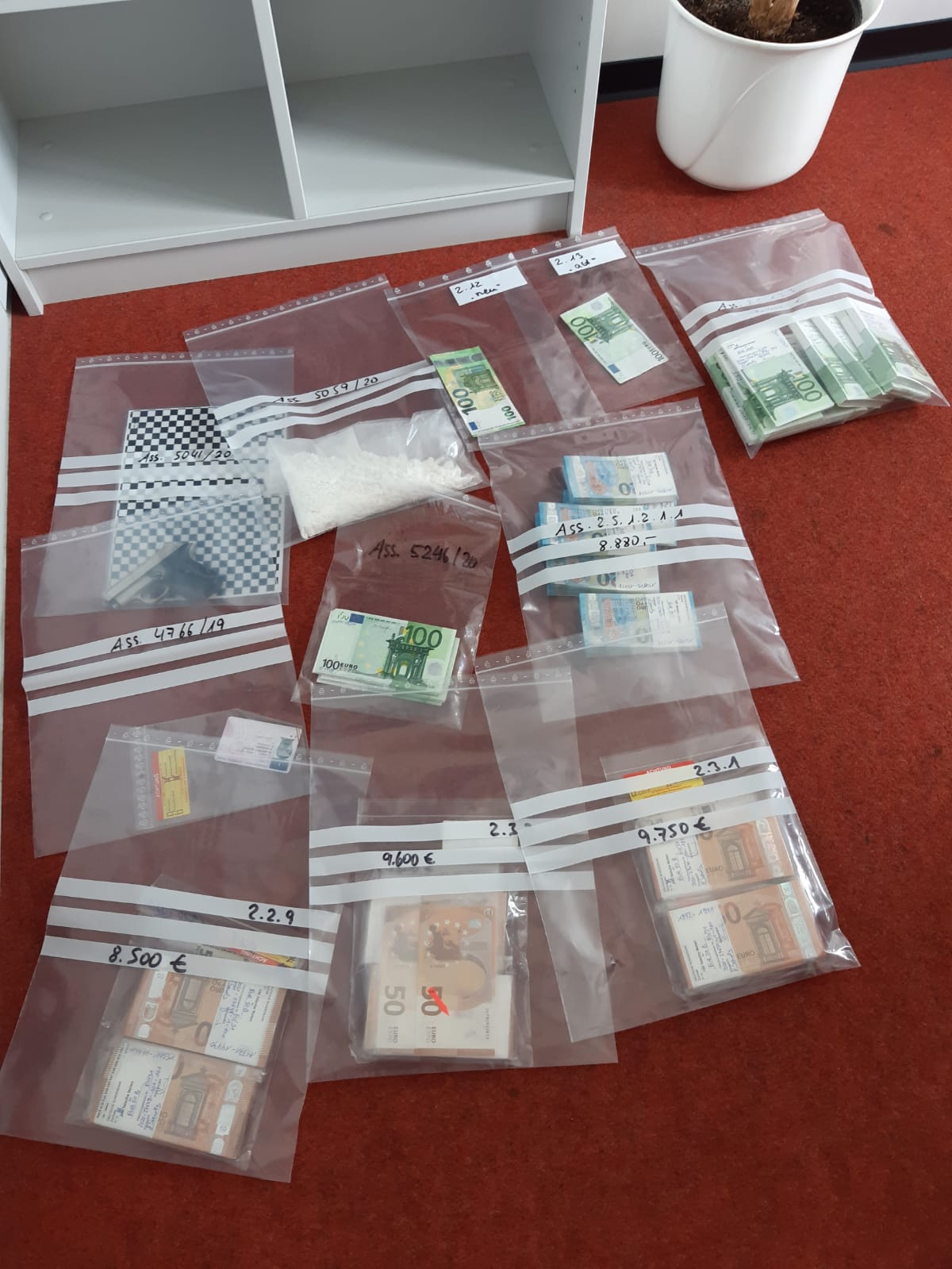
  • Seizures include various documents such as accounting records, IT evidence and €30 000 in cash
  • Judicial security order of €415 000 in total, issued by Germany 

The criminal network is involved in the production of counterfeit euros in the area of Naples in Italy and their subsequent distribution in Germany. 
The main suspect is also believed to be involved in the trafficking of different illegal commodities including drugs, stolen vehicles and falsified documents. He is suspected of distributing these illegal commodities, acquired by his associates living in Naples and connected to the Camorra. 

During the course of the investigation law enforcement officers made several seizures including cocaine, an illegal firearm and counterfeit money for a value of about €160 000.  This investigation also led to the first seizure of a counterfeit banknote of the new €100, just six months after its official release by the European Central Bank.

Europol facilitated the information exchange, operational coordination and provided analytical support. During the action day, Europol supported with technical expertise and cross-checked operational information against Europol’s databases and the systems of the European Central Bank. 

This investigation is part of the Italian DIA Project ONNET, an EU-financed initiative to tackle mafia-type organised crime groups active in Europe. The project was launched at Europol’s headquarters and targets the mafia-style criminal groups in their entirety, rather than one or more of their specific criminal activities.

Headquartered in The Hague, the Netherlands, Europol supports the 27 EU Member States in their fight against terrorism, cybercrime, and other serious and organized crime forms. Europol also works with many non-EU partner states and international organisations. From its various threat assessments to its intelligence-gathering and operational activities, Europol has the tools and resources it needs to do its part in making Europe safer.


EU supports start of WHO process for establishment of Pandemic Treaty: Council decision

The Council adopted today a decision to support the launch of negotiations for an international treaty on the fight against pandemics. The World Health Assembly, the main governing body of the WHO, is expected to back the establishment of a process for a Framework Convention on Pandemic Preparedness and Response during its (virtual) meeting which starts on 24 May. The proposal for an international treaty on pandemics was first announced by the President of the European Council, Charles Michel, at the Paris Peace Forum in November 2020.

The objective of the Council decision is to assure the participation of the EU in the negotiations addressing matters falling within Union competence, in view of the Union’s possible accession to the treaty.

The proposal to conclude a treaty on pandemics is discussed in the context of international efforts to reinforce global health security, in particular on preparedness and response to health emergencies, in light of lessons learnt from the pandemic.

Background and next steps

At the European Council of 25 February 2021 EU leaders underlined the need for global multilateral cooperation to adress current and future health threats and agreed to work on an international treaty on pandemics within the WHO framework and to advance global health security.

On 30 March 2021, leaders from all around the world joined the President of the European Council and the Director-General of the World Health Organization, Dr. Tedros Adhanom Ghebreyesus, in an open call for an international treaty on pandemics.

The European Union has an informal observer status at the WHO.


EU ready to discuss EEA states’ financial contribution to social and economic cohesion for 2021-2027

The Council adopted today a decision authorising the opening of negotiations with Iceland, the Principality of Liechtenstein and the Kingdom of Norway for an agreement on the future financial contribution of the EEA EFTA States to social and economic cohesion in the European Economic Area.

The Council also adopted negotiating directives which constitute a mandate to the Commission for the negotiations.

On the basis of this mandate, negotiations should now be conducted and concluded swiftly, in order to ensure that the instruments for adopting the above arrangements enter into force as soon as possible, taking into account the timeline of the next seven-year-period for the EU cohesion policy instruments.

Following the expiry of the EEA and Norway Financial Mechanisms 2014-2021 on 30 April 2021,  the new mechanism for financial contributions from the three partner countries will be aimed at alleviating social and economic disparities in the European Economic Area in the period 2021–2027.