EIOPA finalises the regulation of the pan-European Personal Pension Product

Today the European Insurance and Occupational Pensions Authority (EIOPA) delivered to the European Commission a set of draft Regulatory and Implementing Technical Standards and its advice on Delegated Acts to implement the framework for the design and delivery of the Pan-European Personal Pension Product (PEPP).

EIOPA’s proposed legal instruments follow the objective to unlock the potential of the European personal pension market by setting the right incentives for the creation of future PEPPs, as portable, simple and cost-efficient products. The regulatory provisions include clear and enforceable quality criteria for PEPP to be followed by providers and so to ensure that European consumers will be offered high-quality, safe, transparent and simple PEPPs. At the same time, EIOPA is leaving sufficient room for innovation and competition to reach good pension outcomes. Clear criteria for sound and robust investment strategies and risk mitigation techniques will help in delivering better long-term returns to savers and in managing investment risks to match the European citizen’s risk appetite.

In this regard, EIOPA developed two mandatory consumer information documents: the PEPP Key Information Document (PEPP KID) and PEPP Benefit Statement. These standardised information documents will provide consumers with relevant information allowing for easier decision-making before entering into a binding contract and monitoring the savings’ performance during the life of the contract.

The PEPP consumer information documents introduce a holistic approach for the assessment and analysis of the PEPPs’ risk-reward profiles, with a ‘summary risk indicator’ in the PEPP KID that identifies the riskiness of the different PEPP investment options – as well as comparative information to understand the relative risk to the expected future PEPP retirement benefits. Further, projections of future retirement income are key for consumers to understand the characteristics of PEPPs and to enable the consumer to consider whether the product meets the individual retirement objectives. 

Furthermore, online distribution will be one of the most important opportunities of PEPPs to attract the consumer’s interest and to engage with the PEPP saver for the retirement planning. It will be particularly critical that consumers can easily access, understand and use the information presented in a digital format. The use of digital means is expected to bring important cost-efficiencies in the distribution process.

Cost-efficiency is also one of the major goals for the success of the PEPP. In case of the Basic PEPP the annual cost will be limited to 1% of the PEPP saver’s accumulated capital at the end of each year. The Basic PEPP – the core or default investment option – has been specifically regulated to offer a relatively high level of capital protection, which can be further extended to a capital guarantee. The cost of providing that guarantee is excluded from the cost cap but must be expressly disclosed.

Finally, the success of PEPP will depend on strong supervision and close cooperation between national competent authorities in the different Member States. EIOPA is of the view that regular supervisory reporting and solid product intervention powers will be necessary to ensure efficient and effective supervision and monitoring of the PEPP market, both at national and European level.

In developing its proposals, EIOPA built on the expertise of the supervisory community of both the insurance and pension sectors, as well as of the other European Supervisory Authorities, the European Central Bank and the Organisation for Economic Co-operation and Development. At the same time, EIOPA conducted an active dialogue with a wide range of stakeholders, including EIOPA’s Expert Practitioner Panel on PEPP and its two stakeholder groups, the Insurance and Reinsurance Stakeholder Group and the Occupational Pensions Stakeholder Group.

Gabriel Bernardino, Chairman of EIOPA, said: ‘With the delivery of EIOPA’s proposed implementing measures specifying the PEPP Regulation, EIOPA has fulfilled its objective to design the PEPP as a simple, safe and reliable retirement savings option for the European citizens and to provide a powerful tool to close the pension savings gap. PEPP is a unique opportunity to offer consumers the participation in sustainable investments and the European Capital Market Union, whilst ensuring good pension outcomes and protection against downside market risk.’



As restrictions are eased, asylum applications in the EU+ increase significantly, but remain at half pre-COVID-19 levels

Following the gradual relaxation of emergency measures in EU+ countries,1 in June about half as many applications for international protection were lodged compared to the months immediately prior to the COVID-19 outbreak in Europe.

The impact of emergency measures on asylum trends continued to be visible in June. Although the 31 500 applications in June represented a threefold increase from May, this number was still at about half the level prior to the pandemic. In fact, almost all EU+ countries received fewer applications in June than in the first two months of the year. In the first half of 2020 the overall number of asylum applications dropped by 37 % compared to the same period in 2019.

In the coming months, applications for asylum are expected to continue rising but albeit slowly because asylum services are likely to remain partially limited plus travel restrictions with third countries will continue to reduce entry opportunities, especially in the event of a second wave.

Repeated applications are those that are lodged by applicants in the same country following a previous application that was rejected or discontinued. In June, the share of repeated applications decreased slightly (11 %) but remained higher than pre-COVID-19 levels (8 – 9 %).

Syrians and Afghans continued to lodge the most asylum applications, followed by Venezuelans and Colombians who suddenly started to lodge more applications after two months of very low levels indeed.

For the fourth successive month, first instance decision making exceeded the number of applications that were lodged: in June, over 34 300 first-instance decisions were issued, somewhat more than in May which demonstrates that many asylum services have been able to continue issuing decisions despite this year’s challenges. Indeed, decision making has been rather less affected by the emergency measures in EU+ countries, but the temporary suspension of face-to-face interviews for some time seems to have prevented a more sizeable increase in decisions. 

In turn, the number of pending cases at first instance continued to decrease slightly for the fourth month in a row. However, with some 426 700 applications awaiting a decision at first instance at the end of June, the number of pending cases remained significant.

For more information and an interactive data-visualisation, please visit the Latest Asylum Trends page.

[1] Includes European Union Member States, Norway, and Switzerland.


Declaration by the High Representative on behalf of the EU on the alignment of certain countries concerning restrictive measures in view of the situation in Venezuela

On 29 June 2020, the Council adopted Decision (CFSP) 2020/898[1].

The Council Decision adds eleven persons to the list of natural and legal persons, entities and bodies subject to restrictive measures in Annex I to Decision (CFSP) 2017/2074.

The Candidate Countries the Republic of North Macedonia, Montenegro and Albania[2], the country of the Stabilisation and Association Process and potential candidate Bosnia and Herzegovina, and the EFTA countries Iceland, Liechtenstein and Norway, members of the European Economic Area, as well as Ukraine, the Republic of Moldova and Georgia align themselves with this Council Decision.

They will ensure that their national policies conform to this Council Decision.

The European Union takes note of this commitment and welcomes it.


[1] Published on 29.06.2020 in the Official Journal of the European Union L 205I/6.

[2] The Republic of North Macedonia, Montenegro and Albania continue to be part of the Stabilisation and Association Process.


Engage our youth to shape Europe’s future

Political participation in our modern democracies helps ensure that policies and measures necessary to implement human rights commitments enjoy the support of society.

But findings of FRA’s recent Fundamental Rights Survey signal a lack of political participation among young people.

They consistently attach a lower level of importance than older age groups to traditional forms of politics.

For example, under 60% of young people aged 16-29 consider freedom of opposition parties to criticise the government of high importance compared with about 70% of people aged 54 or older.

As one young German woman told FRA: “Everybody always says that we can’t change anything anyways, but it is at least a small start to go to vote, I mean how many youths don’t go to vote at all anymore. And then they ultimately get upset about the ones who are still there.”

Such sentiment underlines the need to promote the full participation of young people in political, social and economic life. This is vital for a pluralistic, democratic and fundamental rights-based future of our societies.

The EU Youth Strategy 2019-2027, the framework for EU youth policy cooperation, already acknowledges this. It seeks to foster the participation of young people in democratic life while also supporting their social and civic engagement.

One way to do this is to harmonising across the EU the minimum age to vote or stand as a candidate in elections, or to take part in youth councils – aligned with the principles set out in the EU Charter for Fundamental Rights concerning citizens’ rights (Articles 39 and 40). Currently, for example, only three Member States give 16 or 17-year-olds the right to vote in any election.

The youth-led #FridaysForFuture movement against climate change also offers hope.

The EU and its Member States should build on such initiatives taking note of how political engagement among young is evolving.

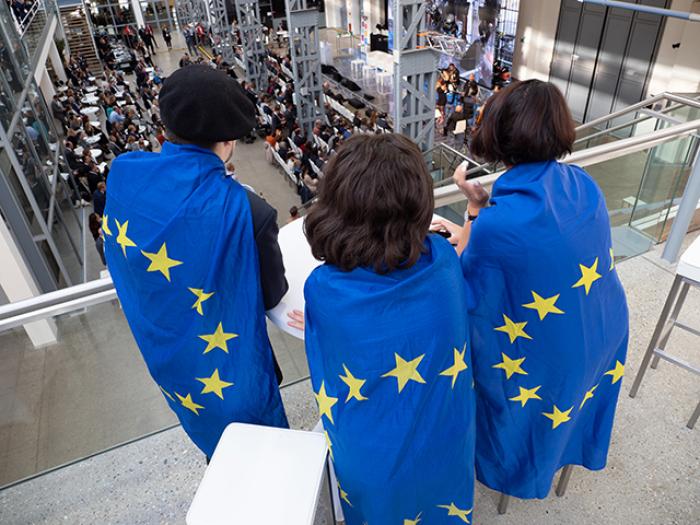
Europe needs new ways of engaging, involving and communicating effectively with its youth. International Youth Day is a good place to start.


Let’s unleash youth potential

11/08/2020 – 23:35

News stories

The aspirations of young people around the world need to be at the core of our political, social and economic development debate. Protecting and fighting for youths’ equal rights, particularly in developing regions, contributes to a fairer and more sustainable development. On the International Youth Day, the EU highlights the importance of giving voice to the young people and empowering them to better address the challenges of the future.