EUR 150 million EIB backing for Irish smart meter rollout
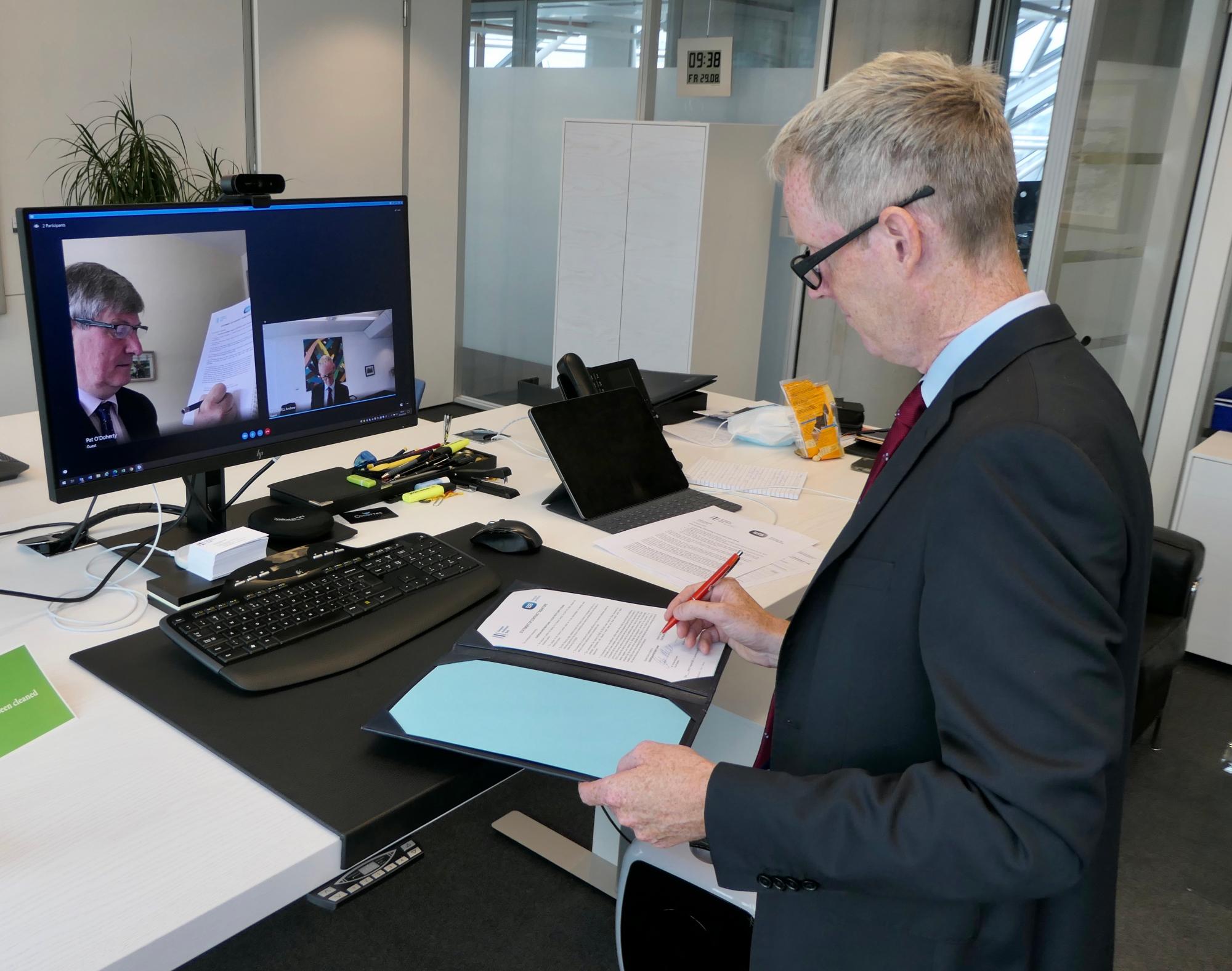
>@Richard Willis/EIB 2020
©Richard Willis/EIB 2020

EUR 150 million EIB backing for Irish smart meter rollout

  • Supports ESB Networks installation of 2.4 million smart meters in every home, farm and business in Ireland by the end of 2024
  • Increased use of smart meters delivers benefits to customers, the economy and the environment
  • The Commission for the Regulation of Utilities has tasked ESB Networks with the roll-out of the National Smart Metering Programme which is a key part of Irish Government’s National Climate Action Plan

The European Investment Bank (EIB) and ESB are today (Friday August 28) signing a loan facility to support the roll out of 2.4 million smart meters to every home, farm and business in Ireland by the end of 2024.

The EIB has agreed to provide EUR 150 million to support ESB Networks national smart metering programme, which is a key element of the National Climate Action Plan, supporting Ireland’s transition to a low carbon electricity network and delivering benefits to customers, the economy and the environment.

The new EUR 150 million 15-year loan will support the roll out programme, which started in counties Cork, Laois and Kildare in Autumn 2019 and is being delivered on a phased basis.  By the end of 2020 it is envisaged that 200,000 meters will have been replaced and approximately 500,000 meters will be replaced in each of the four years thereafter. From 2021, electricity supply companies will be able to offer new smart services to customers with smart meters.

Eamon Ryan, Minister for Climate Action, Communication Networks and Transport, said:

“Ensuring continued climate action investment is essential for Ireland to contribute to tackling the global climate emergency. I welcome the European Investment Bank’s latest vote of confidence in Ireland’s National Climate Action Plan and the new EUR 150 million backing for ESB Network’s roll out of smart meters. The EIB’s support for 70 million smart meters across Europe has shown how new technology enables homeowners to use energy in a smarter way, save money on electricity bills and reducing their impact on the environment. The EIB is a key partner for long-term investment in Ireland and I look forward to ensuring that the EIB, as Europe’s climate bank, continues to increase support for high-impact climate investment in this country.”

Commenting on the on the signing of the loan facility, Pat O’Doherty, Chief Executive of ESB, said: “The National Smart Metering Programme being delivered by ESB Networks is an important enabler of Ireland’s National Climate Action Plan and helping empower all electricity consumers to actively play their part. This is a big investment in Ireland’s transition to a low-carbon future, and the wider economy.  ESB has a long-standing relationship with the EIB and we welcome their support in helping to deliver this important programme.’

Andrew McDowell, Vice President of the European Investment Bank, said:

“The European Investment Bank – as the EU Climate Bank – is committed to financing Europe’s energy transition. Our EUR 150 million financing commitment to ESB Networks will support the extensive roll out of smart meters to every home and business in the country, giving consumers greater control over their energy consumption and supporting the electrification of heating and transport. The EIB looks forward to further increasing our support for climate action with Irish partners in the years ahead.” said Andrew McDowell, Vice President of the European Investment Bank.”

Benefits of Smart Metering

ESB Networks will replace 2.4 million meters with modern smart meters in every home, farm and business by the end of 2024. These new meters will deliver benefits to customers, the economy and the environment and will facilitate Irelands transition to a low carbon electricity network. The benefits include:

  • Facilitating the development of Ireland’s growing renewable generation, smart grids and support the electrification of transport and heat.
  • Providing customers with greater access to accurate information on energy usage, giving greater control over energy consumption. In trials, consumers reduced consumption by up to 3% and peak demand by 8%.
  • Enabling more accurate billing, significantly reducing the need for manual meter readings and estimated bills.
  • Improving customer services by allowing ESB Networks to find faults quicker and manage the network more efficiently. It will also enable customers to switch electricity supplier and move premises more easily.
  • Enabling electricity supply companies to begin to offer new smart products and services, giving more choice and enabling customers to move some of their consumption to times of day when electricity is cheaper.

Supporting six-year installation programme

The 15-year long term EIB loan will support the first phase of the six-year smart meter installation programme. There will be no additional charge to customers for a smart meter upgrade, like other meter and electricity infrastructure upgrades the smart metering programme costs are included in the existing charges for use of the electricity network

Building on EIB energy track record

Over the last five years the EIB has supported new investment across Europe to provide more than 70 million advanced and digital electricity smart meters. This follows the EIB’s first support for innovative metering technology in Italy in 2000.  Over the last 43 years the EIB has provided EUR 4.2 billion for energy investment across Ireland.


Background information:

The European Investment Bank (EIB) is the long-term lending institution of the European Union owned by its Member States. It makes long-term finance available for sound investment in order to contribute towards EU policy goals.

ESB

ESB operates across the electricity market: from generation, through transmission and distribution to the supply of customers with an expanding presence in the Great Britain generation market. In addition, we extract further value through supplying gas, energy services and using our networks to carry fibre for telecommunications. ESB is the owner of the distribution and transmission networks in the Republic of Ireland (via ESB Networks) and Northern Ireland (via Northern Ireland Electricity Networks Ltd).


Press release – Future EU financing: Parliament and German Council Presidency kick off talks

On Thursday, the delegations from Council and Parliament sat together for the first time for trilateral talks on a political level, including the Commission, in view of reaching an agreement on EU financing for 2021-2027.

“There needs to be adequate funding for EU flagship programmes such as the ones for research or the young, that are important for Parliament. There needs to be progress on the Own Resources – the EU’s revenue – and on the Rule of Law, on the role of the budgetary authority and on certain horizontal issues like, for example, climate. So all these elements are on the table. We had a good discussion so far already today. And I’m pretty sure that in the coming weeks we can continue that positive and constructive way of dialogue”, said Budget Committee Chair Johan Van Overtveldt (ECR, BE).

“We want to reach an agreement, but we want to reach a good agreement. Not so much for Parliament as such, but for the European citizens”, he added.

View the full interview with Mr Van Overtveldt and footage of the meeting

Background

In July, Parliament adopted a resolution on the conclusions of the extraordinary European Council meeting of 17-21 July 2020, setting out its negotiating mandate and priorities in view of reaching an agreement. Before the Council can formally adopt the MFF (Multiannual Financial Framework) regulation, Parliament must give its consent under Article 312(2) TFEU.

The negotiating team has welcomed the Recovery Instrument but considers that several improvements are needed, especially by reinforcing specific programmes, introducing a basket of new Own Resources (EU revenue), completing the legislators’ work on the rule of law, and ensuring parliamentary involvement in the Recovery Instrument.

On 1 September Members of the Committee on Budgets will debate the state of play of the negotiations on the Union’s next multiannual budget for 2021-2027 (MFF), the reform of the Own resources (OR) system and the Recovery Plan. Parliament’s negotiating team on the MFF/OR will report back on Thursday’s trilateral talks.

The EP’s negotiating team for the next long-term EU budget and Own Resources reform

Johan Van Overtveldt (ECR, BE), Chair of the Committee on Budgets

Jan Olbrycht (EPP, PL), MFF co-rapporteur

Margarida Marques (S&D, PT), MFF co-rapporteur

José Manuel Fernandes (EPP, PT), Own Resources co-rapporteur

Valérie Hayer (RENEW, FR), Own Resources co-rapporteur

Rasmus Andresen (Greens/EFA, DE)

Follow them on Twitter: https://twitter.com/i/lists/1205126942384676866


Criminal network dismantled in Lithuania, the UK and Ireland

The Hague, 27 August 2020

Judicial authorities and police in Lithuania, United Kingdom and Ireland, with support from Eurojust and Europol, have dismantled a criminal network responsible for drug trafficking, money laundering and trafficking in human beings. At least 65 people were exploited as street dealers.

Yesterday in Lithuania, Ireland and the UK, 18 suspects were arrested, including the leader of the organised crime group (OCG), while 65 searches took place and various assets were seized, with an estimated overall value of €700 000.

The OCG dismantled today was responsible for trafficking large quantities of heroin in Ireland and Northern Ireland (UK). The leader of the OCG, a Lithuanian, was responsible for recruiting and trafficking people from Lithuania for drug trafficking and money laundering. Together with two other individuals, he set up a complex drug transport and distribution network in Ireland and the UK, in which at least 20 individuals have been involved since 2015.

The investigation revealed street dealers operating in the UK and Ireland, who were nearly all Lithuanians. At least 65 people were identified, mostly from vulnerable social backgrounds or drug addicts themselves. Many of these people had been trafficked by the leaders of the OCG with the specific intent to commit crime, i.e. illegally sell drugs on the streets.

Proceeds from the criminal activity were laundered by purchasing various real estate properties and other related financial transactions. A financial investigation is currently ongoing.

Today’s action day, enabled through the coordination centre set up by Eurojust and benefitting from operational support of Europol, was the result of successful cooperation between the judicial and law enforcement authorities in the three countries involved.

The case was referred to Eurojust by the Lithuanian national authorities at the end of 2017 given the cross-border dimension of the criminal activity.

In 2018, a joint investigation team (JIT) was set up between the Lithuanian authorities and their counterparts in Northern Ireland (UK), with financial and analytical support from Eurojust. Authorities in Ireland also joined the JIT during the investigation.

Six coordination meetings were held in a secure environment facilitated by Eurojust, ensuring close cooperation with the national authorities in all countries involved and planning of the joint actions, including setting up a common strategy taking into account the different jurisdictions.

‘Today’s result wouldn’t have been possible without close cooperation between the Lithuanian, Irish and UK authorities, as well Eurojust’s support in facilitating the judicial cooperation between all the parties involved. This shows that by working closely together we can ensure that drugs are kept off the streets and people are kept safe’, said Margarita Sniutyte-Daugeliene, National Member for Lithuania at Eurojust.

Eurojust also helped out by issuing the Mutual Legal Assistance requests, facilitating the real-time exchange of information between the judicial authorities involved, and providing support in order to plan the operational activity conducted today.

Europol provided a secure platform for the exchange of tactical information in real time and ensured remote crosschecks all throughout the joint action day.

Photos © Garda, Ireland


ESMA selects Chair and Independent Members for its CCP Supervisory Committee

Following an open selection process, the Board of Supervisors has submitted to the European Parliament its selected candidates, which it, after having heard them, shall approve or reject.

The selected candidates are:

1. Chair of the CCP Supervisory Committee:
Mr Klaus Löber, currently Head of the Oversight Division at the European Central Bank (ECB);

2. Two positions of Independent Member of the CCP Supervisory Committee:
Ms Nicoletta Giusto, currently Senior Director and Head of International Relations at Commissione Nazionale per le Società e la Borsa (CONSOB); and
Ms Froukelien Wendt, currently Senior Financial Sector Expert at the International Monetary Fund (IMF).

The European Parliament is expected to make a decision within the one-month period set out in EMIR 2.2. The appointment by the Board of Supervisors of the selected candidates, as Chair and Independent Members, will finalise the set-up of the CCP Supervisory Committee, which comprises the competent authorities of Member States where a CCP is established and, where applicable, the central banks of issue of EU currencies.

The finalisation of this process in conjunction with the finalisation of the delegated acts by the Commission will conclude the preparatory steps for the full implementation of the EMIR 2.2 regime.


EUR 30 million EIB backing to accelerate tuberculosis vaccine development in Africa

EUR 30 million EIB backing to accelerate tuberculosis vaccine development in Africa

  • Tuberculosis is the world’s leading infectious disease killer
  • Successful development of a new tuberculosis vaccine will help reduce the disease burden on African countries and in particular in infants in high-risk HIV+ population
  • European Investment Bank (EIB) provides €30 million loan to Vakzine Projekt Management, German subsidiary of Serum Institute of India (SIIPL) to develop improved tuberculosis vaccine.
  • Financing will be used by Vakzine Projekt Management to perform phase-III clinical trials of the vaccine with the ultimate goal to provide an affordable and available substitute of BCG

The European Investment Bank (EIB) today agreed a €30 million loan with Vakzine Projekt Management GmbH, the German subsidiary of Serum Institute of India Pvt. Ltd., the world’s largest vaccine manufacturer.

The agreement, initiated by kENUP Foundation, will support research and development of a new vaccine to prevent tuberculosis in infants in particular in high-risk HIV+ populations. The EIB loan is supported by the dedicated Impact Financing Envelope. The financing structure consists of a contingent loan where the repayment is due only if market authorization is achieved. If the trials do not reach the primary endpoint, the loan is written off.

“We are very pleased to get European Investment Bank funding for such an important trial for tuberculosis and upcoming HIV trials. With this support, I am confident that we will be able to help eliminate these dreadful diseases. Going forward such support from Institutions like the EIB will play a key role in tackling major diseases which have killed millions of people in developed and developing world.” said Dr. Cyrus Poonawalla, Chairman & Managing Director, Serum Institute of India Pvt. Ltd.

The World Health Organization declared tuberculosis a global emergency even surpassing HIV as the leading cause of infection-related death. “The BCG vaccine is the only tuberculosis vaccine currently available and is the standard of care for primary tuberculosis prevention for infants. Our goal is to replace BCG with VPM1002, which is safer, better tolerated and hopefully more effective, as prime vaccine in newborn infants. An achievement like this could be the long-desired turning point in global TB containment for almost 100 years.” Dr. Leander Grode, CEO of Vakzine Projekt Management GmbH.

“Tuberculosis is one of the top ten causes of death worldwide, causing millions of victims in recent years.” said Ambroise Fayolle, European Investment Bank Vice President. “Although the world is currently mostly preoccupied with Covid-19, TB and HIV have not gone away, yet they are treatable or even preventable. I’m proud that the European Investment Bank can support late-stage research into an improved TB vaccine that can save lives, especially children, as well as develop novel treatment for HIV. This research could have an enormous impact on health worldwide, and especially across Africa.”

Accelerating development of more effective tuberculosis vaccine and treatment

Vaccine research and development for the project will be carried out by Vakzine Projekt Management in Germany and clinical trials scaled up in several high-burden sub-Saharan countries. The vaccine will be also tested in high-risk, HIV-exposed groups to enable more effective treatment in Africa.

The €30 million EIB loan signed today will finance the late stage (phase III) clinical trial of a new and improved vaccine protecting against Tuberculosis in infants, which is also partly financed by the European & Developing Countries Clinical Trials Partnership (EDCTP).

Addressing the impact of tuberculosis across Africa

With 26% of new cases on the African continent, and two countries in the top six of most impacted countries, these developments could have a major health impact on the local population. Next to this, the parties expect to sign a further €15m loan in the near future in support of R&D investment into a portfolio of new drugs for the prevention and treatment of HIV, the virus that causes AIDS.

Tuberculosis is the most common illness among people living with HIV, including among those taking antiretroviral treatment, and it is the major cause of HIV-related deaths. Sub-Saharan Africa bears the brunt of the dual epidemic, accounting for 84% of all deaths from HIV-associated tuberculosis in 2018.

In particular, research backed by the EIB help to ensure a higher level of protection, improve safety and accelerate large scale production of a novel TB vaccine for immunisation of infants than BCG. Affordability and availability of the vaccine is the primary goal of the initiative. Additionally, VPM1002 may potentially have positive effects on COVID-19 infections. A study is currently testing whether it can protect from COVID-19, following research on mice, which showed it can protect against other viral lung infections.

Every year, nearly 1,5 million people die from tuberculosis, a disease which according to the WHO is ‘treatable and preventable’, and which is the leading cause of death from a single infectious agent worldwide.

Strengthening EIB support for high-impact public health investment in Africa

The EIB is financing projects across Africa to ensuring that public health efforts can reduce the spread of COVID-19 and better face existing and future health challenges is a global priority.

The EIB is working closely with the World Health Organisation and the global vaccine alliance GAVI to strengthen primary health care cross Africa, including scaling up financing to better protect medical supply chains, improve basic hygiene and safeguard front-line medical workers.

The European Investment Bank’s technical and financial teams in nine African cities help to ensure that technical, environmental, social and financial expertise is shared with project promoters, financial partners and the private sector.

Last year, the European Investment Bank (EIB) provided €3 billion of new financing that supported €10.7 billion of transformational investments across Africa. This included more than EUR 1.8 billion for private sector investment across the continent.


Background information

The European Investment Bank (EIB) is the long-term lending institution of the European Union owned by its Member States. It makes long-term finance available for sound investment in order to contribute towards EU policy goals.

The European Investment Bank has provided €45 billion for public and private investment across Africa over the last 57 years.


Press contact

Richard Willis, r.willis@eib.org, tel.: +352 43 79 82155 / Mobile:  +352 621 55 57 58
Website: www.eib.org/press – Press Office: +352 4379 21000 – press@eib.org