ESMA sees high risk of decoupling of financial market performance and underlying economic activity

The Report analyses the impact of COVID-19 on financial markets during the first half of 2020 and highlights the risk of a potential decoupling of financial market performance and underlying economic activity, which raises the question of the sustainability of the current market rebound.

The TRV also highlights specific risks for financial stability and investors in relation to Collateralised Loan Obligations (CLOs) model risk, EU fund industry interconnectedness and spill overs, research unbundling and closet index funds costs and performance.

Continued very high risks across ESMA’s remit

The COVID-19 pandemic, in combination with the valuation risks highlighted in ESMA’s previous risk assessments, led to massive equity market corrections in Q1 while in Q2 markets witnessed a remarkable rebound, helped by public policy interventions in the EU and elsewhere.

The market environment however remains fragile, and ESMA maintains its risk assessment.  It sees a prolonged period of risk to institutional and retail investors of further – possibly significant – market corrections and very high risks across the whole of ESMA’s remit. The extent to which these risks will materialise will depend on two drivers: the economic impact of the pandemic, and additional external events in an already fragile global environment. The impact on EU corporates and their credit quality, and on credit institutions, are of particular concern, as are growing corporate and public indebtedness and the sustainability of the recent market rebound.

Decoupling between market performance and economic activity

The sustainability of the recent market rebound remains a concern. Equity markets have surged by 40% in the euro area since the trough reached in mid-March, almost back to pre-crisis levels, while the IMF expects GDP to drop by more than 10% in 2020, followed by a mild recovery of 6% in 2021.

Initial impact of COVID-19 on financial markets

During the reporting period for this TRV, ESMA saw the financial market go through three stages, each described in detail in this report: i) a liquidity and volatility period (mid-February – end-March) where markets, investment funds and infrastructures faced high levels of stress, ii) a rebound period (early to end-April) where markets grew swiftly on the back of policy actions and iii) a differentiation stage (starting early May), where credit and solvency risk came to the fore, as investors started to differentiate between issuers and asset classes amid ongoing deterioration of economic fundamentals.

Against the background of these events, regulators have monitored closely any threats to financial stability and taken measures to promote stability, investor protection and market integrity.

Focus on risks for financial stability and investors

This TRV also takes an in-depth look at specific risk issues in four articles: 

  • Model risk in Collateralised Loan Obligations (CLOs): The benefits of securitisation depend on its ability to effectively engineer and limit credit risk. Following up on ESMA’s recent thematic report of rating methodologies used for CLOs, this article explores the approaches to modelling CLO credit risk adopted by the three main Credit Rating Agencies.
  • Interconnectedness and spillovers in the EU fund industry: The COVID-19 turmoil has highlighted the risks of market-wide stress, not least for investment funds. This article assesses the connectedness among EU fixed-income funds. Our empirical results suggest high spillover effects, indicating that funds exposed to less liquid asset classes are more likely to be affected by shocks originating in other markets than funds invested in more liquid assets.
  • MiFID II Research Unbundling – first evidence: This article analyses the impact on EU sell-side research of the MiFID II Research Unbundling provisions that require portfolio managers to pay for the research they obtain. In the past, concerns have been raised, based primarily on survey data, that the new rules could have detrimental effects on the availability and quality of company research in the EU. In order to provide a more detailed, data-based contribution to inform this discussion, ESMA has analysed a sample of 8 000 EU companies between 2006 and 2019, and does not find material evidence of harmful effects from the unbundling rules.
  • Costs and performance of closet index funds: ‘Closet indexing’ refers to the situation in which asset managers claim to manage their funds in an active manner while in fact tracking or staying close to a benchmark index. In this article ESMA looks at annual fund-level data for the period 2010-2018 and finds that investors see lower net performance of potential closet indexers than the net performance of genuinely active funds, as the marginally lower fees of potential closet indexers are outweighed by reduced performance.


Webinar on ESMA's report on trends, risks and vulnerabilities no.2 2020

The Report analyses the impact of COVID-19 on financial markets during the first half of 2020 and highlights the risk of a potential decoupling of financial market performance and underlying economic activity, which raises the question of the sustainability of the current market rebound. 

​During the webinar you will see a presentation of the report and its findings.  The presentation will be followed by a Q&A session.


EUIPO Executive Director meets Commissioner Didier Reynders

September 02, 2020 EU Intellectual Property Network

EUIPO Executive Director meets Commissioner Didier Reynders

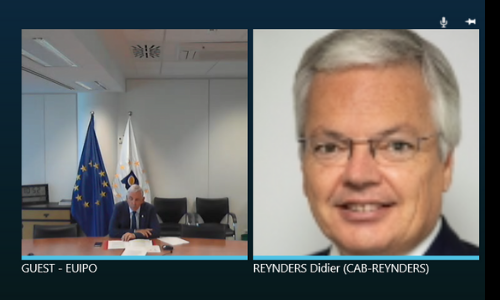
The Executive Director of the EUIPO, Christian Archambeau, has held a meeting with the EU Commissioner for Justice, Mr Didier Reynders.

During the meeting, which took place via videolink, Mr Archambeau presented the EUIPO’s Strategic Plan 2025 and the work of the European Observatory on Infringements of Intellectual Property Rights.

The EUIPO’s cooperation with other EU institutions and agencies, such as CEPOL, Europol and Eurojust, was also discussed, as was the growing impact of intellectual property crime and its links to other serious crimes.

Mr Archambeau has engaged in a series of bilateral meetings with EU representatives. Through these contacts, the EUIPO is actively seeking to contribute to the European Commission’s and EU institutions’ policies within the field of IP rights and their protection.

Tag: #ipnetwork


Libya: High Representative held talks with President Serraj and

The High Representative/Vice-President Josep Borrell visited Libya on Tuesday 1st September for the first time since the beginning of his mandate, continuing EU efforts to advance the political process and resume political dialogue to end the conflict in the country.

He met with President of the Presidency Council and Prime Minister of the Government of National Accord (GNA) Faiez Serraj in Tripoli and with the President of the House of Representatives Aguila Saleh in Al Qubah in eastern Libya.

In his meetings, Josep Borrell reiterated the EU’s support to an inclusive Libyan-led and Libyan-owned political resolution of the Libyan conflict and confirmed that Libya remains on top of the EU’s political agenda. He discussed the latest developments in the country, and conveyed EU’s strong and unwavering commitment to preserve Libya’s territorial integrity, sovereignty and national unity. 

The visit of the High Representative took place shortly after the 21 August understanding between President Serraj and Speaker Saleh, which provides for a ceasefire, the return of foreign fighters  to be discussed in  the next round of 5+5 military talks, modalities for lifting the oil blockade, and the relaunch of the political process leading to an agreed reform and  eventual elections.

In his meetings in Tripoli and Al Qubah, the High Representative welcomed the ceasefire understanding and stressed the need for its prompt sustainable implementation. He was encouraged to hear the determination and commitment from his Libyan interlocutors to work in this direction, and to implement these principles in the framework of the UN-led Berlin process. This process is the only international framework that offers a realistic opportunity for the political dialogue needed to bring the Libyan conflict to an end. Discussions focused on the required mediation efforts and de-escalation measures, including the enforcement of the UN arms embargo and EU operation Irini’s role in its implementation.

In the meeting with Prime Minister Serraj and his cabinet members, the High Representative also discussed other issues of common concern, including migration management and the recent public demonstrations.

In Tripoli, Josep Borrell also met with the Chairman of the National Oil Corporation, Mustafa Sanalla to discuss the worrying situation of the oil blockade that urgently requires joint international resolve to prevent a collapse of Libya’s oil sector, which is crucial for Libya’s economy and the prosperity of its people.

During his talks in Al Qubah with Speaker Saleh, the High Representative got additional updates about the situation in eastern Libya and spoke about related prospects for a peaceful resolution of the Libyan conflict.


Chair's Statement following the 1 September meeting of the Joint

A meeting of the Joint Commission of the Joint Comprehensive Plan of Action (JCPOA) took place in Vienna on Tuesday 1st September. Under the terms of the JCPOA, the Joint Commission is responsible for overseeing the implementation of the agreement. The Joint Commission was chaired, on behalf of EU High Representative Josep Borrell, by EEAS Secretary General Helga-Maria Schmid and was attended by representatives of China, France, Germany, Russia, the United Kingdom and Iran at the level of Political Directors/Deputy Foreign Ministers.

All participants reaffirmed the importance of preserving the agreement recalling that it is a key element of the global nuclear non-proliferation architecture, as endorsed by United Nations Security Council Resolution 2231 (2015). Full implementation of the agreement by all sides remains crucial.

In light of recent discussions in the UN Security Council in New York concerning the issue of the attempted reinstatement of previously lifted UN sanctions, the participants reaffirmed that the United States unilaterally announced its cessation of participation in the JCPOA on 8 May 2018 and that it had not participated in any JCPOA-related activities subsequently. Participants reconfirmed that it therefore could not be considered as a participant State. In this regard, participants also reaffirmed their various statements and communications made previously at the UN Security Council including that of the High Representative of 20 August as the Coordinator of the JCPOA to the effect that the US cannot initiate the process of reinstating UN sanctions under UNSC resolution 2231.

Participants welcomed the Joint Statement of Iran and the IAEA dated 26 August, the implementation of which has already started. In this context, they recalled the important role of the IAEA as the sole impartial and independent international organisation responsible for the monitoring and verification of nuclear non-proliferation commitments.

The Joint Commission addressed nuclear as well as sanctions lifting issues under the agreement. Experts will continue discussions on all issues of concern.

Participants reiterated the importance of nuclear non-proliferation projects, in particular the Arak Modernisation Project and the stable isotope project in Fordow. Taking into account the potential consequences of the US decision in May to end the Arak waiver, participants reiterated their strong support and collective responsibility for the continuation of the project.

The meeting took place against the background of the coronavirus pandemic. Participants expressed their solidarity with all countries affected and with their efforts to address the outbreak. The Joint Commission had not been able to convene recently due to relevant travel restrictions.