Russia: Statement by High Representative/Vice-President Josep Bo

The European Union condemns in the strongest possible terms the poisoning of the Russian opposition leader Alexei Navalny.

The toxicological analysis carried out by a specialised laboratory of the German armed forces proves that Mr Navalny was poisoned by a military-grade chemical nerve agent of the “Novichok” group, developed by the Soviet Union and later, Russia. The use of chemical weapons under any circumstances is completely unacceptable and a breach of international law.

It is essential that the Russian government investigates thoroughly and in a transparent manner the assassination attempt of Mr Navalny. Alexei Navalny’s case must not go unresolved. Those responsible must be brought to justice.

We are grateful to the staff of the Charité – Universitätsmedizin hospital in Berlin for their treatment of Mr Navalny and wish him a prompt and full recovery.

The European Union will continue to closely follow the issue and discuss its implications.
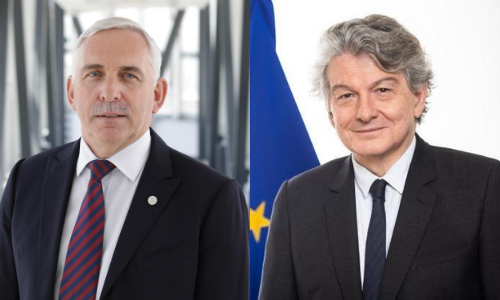


EUIPO Executive Director meets Commissioner Thierry Breton

September 02, 2020 About the EUIPO

EUIPO Executive Director meets Commissioner Thierry Breton

The Executive Director of the EUIPO, Christian Archambeau, had a virtual bilateral meeting with Thierry Breton, the European Commissioner for Internal Market, on 1 September 2020.

This is the first meeting with Commissioner Thierry Breton, who took up his role on 1 December 2019.

The Executive Director presented the EUIPO’s scope of activities and initiatives in the context of the recently launched Strategic Plan 2025.

Discussions also focused on the cooperation activities between the European Commission and the EUIPO, within the framework of the Memorandum of Understanding signed in April 2019.

Mr Archambeau stressed the commitment of the EUIPO to pursue ongoing collaboration with the European Commission on aspects of common interest and future cooperation opportunities, notably with regard to the Commission’s new IP Policy agenda.

Within this context, topics in the agenda also included activities in support of SMEs, EU external actions, cooperation on enforcement, the Digital Services Act and the possible development of the EUIPO’s competencies.

Mr Breton and Mr Archambeau agreed on following up through a regular exchange of opinions, in particular within the context of the Intellectual Property Action Plan that will be drafted by DG GROW following the consultation that took place over the summer.

Mr Archambeau has engaged in a series of bilateral meetings with EU representatives, such as the recent exchange with Commissioner Didier Reynders. Through these contacts, the EUIPO is actively seeking to contribute to the European Commission’s policies within the field of IP rights and their protection.

Tag: #ipnetwork


Press release – COVID-19: EU countries should harmonise testing procedures and frequency

On Wednesday, the Committee for Environment, Public Health and Food Safety held a debate with Dr Andrea Ammon, Director of the European Centre for Disease Prevention and Control (ECDC), after she gave an update on the situation of the COVID-19 pandemic in the EU and the ECDC’s work to address it.

Dr Ammon highlighted the most recent data related to COVID-19 in the EU including:

  • Notification rate at EU level on the rise in the last five weeks to currently 46 COVID-19 infections per 100.000 inhabitants per week
  • Epidemiological situation different across the EU ranging from 2 to 176 cases per 100.000 inhabitants
  • Testing for COVID-19 range from 173 to 6.000 per 100.000 inhabitants per week which has a direct impact on the notification rate
  • Second infections of COVID-19 very rare and with milder symptoms
  • A protocol on winter and seasonal flu is being established by ECDC with member states for 1 October, including increased flu vaccination for vulnerable groups

Many MEPs highlighted the need to achieve a common approach in limiting the spread of COVID-19 and replace the current tendency for many member states to designate other EU countries as red zones and close borders.


COVID-19 testing must be harmonised at EU-level

MEPs also deplored that there is still no common modality for counting COVID-19 cases or for testing as each country follows the recommendations of its own scientific agencies without coordination.

This was echoed by Dr Ammon, who said harmonising testing procedures and frequency is key to achieving better and more comparable data on infection levels in Europe. Dr Ammon furthermore welcomed talks to expand the ECDC’s mandate to also issue recommendations, which currently is only the competence of member states, as well as to increase its resources. The issue of misinformation about COVID-19 vaccinations and vaccine-hesitancy including by some young people was raised as a challenge and Dr Ammon said the ECDC is doing what it can to inspire trust.

Committee Chair Pascal Canfin (Renew, FR) informed that there will be a debate with the Commission on COVID-19 vaccines on 7 September as well as a public hearing planned for 22 September.


Watch the full recording of the debate here.


Background

The ECDC is the EU agency monitoring the COVID-19 outbreak and issuing regular epidemiological updates and risk assessments. The ECDC Risk assessment on COVID-19, released on 10 August 2020 shows that a recent increase in COVID-19 cases has been reported in many EU/EEA countries following the relaxation of certain rules to allow for a more normal life while the virus is still in circulation.


Belgrade-Pristina Dialogue: High-Level meeting in Brussels on 7

On Monday 7 September, EU High Representative for Foreign Affairs and Security Policy/Vice-President of the European Commission, Josep Borrell, and the EU Special Representative for the Belgrade-Pristina Dialogue and other Western Balkan regional issues, Miroslav Lajčák, will host the President of Serbia, Aleksandar Vučić, and the Prime Minister of Kosovo, Avdullah Hoti, for another high-level meeting of the Belgrade-Pristina Dialogue in Brussels.

As part of the comprehensive agreement to normalise relations between Kosovo and Serbia, the meeting will address non-majority community arrangements, and the settlement of mutual financial claims/property. This weekend, ahead of the high-level meeting, EU Special Representative Lajčák will host the fourth expert-level meeting on the topics previously discussed, namely missing and displaced persons and economic cooperation.

The High-level meeting of the Belgrade-Pristina Dialogue is scheduled to start at 10:00 on 7 September. Photo and video coverage will be provided by the EEAS and available on Council and EbS channels.

High Representative Borrell will give a press statement before the start of the Dialogue meeting and EU Special Representative Lajčák at the end of the meeting. Both statements will be broadcast on Council and EbS channels, the HRVP’s statement at approximately 10:30 and the EUSR’s statement after the end of the meeting.

Due to the coronavirus-related limitations, access for the media to the EEAS building will not be possible.


EU Court of Justice: three judges and an advocate-general appointed

The representatives of the governments of the member states today appointed three judges and an advocate-general to the Court of Justice. 

Mr Koen Lenaerts (Belgium) was appointed judge from 7 October 2021 to 6 October 2027 as part of the partial renewal of the composition of the Court of Justice. The terms of office of 14 judges and 6 advocates‑general of the Court of Justice will expire on 6 October 2021. 

Ms Ineta Ziemele (Latvia) was appointed judge from 7 September 2020 to 6 October 2024 following the resignation of Mr Egils Levits. 

Mr Jan Passer (Czech Republic) was appointed judge from 6 October 2020 to 6 October 2024 following the resignation of Mr Jiří Malenovský. 

Mr Athanasios Rantos (Greece) was appointed advocate-general from 7 September 2020 to 6 October 2021 following the withdrawal of the United Kingdom from the EU.

Background

The Court of Justice of the European Union consists of two courts: the Court of Justice and the General Court.

The judges and advocates-general are appointed by common accord of the governments of the member states after consultation of a panel responsible for giving an opinion on prospective candidates’ suitability to perform the duties concerned. They are chosen from among individuals whose independence is beyond doubt. For appointment to the Court of Justice, candidates must possess the qualifications required for appointment, in their respective countries, to the highest judicial offices, or be jurisconsults of recognised competence. For appointment to the General Court, they must possess the ability required for appointment to high judicial office.