Online outreach event for the launch of the new EU priorities fo

This timely event started with a presentation of the priorities followed by a brief presentation of the three main thematic annexes: human rights, rule of law and democracy. Our panel included a good mix of prominent speakers both from the EU and the Council of Europe. The subsequent discussion revealed concrete possibilities to further strengthen the cooperation between the two organisations.

In her opening remarks, EU Ambassador Meglena Kuneva stressed the need to discuss “a document of outmost importance for our Delegation”, i.e. the new EU priorities for the cooperation with the Council of Europe 2020-2022. The Ambassador reaffirmed that the new priorities constituted the guiding principles of EU’s actions, reflecting our common values and goals with the Council of Europe, driving our work for the next two years and a half. She also highlighted the significance of a strong multilateral cooperation at a regional level to address the consequences of the pandemic.

Ellis Mathews presented the new priorities as a landmark for EU-Council of Europe cooperation in the areas of democracy, human rights and the rule of law. He reaffirmed EU’s strong commitment to promote the highest level of human rights protection, to ensure the proper functioning of the Rule of Law across the continent and to uphold democracy both within Europe and in its wider neighbourhood. In the view of those shared values, the Council of Europe is seen as providing a comprehensive and complementary platform to achieve these objectives. In doing so, he reasserted Council of Europe’s central role in the areas of Human Rights, Rule of Law and Democracy, as well as its extensive experience and widely recognised expertise. He stressed that the EU was regularly using Council of Europe’s monitoring bodies’ work as a point of reference. Regarding the challenges posed by COVID-19, he stressed that both organisations managed to modify their common projects in order to adapt to this new reality whilst preserving their core shared values. Moreover, he highlighted the importance of the newly adopted priorities for the EU’s enlargement and neighbourhood policies.

EU-Council of Europe’s cooperation on human rights, democracy and rule of law were presented respectively by Luisa Ragher, Patrick Costello and Niovi Ringou. Luisa Ragher highlighted the timeliness of the adoption of the priorities regarding the new challenges arising from the pandemic. In that sense, she stressed the impact of the COVID-19 on human rights, such as the rise of gender-based violence, inequalities, discrimination, the shrinking of freedom of expression and association, as well as the silencing of journalists. She also reaffirmed the importance to reinforce multilateral cooperation in all of these areas. She presented EU’s accession to the European Convention of Human Right as one of the key priority for the next two years, along with the adoption of new policy tools aimed at facilitating EU and Council of Europe’s cooperation and synergies in areas such as artificial intelligence the asylum and migration policy, the protection of children against sexual abuse, the protection of journalists, human rights defenders, and civil society.

Patrick Costello stressed that the threats to democracy have been exacerbated by the pandemic. According to him, “those values should not be taken for granted”. He reaffirmed the priority of the right to health but also stressed the need to have necessary, proportionate and time-limited measures in order to avoid authoritarianism. Moreover, he highlighted the importance of the work of the Venice Commission, underlined the complementarity of both institutions and highlighted the standard setting work of the Council of Europe through the European Court of Human Rights. Thus, he stated:Thematic cooperation for democracy and Human Rights protection is the guiding thread of our partnership with the Council of Europe. Curbing disinformation, tackling Artificial Intelligence and environmental threats, promoting a rule of law culture along with the Group of States against Corruption (GRECO) and the Venice Commission are among our main joint goals”.

As for Niovi Ringou, she stressed the long and fruitful history of cooperation between the EU and the Council of Europe in the field of Rule of Law. She stated that the European Commission relied on the Council of Europe’s expertise, notably through the European Court of Human Rights, the Venice Commission, GRECO, the Commissioner for Human right and the Parliamentary Assembly of the Council of Europe (PACE). She announced the adoption by the European Commission of the first annual report on Rule of Law, including developments in the justice system, anti-corruption and media pluralism. Moreover, she reiterated EU’s commitment to pursue cooperation with neighbourhood countries in the framework of the Council of Europe and the Eastern partnership.

Christos Giakoumopoulos and Snežana Samardžić-Marković, addressed EU priorities viewed from the Council of Europe’s side. They both presented the priorities as the most ambitious and comprehensive document of cooperation between both institutions. Christos Giakoumopoulos underlined the importance of referring to the CoE as a standard-setter in the field of Human Rights, Rule of Law and Democracy and described the EU as a strategic partner in internal and external policies. Moreover, he referred to numerous areas of cooperation in the field of Human Rights, such as the European Convention on Human Rights’ accession, freedom of expression, Artificial Intelligence and data protection, bioethics, migration and detention under newly adopted prison rules. Regarding the upcoming perspectives, he stressed that the environment was high on the agenda of both the Council of Europe and the EU, as well as social rights and the Rule of Law mechanism. Snežana Samardžić-Marković also stressed the timeliness of this discussion and the importance of joining forces. She mentioned the 25th anniversary of the joint programmes with the EU on the education sector and stressed the importance of explaining to the young generation that democracy should not be taken for granted. She also emphasized the Youth Partnership as a top priority, as well as the importance of involving children in the formulation of Council of Europe’s instruments. “Democratic culture and digital citizenship education are at the core of Council of Europe’s work on education”. Finally, she stressed the threat to civil society and freedom of expression and reaffirmed the need for the civil society to participate in the democratic process.

Verena Taylor presented EU-Council of Europe’s Joint Programmes as an essential tool to implement the priorities. She highlighted numerous multilateral and thematic programmes of cooperation such as the programme HELP or the Youth Partnership. “EU-Council of Europe facilities help innovate in order to offer a rapid response to Human Rights and Rule of Law challenges faced by Council of Europe’s Member States”. She also reaffirmed the importance of the cooperation in the field of the Rule of Law and called for the strengthening of the EU-Council of Europe’s cooperation in areas such as violence against women, human trafficking, environment, education and EU neighbourhood. “Our enlargement and neighbourhood policies are a component of the cooperation framework with the Council of Europe. Our joint programs are meant to address sustainable justice reform, fight against corruption, support for free media and a strong civil society”, she stated. Finally, Ambassador Panayiotis Beglitis highlighted the next steps in the implementation of the newly adopted priorities as regard to the Greek’s Chairmanship. As Ellis Mathews rightly described, the priorities are “a compass for the future”.



Funded traineeship for young graduates at the EU Delegation to S

Are you a young graduate interested in international relations? Are you curious to learn more about work of a diplomatic mission and how the EU Delegation represents EU interests and values in Serbia?

What we offer?

A traineeship of up to 6 months within the Political Section Section of the EU Delegation to the Republic of Serbia, starting in November 2020, subject to respect to the local legislation as well as the national legislation of the candidate(s) if non-resident.

Description of the Section:  

The Political Section is responsible for following political relations between the EU and the Republic of Serbia.

It monitors elements related to political criteria of the accession negotiations, the area of rule of law, fundamental rights and follows Serbia’s foreign policy. Its main interlocutors are government officials, members of the parliament, politicians, academic institutions/think tanks, civil society leaders, and foreign diplomats.

The Section is headed by a Head of Section and consists of a team of five people.

Main tasks:

  • Researching and preparing necessary background material on various political, legal and rule of law related matters (Chapters 23 and 24);
  • Assisting in monitoring and reporting on Serbia’s progress in meeting criteria of the accession negotiations, particularly related to Chapters 23 (Judiciary and Fundamental rights);
  • Oranising events and related logistics;
  • Attending events, conferences, meetings, taking notes and reporting back;
  • Short translations and summaries of incoming mail for the political section;
  • Table and power point presentations on political and legal topics;
  • Drafting invitations, replies to letters, minutes and reports from meetings;
  • Summarising official documents, articles, opinion polls etc;
  • Compiling and contributing to briefings and reports.

Administrative tasks such as follow up of contact lists, filling in for ad hoc and urgent requests

Qualifications or special requirements:

  • In assessing the applications received, account will need to be taken of the COVID-19 situation and its possible effects on access possibilities to Country and thus candidates currently residing in Country might be preferred (to be modified by HQ)
  • University degree in political sciences, social studies or law; 
  • Fluent in English and Serbian both written and spoken (important to be able to have good understanding of topics in the local language);
  • Good knowledge of the EU commitments and understanding of the political developments and the European integration process in Serbia;
  • Good analytical skills and capacity to formulate these in a structured manner;
  • Ability and willingness to work in an international environment;
  • Ability to deliver good quality work output in tight deadlines;
  • Computer literate with practical experience in Microsoft packagesInitiative, flexibility, good organisational skills and a team player is an advantage.

How to apply?

Please send the following documents to the e-mail address : DELEGATION-SERBIA-ADMINISTRATION@eeas.europa.eu :

  • A detailed Europass curriculum vitae (CV)
  • a cover letter describing why you want to participate in a EU traineeship
  • and an application form

Please mention in the subject of your e-mail: Funded Traineeship – Name/POL Section

Important information

Before applying you are requested to examine the dedicated website as well as the general eligibility criteria for a paid traineeship (Article 8 of the Decision ADMIN(2017)28 – Paid traineeship)

Each selected trainee will receive a monthly grant to cover living expenses. All costs related to travel inside the country of residence, visa, insurance, accommodation must be borne by the trainee.

Applications from non-eligible candidates will not be considered. After the evaluation of all applications, shortlisted candidates will be contacted and invited for an interview. Unsuccessful candidates will be notified by email. In case the selected candidate is not able to present the required documents, his/her candidacy will be rejected.

Non-resident candidates must provide proof that they will be covered against the risk of a pandemic and the costs of repatriation.

The Delegation informs that even if our Headquarters confirm the eligibility of the selected application, traineeships could be postponed, suspended or even cancelled considering the very evolving context of the COVID-19 outbreak in the host country as well as in the country of origin.


AfrIPI endorses Intellectual Property cooperation plan in Africa

Please enable JavaScript to view the page content.
Your support ID is: 11469114196811650228.

This question is for testing whether you are a human visitor and to prevent automated spam submission.
Red dot

bottle

What code is in the image?

Your support ID is: 11469114196811650228.


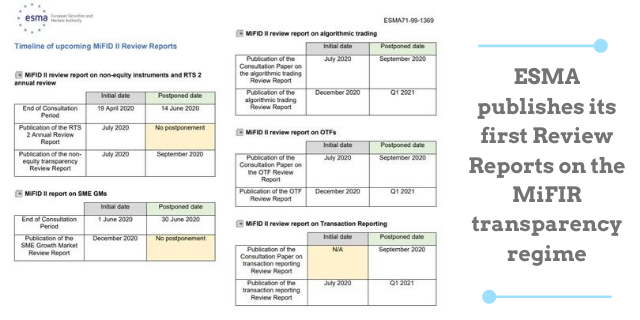
ESMA PROVIDES FOR THE OPTION TO APPLY THE ANNUAL TRANSPARENCY CALCULATIONS FOR NON-EQUITY INSTRUMENTS FROM 21 SEPTEMBER

This decision also applies to the quarterly calculations for the purpose of the systematic internaliser (SI) regime for non-equity instruments other than bonds.

ESMA published the results of the liquidity assessment for non-equity instruments other than bonds and the determination of the pre- and post-trade sizes specific to the instrument (SSTI) and large in scale (LIS) thresholds for non-equity instruments on 15 July 2020. Furthermore, ESMA published on 31 July the first calculations for the SI regime for non-equity instruments other than bonds. The application date for both calculations is 15 September 2020.

Since the publication of these results, ESMA has been approached by stakeholders raising concerns that the application of the non-equity transparency calculations coincides with the quarterly expiry week of many equity derivatives, a week characterised by high trading volumes and a higher level of volatility due to the rolling over of many contracts. In order to avoid technical issues that might be exacerbated by high market volatility during the current sensitive period, ESMA agreed that trading venues and investment firms may apply the non-equity transparency calculations from 21 September instead of 15 September 2020.

As announced on 15 July 2020, ESMA will provide the annual transparency calculations for non-equity instruments at instrument (ISIN) basis, both liquid and illiquid ones, as of 14 September 2020. This information will be made available through the Financial Instruments Transparency System (FITRS) both by publishing XML files and through the Register web interface.

In addition, in order to avoid potential misalignments between the application of the non-equity transparency calculations and the start of the mandatory SI-regime for non-equity instruments other than bonds, investment firms, applying the non-equity transparency calculations on 21 September instead of 15 September 2020, may perform the SI-test for non-equity instruments other than bonds by 21 September 2020.

Next steps

The transparency requirements based on the results of the annual transparency calculations for non-equity instruments will apply from 15 September 2020, with the option to delay application to 21 September 2020, until 31 May 2021. From 1 June 2021, the results of the next annual transparency calculations for non-equity instruments, to be published by 30 April 2021, will become applicable.

ESMA will publish the next quarterly publication of data for the purpose of the SI regime by 1 November 2020 with an application date of 15 November 2020 for equity and equity-like instrument, bonds and non-equity instruments. 


ESMA Newsletter – Nº16

ESMA newsletter

wirecard

ESMA has launched an assessment of the supervisory response in the financial reporting area by BaFin and the Financial Reporting Enforcement Panel (FREP) to the events leading to the collapse of Wirecard AG.

It will be completed by 30 October 2020.

High quality financial reporting is core to investor trust in capital markets and Wirecard’s collapse has undermined this trust. Therefore, it is necessary to assess these events to help in restoring investor confidence.

For further information, please visit our webpage here.

CPP

ESMA has published the results of its third stress test exercise regarding Central Counterparties (CCPs) in the European Union (EU) which confirm the overall resilience of EU CCPs to common shocks and multiple defaults for credit, liquidity and concentration stress risks.​

The credit stress test highlighted differences in resilience between CCPs under the selected market stress scenario, although no systemic risk has been identified. Similarly, the liquidity stress test showed EU CCPs to be resilient under the considered scenarios and did not reveal any systemic risk.

For further information, visit our webpage here.

ESMA newsletter

On 13 July ESMA began to receive reports from trade repositories (TRs) as the new reporting regime for financial and non-financial market participants under the Securities Financing Transactions Regulation (SFTR) began. The initial phase has gone smoothly.

Next steps:

ESMA will continue to engage with market participants to clarify any remaining issues and will assess the need for further supervisory convergence measures to facilitate compliance with the new reporting requirements.

Our LinkedIn Blogpost provides further details.

newsletter

trv

ESMA has published on 2 September its second Trends, Risks and Vulnerabilities (TRV) Report of 2020​.

The Report analyses the impact of COVID-19 on financial markets during the first half of 2020 and highlights the risk of a potential decoupling of financial market performance and underlying economic activity, which raises the question of the sustainability of the current market rebound.

A webinar open to the public will be held on 9 September to present the report. 

newsletter

mifir

newsletter

CPP

Following an open selection process, the Board of Supervisors has submitted to the European Parliament its selected candidates:

The selected candidates are:

1. Chair of the CCP Supervisory Committee:

Mr Klaus Löber, currently Head of the Oversight Division at the European Central Bank (ECB);

2. Two positions of Independent Member of the CCP Supervisory Committee:

Ms Nicoletta Giusto, currently Senior Director and Head of International Relations at Commissione Nazionale per le Società e la Borsa (CONSOB); and
Ms Froukelien Wendt, currently Senior Financial Sector Expert at the International Monetary Fund (IMF).

Month ahead

Important consultations closing this month​

consultations

newsletter

Speakers

Speaking appearances by ESMA staff in September

september

@ESMA

Vacancy Notices 

Open vacancies & deadlines 

Traineeship notice – Transversal profile (F/M)  31/12/2020 
Traineeship notice – Legal profile (F/M)  31/12/2020 
Traineeship notice – Financial Markets Profile (F/M)  31/12/2020
RIS Team Leaders – Ratings, Indices and Securitisation Department   14/09/2020

All open vacancies can be found on ESMA’s recruitment portal 

newsletter

press office

Missed any ESMA publications? Check out the full list of news items on our website. 

  • Most recent publications

1 September

ESMA publishes Call for Evidence in the context of the review of transparency requirements for equity and non-equity instruments

The European Securities and Markets Authority (ESMA), the EU’s securities markets regulator, has published a Call for Evidence (CfE) in the context of its intention to review Commission Delegated Regulation (EU) No 2017/587 (RTS 1) and Commission Delegated Regulation (EU) No 2017/583 (RTS 2) starting from Q4 2020-Q1 2021. RTS 1 and RTS 2 contain the main implementing measures in respect of the MiFID II/MiFIR transparency regime for equity and non-equity instruments.

31 August 

ESMA publishes list of thresholds for shareholder identification

The European Securities and Markets Authority (ESMA), the EU’s securities and markets regulator, has published a document listing the thresholds above which shareholders can be identified in the various Member States of the European Union (EU).

28 August

ESMA PROPOSES TO FURTHER POSTPONE CSDR SETTLEMENT DISCIPLINE

The European Securities and Markets Authority (ESMA), the EU’s securities markets regulator, has published a final report on draft regulatory technical standards (RTS) definitively postponing the date of entry into force of the Commission Delegated Regulation (EU) 2018/1229 (RTS on settlement discipline) until 1 February 2022.

27 August

ESMA selects Chair and Independent Members for its CCP Supervisory Committee

The European Securities and Markets Authority (ESMA), the EU’s securities markets regulator, has selected the candidates for the CCP Supervisory Committee set-up under the amended European Market Infrastructure Regulation (EMIR 2.2).

27 August

Risk parameters in ESMA’s guidelines on stress test scenarios under the Money Markets Fund Regulation to be updated

The European Securities and Markets Authority (ESMA), the EU securities markets regulator, today confirmsthat the 2019 Guidelines on stress test scenarios under the Money Market Funds Regulation (MMFR) will be updated in 2020 to include a modification of the risk parameters to reflect recent market developments related to the COVID-19 crisis.

19 August

ESMA provides updated XML schema and reporting instructions for securitisation reporting

The European Securities and Markets Authority (ESMA), the EU’s securities markets’ regulator, has published updated reporting instructions and XML schema (version 1.2.0) for the templates set out in the technical standards on disclosure requirements. The updates address technical issues identified by stakeholders since December 2019.

19 August

ESMA recommends priority topics in AIFMD review

The European Securities and Markets Authority (ESMA), the EU’s securities markets regulator, has written to the European Commission (Commission) highlighting areas to consider during the forthcoming review of the Alternative Investment Fund Managers Directive (AIFMD).

07 August

ESMA ISSUES LATEST DOUBLE VOLUME CAP DATA

The European Securities and Markets Authority (ESMA), the EU’s securities and markets regulator, has updated its public registerwith the latest set of double volume cap (DVC) data under the Markets in Financial Instruments Directive (MiFID II).

06 August

ESMA AGREES POSITION LIMITS UNDER MIFID II

The European Securities and Markets Authority (ESMA), the EU’s securities markets regulator, has published twelve opinions on position limits regarding commodity derivatives under the Markets in Financial Instruments Directive and Regulation (MiFID II/MIFIR).

04 August

ESMA IS SEEKING SECONDARY MARKET EXPERTS TO JOIN ITS CONSULTATIVE WORKING GROUP

The European Securities and Markets Authority (ESMA), the EU’s securities markets regulator, is opening the call for expression of interest to renew the composition of the Consultative Working Group (CWG) of the ESMA Secondary Markets Standing Committee (SMSC). Experts are asked to send their application by 14 September. The members of the CWG are selected for a two-year renewable term.

31 July

ESMA publishes data for the systematic internaliser calculations for equity, equity-like instruments, bonds and other non-equity instruments

The European Securities and Markets Authority (ESMA), the EU’s securities markets regulator, has published data for the systematic internaliser quarterly calculations for equity, equity-like instruments, bonds and, for the first time, for other non-equity instruments under the Markets in Financial Instruments Directive (MiFID II) and Regulation (MiFIR).

31 July

ESMA makes new bond liquidity data available

The European Securities and Markets Authority (ESMA), the EU’s securities markets regulator, has made available new data for bonds subject to the pre- and post-trade requirements of the Markets in Financial Instruments Directive (MiFID II) and Regulation (MiFIR) through its data register.

31 July

EBA and ESMA launch consultation to revise joint guidelines for assessing the suitability of members of the management body and key function holders

The European Banking Authority (EBA) and the European Supervisory Market Authority (ESMA) launched a public consultation on their revised joint Guidelines. This review reflects the amendments introduced by the fifth Capital Requirements Directive (CRD V) and the Investment Firms Directive (IFD) in relation to the assessment of the suitability of members of the management body. The consultation runs until 31 October 2020.

31 July

ESMA makes new bond liquidity data available

The European Securities and Markets Authority (ESMA), the EU’s securities markets regulator, has made available new data for bonds subject to the pre- and post-trade requirements of the Markets in Financial Instruments Directive (MiFID II) and Regulation (MiFIR) through its data register.

31 July

EBA and ESMA launch consultation to revise joint guidelines for assessing the suitability of members of the management body and key function holders

The European Banking Authority (EBA) and the European Supervisory Market Authority (ESMA) launched a public consultation on their revised joint Guidelines. This review reflects the amendments introduced by the fifth Capital Requirements Directive (CRD V) and the Investment Firms Directive (IFD) in relation to the assessment of the suitability of members of the management body. The consultation runs until 31 October 2020.

31 July

ESMA withdraws registration of NEX Abide Trade Repository AB

The European Securities and Markets Authority (ESMA), the EU’s Securities Markets Authority, has withdrawn the trade repository (TR) registration of NEX Abide Trade Repository AB (NATR).

28 July

ESMA submits opinion to European Parliament on 2018 discharge process

ESMA submitted an Opinion on the European Parliament’s (EP) observations made in the 2018 discharge process. The Opinion sheds light on concrete actions taken by ESMA, including in relation to supervisory fees for credit ratings agencies and trade repositories, establishing the Proportionality Committee, on investigating dividend arbitrage trading schemes.

28 July

ESMA updates transparency opinions for 3rd country venues

The European Securities and Markets Authority (ESMA), the EU’s securities markets regulator, has updated the list of third-country venues (TCTV) in the context of the opinion on post-trade transparency under MiFIR, following new requests from the industry.

28 July

ESMA is preparing a new RTS to further postpone CSDR settlement discipline

The European Securities and Markets Authority (ESMA), the EU’s securities markets regulator, is working on a proposal to possibly delay the entry into force of the CSDR settlement discipline regime until 1 February 2022. This is due to the impact of the COVID-19 pandemic on the implementation of regulatory projects and IT deliveries by CSDs and came as a request from the European Commission.

23 July

ESMA publishes the MiFID/MiFIR Annual Review Report

The European Securities and Markets Authority (ESMA), the EU’s securities markets regulator, has published the MiFID/MiFIR Annual Review Report under Commission Delegated Regulation (EU) 2017/583 (RTS 2). This report lays down the thresholds for the liquidity criterion ‘average daily number of trades’ for bonds, as well as the trade percentiles.

21 July

ESAs notify the European Commission about the outcome of the review of the PRIIPs key information document

The European Supervisory Authorities (ESAs) have informedthe European Commission of the outcome of the review conducted by the ESAs of the key information document (KID) for packaged retail and insurance-based investment products (PRIIPs).

21 July

ESMA recommends supervisory coordination on accounting for COVID-19-related rent concessions

The European Securities and Markets Authority (ESMA), the EU’s securities markets regulator, has issued a Public Statement recommending coordination of supervisory action with regards to issuers’ accounting for COVID-19-related rent concessions.

17 July

ESMA tells market participants to continue preparations for the end of the UK transition period

The European Securities and Markets Authority (ESMA), the EU’s securities markets regulator, urges financial market participants to finalise preparations and implement suitable contingency plans in advance of the end of the United Kingdom’s (UK) transition period on 31 December 2020. ESMA also confirms that previously agreed Memoranda of Understandings (MoUs) on cooperation and information exchange concluded with the UK’s Financial Conduct Authority (FCA) remain valid and will come into effect at the end of the transition period.

17 July

ESMA PROVIDES GUIDANCE ON WAIVERS FROM PRE-TRADE TRANSPARENCY

​The European Securities and Markets Authority (ESMA), the EU’s securities markets regulator, published an opinion providing guidance on pre-trade transparency waivers for equity and non-equity instruments. The document replaces the guidance of the Committee of European Securities Regulators and ESMA’s opinions on waivers from pre-trade transparency under the Market in Financial Instruments Directive (MiFID) I.

16 July

ESMA publishes translations for Guidelines on liquidity stress testing in UCITS and AIFs

The European Securities and Markets Authority (ESMA) has issued the official translations of its guidelines on standardised procedures and messaging protocols.

newsletter