Germany: Magazino raises €21 million to expand robot software ACROS.AI on third-party hardware
>@Magazino
©Magazino

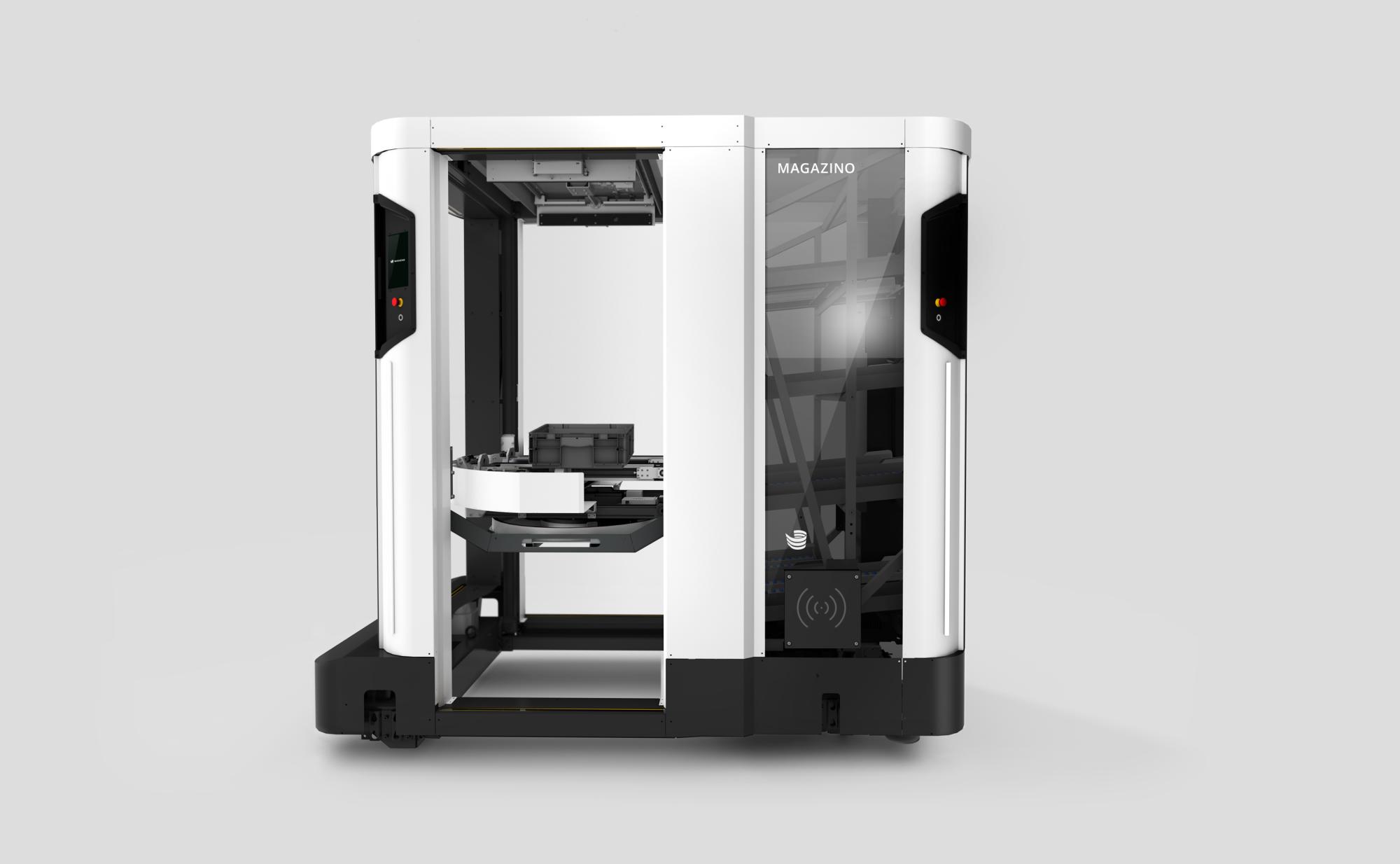
The robotics company Magazino has closed a Series B financing round of €21 million. Jungheinrich AG and the European Investment Bank (EIB) are leading the round, with existing investors also participating. The capital raised will be used to expand international sales activities and above all to accelerate the expansion of the “ACROS.AI” software stack a software platform for intelligent robots developed by Magazino that is also used on third-party hardware.

At the same time, Jungheinrich and Magazino agreed on a broad strategic cooperation and intend to combine their skill sets in the field of mobile automation.

“Magazino is a highly innovative young company that has outstanding skills in the area of navigation and control software for mobile automation. This investment chimes with our strategy in the field of automation and will make a significant contribution to the accelerated expansion of our business with automated trucks”, says Dr Lars Brzoska, Chairman of the Board of Management of Jungheinrich AG.

Automation is one of the biggest growth drivers in the intralogistics sector. Double-digit growth rates are expected in this segment in the coming years. This trend is driven above all by the persistently strong growth in online trade and the global shortage in logistics specialists, particularly forklift operators.

“Jungheinrich’s investment in Magazino demonstrates the high market demand for our robotics software ACROS.AI and our robots. With it, Magazino will take on a central role in software in the rapidly growing market for mobile robotics”, says Frederik Brantner, CEO and Co-Founder of Magazino.

In addition to the investments made by the existing shareholders and Jungheinrich AG, the European Investment Bank (EIB) is providing Magazino GmbH with financing of up to €12 million. The investment from the EU bank is secured by a guarantee from the European Fund for Strategic Investments (EFSI). EFSI is at the heart of the Investment Plan for Europe, under which the EIB and the European Commission work together as strategic partners to channel private capital into projects that strengthen the sustainability and competitiveness of the European economy. In many of these transactions, EIB involvement has an important signalling effect to private investors, whose risk is often significantly reduced by the EU bank’s in-depth analysis and involvement.

“Our investment supports a young, medium-sized company which, with its focus on artificial intelligence and automation, is of particular strategic value for the EU”, said Ambroise Fayolle, EIB Vice-President responsible for business in Germany. “These sectors are to a large extent knowledge-based and crucial for the future innovative capacity of European industry. They make our economy less prone to crises. I am particularly pleased that in such a challenging year we are promoting a project that benefits the company itself but can also initiate new developments with its customers and partners.”

European Commissioner for the Economy, Paolo Gentiloni, said: “The European Commission is committed to helping our SMEs to grow and invest in innovation. That is exactly what we are doing through the EFSI guarantee for Magazino. With their cutting-edge intelligent robots for warehouse logistics, Magazino is a true protagonist of the digital transition that offers such immense opportunities.”

Background information

About Magazino

Magazino GmbH develops and builds intelligent, mobile robots that perceive their environment and make their own decisions. These autonomous robots work alongside people and make processes in e‑commerce, fashion and production logistics more flexible and efficient than ever before. With over 100 employees in Munich, Magazino is the largest advanced robotics team in Europe. Magazino’s investors include Körber AG, Zalando and Fiege Logistik.

About Jungheinrich

Founded in 1953, Jungheinrich ranks among the world’s leading solutions providers for the intralogistics sector. With a comprehensive portfolio of material handling equipment, automatic systems and services, Jungheinrich is able to offer customers tailored solutions for the challenges posed by Industry 4.0. The Hamburg-based group is represented worldwide in 40 countries by its own direct sales companies and in approximately 80 other countries through partner companies. Jungheinrich employs 18 000 people worldwide and generated Group revenue of €4.07 billion in 2019. Jungheinrich shares are listed on the SDAX.



Belarus: Declaration by the High Representative on behalf of the

Recalling the Declaration by the High Representative on behalf of the European Union of 11 September, the EU once again reiterates that the 9 August Belarus Presidential elections were neither free nor fair. The European Union does not recognise their falsified results. On this basis, the so-called ‘inauguration’ of 23 September 2020 and the new mandate claimed by Aleksandr Lukashenko lack any democratic legitimacy.

This ‘inauguration’ directly contradicts the will of large parts of the Belarusian population, as expressed in numerous, unprecedented and peaceful protests since the elections, and serves to only further deepen the political crisis in Belarus.

The European Union’s position is clear: Belarusian citizens deserve the right to be represented by those they freely choose through new inclusive, transparent and credible elections.

We are impressed and moved by the courage of the Belarusian people who continue to demonstrate peacefully for democracy and for their fundamental rights despite the brutal repression of the Belarusian authorities. We stand in solidarity with them and fully support their democratic right to elect their President through new free and fair elections under the OSCE/ODIHR’s supervision.

We reiterate our expectation that the Belarusian authorities immediately refrain from any further repression and violence directed against the Belarusian people and immediately and unconditionally release all those detained, including political prisoners.

The EU remains convinced that an inclusive national dialogue and responding positively to the demands of the Belarusian people for new democratic elections are the only way forward in finding a way out of the serious political crisis in Belarus that respects the wishes of the Belarusian people.

In light of the current situation, the EU is reviewing its relations with Belarus.


Poland: BNP Paribas Bank Polska and EIB join forces for energy efficiency investments

>@EIB
©EIB
  • PLN 71.2 million (EUR 16 million) first loss guarantee agreement to help BNP Paribas Bank Polska to finance Polish energy efficiency projects.
  • The guarantee comes under the first Polish operation included in the PF4EE programme funded by the EIB and the European Commission.
  • The project is expected to benefit around 15.000 households, small farmers and housing associations. 

The European Investment Bank (EIB) has signed a PLN 71.2 million (EUR 16 million) guarantee agreement with BNP Paribas Bank Polska to provide a first loss portfolio guarantee to support the financing of energy efficiency projects from Polish homeowners, micro-farmers, and housing associations. The guarantee will help BNP Paribas Bank Polska to provide, under the agreement with the EIB, PLN 742 million (EUR 166.7 million) of new financing for energy efficiency projects. The banks estimate that around 15.000 clients will benefit from the project. The EIB guarantee comes under the Private Finance for Energy Efficiency (PF4EE), a joint initiative launched by the European Commission via the LIFE programme and the EIB.

The increased use of renewable energy is one of the key objectives of the Polish authorities and the European Union, which BNP Paribas Bank Polska and the EIB support,. This operation is set to facilitate investments in energy efficiency and renewable energy by Polish home owners, farmers and housing associations. The programme can support the installation of renewable energy sources in individual homes and micro-farms, as well as finance the comprehensive energy refurbishment of multi-home apartment buildings. Measures that are eligible for this financing include solar photovoltaic installation for private homeowners and micro-farmers and a wide range of energy efficiency measures for multi-apartment buildings, such as energy efficient windows or facades, heating and ventilation systems, renewable energy sources integrated into the buildings and other measures.

EIB Vice-President Teresa Czerwinska commented: “When you talk about climate action, there is much to be gained from energy efficiency. Investing in climate-relevant projects is not only about energy generation or e-mobility – a huge effort is needed to better manage and use the energy that we consume. In line with our commitment to raise the share of our climate financing to 50% by 2025, we wholeheartedly support this project with our long-time partner BNP Paribas Bank Polska, which will give Polish homeowners and farmers the chance to improve their environmental standing and save on their energy bills.”

Managing Director responsible for Assets and Liabilities Management and Head of BNP Paribas Bank Polska’s Sustainable Finance Competence Center Jarosław Rot added: “Care for the environment, sustainable development and energy efficiency are now key topics of public debate and challenges we all face. At BNP Paribas Bank Polska, we actively take initiatives to support the construction of a sustainable economy and protect natural resources. As the first on the Polish market, we have established cooperation with European institutions regarding the PF4EE instrument. Thanks to this, we can offer our clients financing of renewable energy sources in their homes and farms as well as thermo-modernisation projects for multi-family buildings on a massive scale. We are proud to be able to participate in the energy transformation of so many market segments and to help a wide group of Poles to derive renewable energy from home appliances.”

European Commissioner for Energy Kadri Simson said: “Energy efficiency is a common priority for many countries around the globe. It is an essential component of EU energy policy and key for the clean energy transition. Therefore, the ‘energy efficiency first’ principle remains our motto to live and work by. Given the challenges we have faced this year with the COVID-19 outbreak, it will have an even bigger role to play in the future as we look to recovery: small-scale energy projects have significant potential to create new jobs and reduce energy bills. I am pleased to see projects that boost the usage of renewables and energy efficiency in Poland.”

 Background information

BNP Paribas Bank Polska S.A., which has been listed on the Warsaw Stock Exchange since 2011 is a member of the BNP Paribas banking group whose footprint spans 71 countries. In Poland, as a universal bank with a global reach, it provides services to retail customers and other segments including Wealth Management, microbusinesses, SMEs and corporate banking. As it advocates green initiatives, BNP Paribas supports its clients in the transition to a low carbon economy, endeavors to curtail the adverse impact of its operations on the natural environment and inspires clients to make good financial decisions. The Bank has provided funding for more than 10 thousand households to install photovoltaic panels. The Bank also consistently pursues its strategy of financing businesses in Poland while also supporting investments of strategic importance to the country with a positive social, economic and environmental impact.

PF4EE is a joint EIB-European Commission financial instrument to promote energy efficiency lending by financial institutions. This is the 11th operation under the programme and the first in Poland. The PF4EE Instrument Risk Sharing Facility is a risk mitigation mechanism that enables financial intermediaries to partially recover losses they may incur in their newly originated portfolios of energy efficiency loans to final beneficiaries.


Press release – New committees begin their work

Special Committee on Foreign Interference in all Democratic Processes in the EU (INGE)

Chair: Raphaël GLUCKSMANN (S&D, FR)

1st Vice-Chair: Javier ZARZALEJOS (EPP, ES)

The other three vice-chairs will be elected at a later meeting.

The Special Committee on Foreign Interference in all Democratic Processes in the EU is composed of 33 members and is mandated to examine, among others, how outside manipulation and campaign financing affected elections in the EU and what the EU could do to counter disinformation.

You can follow all news about the special committee by signing up to its twitter account, @EP_Democracy


Special Committees on Artificial Intelligence in a Digital Age (AIDA)

Chair: Dragoş TUDORACHE (Renew/RO)

1st Vice-Chair: Miapetra KUMPULA-NATRI (S&D/FI)

2nd Vice-Chair: Geoffroy DIDIER (EPP/FR)

3rd Vice-Chair: Edina TÓTH (EPP/HU)

4th Vice-Chair : Birgit SIPPEL (S&D/DE)

The Special Committee on Artificial Intelligence in a Digital Age is made up of 33 members. Its mandate is to analyse the future impact of artificial intelligence in the digital age on the EU economy, in particular on skills, employment, fintech, education, health, transport, tourism, agriculture, environment, defence, industry, energy and e-government.

You can follow all news about the special committee by signing up shortly to its twitter account, @EP_ArtifIntel


Special Committee on Beating Cancer (BECA)

Chair: Bartosz ARŁUKOWICZ (EPP, PL)

1st Vice-Chair: Joanna KOPCIŃSKA (ECR, PL)

2nd Vice-Chair: Sara CERDAS (S&D, PT)

3rd Vice-Chair: Nathalie COLIN-OESTERLÉ (EPP, FR)

4th Vice-Chair: Ivars IJABS (Renew Europe, LV)

The Special Committee on Beating Cancer is made up of 33 full members and is specifically tasked with evaluating opportunities for concrete EU action, identifying legislation and other measures that can help prevent and fight cancer.

You can follow all news about the special committee by signing up to its twitter account, @EP_Environment


Subcommittee on Tax Matters (FISC)

Chair: Paul TANG (S&D, NL)

1st Vice-Chair: Markus FERBER (EPP, DE)

2nd Vice-Chair: Martin HLAVACEK (Renew, CZ)

3rd Vice-Chair: Kira PETER-HANSEN(Greens, DK)

4th Vice-Chair: Othmar KARAS (EPP, AT)

The subcommittee on tax matters is composed of 30 members and its mandate instructs it to deal primarily with the fight against tax fraud, tax evasion and tax avoidance, as well as financial transparency for taxation purposes.

You can follow all news about the subcommittee by signing up to its twitter account, @EP_Taxation


Committee of Inquiry on Animal Transport (ANIT)

Chair: Tilly METZ (Greens/LU)

1st Vice-Chair: Marlene MORTLER (EPP/DE)

2nd Vice-Chair: Anja HAZEKAMP (GUE/NL)

3rd Vice-Chair: Mohammed CHAHIM (S&D/NL)

4th Vice-Chair : Martin HOJSÍK (Renew/SK)

The Animal Transport Inquiry Committee, made up of 30 full members, should investigate alleged violations in the application of EU law on the protection of animals during transport and related operations within and outside the EU. It will focus on how EU rules are being implemented by member states and whether the EU Commission is enforcing them properly.

You can follow all news about the inquiry committee by signing up to its twitter account,

@EP_Agriculture


Press release – COVID-19: MEPs call for measures to close the digital gap in education

The resolution was adopted by 26 votes in favour, none against and 4 abstentions.

“The last six months have seen our education and training turned upside down. The pandemic has shown both creativity and ingenuity and at the same time exposed deeply worrying gaps in terms of access to and quality of education. The digital divide is making existing inequalities worse and leaving behind those who are already at a disadvantage,” said the rapporteur Sabine Verheyen (EPP, DE).


Digital education must be reality for all

In the resolution, MEPs deplore the “severe discrepancies” in learning across the EU during the lockdown, with 32% of pupils in some Member States not having had any access to education for several months. They fear that this will decrease future income levels for a whole generation and negatively impact labour productivity and competitiveness for the Union as a whole.

Therefore, closing the digital divide must be an “immediate priority”, with the Commission prioritising investments in digital infrastructure and equipment, particularly in remote and rural areas. “The primary lesson from the crisis” is that inclusion and equal opportunities must be at the heart of the EU’ s future education and training policies.


“A bold vision for the European Education Area”

MEPs also criticise the missing coordination and exchange of best practices during the crisis, and say that the EU should play a more active coordinating role.

“We want to see a bold vision for the European Education Area across education and training sectors that is backed up by concrete measures. And we want to see a Digital Education Action Plan that evolves from a collection of small-scale actions to a fully-fledged digital skills and education strategy. Grand ideas without the money to fund them cannot work though”, said Ms Verheyen.

The expected “education package” proposals should transform the European Education Area “from a loose vision of principles into a concrete work programme” that also ensures automatic mutual recognition of qualifications, diplomas and learning periods abroad by 2025 at the latest, MEPs say. The foreseen Digital Education Action Plan must set out a fully-fledged digital skills and education strategy.


Plans need a funding to match

MEPs also underline that high-quality education systems are the foundation of the EU’s global competitiveness and criticize the proposed cuts in the long-term budget. in programmes such asErasmus+, Horizon Europe and the European Social Fund Plus. They therefore reiterate their call for the Erasmus+ budget to be tripled compared to the 2014-2020 MFF.


Further steps

The resolution is set to be put to plenary vote during the second plenary session of October .

The European Commission has promised to come up with a new “education package” – Communication on the European Education Area and a revised Digital Education Action Plan – by the end of this month.