Speech by President Charles Michel at the Partnership 4 Growth Summit

President Charles Michel spoke at the 2021 P4G Seoul Summit, hosted by the Republic of Korea, on an “Inclusive Green Recovery Towards Carbon Neutrality”

I would like to thank the Republic of Korea for organising this important summit.

Covid-19 has consumed our attention for more than a year. But we all know there is another great challenge — climate change. It has not taken a break during this global pandemic. COVID has not diminished our climate goals. In fact, it has done the opposite. It has sharpened our focus and intensified our resolve to protect our natural world.

In the European Union, we launched our green transition well before the pandemic. In 2019, we took a landmark decision, committing to become the first carbon neutral continent by 2050. This led to our ground-breaking European Green Deal. In fact, COVID-19 has galvanised our resolve to transform the paradigm of our development model. From destructive short-term thinking towards a sustainable model that respects the life of our planet and the lives of our citizens.

The COVID pandemic has been a double-edged sword. It has tested our societies like never before. And forced us to take a hard look in the mirror at some weaknesses. But we have also seen our strengths. And the opportunities that lie ahead. For our people, for our societies, and for our planet. We have a unique opportunity — to build back our societies in a way that respects our planet.

We want to be a leader in global climate action. We have big goals. And we have made robust commitments. We want to become the first climate neutral continent by 2050. We want to reduce our carbon emissions by at least 55% by 2030. And for that to happen, we have mobilised a massive budget and recovery package: 1.8 trillion euros. Our growth strategy for the future.

Over 30% of our recovery package will go to greening our economies. And at least 20% will go to our digital priorities. This digital investment will have a direct impact on our climate objectives. For example, by improving the performance of super computers to make better climate decisions or developing smart mobility. And digitising our societies will have a wide-ranging impact. From driving research, innovation and technology to creating jobs and modernising our economies.

This global challenge will require huge collective intelligence. Developed countries have a special responsibility to support those in need. In the Paris Agreement, developed countries committed to 100 billion dollars per year in climate finance. G20 countries make up 85% of global GDP and 80% of global emissions.

We have a duty to show leadership in reducing emissions. A number of solutions already exist. But we need the political will.
First, by putting a price on carbon. And second, by developing green finance. We must come together, as one international community, to meet this urgent and vital challenge.

The world has paid a heavy price during COVID. In lives, in livelihoods, and in personal liberties. I would even say we have rediscovered a bit of modesty. We have come back to what matters most. The health of our families. The health of our communities. And the health of our planet.

One world, one health. All of us in this together.

Thank you.


Forward look: 31 May – 13 June 2021

The location and the format (physical or virtual) indicated for each meeting are subject to change.

Transport, Telecommunications and Energy Council (Transport), 3 June

Ministers will aim for a general approach on the Single European Sky, hired vehicles, and third country certificates in inland navigation. The Council is due to adopt conclusions on railways and on sustainable and smart mobility, and will discuss the latter topic.

Transport, Telecommunications and Energy Council (Telecommunications), 4 June

Ministers will assess progress on the Data Governance Act and on measures for a high common level of cybersecurity across the Union. They will discuss the topic of “2030 Digital Compass: How to chart the way towards the EU’s digital future”.

Justice and Home Affairs Council (Justice), 7 June

Ministers will hold a debate on how to combat illegal content online in the context of the digital services act proposal. They will also aim to reach general approaches on the regulation on assignment of claims, the regulation on cross border e-Justice in Europe (e-CODEX) and the regulation amending the European Agency for Fundamental Rights.

Justice and Home Affairs Council (Home Affairs), 8 June

Ministers will hold a debate on the impact of COVID-19 in fighting criminality and will exchange views on the internal security outlook regarding artificial intelligence. They will also have a first discussion on a Schengen strategy, which is expected to be presented by the Commission next week.

Environment Council, 10 June

Ministers will hold debates on the proposal for a revised Regulation concerning batteries and waste batteries. They will aim to approve Council Adaptation to Climate Change and hold a first exchange of views on the EU Action Plan on Zero Pollution.

Transport, Telecommunications and Energy Council (Energy), 11 June

Ministers will aim to reach a general approach on the revision of the TEN-E Regulation and approve Council conclusions on a Renovation Wave, followed by an exchange of views on hydrogen.


1st Referral Action Day Against Right-Wing Terrorist Online Propaganda

On 27 May 2021, the 1st Referral Action Day against right-wing terrorist online propaganda was coordinated by the European Union Internet Referral Unit at Europol’s headquarters in The Hague. The Action Day was joined by a total of 28 international partners: Australia, Austria, Belgium, Croatia, Czech Republic, Denmark, France, Georgia, Germany, Greece, Hungary, Ireland, Italy, Latvia, Lithuania, Luxembourg, Moldova, Montenegro, North Macedonia, Norway, Portugal, Romania, Serbia, Slovakia, Spain, Sweden, United Kingdom, and the New York City Police Department.

Referral Action Days are based on the referral by Europol and specialised units in partner countries of terrorist propaganda to online service providers that are responsible for evaluating the content to establish any potential breach of their terms of service. Among the items referred were:

  • right-wing terrorist and extremist content;
  • material produced by or favouring proscribed right-wing organisations;
  • material produced and disseminated concerning relevant right-wing attacks, such as texts, videos, audio files, publications, images, and social media accounts.

During the Referral Action Day, the parties involved reviewed the referral process, from detecting terrorist content to its flagging to online service providers (OSPs). A total amount of 1 038 items were assessed for referral to the OSPs with a request to be reviewed against their terms of service.

The threat posed by violent right-wing extremism has been growing. The terror attacks in Christchurch (New Zealand), Poway (USA), El Paso (USA), Bærum (Norway), and Halle (Germany) were part of a wave of violent incidents worldwide, the perpetrators of which were part of similar transnational online communities and took inspiration from one another.

The use of the internet is becoming increasingly important in this context. This no longer applies only to radicalisation and recruitment but also to the dismantling of crimes by law enforcement. This first Referral Action Day against right-wing terrorist and extremist online propaganda aimed to discover the sources of Internet activities and develop approaches to combat them.  Similar joint actions will continue to be organised in the future.


Industrial-scale cocaine lab uncovered in Rotterdam in latest Encrochat bust

An international multi-agency operation has led to 9 arrests, the seizure of over €3.4 million in cash and the shutdown of an industrial-sized cocaine production lab in the framework of Operation SR13

The cooperation between the French National Gendarmerie (Gendarmerie Nationale) and the Dutch Police (Politie) in the framework of the investigation into Encrochat has led to the discovery of an industrial-scale cocaine laboratory in the city of Rotterdam in the Netherlands. 

Acting on information from Europol and the  French Gendarmerie, 80 Dutch police officers, accompanied by their SWAT teams and specialised dogs, raided in the early hours of 26 May several addresses in the cities of Rotterdam and The Hague. The clandestine drug laboratory was found hidden in a building also housing a garage used by criminals to customise vehicles with secret compartments to transport drugs across Europe. A total of 7 vehicles already equipped with such compartments were seized on site, alongside a vehicle worth €110 000.

Both the drug laboratory and garage were run by the same criminal syndicate who was flooding Europe with cocaine. One of its members was arrested in Rotterdam under a European Arrest Warrant facilitated by Eurojust. 

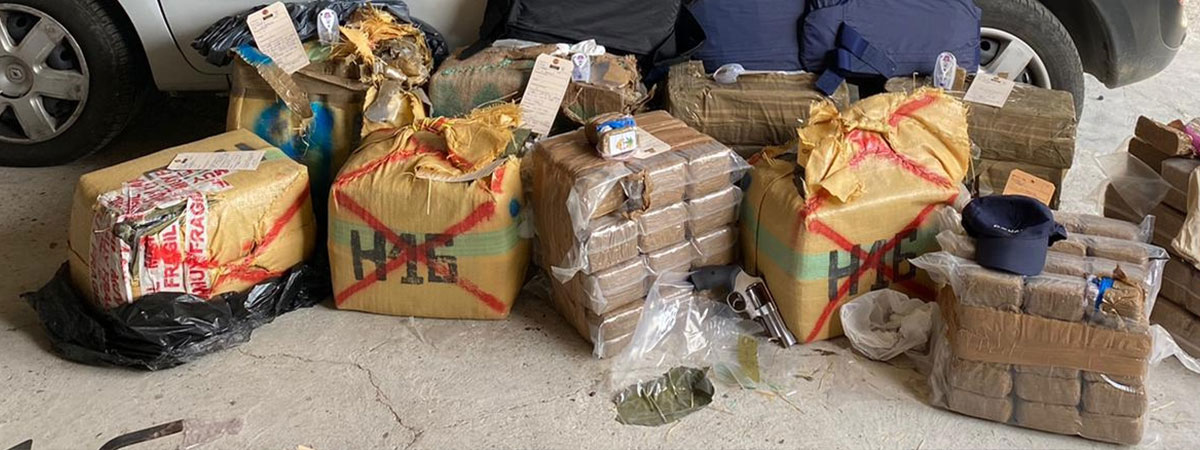
This sting follows an earlier action day carried out by the French Gendarmerie on 31 March on the occasion of which 450 of its officers were deployed against the same criminal group, leading to the arrest of 8 members of the gang. In addition, €5 million worth of cocaine was also seized in the region of Marseille, alongside €3 million worth of cannabis resin and €3.4 million in cash. The investigation was able to trace back the cocaine to the underground laboratory targeted this week in the Netherlands. 

Europol support

In the framework of intelligence activities underway with its operational counterparts, Europol developed actionable intelligence concerning the activities in Europe of this criminal syndicate.

In November 2020, Europol  brought together the national investigators on both sides who have since been working closely together to establish a joint strategy to bring down the whole network. The suspects were identified with the support of Operation EMMA 95/LEMONT 26, the French and Dutch-led investigation against the Encrochat network.

Since then, Europol has provided continuous intelligence development and analysis to support the field investigators. 


Joint Statement of the Members of the EEA Council

Joint Statement of the Members of the EEA Council

The members of the EEA Council held a video conference on 28 May 2021 at the initiative of Mr Augusto Santos Silva, Minister of Foreign Affairs of Portugal.[1] The video conference was attended by Mr Guðlaugur Þór Þórðarson, Minister for Foreign Affairs and International Development Cooperation of Iceland, Ms Ine Eriksen Søreide, Minister of Foreign Affairs of Norway and Ms Dominique Hasler, Minister of Foreign Affairs of Liechtenstein, as well as by representatives of the European Commission and the European External Action Service. The members of the EEA Council discussed the overall functioning of the Agreement on the European Economic Area (EEA Agreement) and held an orientation debate on Strategic Autonomy.

Following the videoconference, the members of the EEA Council adopted the following joint statement:

COVID-19

  1. We acknowledge the far-reaching effects of the COVID-19 crisis and stress the need to meet this unprecedented challenge in a spirit of solidarity. We welcome the particularly close cooperation between the EU and the EEA EFTA States during the pandemic. This continues to prove essential in areas such as research, development, and procurement of vaccines, for the acquisition of medicines, medical and protective equipment, and for the ongoing response to the pandemic with exchange of data, experience and views in relevant fora. Reaffirming the central role of the EEA Agreement in closely linking our societies and economies, we stress the continued need to pursue such close cooperation and the importance of considering how to help alleviate the serious socio-economic impact of the COVID-19 pandemic through all available instruments. Ensuring the integrity of the Internal Market and the smooth functioning of the EEA Agreement remain essential priorities in this context. We welcome the participation of EEA EFTA States in the central distribution of vaccines through the EU procurement scheme and underline the importance of preserving the integrity of the Internal Market in the establishment of mechanisms for the production, supplies and deliveries of vaccines.
  2. We emphasise the critical importance of a coordinated approach for the swift and effective roll-out of COVID-19 vaccines across the EEA. We note the initiative to establish a European Health Union aiming at strengthening the EU’s health security response capacity and better equipping authorities at all levels to prevent and address future pandemics in a coordinated manner. We also note the launch of the EU4Health Programme, which will contribute to the availability and affordability of medicines and healthcare products.

Political dialogue

  1. We recognise that the special partnership between the EU and the EEA EFTA States is the best guarantee of long-term shared prosperity and stability. It has contributed to a Europe based on peace, democracy, the rule of law and human rights. In this context, within the framework of the Political Dialogue, we held informal exchanges of views on current foreign policy matters of mutual interest. We underline the importance of continuing the practice of inviting officials from the EEA EFTA States to political dialogues held in conjunction with the EU Council working parties.

Cooperation in the EEA

  1. We confirm our support for the EEA Agreement as a fundamental basis for future relations between the EU and the EEA EFTA States and stress the importance of the two-pillar structure of the Agreement. We recognise the positive contributions made by the EEA EFTA States to the decision-shaping process of EEA-relevant EU legislation and programmes through their participation in committees, expert groups, studies, and agencies, as well as through the submission of EEA EFTA Comments. Furthermore, we stress the positive contribution of the EFTA Surveillance Authority and of the European Commission in monitoring the compliance with the EEA Agreement in all its Member States. We underline the importance of inviting EEA EFTA Ministers to informal EU Ministerial meetings and Ministerial conferences, organised by the Presidency, relevant to EEA EFTA participation in the Internal Market and express our appreciation to the current Portuguese and incoming Slovenian Presidencies for the continuation of this practice.
  2. We agree on the need to further strengthen communication efforts on the EEA Agreement and on its benefits for citizens and businesses. Emphasising that greater knowledge of the EEA Agreement throughout the EEA at all levels is in the interest of all Contracting Parties and the good functioning of the Internal Market, we urge the EU and the EEA EFTA States to ensure that information on the EEA Agreement is made readily and easily available.
  3. We recognise the ongoing challenges in international trade at a time where global supply chains have been under strain due to the COVID-19 pandemic and reconfirm the commitment to open, fair and sustainable trade and rules-based trade relations.
  4. Recognising the important role of parliamentary cooperation and cooperation between economic and social partners, we note the Resolution of the EEA Joint Parliamentary Committee adopted at its meeting on 28 April on the Annual Report of the EEA Joint Committee on the Functioning of the EEA Agreement in 2020.

Incorporation of EEA-relevant EU acts

  1. Noting the Progress Report of the EEA Joint Committee, we express our appreciation for the work of the Joint Committee in ensuring the continued successful operation and good functioning of the EEA Agreement.
  2. We recognise the ongoing work to reduce the number of EU acts awaiting incorporation into the EEA Agreement and that important progress had been made in 2021. These efforts are the result of the joint efforts of the EU Institutions and the EEA EFTA States.  We however note that the backlog remains high and stress the need to make the necessary resources available to increase the speed and volume of incorporation of EU legal acts and thereby continue to ensure legal certainty and homogeneity in the EEA.

The withdrawal of the United Kingdom from the EU and the EEA Agreement

  1. We welcome the dialogue between the EU and the EEA EFTA States on issues related to the implication of the UK’s withdrawal from the European Union and the new relationship between the EU and the UK that are relevant for the EEA Agreement and encourage the continuation of this dialogue. In this context, we underline the importance of ensuring the continuation of a well-functioning, homogenous EEA and of preserving the integrity of the Internal Market.

The development of the Internal Market and Digital Transformation

  1. We emphasise the importance of a well-functioning Internal Market, including the Digital Single Market, which will be essential to sustain economic recovery across the EEA. While it proves necessary to temporarily adapt certain rules, such as on state aid, due to the COVID-19 crisis, we underline the indivisibility of the four freedoms and the importance of common rules and equal conditions in the Internal Market making significant progress. The high average rate of youth unemployment in Europe and the prospect of its increase due to COVID-19 crisis remain an important challenge for the Internal Market.
  2. We reiterate the importance of the close involvement of the EEA EFTA States in the design and development of Internal Market policies and initiatives. We encourage active cooperation on initiatives for better enforcement and implementation of Internal Market rules and welcome the EEA EFTA States’ participation in the Single Market Enforcement Task Force (SMET).
  3. We welcome the proposals of the European Commission for the Digital Services Act and Digital Markets Act as a means to provide for a safe, fair and rules-based internal market for digital services, addressing safety concerns and illegal content online, whilst preserving the innovative potential of the digital economy. The importance of the EU and the EEA EFTA States working closely together on these issues is underlined.
  4. We furthermore note the proposals for a revised Directive on Security of Network and Information Systems (NIS) and the Data Governance Act. Achieving a high common level of cybersecurity and circulation of data in line with European values across the EEA will be essential priorities for the Digital Single Market.

The European Green Deal

  1. High ambitions, collective effort and urgent action are needed to speed up the transition to a sustainable, climate neutral and environmentally friendly future. We further note the preparatory work on the important ‘Fit-for-55’ package which will amend several key EEA-wide policy instruments. We recognise the importance of sustainable finance including as a means of channelling private investment into green growth.
  2. We express our full commitment to stepping up global efforts to tackle climate change, pursuing sustainable energy transition, and protecting the environment. We emphasise the importance of continued close cooperation between the EU and the EEA EFTA States on these issues, including on renewable energy, hydrogen and carbon capture and storage and mineralisation (CCSM). We furthermore agree that it is essential to put these issues and the loss of biodiversity at the heart of a renewed ambition to achieve sustainability. We note that cooperation towards a cleaner Europe and a toxic-free environment will continue, related to the key actions of the European Commission on the new Circular Economy Action Plan and on the Chemicals Strategy for Sustainability. We further note the European Commission Strategy on offshore renewable energy.
  3. We stress the importance of the EU and the EEA EFTA States working together in decarbonising the transport sector, by speeding up the green transition in all modes of transport and developing a sustainable, intelligent, and more resilient transport industry. We welcome the European Strategy for Sustainable and Smart Mobility and the related EEA EFTA Comment, which stresses the need for innovative solutions while ensuring a level playing field for Europe with the objective to take the global lead to reduce greenhouse gas emissions from transport. In light of current circumstances, we recognise the need for increased cooperation for the recovery of the transport sector in the EEA and welcome the good cooperation on the Green Lanes network.
  4. We note the European Commission Communication on the Farm to Fork Strategy for a fair, healthy, and environmentally-friendly food system. We welcome the EEA EFTA comment which stresses the importance of joining forces in promoting the global transition to sustainable food systems in international standardisation bodies and relevant multilateral fora, inter alia to promote safe food and healthy diets, reduced carbon and environmental footprints, animal welfare and the fight against antimicrobial resistance.
  5. Recognising that climate change is a global problem, we reiterate our full commitment to implement the UN 2030 Agenda and the Paris Agreement as the essential multilateral frameworks governing global action against climate change. We underline the continued importance of increased ambition under the Paris Agreement, and that all Parties should submit enhanced National Determined Contributions as soon as possible.

The Social Dimension

  1. We recognise that the EEA Agreement has an important social dimension, covering issues related to labour law, health and safety at work and gender equality. The social impact of the COVID-19 crisis was partly cushioned by unprecedented support measures, but a robust recovery would be essential to overcome further adverse developments.
  2. In this context, we note the launch of the Action Plan to implement the European Pillar of Social Rights and the outcome of the Porto Social Summit in May. We note the new social rules in the Mobility Package to enhance traffic safety and better social rights for drivers and highlighted the need to focus further efforts on enforcement and exchange of information.

EU programmes

  1. Acknowledging the contribution made by EU programmes to building a greener, more digital, and resilient Europe, we recall the significance of the participation and financial contributions of the EEA EFTA States in EEA-relevant programmes under the recent Multiannual Financial Framework for 2014-2020. We welcome the EEA EFTA States’ intention to participate in several programmes foreseen under the new 2021-2027 period and underline that such participation remained based on the relevant provisions of the EEA Agreement.
  2. We welcome that the foreseen participation will strengthen cooperation in areas like research and innovation, education, civil protection, health and digital matters. It is recognised that this cooperation will represent a substantial financial commitment from the EEA EFTA States towards a green, digital, inclusive, and resilient society.
  3. We look forward to the incorporation of the new generation of EU programmes into the EEA Agreement and invited both sides to speedily process the relevant acts. In the meantime, we stress the importance of ensuring that EEA EFTA entities are eligible and able to participate in the preparatory stages and activities from the very start of programmes with foreseen participation of the EEA EFTA States.

Financial Mechanisms

  1. We commend the positive contribution made by the EEA and Norway Financial Mechanisms in reducing social and economic disparities throughout the EEA and in supporting a free and vibrant civil society, as this contributes to a well-functioning Internal Market. We look forward to the conclusion of the review under Article 11 of Protocol 38C of the EEA Agreement in the EEA Joint Committee in June.
  2. Regarding the agreements on EEA and Norwegian Financial Mechanisms for the 2014-2021 period, we welcome the conclusion of Memoranda of Understanding (MoU) with all 15 beneficiary States and the signing of most of the agreements on programmes. We recall the importance of maintaining a close cooperation between the beneficiary States and the EEA EFTA States, in the spirit of equal partnership between the Contracting Parties to the EEA Agreement.
  3. We note that in the face of the COVID-19 crisis, the EEA EFTA States has, in cooperation with the beneficiary States, put in place a number of flexibilities to mitigate risks for the timely realisation of the programmes and for the achievement of best results in the implementation of the EEA and Norway Financial Mechanisms 2014-2021. Some beneficiary states consider that COVID-19 might have an impact on the achievement of some of the results.

Agricultural trade

  1. We recall the commitment of the Contracting Parties in accordance with Article 19 of the EEA Agreement and call on the parties to pursue the dialogue with a view to reviewing the conditions of trade in agricultural products. We note Contracting Parties’ intention of conducting a new review of the trade regime for processed agricultural products within the framework of Article 2(2) and Article 6 of Protocol 3 to the EEA Agreement, in order to further promote trade in this area.

[1] The members of the EEA Council met informally through videoconference on 25 May 2020 and on 18 November 2020.