Nagorno Karabakh: Remarks by the High Representative / Vice-Pres

Check against delivery!

Thank you Mr President, Honorable Members of the European Parliament,

Members, the current military confrontation along the Line of Contact in the Nagorno Karabakh conflict zone is of our utmost concern. It is the largest confrontation since 1993-1994. We have been very engaged on this issue.

On the day that fighting erupted, I released a statement as High Representative, calling for an immediate cessation of hostilities, de-escalation and strict observance of the ceasefire. During the past days, I have had several phone calls, separately, with the Armenian and the Azerbaijani Foreign Ministers, urging both sides to stop the hostilities and to return to the negotiating table.

Our position is clear: the fighting must stop. Both sides need to re-engage in meaningful negotiations – which, by the way, have not been very fruitful in the last 30 years – without preconditions, under the auspices of the OSCE Minsk Group Co-Chairs. There can be no military solution to the conflict, nor external interference. This position was reinforced by the European Council held on the 1st and 2nd of October.

We have seen extremely worrying reports of a surge in attacks on populated areas, which is taking a deadly toll on civilians. We strongly urge the sides to fully observe their international obligations to protect civilian populations. And, with the resources we have, we have urgently allocated a small amount of money [€500,000] in humanitarian aid for the affected populations.

In fact, we do not have a lot of information about how the conflict is developing. Detailed information is scarce and there is a lot of fake news.

OSCE monitoring on the ground remains suspended, so we do not have observers. But what we observe is an increasing amount of disinformation, which is aimed at mobilising the domestic audiences in both countries and could be used to pull regional actors into the conflict. Media reports need, therefore, to be examined with great caution, because we do not have confirmation of some of the news that has been disseminated.

At this stage, further escalation of the conflict and involvement of regional actors, unhappily, cannot be excluded. This would seriously threaten the stability of the whole region.

On the 30th of September, I discussed the situation with the Russian Foreign Minister and I also spoke with the Turkish Foreign Minister – the two regional actors that are closer to the conflict. I emphasised the importance of de-escalation, the importance that regional actors refrain from any activity and rhetoric that could inflame things even further.

I spoke to the Foreign Ministers of Armenia and Azerbaijan during the weekend. I stressed that the increase of civilian casualties is unacceptable. I heard from both sides the actions taken by the other side; each one of them blames the other for starting and for attacking civilian populations, not in Nagorno Karabakh itself, not in the region in dispute, but from Armenia to Azerbaijan and from Azerbaijan to Armenia.

The fighting should stop. The OSCE Minsk Group Co-chairs are going to have meetings this week with the Foreign Affairs Ministers of the two countries, and the only way to get out of this situation is that the Minsk Group Co-chairs pushes for immediate negotiations as soon as possible.

We will continue working with key partners to try to help stop the hostilities, because the only solution is to go back to the negotiating table. But this negotiation table has been open for the last 30 years without any kind of advance. War is not an alternative; we have to push both parties to stop fighting and start negotiating without preconditions. But this is, for the time being, not the case.

I am sorry that I cannot inform you more about that, because as I said, the information is very much scarce and we have to take care not to disseminate news that has not been confirmed.

About the situation in Cyprus, I share the concerns of the Honorable Member who took the floor a moment ago. For sure this issue of Famagusta was taken into consideration at the European Council as well. The opening of this area, which is a closed area according to the ceasefire agreements under the auspices of the United Nations is a serious violation of this agreement and yesterday we issued an statement and today the 27 [EU Member States] will issue another one asking Turkey to stop doing this activity. You know that the European Council issued a statement on the situation in the Eastern Mediterranean. For sure this is not going to help. On the contrary, it is going to increase tensions and to make it more difficult to reach an agreement on an especially difficult situation for all of us on the Eastern Mediterranean.

Thank you.

Link to the video: https://audiovisual.ec.europa.eu/en/video/I-195714

Closing remarks

Thank you President, thank you to all of you for your interesting and engaging remarks.

I think your message is clear, it has been repeated 65 times with different voices, but expressing the same concerns and the same request to act.

Next Monday, I will bring your voice to the Foreign Affairs Council in Luxembourg, where we will have to follow up on the situation and see what we can decide about it.

But the European Council was very clear that they consider that the framework within which to mediate and to act on this conflict is the OSCE Minsk Group Co-Chairs. This was clearly what the European Council said. They asked me to support the work of the OSCE Minsk Group Co-Chairs – and that is what we are doing. But we have to let this group of people work, because it is the only one that has been recognised by the two sides.

I think that Mr [Reinhard] Bütikofer [Member of the European Parliament] is right when he says that there are some new things in this conflict. One is that Americans are withdrawing and Turkey is taking a stronger, much more assertive position.

The European Council also discussed about the relationship with Turkey. I invite you to read the conclusions of the European Council, which say that in December, we will take stock of the evolution of the situation in the Eastern Mediterranean and all the conflicts in which Turkey is more or less involved, in order to take decisions on how we continue our relationship with Turkey.

We are going to continue calling for a ceasefire. I will bring your voice to the Foreign Affairs Council. We will remind the two sides of their obligation to protect civilians under international humanitarian law. And we will keep working, also with Turkey, in order to build a constructive contribution to the conflict settlement and help the efforts to stop the hostilities.

We have a Special Representative for the South Caucasus [Mr Toivo Klaar], who is there and who is in touch with the two sides of the conflict.

Yesterday, the Turkish [Foreign] Minister [Mevlüt Çavuşoğlu] was in Baku, and I was really concerned when I saw that he was expressing full support to Azerbaijan. My last talk with Azerbaijani Minister [Jeyhun Bayramov] was also very worrisome, because he was clearly saying that the fight will continue until Armenia accepts a concrete schedule for withdrawing from Nagorno Karabakh, which is a precondition for conversation, for talks. It is very difficult. The situation is really becoming worse and worse.

All of you have been asking to act, but I have heard very few concrete versions of the verb ‘act’. What do you mean by ‘act’? We will do whatever we can do in order to support the OSCE Minsk Group Co-Chairs, which is the framework that the European Council decided to support in order to look for a negotiated solution, pushing both sides to stop the fighting, and especially putting pressure on Turkey to not continue to intervene. But to ‘act’ – if you mean by ‘act’ taking military action – is completely out of question.

We are going do what we can do as the European Union, with the resources we have in the diplomatic arena. The European Council has decided to see what is going on from now until December to review our relationship with Turkey. This is what the European Council decided after a long discussion on our relations with Turkey. I have to stick to that. I will obey and I will try to implement the mandate of the European Council in order to support the OSCE Minsk Group Co-Chairs that I hope this week will have meetings with the Foreign Affairs Minister of Azerbaijan and I hope with the Foreign Affairs Minister of Armenia as well.

Thank you.

Link to the video: https://audiovisual.ec.europa.eu/en/video/I-195715


Iran: Remarks by the High Representative/Vice-President Josep Bo

Check against delivery!

I thank the European Parliament for its ongoing concern about the situation in Iran, including the recent worrying Human Rights related developments.

Iran is in the middle of a difficult period. The COVID-19 is affecting the country severely, with more than 3,000 new infections every day, nearing half a million in total, and at least 27,000 deaths. The COVID-19 crisis is further deepening Iran’s existing economic difficulties. Following the Joint Comprehensive Plan of Action, the so-called JCPOA, Iran had legitimate expectations that this “nuclear deal” would result in more concrete economic benefits.

Yet, after the regrettable US departure from the agreement and re-instatement of severe sanctions, the overall economic figures speak for themselves; the International Monetary Fund is predicting a 10% drop in GDP this year, [after a] 8,5 drop last year; unemployment is at 16%; [within the past year] the Iranian rial has lost almost half its value towards the US dollar; trade with the EU has decreased. In addition, Iran is experiencing shortages of important humanitarian items like personal protective equipment and medicine that could help in fighting COVID-19. There are severe shortages of all capacities to fight the COVID-19.

As European Union, we were quick to provide humanitarian support, with a [humanitarian] air bridge, and we keep strongly advocating – together with the UN Secretary General [António Guterres] that sanctions must not impede humanitarian trade. Together with European Union Member States we also keep looking at ways to encourage more legitimate trade between the EU and Iran, including through INSTEX [the Instrument in Support of Trade Exchanges]. But we need to do more.

These difficulties have also had a political impact in Iran, not least at the parliamentary election earlier this year; we have seen a strengthening of those opposed to the nuclear deal, who are distrustful of the West and who do not support diplomacy and engagement. Together with our European and international partners, we are working hard to make sure that diplomacy with Iran continues to be possible.

We have also witnessed several deeply concerning human rights developments recently. This includes the treatment of Nasrin Sotoudeh and the many other political prisoners who remain imprisoned, whose health is at risk and should be released on humanitarian grounds, or at least have prompt access to medical assistance if they require it.

We also condemned publicly the execution of Iranian wrestler Navid Afkari and called on the Iranian authorities to investigate allegations that he was tortured in detention. We underline to all our partners, and not just Iran, that the perpetrators of such acts must be held accountable.

We continue to engage the Iranian authorities on their distressing practice of arbitrarily detaining European Union-Iranian dual nationals. We acknowledge the temporary release of French citizen Fariba Adelkhah, no individual should be used as a pawn and I want to once again urge the Iranian authorities to cease this policy.

Madam President, Honourable Members,

Let me finish with some remarks on the nuclear agreement. I want to be clear: As Coordinator – because the High Representative acts as coordinator of the JCPOA – I will continue to do everything possible to ensure the preservation and full implementation of the nuclear deal by all parties. Why is this so important? Because it is in our very own European security interest. And because the agreement continues to deliver. Without the nuclear deal, Iran could have developed a nuclear weapon by now with all the security implications for the region and beyond.

Of course, I am very concerned about Iran’s reduced implementation of its JCPOA nuclear commitments following the US withdrawal from the agreement two years ago. And I do believe that full implementation of the nuclear deal by Iran and the other parties remains crucial to our efforts to preserve it.

However, we should not forget that even though the amount of nuclear material Iran possesses today is more than it had two years ago, it is still far less than the ten tons of enriched uranium that Iran possessed before the agreement. And we know that this is thanks to the JCPOA: Iran is the most monitored country in the world by the International Atomic Energy Agency, with now almost 400 inspections per year. If we were to lose the agreement, we would lose such critical information about the nuclear programme, too.

During recent weeks, a great amount of attention has been devoted to attempts by the United States to bring back the United Nations Iran sanctions. Here I want to be very clear also, once more: bringing back these sanctions would have meant the end of the JCPOA. 13 members of the Security Council, including all European members, rejected this approach and underlined the importance to keep the agreement in place – this way supporting the understanding that the US is no longer part of the JCPOA because they freely decided to withdraw from it. They were also very clear that – after leaving the agreement in 2018 – the United States was not in a position to initiate the so-called ‘snap back’ process of bringing back United Nations sanctions under the UN Security Council resolution 2231. As JCPOA Coordinator, I thus want to re-iterate that all sanctions lifting commitments under the agreement remain in place.

I will personally continue to remain engaged on all of these issues, knowing that you are being criticized by both parts when you take this stance, and I count on the strong backing of this Parliament and the Council to promote a holistic approach to Iran that takes into account the different facets of our bilateral relationship. Engagement with Iran on all these issues remains in the European Union’s vital strategic interest, and that is why we are approaching the issue the way we do.

Thank you.

Link to the video: https://audiovisual.ec.europa.eu/en/video/I-195823

Closing remarks

Thank you President, it has been a busy morning. We have been here for 4 four hours and we are reaching the end of these intense debates about three very important issues. Many things have been said, I agree with many of them. And I could say exactly what Mr [Michael] Gahler has said at the end – the worst thing would be Iran becoming nuclear. Thanks to this [nuclear] deal, it is not nuclear. Other Members [of the European Parliament] have said the same thing, I cannot mention all of them.

To try to keep the JCPOA alive – although, as Mr [Reinhard] Bütikofer has said, it is very weak, it is not in a very good shape because the withdrawal of the US is something that jeopardises its existence and continuity. But to keep the JCPOA [alive] although in a reduced regime, is not contradictory with the importance that we have to give to the situation of human rights in Iran. I know that this is something that the entire Parliament is very much concerned with and I can assure you that we will continue working to put in front of the Iranian authorities our concerns, our rejection of the executions, and the tensions that have been mentioned here today. We will do that in close collaboration with the German Embassy in Tehran, which is currently acting as our local representation since we do not have a European Union Delegation on the ground.

And Mr Bütikofer is also right, we have to look further. Whatever is going to happen in the US after the next election… it is not sure that the JCPOA will resist. We have to look for a new agreement – is it possible? Remember how difficult it was to reach this agreement, how many years of tough work were required? To rebuild the agreement in order to adapt it to the new circumstances and even enlarging it would be good, if possible. It would depend very much on the political landscape in January next year.

In the meantime, about the arms embargo, I want to stress that we, Europeans, will continue to keep our arms embargo in place. The comprehensive arms embargo of the European Union, not related to the JCPOA, will continue into 2023. But we cannot say that we fight to keep the JCPOA alive and at the same time impose an arms embargo related to the JCPOA itself. On that, I think we cannot share the position of the US, as did not 13 Members of the United Nations Security Council.

All in all, we are trying to do our best to increase our trade with Iran. It is very difficult because the American sanctions are very powerful, but the Iran deal is not just a nuclear deal – it is a nuclear deal on one side and an economic deal on the other. And one thing goes with the other. We cannot pretend [to ask] Iran to fulfil all the nuclear obligations if at the same time they do not get any kind of reward from the economic side. This is a delicate balance, and let us try to work on two things at the same time: the nuclear agreement and human rights. We continue fighting to keep the nuclear agreement alive and working, and at the same time, we will continue working to make the Iranian authorities aware that the respect of human rights is a sine qua non condition for us to engage with them.

And in both things I need the support of the European Parliament, for a realistic approach to one of the most important problems for our security. Because without the JCPOA, today Iran would be a nuclear power and then we would be in a completely different scenario, in a completely different situation. I think that this achievement of the European Diplomacy, – which took a lot [of] efforts from a lot of people, from Javier Solana [former High Representative for the Common Foreign and Security Policy and Secretary General of the Council of the European] to Ms Federica Mogherini [former High Representative of the Union for Foreign Affairs and Security Policy and Vice-President of the European Commission], it deserves to be preserved. It deserves to be continued, to facilitate a non-nuclear Iran. And it gives us also leverage to engage with Iran on these other very important issues, such as human rights, that I know the Members of the [European] Parliament are very much attached to, as I am. You can count on the work of the European External Action Service engaging on these issues. The two of them can go in parallel, one thing does not prevent the other.

Thank you very much Members of the Parliament for your support and for this long and moving session.

Link to the video: https://audiovisual.ec.europa.eu/en/video/I-195825


Jordan: The EU Bank supports the implementation of the Municipal Energy Efficiency Programme

>@S B/Unsplash
©S B/Unsplash

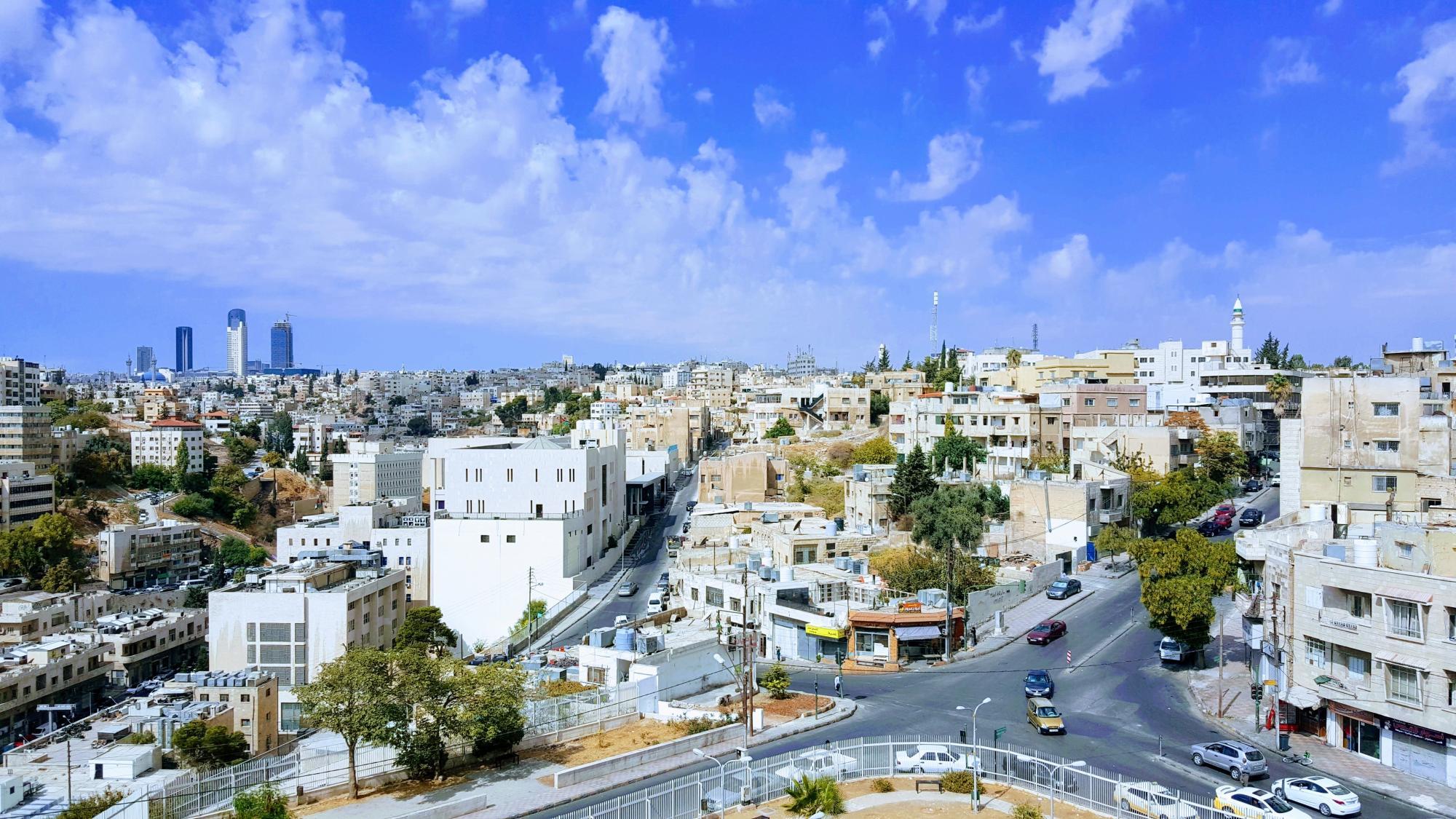
The European Investment Bank (EIB) and Cities and Villages Development Bank (CVDB) have signed a Technical Assistance cooperation agreement of EUR 1.4 million grant to support the implementation of the CVDB – Municipal Energy Efficiency Programme. The Programme is an important initiative that seeks to invest in energy efficiency across Jordanian Municipalities.

The advisory services are complementary to the EUR 45 million EIB loan provided to the CVDB in October last year. The services will include conducting needed technical studies, development of the pipeline of sub-projects of the programme and supporting its management. The project’s pipeline will include sub-projects that improve municipal services buildings and lighting infrastructure throughout Jordan, the refurbishment and energy efficiency upgrade of public buildings and the installation of solar panel facilities on buildings, solar farms and public lighting investments.

The Bank’s support to the project comes through a grant under the EIB’s Economic Resilience Initiative (ERI), which is designed to strengthen EU Southern Neighbouring countries’ ability to address key challenges. The Municipal Energy Efficiency Programme is in line with the current EU-Jordan partnership Priorities and Compact, especially the objectives of “a sustainable use and management of natural resources”. The programme will contribute to the objective of developing energy efficiency and renewable energy investments to attain reduction of energy use by 20%, and improve contribution of renewables in electricity generation to 15%.

Dario Scannapieco, Vice President of the Bank commented on the signature: “EIB, the Bank of the European Unions is a longstanding partner to Jordan. We are happy to complement our financing to the Municipal Energy Efficiency Programme with advisory services to facilitate and support our Jordanian partners in the successful implementation of the programme.”

The EU’s Ambassador to Jordan, H.E. Maria Hadjitheodosiou, welcomed the continued cooperation between the EIB and the Cities and Villages Development Bank. She highlighted that the advisory services that will be provided via this cooperation agreement are fully aligned with and reinforce the EU’s partnership agreement with Jordan.

Osama Al-Azzam the DG of CVDB added that this grant will provide consultancy and Technical support services that will contribute to the implementation of the project in accordance with best practices and for the interest of Jordanian municipalities in order to reduce the electric energy bill and reduce the financial burdens on the municipalities.

Jordan and the EIB

EIB in the region

Economic Resilience Initiative


EU-Japan joint naval exercise

On 5-6 October, the European Union and Japan carried out a joint naval exercise in the Gulf of Aden off the coast of Somalia. The exercise involved a warship supporting maritime patrol aircraft of EU NAVFOR Somalia Operation Atalanta and a vessel of the Japan Maritime Self-Defence Force patrolling the region against piracy. The exercise confirmed the commitment of the EU and Japan and the coordination between their respective forces in the fight against piracy.

The EU and Japan are committed to upholding the rules-based international order through practical maritime cooperation, including cooperation on freedom of navigation and overflight, to secure sea-lanes of communication and to protect the global maritime domain against all types of threat, traditional and non-traditional. In this context, the EU and Japan reaffirm the universal and unified character of the 1982 UN Convention on the Law of the Sea, which sets out the legal framework within which all activities in the oceans and seas must be carried out. The EU and Japan are determined to pursue and enhance their cooperation on freedom of navigation and maritime security through future training initiatives and operational activities at sea. Furthermore, they stand ready to extend their lasting cooperation in this area so as to include also other partners in the Indian Ocean and in the Pacific region.

Factsheet on enhancing EU security cooperation in and with Asia: https://eeas.europa.eu/headquarters/headquarters-homepage/63292/eu-asia-…


Italy: EU backs MMI’s Robotic System for Microsurgery

>@MMI
©MMI

MMI SpA, an Italian company dedicated to improving clinical outcomes for patients undergoing microsurgery, has signed a financing agreement with the European Investment Bank (EIB) granting access to up to €15 million ($17.74 million), to be deployed over the coming years to support its long-term financial strategy. The EU bank’s loan is backed by a guarantee from the European Fund for Strategic Investments (EFSI), the main pillar of the Investment Plan for Europe under which the EIB and the European Commission are working together as strategic partners, with the EIB’s financing operations boosting the competitiveness of the European economy.

EIB Director Christoph Kuhn said: “Certain sectors are sometimes overlooked when we talk about ‘Italian excellence’, but surgical robotics definitely qualifies in that category. I am glad that, with backing from the Investment Plan for Europe, the EIB can get behind MMI to improve the lives of patients that need to have microsurgery. European knowledge and expertise need to be supported, especially in these economically difficult times, and the EU bank is here to do just that.”

European Commissioner for the Economy, Paolo Gentiloni, said: “European companies have long been at the forefront of innovative solutions in the field of healthcare. Thanks to the backing of the European Fund for Strategic Investments, the EIB can support MMI SpA as it continues developing the next generation of microsurgical instruments to help patients undergoing surgery in the future.”

We are pleased to have secured a loan instrument from the European Investment Bank and appreciate the vote of confidence in our company and innovative solutions from such a high-calibre institution. This agreement comes at an exciting time for our company. The resources will further strengthen our financial position in preparation for the commercial launch in Europe of our breakthrough robotic system aimed at improving the standard of care for patients undergoing microsurgical procedures”, said Gianluca Landi, CFO of MMI SpA.

Background information

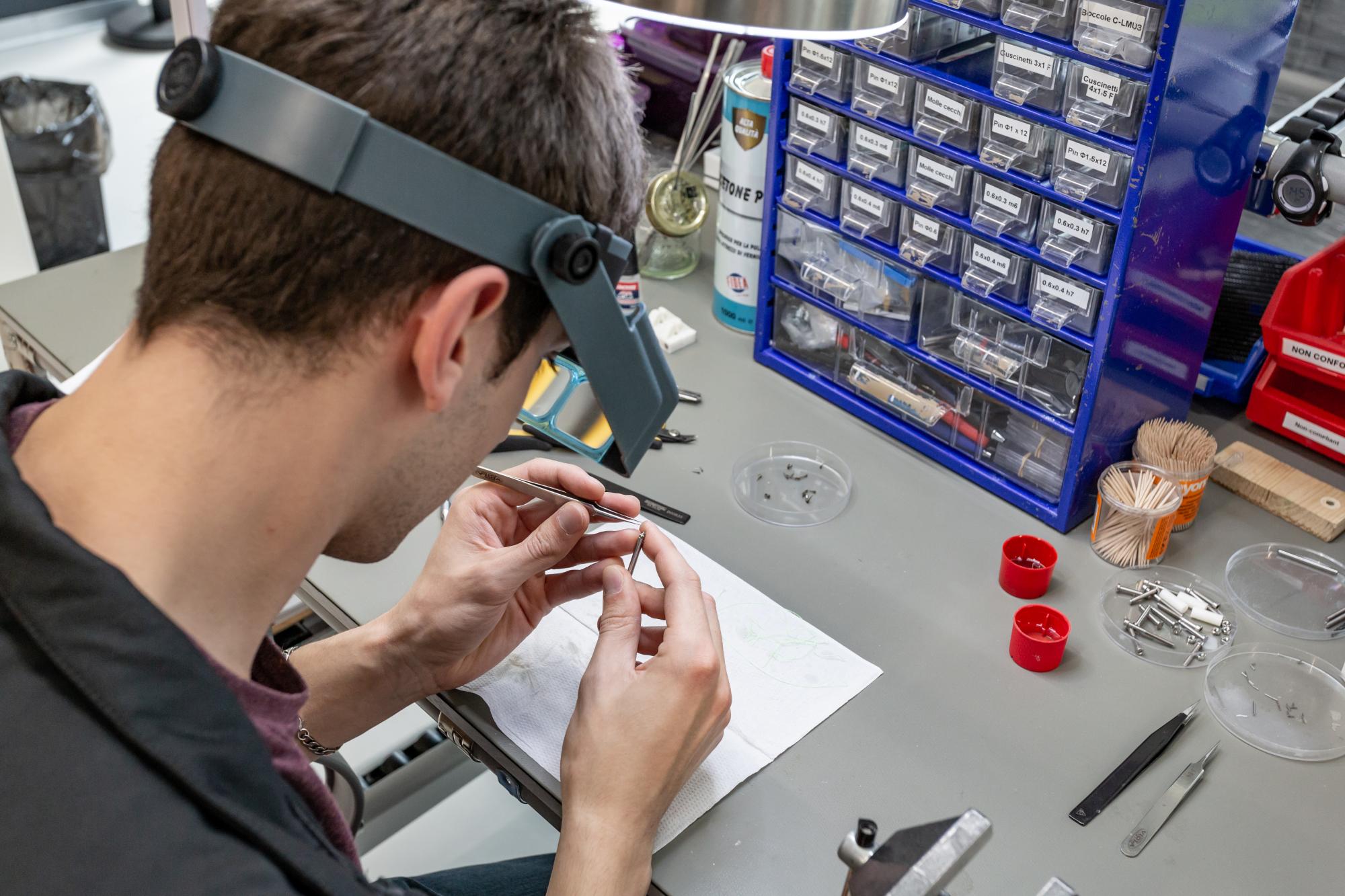
Medical Microinstruments S.p.A. (MMI) was founded in 2015 near Pisa, Italy to enhance surgical performance through the development of a robotic system that enables surgeons to achieve better outcomes on delicate microsurgical procedures. The MMI robotic platform combines proprietary innovations including the world’s smallest wristed microinstruments as well as tremor-reducing and motion scaling technologies. Together, these powerful capabilities enable more surgeons to successfully perform microsurgery while expanding the field of supermicrosurgery. For more information, please visit: www.mmimicro.com

The European Fund for Strategic Investments (EFSI) is the main pillar of the Investment Plan for Europe. It provides first-loss guarantees enabling the EIB to invest in more and often riskier projects. The projects and agreements approved for financing under the EFSI are expected to mobilise €514 billion in investment, supporting over 1.4 million start-ups and small and medium-sized enterprises across the European Union. Total financing under EFSI in Italy since 2015 amounts to €12.5 billion and is set to trigger €79.4 billion in additional investments through co-financing with private and public partners.