Press release – Climate change: the EU needs to be better prepared so it can better adapt

On Tuesday, the Committee for Environment, Public Health and Food Safety approved a resolution on adaptation to climate change, with 64 votes to 9 and 7 abstentions, providing input on the upcoming EU Strategy on adaptation to Climate Change.

The resolution calls for a renewed and improved focus on adaptation, as it is crucial to prepare for a changing climate by building resilient societies that are able to minimise the adverse impact of climate change.

The EU Strategy on adaptation should be an opportunity to ensure EU countries are on track to meet the adaptation goal under the Paris Agreement, show EU global leadership in building global climate resilience through increased financing and promote EU science, services, technologies and practices for adaptation, MEPs say.

How to help the EU adapt to climate change

MEPs call for increased funding at EU, national and regional levels, and for public and private investments in adaptation. The EU’s climate-related spending target should contribute to both climate mitigation and adaptation, they say, recalling that the cost of inaction would be far greater.

The Commission should ensure that costs arising from a failure to take adaptation measures are not passed on to citizens and enforce the “polluter pays” principle, making the polluter take responsibility for adaptation, MEPs agreed.

They also want to ensure that EU funding only goes to climate-proofed infrastructure by making an ex-ante examination to assess the capacity of EU projects to cope with medium-to-long term climate impacts in different global temperature rise scenarios an obligatory condition of receiving EU funding.

Next steps

The resolution is scheduled to be voted on during the 14 – 17 December Plenary session, where a related question will also be presented to the Commission for oral answer.

Background

The European Environment Agency (EEA) has estimated that weather and climate-related extremes have accounted for EUR 426 billion in monetary losses in the period 1980-2017 in EU-28.

Adaptation means anticipating the adverse effects of climate change and taking appropriate action to prevent or minimise the damage. Well planned, early adaptation action is proven to save money and lives later.

The ability to adapt differs across populations, economic sectors and regions within Europe. The EU can ensure that disadvantaged regions and those most affected by climate change are capable of taking the necessary measures to adapt, and when the impact of climate change transcends borders of individual states, e.g. rivers.

As part of the European Green Deal, a new Adaptation Strategy is expected to be adopted by the Commission in early 2021.
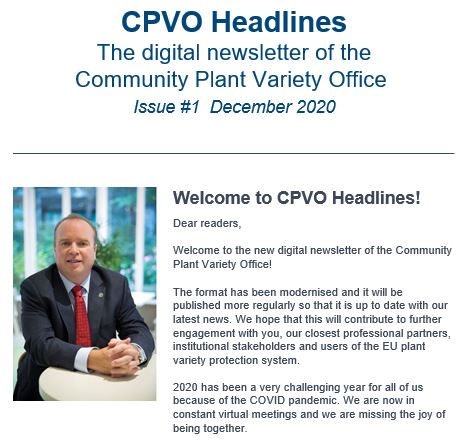


The Community Plant Variety Office launches « CPVO Headlines », the new digital newsletter of the CPVO

On 1 December 2020, the CPVO launched “CPVO Headlines“, the new digital newsletter of the Community Plant Variety Office.

“We realised that the way readers look for news and digest information has changed significantly in the past few years. With this in mind, we decided to modernise the format of CPVO’s newsletter and to offer our subscribers a monthly update which is more digestible, newsworthy and engaging”, said Martin Ekvad, President of the CPVO.

The newsletter can also be read online: “CPVO Headlines #1: December 2020“, and a printable PDF version can be downloaded at the bottom of this page.

If you wish to receive CPVO Headlines directly in your e-mailbox, you must subscribe by filling in the online registration form. Subscribers will be able to unsubscribe at any time.

If you have any question, please contact communication [at] cpvo [dot] europa [dot] eu


Article – New EU rules: digitalisation to improve access to justice

On 23 November, Parliament adopted two proposals aimed at modernising justice systems in the EU, which will help to decrease delays, increase legal certainty and make access to justice cheaper and easier.

New regulations will implement several digital solutions for cross-border taking of evidence and service of documents with the aim of making cooperation between national courts in different EU countries more efficient.

Endorsing distance communication technologies will lower costs and help evidence to be taken quicker. For example, to hear a person in a cross-border proceeding, videoconferencing can be used instead of requiring a physical presence.

A decentralised IT system that brings together national systems will be established so that documents can be exchanged electronically in a faster and more secure way. The new rules include additional provisions to protect data and privacy when documents are transmitted and evidence is being taken.

The regulations help simplify procedures and offer legal certainty to people and businesses, which will encourage them to engage in international transactions, thereby not only strengthening democracy but also the EU’s  internal market.


Press release – MEPs approve deal on tap water and demand that EU water legislation be respected

The agreement with member states on the drinking water directive was approved with 73 votes to 2 and 5 abstentions. The new rules will improve the quality of tap water by tightening the maximum limits for certain pollutants such as lead and harmful bacteria. They also aim to cut plastic litter by encouraging the use of tap water. This could be done by providing water free of charge in public buildings or for a low service fee, and to customers in restaurants, canteens, and catering services.

Comply with EU water legislation by 2027

The Committee also adopted a resolution on the implementation of EU water legislation with 68 votes to 2 and 10 abstentions.

While MEPs agree with the Commission’s assessment that the Water Framework Directive (WFD) is fit for purpose and should not be revised, they strongly regret that half of the bodies of water in the EU are still not in good condition and that the objectives of the WFD have not yet been reached. This is mainly due to inadequate funding, particularly slow implementation, and insufficient enforcement. The precautionary and polluter-pays principles are not being implemented properly, and many member states are using exemptions too broadly, they say.

The resolution underlines that the WFD objectives need to be better integrated into sectoral policies, particularly in agriculture, transport and energy in order to be fully compliant with the WFD and for all surface and ground waters to achieve ‘good status’ by 2027 at the latest.

MEPs urge member states to reduce the use of fertiliser and pesticides and call for such targets to be integrated and implemented in the national Strategic Plans under the EU’s farm policy. Additional action regarding chemicals and pollutants, water pricing policies, hydropower and urban wastewater treatment is needed, they say.

Next steps

The plenary will vote on the deal on the drinking water directive and on the resolution on the implementation of the EU water legislation during its 14 – 17 December session.

Background

The Fitness Check of EU water legislation in December 2019 concluded that the legislation is adequate but that there is room for improvement related to investments, implementation, integrating water into other policies, chemical pollution, administrative simplification and digitalisation.

While the Water Framework Directive established a framework to protect 110.000 bodies of surface water in the EU, the implementation has been lacking. Less than half of the EU’s bodies of water are in good status, even though the deadline for achieving this was 2015.


Alicante News November 2020

December 01, 2020 About the EUIPO

Alicante News November 2020

The latest edition is out now.

The aim of Alicante News is to provide up-to-date information on EUIPO-related matters, as well as on other general IP issues, to the users of the EU trade mark and design registration systems.

In this issue:

  • Enter GIview
  • First GI registration in ARIPO supported by EUIPO
  • European cooperation: online improvements in Romania
  • European Cooperation: new online services in Portugal
  • Monaco and San Marino join Designclass
  • European Cooperation: Slovenia completes the digitisation of its trade mark and design dossiers
  • Fax Phase Out
  • Webinars from the EUIPO Academy
  • Case Law