Statement by the High Representative/Vice-President Federica Mogherini and Commissioner for Humanitarian Aid and Crisis Management Christos Stylianides on the World Humanitarian Day 2017

The European Union (EU) is committed to the safety of humanitarian workers. Every year, the EU marks World Humanitarian Day by adding its voice to the global campaign that honours humanitarian workers who, day after day, put their lives on the line to save the lives of others. World Humanitarian Day marks the anniversary of the 2003 bombing of the UN headquarters in Baghdad, Iraq, when 22 humanitarian workers lost their lives.

High Representative/Vice-President Federica Mogherini and Commissioner Christos Stylianides, made the following statement:

“We live in a world increasingly marked by countless attacks and violence against innocent people globally. This should never become the new normal, something we leave unchallenged.

Humanitarian workers who risk their lives to save others are often the targets. We saw this last week in Central African Republic or in Syria countless times.

Ahead of World Humanitarian Day, we pay tribute to and honour all those who risk their lives while bringing assistance to victims of wars and natural disasters worldwide. We commend the bravery of all men and women that continue to work selflessly for the benefit of others.

In long lasting conflicts, where the rules of war are ignored and trampled on, aid delivery is never easy but always indispensable. Humanitarian workers should be able to operate freely, to help those that need it most.

Sadly, more than 4000 humanitarian workers have bee nvictims of major attacks over the past two decades. Over one third of them were killed. These senseless attacks are a gross violation of International Humanitarian Law. 

We will not allow these attacks to deter our commitment to continue to help those in need.

The EU is a world leader in humanitarian assistance and is committed to promoting global understanding of and respect for International Humanitarian Law and the humanitarian principles.”

Background

In 2016, the EU mobilised €2.1 billion helping over 120 million people in over 80 countries around the world. This was the largest ever EU humanitarian aid budget to help those most in need, from people affected by severe large-scale crises in Syria, Yemen, South Sudan or the Lake Chad region, to victims of natural disasters such as the El Niño phenomenon, the tropical cyclone Winston in Fiji, the drought in Papua New Guinea, or the earthquake in Equator.

The EU contributes to the global respect for and compliance with International Humanitarian Law (IHL) through advocacy and political measures such as dialogue, statements and initiatives, as well as through funding to ensure humanitarian access. The EU funds IHL dissemination targeting a wide range of stakeholders, as well as activities aimed at increasing the capacities of humanitarian workers in advocating for IHL, and implements large-scale information campaigns to raise awareness of IHL across the general public.

For more information:

Website of the European Commission’s Directorate-General for European Civil Protection and Humanitarian Aid Operations (ECHO)

Website of the European Commissioner for Humanitarian Aid and Crisis Management, Christos Stylianides

World Humanitarian Day 2017

ECHO Factsheet: International Humanitarian Law

Solidarity in Action


June 2017 compared with May 2017-Production in construction down by 0.5% in euro area -Down by 0.2% in EU28

In June 2017 compared with May 2017, seasonally adjusted production in the construction sector decreased by 0.5% in the euro area (EA19) and by 0.2% in the EU28, according to first estimates from Eurostat, the statistical office of the European Union. In May 2017, production in construction fell by 0.2% in the euro area and by 0.5% in the EU28.

Full text available on EUROSTAT website


EU: a world leader in helping those affected by crises

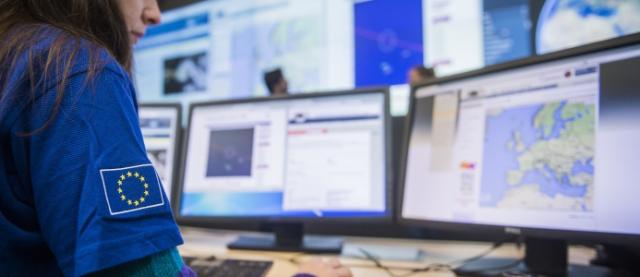
Emergency Response Coordination Centre from the inside

Within the European Union: helping citizens and Member States at home

EU Civil Protection Mechanism

When national capacities to respond to natural disasters are surpassed, European countries often show solidarity by sending assistance in the form of equipment, experts and assets such as planes or vehicles, during the emergency response phase.

This is done through the EU’s Civil Protection Mechanism, which has been put into action a record 8 times this summer to help countries affected by forest fires such as Italy, France, Portugal, Albania and Montenegro.

  • The Emergency Response Coordination Centre (ERCC) is the emergency response hub of the European Commission. It works 24/7, 365 days a year. It coordinates pan-European assistance through the Civil Protection Mechanism and ensures that all participating states in the mechanism are quickly informed of needs from an affected country during a crisis. The decision to activate the Civil Protection Mechanism is not made by the Commission, but has to be made by the national authorities of the affected country.
  • The EU Civil Protection Mechanism facilitates and co-finances the transport of assistance to the affected area.
  • The EU Civil Protection Mechanism facilitates the cooperation in disaster response among 34 European states (28 EU Member States, the former Yugoslav Republic of Macedonia, Iceland, Montenegro, Norway Serbia and Turkey). These Participating States pool the resources that can be made available to disaster-stricken countries all over the world.
  • Since its launch in 2001, the EU Civil Protection Mechanism has monitored over 400 disasters and has received almost 300 requests for assistance. It intervened in some of the most devastating disasters the world has faced, including the floods in Serbia and Bosnia and Herzegovina (2014), the Ebola outbreak in West Africa (2014), the conflict in Ukraine (2014), the earthquake in Nepal (2015), the conflict in Iraq (2016) and hurricane “Matthew” in Haiti (2016).

EU funding for reconstruction after natural disasters

Through funding, the EU lends a helping hand to its citizens and Member States when they are affected by natural disasters.

  • The EU Solidarity Fund was established to express European solidarity to disaster-stricken regions in Member States and countries involved in accession negotiations with the Union. The Fund was created following the severe floods in Central Europe in the summer of 2002. Since then, it has been used for 76 disasters including floods, forest fires, earthquakes, storms and drought. 24 countries have been supported so far for an amount of over €5 billion.
  • The Fund supplements Member States’ public expenditure to finance essential emergency operations such as: restoration to working order of essential infrastructure (energy, water, transport, telecoms, health and education); temporary accommodation and cost of the emergency services to meet the immediate needs of the population; securing of prevention infrastructures such as dam and dykes; measures to protect the cultural heritage; cleaning up operations.
  • The largest amount under the EU Solidarity Fund — €1.2 billion — was recently proposed for Italy, following the earthquakes that struck the country in 2016 and 2017.
  • In addition, Member States can now (since July 2017) activate a special EU support, in the form of an increased EU co-financing rate of 95% to finance reconstruction works linked to natural disasters with the European Regional Development Fund (ERDF). This special EU support can be activated from day 1 of a disaster, and for disasters that have occurred since the beginning of the current programming period, i.e. 1 January 2014. It can therefore supplement EU Solidarity Fund support and provide a quick and efficient EU assistance to regions in distress.

Finally, the Commission stands ready to modify Regional Policy programmes, upon request of the national authorities and within the flexibility of the existing rules, in order to respond to new priorities on the ground. For example, the Portuguese Centro region’s programme has been modified and funding was redirected to restore vital infrastructure and regenerate economic activity in the region following the forest fires of June 2017.

Emergency support within the EU for the refugee crisis

Since 2016, the European Commission can fund humanitarian aid for people in need within the EU territory through the Emergency Support Instrument. Until 2018, up to €700 million of EU-funding will be made available via partner organisations, such as UN agencies, the Red Cross and non-governmental organisations. At this stage, the EU has provided this emergency support to thousands of refugees in Greece, helping provide shelter, food, water as well as protection of child refugees.

The Commission’s humanitarian support complements other EU funding instruments which have already been providing significant financial resources for assistance in Greece such as the Asylum, Migration and Integration Fund (AMIF) the Internal Security Fund (ISF), the European Fund for the Most Deprived (FEAD) and the EU Health Programme. It is also complementary to the voluntary offers for material assistance by states participating in the EU Civil Protection Mechanism.

EU solidarity in action: the European Solidarity Corps

Within Europe, the newly created European Solidarity Corps provides opportunities for young Europeans between 18 and 30 to provide help to people who need it most, either as a volunteer, or in the framework of a traineeship or a job. Just 11 months after President Juncker announced the new initiative for this first time in his State of the Union speech 2016, more than 34,000 young people have joined the European Solidarity Corps. In March 2017, matching with organisations began; since then, about 15,000 participants have been contacted and 700 placements were accepted, most of which already started. Just this week, the first group of European Solidarity Corps volunteers arrived in Norcia, Italy, to help with the ongoing efforts to repair damage and rebuild social services for the local community affected by the severe earthquakes that hit the region a year ago. In total, 230 European Solidarity Corps members will support Italian communities hit by the earthquakes in the next years. The aim is to have 100,000 young people taking part in the European Solidarity Corps by the end of 2020.

Outside of the EU: a global leader in humanitarian and development assistance

Emergency humanitarian assistance

Together with funding provided by EU Member States, the European Union is the world’s largest donor of humanitarian aid. Aid is provided to those most in need in places such as Syria and neighbouring countries hosting large amounts of refugees. It also goes to those forcibly displaced within Africa and other areas of the world. All humanitarian aid is impartial and independent, and is provided to non-governmental and international organisations, the United Nations and the Red Cross societies.

  • Overall, humanitarian assistance from the EU budget in 2016 helped more than 120 million people caught up in natural disasters or conflict in over 80 countries across the world.
  • For 2016, the European Commission adopted its highest ever humanitarian aid budget in at €2.1 billion, due to unprecedented needs around the world.
  • A large part of EU humanitarian aid goes to refugees and displaced people with the European Commission providing more than €1,9 billion of its annual humanitarian aid budget in 2016 to projects helping refugees and internally displaced people (IDPs) in 56 countries. This funding covers projects that help the forcibly displaced access shelter, protection, food and other basic services such as health, nutrition, water, sanitation and education. Given these unprecedented humanitarian crises in 2016, the European Commission targeted humanitarian aid to those most in need and most vulnerable, and by strengthening its policy response. At the first-ever World Humanitarian Summit in May 2016, the EU welcomed the launch of the “Grand Bargain”, to redirect at least US$1 billion dollars over the next five years to the frontline of humanitarian action where it is needed most.

European solidarity is overwhelming supported by EU citizens: almost nine out of ten Europeans think that EU-funded humanitarian aid is important, according to the most recent Eurobarometer survey.

EU solidarity in action: EU Aid Volunteers

EU Aid Volunteers brings together volunteers and organisations from different countries, providing practical support to humanitarian aid projects and contributing to strengthening the local capacity and resilience of disaster-affected communities around the world. The programme offers opportunities for European citizens to become EU Aid Volunteers in humanitarian projects worldwide, showing solidarity with those who most need it; it provides professional support by trained and well-prepared volunteers to communities affected by disaster, capacity building for local staff and volunteers of organisations in countries hit by disasters, and technical assistance for organisations based in Europe to strengthen their capacity to participate in the EU Aid Volunteers initiative. The volunteering projects can last between 1-18 months. In total, 4000 EU Aid volunteers will be deployed to the field during the 6 year initiative.

Long term development aid

The EU is also the world’s largest aid donor. Official Development Assistance provided by the EU and its Member States reached €75.5 billion in 2016, an 11% increase compared to 2015 levels.

EU aid goes to the world’s poorest regions and works with partner countries to address extreme poverty and enhance resilience. We carry out programmes to empower women and young people, improve food and nutrition security, increase health care, create jobs, and increase renewable energies. As a result, more girls and boys are in school now than ever before, fewer children and mothers are dying from preventable causes.

The European Union was instrumental in creating coalitions of high ambition in a number of major international agreements, which will set the global framework for our external actions until 2030. These included the Addis Ababa Action Agenda, a ground-breaking approach to financing sustainable development, the comprehensive and universally-applicable UN 2030 Agenda for Sustainable Development, the forward-looking Sendai Framework for strengthening disaster risk reduction capacities and the first-ever legally-binding global commitment to tackle climate change.


Daily News 18 / 08 / 2017

Statement by European Commission President Jean-Claude Juncker following the attack in Barcelona

“It is with profound sorrow and anguish that I have learnt of the terrorist attack that has struck at the heart of Barcelona. I send my deepest condolences to the families and loved ones of the victims, as well as to Prime Minister Rajoy and the people of Spain. My thoughts are with the people of Barcelona. I hold a special thought for the heroic people who responded by running towards danger to help others and to the security forces who are working to keep the population safe. The Commission is at the full disposal of the authorities for any help or assistance necessary. This cowardly attack has deliberately targeted those enjoying life and sharing time with family and friends. We will never be cowed by such barbarism.” The full statement is available here. (For more information: Annika Breidthardt – Tel.: + 32 229 56153)

World Humanitarian Day: EU a global leader in helping those in need

Ahead of World Humanitarian Day tomorrow, High Representative/Vice-President Federica Mogherini and Commissioner for Humanitarian Aid and Crisis Management Christos Stylianides, have issued a statement commending the efforts of humanitarian workers worldwide and paying tribute to those killed whilst working to save others: “We live in a world increasingly marked by countless attacks and violence against innocent people globally. This should never become the new normal, something we leave unchallenged. Humanitarian workers who risk their lives to save others are often the targets. We saw this last week in Central African Republic or in Syria countless times. (…) we pay tribute to and honour all those who risk their lives while bringing assistance to victims of wars and natural disasters worldwide. (…) Humanitarian workers should be able to operate freely, to help those that need it most.” The statement also highlights the EU’s strong global humanitarian contribution. Last year, the EU provided €2.1 billion helping over 120 million people in over 80 countries around the world. This was the largest ever EU humanitarian aid budget to help those most in need. The full statement is available in all EU languages here. The Commission also helps those affected by crises both within and outside EU, such as for the ongoing forest fires in Europe. A memo is available with details on the EU’s crisis response tools and funding for these kind of events. (For more information: Carlos Martin Ruiz De Gordejuela – Tel.: +32 229 65322; Catherine Ray – Tel.: +32 229 69921; Daniel Puglisi – Tel.: +32 229 69140)

La politique de Cohésion investit dans l’extension du métro de Bucarest, en Roumanie [Updated on 18/08/2017 at 12:29]

34.2 millions d’euros du Fonds de Cohésion vont financer des travaux sur la ligne 4 du métro de Bucarest, dans le premier secteur de la capitale, entre le Parc Bazilescu et le quartier de Străulești. Le projet comprend la construction de près de 2 km de ligne et de deux stations de métro, Laminorului et Străulești. La Commissaire à la politique régionale Corina Creţu a commenté: “Ce projet financé par l’UE promeut une mobilité urbaine durable à Bucarest, où les habitants profiteront d’une meilleure qualité de vie et d’une meilleure qualité de l’air. L’extension du métro aura également des effets positifs pour les entreprises locales et le tourisme dans la ville. J’espère sincèrement que la décision d’aujourd’hui conduira à accélérer les travaux, de sorte que les citoyens de Bucarest puissent bénéficier des services de métro Bazilescu-Străulești au plus tard en mars 2018.” Plus d’informations sur les investissements de la politique de Cohésion en Roumanie sont disponibles sur la plateforme Open Data. (Pour plus d’informations: Johannes Bahrke – Tel.: +32 229 58615; Sophie Dupin de Saint-Cyr – Tel.: +32 229 56169)

Eurostat: La production dans le secteur de la construction en baisse de 0,5% dans la zone euro

En juin 2017 par rapport à mai 2017, la production dans le secteur de la construction, corrigée des variations saisonnières, a diminué de 0,5% dans la zone euro (ZE19) et de 0,2% dans l’UE28, selon les premières estimations d’Eurostat, l’office statistique de l’Union européenne. En mai 2017, la production dans le secteur de la construction avait baissé de 0,2% dans la zone euro et de 0,5% dans l’UE28. En juin 2017 par rapport à juin 2016, la production dans le secteur de la construction a progressé de 3,4% dans la zone euro et de 3,6% dans l’UE28. Un communiqué de presse est disponible ici. (Pour plus d’informations: Lucía Caudet – Tel.: +32 229 56182)

Mergers: Commission clears acquisition of a portfolio of 48 European infrastructure companies by APG

The European Commission has approved, under the EU Merger Regulation, the acquisition of a portfolio of 48 European infrastructure companies (the Portfolio), currently controlled by DIF Management B.V., by APG Asset Management N.V. (APG), of the Netherlands. The Portfolio comprises project companies active in the infrastructure sector, such as wind farms, solar plants, motorways, hospitals, waste treatment, public buildings or housing projects. The companies in the Portfolio are active in Belgium, France, Germany, Ireland, the Netherlands and the UK. APG is the asset management business unit of APG GROEP N.V., a collective pension scheme provider. The Commission concluded that the proposed acquisition would raise no competition concerns given the transaction’s limited impact on the market structure. The transaction was examined under the simplified merger review procedure. More information is available on the Commission’s competition website, in the public case register under the case number M.8567. (For more information: Ricardo Cardoso – Tel.: +32 229 80100; Maria Sarantopoulou – Tel.: +32 229 13740)

Mergers: Commission clears acquisition of sole control over Sapa by Norsk Hydro

The European Commission has approved, under the EU Merger Regulation, the acquisition of sole control over Sapa by Norsk Hydro. Sapa is a worldwide producer of aluminium products with core activities in soft alloy aluminium extrusions, building systems and precision welded tubing. Norsk Hydro is a global supplier of aluminium with activities throughout the value chain. The Commission concluded that the proposed acquisition would raise no competition concerns given that Norsk Hydro already held joint control over Sapa prior to the transaction. Therefore, the transaction would not bring any significant changes in the markets concerned. The operation was examined under the simplified merger review procedure. More information will be available on the Commission’s competition website, in the public case register under the case number M.8577. (For more information: Ricardo Cardoso – Tel.: +32 229 80100; Maria Sarantopoulou – Tel.: +32 229 13740)

Upcoming events of the European Commission (ex-Top News)


Statement by European Commission President Jean-Claude Juncker following the attack in Barcelona

“It is with profound sorrow and anguish that I have learnt of the terrorist attack that has struck at the heart of Barcelona this afternoon.

I send my deepest condolences to the families and loved ones of the victims, as well as to Prime Minister Rajoy and the people of Spain. My thoughts are with the people of Barcelona.

I hold a special thought for the heroic people who responded by running towards danger to help others and to the security forces who are working to keep the population safe. The Commission is at the full disposal of the authorities for any help or assistance necessary. This cowardly attack has deliberately targeted those enjoying life and sharing time with family and friends. We will never be cowed by such barbarism.”