Vítor Constâncio: Growth in a more resilient Euro area

Remarks by Vítor Constâncio, Vice-President of the European Central Bank, on a panel entitled “The Global Economy: Prospects for Broad-Based Growth” at the 32nd Annual G30 International Banking Seminar, Washington D.C., 15 October 2017

Ladies and Gentlemen,

It is a great pleasure to be part of such a distinguished panel. In my remarks today, I would like to reflect on the euro area’s recent economic developments and prospects. In doing so, I will outline the role monetary policy has played – and will continue to play – in supporting the recovery, while also touching upon some of the additional policies required to firmly secure a self-sustained recovery.

The main message I would like to convey is that the euro area economy is experiencing a broad-based, robust and resilient recovery, which is underpinned by the monetary policy measures introduced by the ECB since June 2014. Despite this favourable growth dynamics, inflation developments have been subdued. We remain confident that the continued closing of the output gap will lead inflation to return to our medium-term objective, yet this return remains conditional on a very substantial degree of monetary accommodation.

Looking beyond monetary policy, considerable reforms have been implemented and institutional progress has been achieved since the crisis, but supply-side policies are still required at the national level to boost potential growth, while at the euro area level, further institutional reforms are needed to enhance the functioning of EMU.

Recent economic developments and prospects

In the second quarter of 2017, euro area real GDP expanded for the 17th consecutive quarter, growing by 2.3% year-on-year and exceeding our expectations from earlier in the year. Growth is also becoming more broad-based across euro area countries, showing the lowest dispersion since the beginning of the monetary union. The flow of survey data in the third quarter has been encouraging and bodes well for continued growth momentum in the period ahead.

Robust economic activity is also being translated into a substantial amount of job creation. Almost 7 million more people are now employed in the euro area than in mid-2013, which implies that all of the employment losses recorded during the crisis have been offset. The improving labour market combined with increasing household wealth, strong consumer confidence and favourable financing conditions should all support continued robust private consumption. Investment prospects also look promising, which reflects both the need to make up for forgone investment in previous years as well as the highly accommodative financing conditions which have been passed through to lower borrowing costs for euro area firms.

The resilience of the recovery reflects the strength of domestic demand which in turn, is being supported by the very favourable financing conditions stemming from the monetary policy measures introduced since June 2014 (see Chart 1).

Chart 1: Impact of ECB measures on key financing conditions
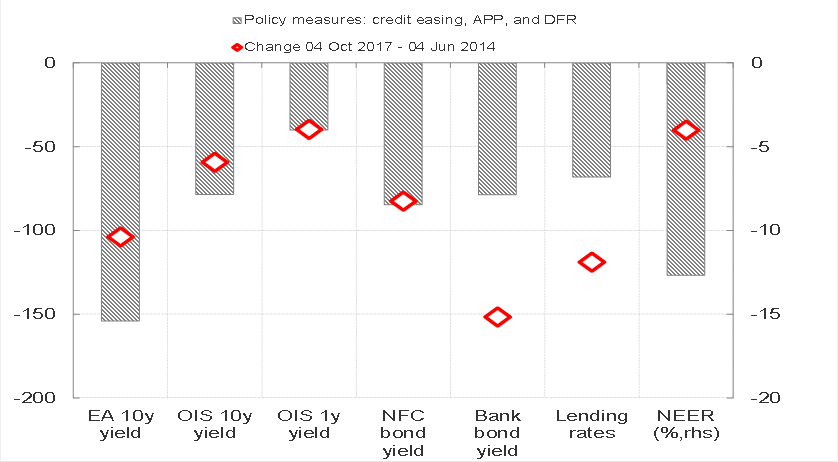
(contributions in basis points and percent)

Source: Bloomberg, ECB, ECB calculations.[1]

ECB staff counterfactual simulations indicate that absent our measures, GDP-weighted euro area 10-year government bond yields would, at present, be about 154 basis points higher and lending rates to NFCs about 68 basis points higher. ECB staff estimates indicate that our measures are contributing to an increase in euro area GDP of around 1.7%, cumulatively over the period 2016-2019 (see Chart 2) – well above monetary policy’s contribution to the two previous euro area recoveries in 2003Q2-2006Q4 and 2009Q3-2011Q3.

Chart 2a: Real GDP growth: actual, baseline projection and counterfactual without policy contribution
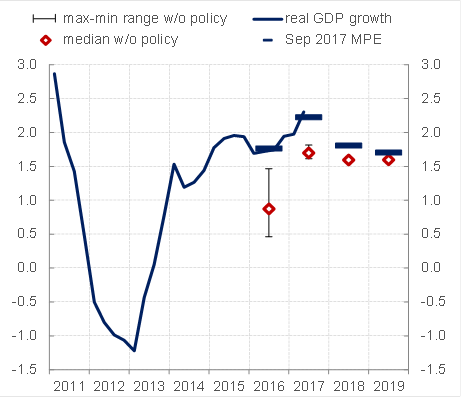
(year on year percentage change)

Chart 2b: HICP inflation: actual, baseline projection and counterfactual without policy contribution
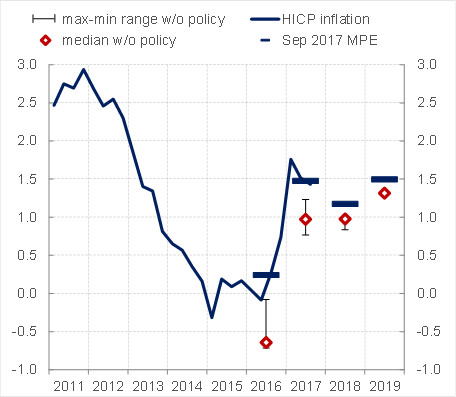
(year on year percentage change)

Sources: ECB computations, SAPI Task Force, September 2017 MPE, BMEs.[2]

Looking ahead, the latest ECB staff projections continue to expect domestic demand to remain the key driver of euro area growth. Annual real GDP is projected to increase by 2.2% in 2017, 1.8% in 2018 and 1.7% in 2019. The risks to the growth outlook are broadly balanced. According to the latest IMF WEO projections, euro area real GDP is expected to grow by 2.1% in 2017 before moderating to 1.9% in 2018 and 1.7% in 2019, which is in line with the ECB projections.

Table 1: Comparison of forecasts for euro area real GDP growth
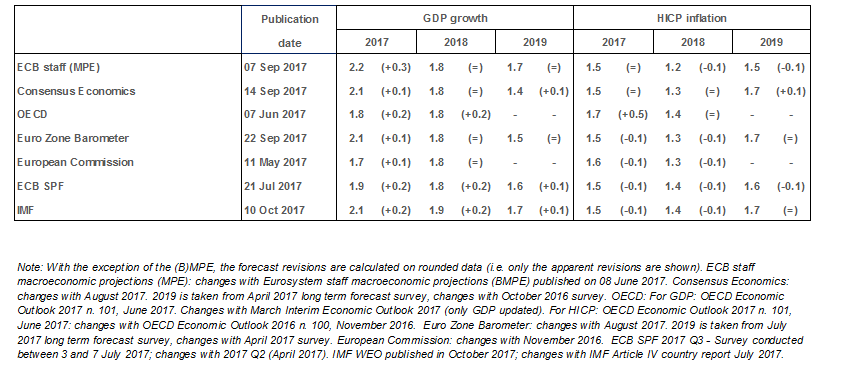
(annual percentage changes)

There are reasons to believe that the strengthening of economic activity, which so far has been significantly supported by accommodative monetary policy, will progressively be supported by more structural factors. Euro area governments have undertaken substantial policy actions and reforms to redress pre-crisis related macroeconomic imbalances and increase economic resilience.[3] For instance, euro area countries which had previously experienced large current account deficits are now in surplus. Moreover, both ECB staff and IMF estimates indicate that the largest driver of this adjustment is non-cyclical in nature, which implies a higher likelihood of sustainability as the recovery continues. Additionally, business cycle synchronisation across euro area countries has increased in recent years.[4] Finally, most countries that had large budget deficits have now positive primary surpluses. In sum, the euro area is now in a better state to withstand future economic or financial shocks.

Despite robust growth dynamics, inflation developments have been subdued. Euro area headline inflation stood at 1.5% in September 2017, according to Eurostat’s flash estimate and is expected to temporarily decline towards the turn of the year owing to energy-related base-effects. Measures of underlying inflation have not yet showed convincing signs of a sustained upward trend (see Chart 3).

Chart 3: Measures of underlying inflation
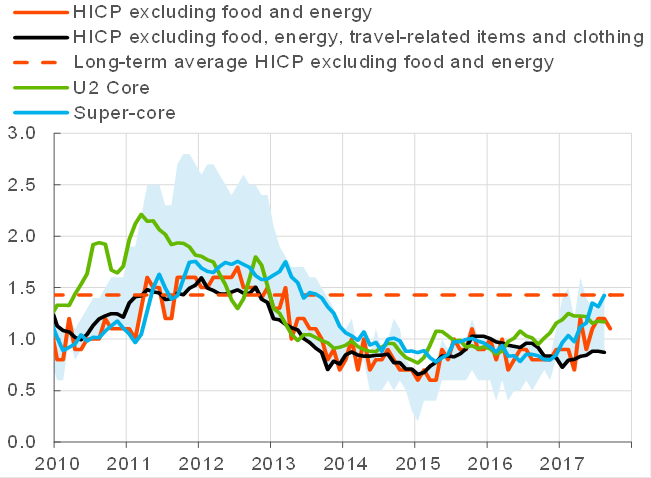
(annual percentage changes)

Sources: Eurostat and ECB calculations[5].

Looking further ahead and according to the latest ECB staff projections, inflation is expected to rise to 1.5% in 2017, 1.2% in 2018 and 1.5% in 2019. There are uncertainties clouding the medium-term outlook for price stability, most notably the recent exchange rate volatility, which requires monitoring with regard to possible implications for inflation dynamics. The inflation outlook from the recent IMF WEO depicts inflation at 1.5% in 2017 and 1.4% in 2018, which is broadly in line with ECB projections.

The apparent disconnect between strong economic activity, on the one hand, and low inflation and wages on the other, is one of the stand-out characteristics of the ongoing recovery.[6] From a policymaker’s perspective, a predictable relationship between slack and inflation represents a key monetary policy transmission mechanism through which central banks exert their effect on inflation dynamics.

While there is no agreed upon approach to estimating a Phillips curve linking inflation to slack, on the whole empirical estimates indicate that the slope is currently flatter than in the period preceding the crisis, with several explanations as to why this might be the case. One reason relates to the choice of slack measurement, as the crisis may have led to structural changes in the labour market. For example, when a broader measurement of unemployment is used (Unemployment 6, currently just below 18%) as opposed to the narrower definition (Unemployment 3, standing at 9.1%), the slope of the euro area Phillips curve appears to have become steeper in recent years. Other reasons proposed include: external factors including globalisation, the enhanced role of adaptive expectations in influencing wage and price decisions, anchored by central bank targets, and finally, non-linearities and time-varying behaviour of different Phillips curve coefficients. [7]

Overall, a steepening Phillips curve provides confidence that the continued closing of the output gap will gradually lead inflation to return to our medium-term objective. Yet, this return remains conditional on a very substantial degree of monetary accommodation.

It is against this background that the Governing Council will decide over the autumn period on a re-calibration of its instruments, with a view to safeguarding the monetary policy impulse that is still necessary to secure a sustained adjustment in the path of inflation, in a way that is consistent with our monetary policy aim.

Other policies

Notwithstanding the strength of the ongoing recovery, supply-side policies as well as institutional reforms are required in order to firmly secure a self-sustainable recovery and a better functioning euro area. Country level policies should be aimed at increasing productivity and facilitating innovation and business investment. Turning to Europe and European reforms, the most relevant ones concern the completion of Banking Union, meaningful progress in the Capital Markets Union and the creation of an additional budgetary stabilisation function for the euro area. Both the Five Presidents Report on “Completing Europe’s Economic and Monetary Union” (2015) and the recent EU Commission paper on the “Deepening of the Economic and Monetary Union” (2017), provide sufficient guidance on the way to proceed towards a stronger monetary union.


We must speed up our cooperation on migration and forced displacement says EIB President Werner Hoyer at #IMF2017

#IMF2017

#IMF2017

“We must speed up our cooperation on migration and forced displacement” says EIB President Werner Hoyer at #IMF2017

14/10/2017

EIB

[Washington]

Better coordination of the work of Multilateral Development Banks could have a significant impact on the millions of people around the world affected by the migration and forced displacement challenge. This is the thinking behind a new proposal debated today by representatives of the world’s multilateral development banks and countries from the G7 in Washington at the IMF/World Bank Group annual meetings.

Werner Hoyer, President of the European Investment Bank (EIB) and World Bank CEO Kristalina Georgieva were co-chairing the meeting alongside Vincenzo La Via, one of Italy’s high level representatives at the G7. Speaking from Washington Dr Hoyer said, 

Irregular migration and forced displacement is not new. But for too long we have lacked a joint, coordinated approach to address both the root causes of this phenomenon and its consequences.
Global institutions like Multilateral Development Banks have a special responsibility to cooperate. It is urgent for us to improve the way in which we work together as we bring assistance to people in all the countries concerned.”

He added, “As the destination of thousands of tragic journeys across the Mediterranean, Italy, which chairs the G7 this year, has been shouldering a disproportionate part of the task of dealing with desperate migrants and displaced persons arriving in Europe. I believe we must respond positively and urgently to Italy’s request to strengthen cooperation among MDBs in this area. We must get better at how we MDBs as a group help address the shocks and stresses that arise from this profound change.” 

Read EIB President Hoyer’s speech here

Links:


The EU-US partnership for building strong institutions and resilient economies

Good morning, Ladies and Gentlemen,

First of all thank you for this invitation here at the German Marshall Fund today.

This year marks the 70th anniversary of the Marshall Plan, whose support was crucial in rebuilding post-war Europe’s economy; and which laid the basis for Europe’s political integration.

It still offers valuable lessons for how to deal with the economic and security challenges that we face today.

Europe’s situation at the time of the Marshall Plan was described by the economist Barry Eichengreen as being stuck in a Catch-22: in order to get the money to invest in its economy, Europe needed to export. But because of the lack of investment, it did not have the capacity to produce those exports.

For those countries receiving it, the Marshall Plan showed a way out of this double bind: it supplied the starting capital to get the gears of the economy turning again, and it strengthened the institutions of the free market economy in Western Europe. In many ways, this was the starting point for the golden decades that followed.

And it was made possible by decisive and coordinated action to restore confidence and kick-start investment after a geopolitical tragedy. This is the first lesson of the Marshall plan.

Unfortunately, Central and Eastern European countries had to wait another 50 years for the Marshall logic to be applied there too.

*        *        *

This year also marks a decade since the beginning of the global economic and financial crisis. This was a difficult period for the world and for Europe in particular. But in the spirit of the Marshall plan, we took decisive and joint action.

We have rebuilt confidence in our financial system by establishing and applying common standards for Europe’s banks. Hence today, our banks are stronger and better capitalised than before. They increasingly have the necessary firepower to lend to the real economy and provide the investment that Europe’s companies need.

We have kept the focus on growth by implementing three main economic policy priorities: boosting investment, structural reforms to improve competitiveness, and implementing responsible fiscal policies.

The Investment Plan, which the Commission launched almost three years ago, is delivering concrete results. The European Fund for Strategic Investments (EFSI) has already mobilised more than €236 billion in both public and private investment to support projects across all 28 EU Member States. Given the success of the initiative, the European Commission has decided to extend the EFSI from its initial €315 to €500 billion by end 2020.

Staying the course of our economic policies pays-off: this year, the EU economy is expanding for the fifth year in a row. Economic growth now stands above 2% for the EU as a whole and at 2.2% for the euro area. We will actually update our forecasts next month. This recovery is broad-based – economies of all 28 Member States, including Greece, are growing. Unemployment is at its lowest level since 2008, investment is picking up, and public finances are in better shape. Public deficits in the EU have been brought down from an average 6.6% of GDP in 2009 to 1.6% now.

Our goal is to use this positive momentum to complete Europe’s Economic and Monetary Union. In December we will unveil new proposals for further strengthening of our monetary union.

We will build on the reform strands of recent years: completing the Banking Union, setting up a single market for capital, relaunching convergence within and between our economies, and stepping up our support to Member States to reform their economies. We want to make our economies more resilient, competitive and inclusive.

We need a resilient economic base to successfully cope with Brexit and its potential impact. We should also not lose sight of new challenges stemming from globalisation, the Fourth Industrial Revolution, climate change and geopolitical developments.

*        *        *

Ladies and gentlemen,

70 years on, the transatlantic partnership holds firm.

Here we have the second lesson of the Marshall Plan in mind: the combination of a political and economic partnership. By investing its own money and looking beyond its own short-term interests, the US ensured that Western Europe turned into a prosperous and reliable ally.

Our partnership transcends economics: it is, above all, a partnership of values. We defend a world view in which nations are not chained to anyone’s sphere of interest. Free nations – for example, Ukraine, Georgia and Moldova – have the right to choose their allies for themselves.

Today the EU–US partnership is also crucial to provide ‘money for reforms’ to countries willing to improve the functioning of their states and economies.

It is not about reform as a one-off measure. We want to reinforce permanent capacity of institutions to resist shocks and to adapt to an ever changing environment, be it economic, social or geopolitical. This is what we call ‘resilience’. This is the third lesson from the Marshall Plan experience: that strongmen don’t last, but strong institutions do.

So building strong institutions should be our priority.

This is especially true now that we see new ways to influence politics emerging. Their impact is not to be underestimated. Influencing and dividing from ‘inside’ is à la mode. Initially these influence tools and techniques were tested in the Baltic States. Now they are put to use during the elections in the US, France, Germany and other countries.

‘Fake news’ or ‘destablising propaganda’ campaigns is just one example. To illustrate, this year Sputnik, a pro-Kremlin news platform operating in 30 languages, published stories claiming that French Presidential candidate Macron could be a US agent; Angela Merkel takes selfies with terrorists; the EU is supplying drugs to Moldova and the Western world is waging war against Slavs, Russians and Serbs especially.

There are numerous fake and tweaked stories. But the bottom line is always the same: to question the Western values. And in European case – to undermine the credibility of the EU cooperation model among ordinary people in our neighbourhood and within the EU itself.

*        *        *

A good example of a working EU – US political and economic partnership is our work in Ukraine.

First of all, political alliance is working. Both the EU and the US have imposed sanctions over Russia’s actions against Ukraine. Second, both support ‘money for reforms’ programmes in Ukraine. Like the Marshall Plan, this assistance is conditional upon continued structural reforms.

Despite the fact that the country is facing conflict, Ukraine’s commitment to reform has been very strong. In less than four years, major reforms have been launched and implemented in public administrations, energy, banking and judiciary.

And the results are clear: the country has stabilised its financial sector, returned to economic growth last year and is expected to grow – at about 2% this year. Last month, Ukraine tapped international markets for the first time in four years.

Staying the course of reforms also enabled Ukraine to fulfil necessary conditions to move closer to the EU. The Association Agreement and visa-free travel to the Schengen area are major achievements.

Now decisive actions are needed to complete the ambitious anti-corruption reform.

So far, the EU and its Member States have provided by far the largest assistance to Ukraine: we have pledged around €12.8 billion for the period up to 2020. The European Union has also extended macro-financial assistance of a combined value of €3.4 billion, of which €2.8 billion have been already disbursed. We encourage the Ukrainian authorities to continue to implement the few outstanding conditions for last disbursement of €600 million still this year.

*        *        *

Ladies, Gentlemen,

To conclude, on the global scene, the EU is a strong and reliable partner. We count on our allies in Washington D.C. to continue to defend our shared values and uphold the transatlantic cooperation. Our partnership has been tried and tested many times, and has always come out strongly.

I see strengthening resilience of our institutions and economies as the priority today. This applies to our Member States as well as to our neighbouring countries.

The Marshall ethos of reforms, integration, capacity–building and openness should guide us and enable us to weather future shocks, be them geopolitical, economic or societal ones. 

Thank you!


Vice-President Valdis Dombrovskis’ press statement with the US Commodity Futures Trading Commission (CFTC)

Good morning everybody.

First of all, I would like to thank Chairman Giancarlo for the warm welcome.

The European Commission has a close and constructive cooperation with the CFTC. And we are determined to keep up this up in the future.

This is important, because financial markets are truly global. Working together is the best way to ensure their stability and resilience while avoiding market fragmentation and overregulation.

I am pleased to announce that today we have taken two further steps in this direction:

First, the European Commission and the CFTC have agreed on a common approach regarding certain derivatives trading platforms. It is important that European counterparts can continue trading in derivatives on authorised US markets. This agreement is an excellent example of how a safe, yet global, trading environment can be ensured in a spirit of open cooperation. I would like to thank Chairman Giancarlo and his team for working with the European Commission to reach this common approach.

Second, the European Commission has adopted today an equivalence decision regarding the US framework for non-cleared over-the-counter derivatives. Together with a similar decision by the CFTC for the EU framework, this will avoid a double regulatory burden for these transactions both in the EU and in the US. This is important because it ensures that cross-border actors will not have to post double margins for derivatives transactions.

Together, these two measures will provide certainty to markets, minimise regulatory arbitrage, and encourage competition on a level playing field.

Thank you very much.


October 2017: Security Union – Commission presents anti-terrorism package

The news:

In October 2017, the European Commission will present a set of measures to better defend European citizens against terrorist threats and build a Europe that protects. Together with the 11th Progress Report towards an effective and genuine Security Union, the package will include guidance and support to Member States in protecting public spaces, next steps on countering radicalisation as well as actions to cut off access to the means used by terrorists to prepare and carry out attacks, such as dangerous substances or terrorist financing.  

The background:

Security has been a political priority since the beginning of the Juncker Commission’s mandate – from President Juncker’s Political Guidelines of July 2014 to the latest State of the Union address on 13 September 2017.

The European Agenda on Security guides the Commission’s work in this area, setting out the main actions to ensure an effective EU response to terrorism and security threats in the European Union. Since the adoption of the Agenda, significant progress has been made in its implementation, paving a way towards an effective and genuine Security Union.

The creation by President Juncker of a specific Commissioner portfolio for the Security Union demonstrates the importance the Commission has attached to building its resilience and stepping up its response to the terrorist threat.

The sources:

10th Progress Report towards an effective and genuine Security Union

Communication: European Agenda on Security

Communication: Delivering on the European Agenda on Security to fight against terrorism and pave the way towards an effective and genuine Security Union

Factsheet: Security Union, a Europe that protects