France: EIB supports Eutelsat for the procurement and launch of the KONNECT VHTS satellite

>@NASA/Unsplash
©NASA/Unsplash
  • Eight-year, €200 million EIB loan focused on the KONNECT VHTS programme, an advanced satellite providing unprecedented capacity for both fixed and mobile broadband services.
  • The project contributes to boosting high-speed broadband coverage on a pan-European level in line with the Gigabit Society targets of the European Commission.

The European Investment Bank (EIB), the long-term lending institution of the European Union, and Eutelsat, one of the world’s leading satellite operators, announced a €200 million financing agreement at the European Space Conference today. This eight-year loan will back investments related to the procurement and launch of the KONNECT VHTS satellite for the provision of advanced broadband services in Europe and neighbouring areas.

KONNECT VHTS is an advanced satellite providing unprecedented upload and download speed capacity for both fixed and mobile broadband services. With a weight of 6.3 tonnes and a Ka-band capacity of 500 Gbps, this next generation satellite will carry the most powerful on-board digital processor ever put into orbit, offering capacity, allocation flexibility, optimal spectrum use, and progressive ground network deployment. It will deliver cost-effective, competitive broadband connectivity allowing notably the provision of ubiquitous and affordable very high-speed fixed broadband access to European households, businesses and public administrations in remote areas that remain beyond the reach of terrestrial infrastructure. 

Commenting on the agreement, Rodolphe Belmer, CEO of Eutelsat, said: “This long-term financing with the EIB ensures that major players in the space sector like Eutelsat have access to diversified and compelling sources of funding. It is very positive that the European Union has an agenda in support of the space sector that places space connectivity at the centre of its priorities. This commitment also underlines the EU’s belief in geostationary satellites as an indispensable complement to the provision of connectivity to unserved or poorly served regions significantly more quickly and cheaply than deploying terrestrial infrastructure in remote areas.”

“I am very pleased about this agreement with Eutelsat. It is an important step in the launch of a new generation satellite able to deliver accessible, cost-effective and competitive connectivity to all,” said EIB Vice-President Ambroise Fayolle. “Space is an important driver of innovation in Europe. This investment illustrates how the EU can support researchers, innovators and entrepreneurs in catalysing the development of advanced technologies to the benefit of end-users, customers, service providers and public authorities.”

The transaction follows the EU and EIB’s commitment to strengthen their support for European space companies. It is in line with the Gigabit Society targets of the European Commission stating that all households in Europe will have access to at least 100 Mbps internet connectivity by 2025. 

About Eutelsat

Founded in 1977, Eutelsat Communications is one of the world’s leading satellite operators. With a global fleet of satellites and associated ground infrastructure, Eutelsat enables clients across video, data, government, fixed and mobile broadband markets to communicate effectively with their customers, irrespective of their location. Over 6 600 television channels operated by leading media groups are broadcast by Eutelsat to 1 billion viewers equipped for DTH reception or connected to terrestrial networks. Headquartered in Paris with offices and teleports around the globe, Eutelsat assembles 1 000 men and women from 46 countries who are dedicated to delivering the highest quality of service.



Sweden: European loan for upgrade of wastewater plant in Stockholm archipelago

  • EIB signs SEK 1 billion (€97 million) loan for the Käppala Wastewater Treatment Plant in the municipality of Lidingö, near Stockholm.
  • The upgrade will allow the facility to deal with wastewater from up to 900 000 people.
  • Together with the biogas produced during the digestion process, the project is expected to have a positive impact on the environment and water quality in the Baltic Sea.

The European Investment Bank (EIB) has signed a SEK 1 billion (€97 million) loan agreement with the Käppalaförbundet, an intermunicipality partnership in the Stockholm archipelago, for an upgrade and capacity increase of their wastewater treatment plant. The centralised wastewater treatment at Käppala will be upgraded to deal with the wastewater of around 900 000 people.

EIB Vice-President Thomas Östros noted: “Stockholm’s famous “skärgård” is of high importance for both the environment and the local economy. As the EU’s climate bank, we are happy to support the extension of the Käppala plant, helping to maintain the area in a sustainable way for the population.”

“This upgrade will secure the water treatment services for our 11 member municipalities for many decades to come and at the same time greatly improve the water quality of our beautiful archipelago”, said Andreas Thunberg, CEO of Käppalaförbundet.

The original plant was put into operation in 1969, and was already extended once with support from an EIB loan of 6 million ECU in 1997. By minimising pollution of the receiving waters, the project will have a positive impact on the immediate environment and the Baltic Sea, and is expected to improve living conditions for the inhabitants of the Stockholm area.

Background information:

The project will allow the promoter to fully meet the requirements of the Urban Waste Water Treatment Directive (91/271/EC), the Water Framework Directive (2000/60/EC) and Helsinki Commission (HELCOM) recommendations for WWTP’s effluent (recommendation 28E/5, HELCOM).

Käppalaförbundet treats wastewater from 11 municipalities located north and east of Stockholm. Its treatment plant, the Käppala Wastewater Treatment Plant, is Sweden’s third-largest, and employs a very effective treatment process. It also exploits the nutrients and energy contained in the wastewater, and produces sludge, biogas and heat that are recycled for the community.


ESMA reminds firms of the MiFID II rules on reverse solicitation

The European Securities and Markets Authority (ESMA), the EU’s securities markets regulator, is issuing a Public Statement to remind firms of the MiFID II requirements on the provision of investments services to retail or professional clients by firms not established or situated in the European Union (EU).

With the end of the UK transition period on 31 December 2020, some questionable practices by firms around reverse solicitation, where the product or service is marketed at the client´s own exclusive initiative, have emerged. For example, some firms appear to be trying to circumvent MiFID II requirements by including general clauses in their Terms of Business or through the use of online pop-up “I agree” boxes whereby clients state that any transaction is executed on the exclusive initiative of the client.

ESMA reminds firms that “where a third-country firm solicits clients or potential clients in the Union or promotes or advertises investment services or activities together with ancillary services in the Union, it should not be deemed as a service provided at the own exclusive initiative of the client”. This is true “regardless of any contractual clause or disclaimer purporting to state, for example, that the third country firm will be deemed to respond to the exclusive initiative of the client”.

ESMA would also like to highlight that:

  • the provision of investment services in the EU without proper authorisation in accordance with the EU and the national law applicable in Member States exposes service providers to the risk of administrative or criminal proceedings, for the application of relevant sanctions; and
  • when using the services of investment service providers which are not properly authorised in accordance with EU and Member States’ law, investors may lose protections granted to them under EU relevant rules, including coverage under the investor compensation schemes in accordance with Directive 97/9/EC. 


Returning foreign fighter arrested in Spain

The suspect was part of the so-called Islamic State in the Iraqi-Syrian conflict zone.

Europol supported an operation of the Spanish National Police (Policía Nacional) leading to the arrest of a member of the so-called Islamic State. The suspect had recently returned from the conflict zone on the border of Iraq and Syria. Two other individuals associated with the suspect were also arrested during the operation in Barcelona.

On 24 December law enforcement officers detected a potentially dangerous individual that had recently arrived in Spain. The investigation determined that this individual was hiding out in a run-down property in Barcelona. Officers later discovered that the suspect was not living there alone. The fact that the suspect was so determined to cover their tracks and the risk of their location meant officers were swift to act and arrest the individuals.

The individual, a jihadist returning from the Iraqi-Syrian conflict zone, would have been active as a member of the so-called Islamic State for a considerable amount of time. On his way back from the conflict zone, the suspect travelled through Iraq, Turkey and Senegal where he continued his terrorist activity. Before entering Spain, the suspect was based in Algeria, where he was in touch with a branch of the so-called Islamic State in North Africa. This arm of the so-called Islamic State has been subject to significant law enforcement operations in recent weeks.

Europol facilitated the information exchange and supported the case with operational analysis. On the action day, Europol provided support by deploying two experts to Spain to cross-check operational information against Europol’s databases and provide links to investigators in the field. Europol also provided technical support for the analysis of the seized electronic devices.

Headquartered in The Hague, the Netherlands, we support the 27 EU Member States in their fight against terrorism, cybercrime and other serious and organised forms of crime. We also work with many non-EU partner states and international organisations. From its various threat assessments to its intelligence-gathering and operational activities, Europol has the tools and resources it needs to do its part in making Europe safer.

Watch the video


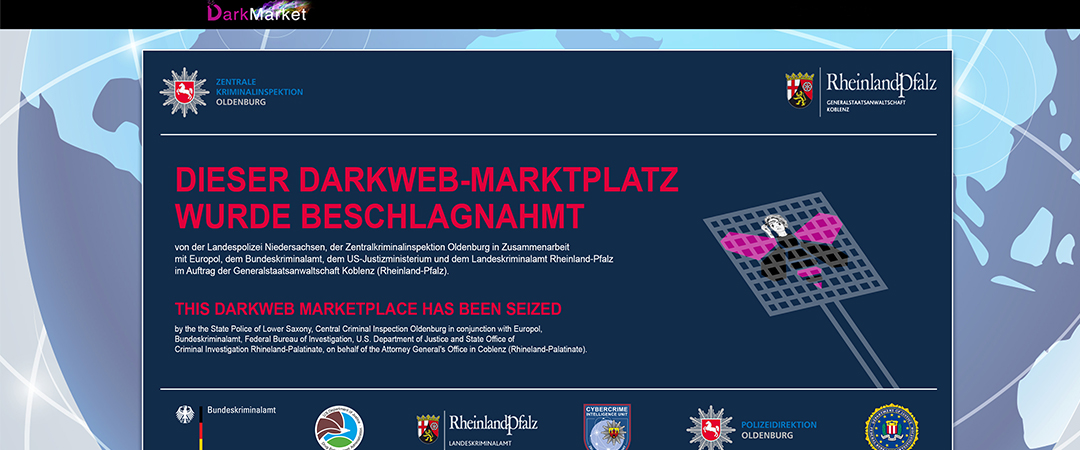
DarkMarket: world's largest illegal dark web marketplace taken down

DarkMarket, the world’s largest illegal marketplace on the dark web, has been taken offline in an international operation involving Germany, Australia, Denmark, Moldova, Ukraine, the United Kingdom (the National Crime Agency), and the USA (DEA, FBI, and IRS). Europol supported the takedown with specialist operational analysis and coordinated the cross-border collaborative effort of the countries involved.

DarkMarket in figures:

  • almost 500 000 users;
  • more than 2 400 sellers
  • over 320 000 transactions;
  • more than 4 650 bitcoin and 12 800 monero transferred

At the current rate, this corresponds to a sum of more than €140 million. The vendors on the marketplace mainly traded all kinds of drugs and sold counterfeit money, stolen or counterfeit credit card details, anonymous SIM cards and malware.

Germany takes the lead

The Central Criminal Investigation Department in the German city of Oldenburg arrested an Australian citizen who is the alleged operator of DarkMarket near the German-Danish border over the weekend. The investigation, which was led by the cybercrime unit of the Koblenz Public Prosecutor’s Office, allowed officers to locate and close the marketplace, switch off the servers and seize the criminal infrastructure – more than 20 servers in Moldova and Ukraine supported by the German Federal Criminal Police office (BKA). The stored data will give investigators new leads to further investigate moderators, sellers, and buyers. 

Europol’s involvement

  • Facilitated international information exchange.
  • Provided specialist operational support.
  • Provided advanced analytics that assisted the German authorities in identifying and tracking down the alleged administrator.
  • Supported Germany in coordinating the cross-border collaborative effort involving international partners.

Europol’s Dark Web Team

One of Europol’s initiatives is to create a coordinated law enforcement approach to tackle crime on the dark web. This involves law enforcement agencies from across and outside the EU and other relevant partners and organisations, such as Eurojust.
 
To achieve this goal, Europol’s European Cybercrime Centre (EC3) has established a dedicated Dark Web Team to work together with EU partners and law enforcement across the globe to reduce the size of this underground illegal economy. 

It will deliver a complete, coordinated approach: 

  • sharing information;
  • providing operational support and expertise in different crime areas;
  • developing tools, tactics and techniques to conduct dark web investigations;
  • identifying threats and targets. 

The team also aims to enhance joint technical and investigative actions, organise training and capacity-building initiatives, together with prevention and awareness-raising campaigns – a 360° strategy against criminality on the dark web.

A shared commitment across the law enforcement community worldwide and a coordinated approach by law enforcement agencies have once again proved their effectiveness. The scale of the operation at Europol demonstrates the global commitment to tackling the use of the dark web as a means to commit crime. 


Headquartered in The Hague, the Netherlands, Europol supports the 27 EU Member States in their fight against terrorism, cybercrime, and other serious and organized crime forms. Europol also works with many non-EU partner states and international organisations. From its various threat assessments to its intelligence-gathering and operational activities, Europol has the tools and resources it needs to do its part in making Europe safer.