Commission proposes to improve transparency and predictability of working conditions

As part of the follow-up to the European Pillar of Social Rights, the European Commission has adopted today a proposal for a new Directive for more transparent and predictable working conditions across the EU. The Commission’s proposal complements and modernises existing obligations to inform each worker of his or her working conditions. In addition, the proposal creates new minimum standards to ensure that all workers, including those on atypical contracts, benefit from more predictability and clarity as regards their working conditions.

Valdis Dombrovskis, Vice-President responsible for the Euro and Social Dialogue, Financial Stability, Financial Services and Capital Markets Union said: “The consultations of social partners confirmed the need for more transparent and predictable working conditions in the EU. This proposal respects the compromise of more secure employment in current and future types of working arrangements, allowing for flexibility, and ensuring a level playing field. This proposal fully respects national social dialogue practises, by allowing social partners to implement the new minimum requirements relating to working conditions through collective agreements.

Marianne Thyssen, Commissioner for Employment, Social Affairs, Skills and Labour Mobility, added: “With today’s proposal we are taking action to improve transparency and predictability of working conditions. The world of work is changing fast with a growing number of non-standard jobs and contracts. This means that more and more people are at risk of not being covered by basic rights anymore, starting from the right to know the terms under which they work. Increased transparency and predictability will benefit to both workers and businesses.

The Commission estimates that 2 to 3 million additional workers on atypical contracts will be covered and protected by the proposal compared to existing legislation. At the same time, the proposal also puts measures in place to avoid administrative burden on employers, for instance by giving them the possibility to provide the requested information electronically. The new rules will also create a level-playing field for companies, so that employers will benefit from fairer competition in the internal market, with fewer loopholes. More transparent and predictable working conditions are also important for a more motivated and productive workforce.

More concretely, the Commission aims to reduce the risk of insufficient protection of workers by:

  • Aligning the notion of worker to the case-law of the European Court of Justice. Under current rules, the definitions may vary and certain categories of workers end up being excluded. By using the definition of worker from the case-law of the Court, this Directive would ensure that the same broad categories of workers will be covered.
  • Bringing within the scope of the Directive forms of employment that are now often excluded. This includes domestic workers, marginal part-time workers or workers on very short contracts, and extending it to new forms of employment, such as on-demand workers, voucher-based workers and platform workers.
  • Ensuring that workers are provided with an updated and extended information package directly at the start of employment from day one, instead of two months following the starting date as is currently the case.
  • Creating new minimum rights, such as the right to greater predictability of work for those working mostly with a variable schedule, the possibility to request transition to a more stable form of employment and receive a reply in writing, or the right to mandatory training without deduction from salary.
  • Reinforcing the means of enforcement and redress as a last resort to resolve possible disagreements, should dialogue not suffice.

The proposed Directive would need to adopted by the European Parliament and the Council of the European Union, and be implemented by the Member States, either through legislation or by social partners’ collective agreements. Fully recognising the importance of social dialogue, social partners would be able to modulate the minimum rights proposed by the Directive as long as its overall level of protection is respected.

This initiative is one of the Commission’s actions to implement the European Pillar of Social Rights, which was proclaimed at the Social Summit for Fair Jobs and Growth in Gothenburg on 17 November 2017. More specifically, the Directive contributes to implementing Principle 5 on ‘Secure and Adaptable Employment’ and Principle 7 on ‘Information about Employment Conditions and Protection in case of Dismissals’.

Background

The Commission’s proposal for a Directive on “Predictable and Transparent Working Conditions” updates and replaces the 1991 Written Statement Directive (91/533/EEC), which gives employees starting a new job the right to be notified in writing of the essential aspects of their employment relationship. After more than 25 years, this Directive does not no longer capture changing labour market realities, in particular the new forms of work that have developed in recent years. Increased labour market flexibility and a growing diversity of forms of work have created new jobs and allowed more people to become professionally active. But it also exposed some gaps in the protection of workers and, in some cases involving vulnerable workers, contributed to new forms of precariousness.

The initiative was announced in April 2017 together with the European Pillar of Social Rights. It is part of the 2018 Commission Work Programme and followed a two-stage consultation of social partners. The social partners did not enter into negotiations to propose their own agreement. Therefore the Commission decided to take action in line with the Treaty on the Functioning of the European Union.

The initiative also responds to the Resolutions of the European Parliament of 19 January 2017 on a European Pillar of the Social Rights, requesting a framework Directive on decent working conditions in all forms of employment, and of 4 July 2017 on working conditions and precarious employment, calling for a revision of the 1991 Directive to take account of new forms of employment.

The European Council of 14-15 December called upon the EU legislator to progress swiftly on pending social files at EU level referring also to the initiatives announced by the Commission in its Work Programme, which includes this Directive.

The proposed Directive was prepared on the basis of a dedicated public consultation and an extensive evaluation of the existing legislation, the results of which are summarised in the impact assessment.

Next steps

In accordance with the ordinary legislative procedure, this proposal will now be examined by the European Parliament and the Council.

For more information

MEMO: Commission’s proposal to increase transparency and predictability of working conditions – Questions and Answers

News item with links to legal documents on the DG Employment website

Follow Marianne Thyssen on Twitter and Facebook

Follow Vice-President Dombrovskis on Twitter: @VDombrovskis

Subscribe to the European Commission’s free e-mail newsletter on employment, social affairs and inclusion


Greece: European Investment Bank confirms EUR 70 million loan for ElvalHalcor planned expansion

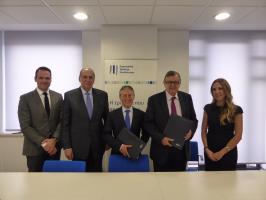
Signature with EIB-ElvalHalcor

Signature with EIB-ElvalHalcor

European Investment Bank confirms EUR 70 million loan for ElvalHalcor planned expansion

21/12/2017

EIB

[Greece]

The European Investment Bank (EIB) has agreed to provide EUR 70 million loan to support a planned EUR 150 million investment programme of ElvalHalcor Hellenic Copper and Aluminium Industry S.A in technical and building infrastructure, which will also demand additional operating and working capital funds of more than EUR 50 million in the next 5 years. This loan contract is the first step in implementing this important investment, since ElvalHalcor envisages to attract further international financing. ElvalHalcor is a leading aluminium rolling company worldwide, one of the largest Greek exporters and the only aluminium rolling company in Greece.

The planned investment programme at the Company’s plant in Oinofyta in Voiotia, Greece, aims to increase the company’s overall production capacity and support the development of new aluminium products and the plant’s further modernisation. In addition it will introduce the latest industrial technology, improve energy use and reduce waste.

“New investment by Greek companies is crucial to benefit from new business opportunities, at home and abroad. With this investment, the Company plans to expand production and create new jobs. The European Investment Bank is pleased to provide EUR 70 million to support transformational investment at the Oinofyta site that will strengthen specialist production of an impressive range of aluminium products. This new loan demonstrates the EIB’s strong partnership with Greek business and we look forward to accelerating essential investments with other industry leaders across the country.” said Jonathan Taylor, European Investment Bank Vice President.

The finance contract for the EUR 70 million up to 8 years EIB loan was signed in Athens yesterday by Nicholas Jennett, Deputy Director General of the European Investment Bank and Lampros Varouchas, Managing Director of the aluminium rolling division of ElvalHalcor and Dimitris Kyriakopoulos, Executive Vice President of ElvalHalcor.

Over the last decade the European Investment Bank has provided more than EUR 5 billion for business investment across Greece. 


Press Release: Somalia security situation

EASO publishes a Country of Origin Information (COI) report on security situation in Somalia

Today, the European Asylum Support Office (EASO) published a Country of Origin Information (COI) Report entitled ‘Somalia security situation’. The report is the third EASO COI report on Somalia, and provides an update of the EASO COI report on Somalia security situation, published in February 20161

In the first ten months of 2017, nationals from Somalia lodged close to 12 000 applications in the EU+, ranking 14th among the most common citizenships of origin of applicants. While the number of Somali applications awaiting a first-instance decision has decreased by 57% in the past 12 months, from more than 27 000 in October 2016 to close to 11 600 at the end of October 2017, Somalia still represented a significant decision-making backlog and ranked 13th in terms of pending cases at  first-instance in the EU+.

The report provides an overview of the security situation in Somalia, information relevant for the protection status determination of Somali applicants for international protection. The first part of the report provides a general description of the security situation in Somalia, covering the following topics: a brief overview of the political and economic situation; actors in the conflict (state’s armed forces, international forces and armed groups); the impact of the violence on the state ability to secure law and order, with descriptions of the Judiciary, detention conditions and death penalty; the impact of the violence on the civilian population, and the impact of the current drought. 

In the second part, the report describes the security situation in different regions in Somalia, including the capital Mogadishu. These chapters provide a general overview of the region, followed by the major violent incidents. The report outlines the actors in each region and the areas of control or influence by each of these actors. Finally, the report provides information on the impact of the violence on the population. The reference period for the security report runs from January 2016 until 31 August 2017.

This new report is to a large extent based on a joint fact-finding mission report by the Austrian Bundesamt für Fremdwesen und Asyl/Staatendokumentation and the Swiss Staatssekretariat für Migration, as well as a joint fact-finding mission report by the Danish Immigration Service and the Danish Refugee Council. Findings from these fact-finding missions were combined with desk research. A researcher from Denmark participated in the drafting process of this report jointly with EASO. In accordance with the EASO COI Report Methodology, the report was reviewed by experts from Belgium, Italy, The Netherlands and Norway, in order to ensure the highest quality.

It is EASO’s intention to continue to produce such reports on important countries of origin and to update them on a regular basis in order to raise and harmonise COI standards in the EU and to further support the practical implementation of the Common European Asylum System.

Any further information may be obtained from the European Asylum Support Office on the following email address: press@easo.europa.eu 

____

[1] All reports are available via EASO’s website: https://www.easo.europa.eu/information-analysis/country-origin-information/country-reports  


Removing barriers to free flow of data – Council agrees its position

The EU is developing new rules to allow non-personal data to move freely and easily across country borders. Member states’ ambassadors (Permanent Representatives Committee) today agreed on a mandate for the presidency to launch negotiations with the European Parliament on the proposal, which aims to boost the EU data economy by removing any unjustified restrictions on the geographical location for storing or processing data. At the same time, the new law would ensure that authorities have access to data stored or processed in another member state so that they can carry out their duties.

In essence, the new rules will create a single market for data storage and processing services, such as cloud computing. They will provide legal certainty and increase trust in the use of these services. Together, this draft regulation and the general data protection regulation adopted last year will provide a coherent set of rules that cater for free movement of different types of data.

Eliminating data localisation measures is expected to drive down the costs of data services, give companies greater flexibility in organising their data management and data analytics, and expand their choice of providers. A company operating in several member states will be able to avoid the costs of duplication of IT infrastructure. Removing data localisation restrictions is considered a key factor for the data economy to reach its full potential and double its value to 4% of European GDP in 2020.

“Data is at the heart of all modern economies and societies and can generate immense value. Seamless data mobility saves costs for businesses, especially for start-ups and SMEs, and is essential for many next-generation digital services. This proposal has been a top priority for the Estonian presidency, so I am very pleased that we now have a mandate ready for the Bulgarian presidency to kick off talks with the European Parliament as soon as the Parliament is ready,” said Urve Palo, Estonian Minister for Entrepreneurship and Information Technology.

The Council text allows member states to impose data localisation requirements only when these are justified on grounds of public security. To ensure the effective application of the principle of free movement of data, member states must notify their data localisation requirements to the Commission. The text is also designed to ensure that member states are not prevented from insourcing the provision of services involving data processing. 

Member states’ competent authorities will continue to have access to data even when it is stored or processed in another country. An additional cooperation mechanism will be created to make sure such access is not hampered.

If a data set contains both personal and non-personal data, the general data protection regulation will apply to the personal data part of the set, while the non-personal data will be covered by the free flow of data regulation.

The draft regulation also encourages the development of codes of conduct to make it easier for users of data processing services to switch service providers and to port their data from one service provider to another or back to their own IT systems.

Both the Council and the Parliament have to agree on the text before it can enter into force. The Parliament has not yet adopted its position.

The European Council in October called for co-legislators to reach an agreement on this priority dossier by June 2018.


Cybersecurity: EU institutions strengthen cooperation to counter cyber-attacks

On 20 December 2017 EU institutions took an important step in strengthening their cooperation in the fight against cyber-attacks. An inter-institutional arrangement which enters into force today establishes a permanent Computer Emergency Response Team (CERT-EU) covering all the EU’s institutions, bodies and agencies. It consolidates the existing task force into a permanent and effective team responsible for ensuring a coordinated EU response to cyber-attacks against its institutions.

CERT-EU works very closely with the internal IT security teams of the EU institutions, and liaises with the Computer Emergency Response Teams and IT security companies in member states and elsewhere, exchanging information on threats and how to handle them. It also cooperate closely with its counterparts at NATO.

CERT-EU is a member of the network of EU national and governmental Computer Security Incident Response Teams that has been established by the Directive on security of network and information systems.

In recent years, Computer Emergency Response Teams have been set up in both the public and private sectors as small teams of cyber-experts that can respond effectively and efficiently to information security incidents and cyber threats. They are a key component in the strategy to combat these threats by assisting their clients in detecting and preventing weaknesses. They provide advance warning to their clients and recommend action to mitigate risks. They help to detect compromised systems and attacks and to take appropriate steps to prevent them or assist organisations to recover from them. They are highly interconnected with each other, creating a community of experts fighting for the common cause of cybersecurity.

CERT-EU’s resources are provided by EU institutions, bodies and agencies. The team operates under the strategic oversight of an inter-institutional Steering Board.