Infringements: Commission refers Italy to Court over its failure to adequately prevent further spread of the quarantine harmful organism ‘Xylella fastidiosa’ in Apulia

Today, the European Commission decided to refer Italy to the Court of Justice of the EU on the grounds that the Italian authorities are not taking the necessary measures to eradicate the quarantine harmful organism Xylella fastidiosa in Apulia and thus have failed to stop its spread.

Following the first notification of the outbreak of Xylella fastidiosa in the Apulia region in October 2013, the Italian authorities failed to fully comply with the EU rules on quarantine organisms harmful to plants or plant products and prevent its further spread in Apulia (Commission Implementing Decision (EU) 2015/789and Council Directive 2000/29/EC). These measures involve, among other provisions, the removal of infected plants in some parts of the demarcated areas immediately after the first confirmation of the presence of Xylella fastidiosa, as well as monitoring and sampling of the plants in the relevant parts of the demarcated area. The timetable communicated by Italy was considered not effective to ensure the immediate removal of the infected trees as requested by EU legislation. This lack of adequate action increases the high risk of further spreading of the organism out of the current demarcated area.

Background

Xylella fastidiosa is one of the most dangerous plant bacteria worldwide, causing a variety of diseases, leading invariably to the death of infected plants, with huge economic impact for agriculture. Member States have to take all necessary measures to eradicate Xylella fastidiosa and, when this is not possible, at least prevent its further spread within the rest of Italy and elsewhere in the EU territory.

The Commission has repeatedly urged Italy to fulfil its obligations. A letter and a supplementary letter of formal notice were sent in December 2015 and in July 2016, followed by a reasoned opinion in July 2017.

The Commission continues to use all available means to pursue the ongoing dialogue with the Italian authorities with the aim to prevent further spread of Xylella fastidiosa in Apulia.

For more information

-The EU’s actions to fight Xylella fastidiosa

-On the key decisionsofthe May 2018 infringements package, please refer to the full MEMO/18/3446.

-On the general infringements procedure, see MEMO/12/12.

-On the EU infringements procedure.
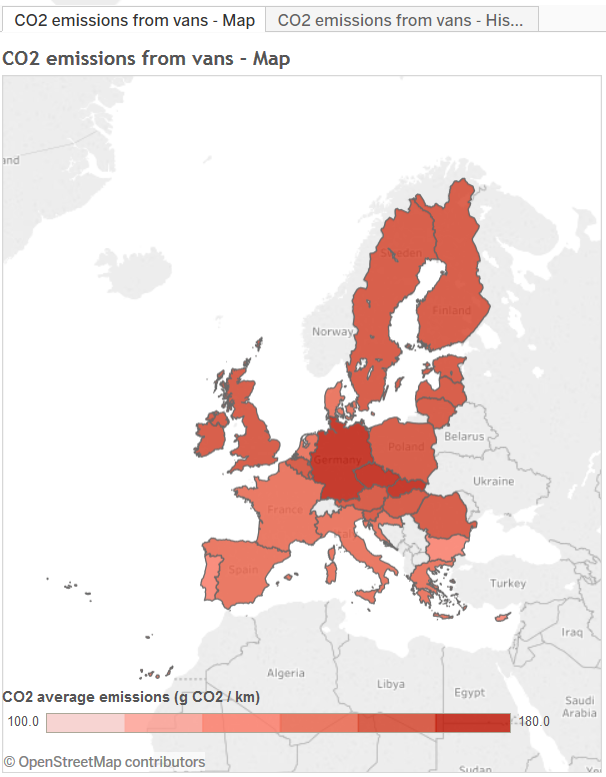


New vans sold in Europe in 2017: large decrease in annual average CO2 emissions

 Image © Ryan Searle

The average van registered in the EU in 2017 emitted 156.0 grams of CO2 per kilometre (g CO2/km), which is 7.7 grams less than in 2016. This reduction brings the EU average emissions 10.9% below the 2017 target of 175 g CO2/km. This target was already met in 2013. Further efficiency improvements of 6% are still needed to reach the EU’s more stringent target of 147 g CO2/km set for 2020.

Key findings

  • In 2017, almost 1.6 million new vans were registered in the EU as in 2016. Higher sales in Sweden (+48%), Czech Republic (+26%) and Slovenia (+20%) were balanced by lower sales in Croatia (-27%), Hungary (-16%), Ireland (-13%), Poland (-12%) and United Kingdom (-10%).
  • Two out of three new vans (64%) registered in the EU were sold in just four Member States: the United Kingdom (20%), France (19%), Germany (15%) and Italy (10%).
  • The average fuel-efficiency of new vans varied widely across Member States due to the different models and sizes of vehicles sold in each country. As last year, average emissions were lowest in Portugal (133.2 g CO2/km), Cyprus (133.4 g CO2/km) and Bulgaria (134.9 g CO2/km) and highest in the Czech Republic (173.6 g CO2/km), Slovakia (170.1 g CO2/km) and Germany (169.2 g CO2/km).
  • The average weight of new vans sold in 2017 also varied across countries. Smaller vehicles were sold in Malta, Cyprus and Portugal (< 1 570 kg); larger vehicles (>1 950 kg) in Slovakia, Czech Republic and Finland.
  • There is now an increasing number of electric and plug-in hybrid van models available on the EU market. Registrations of such vehicles increased by 32% in 2017, compared with previous year, representing 0.8% of the total EU van sales. However, this is significantly lower than electric and plug-in hybrid passenger cars’ 1.5 % share of total car sales in the same year.
  • Diesel vehicles continue to make up the vast majority of the new van fleet, constituting 96% of sales.

Background

The EEA collects and regularly publish data on new light commercial vehicles registered in Europe, in accordance with Regulation (EU) No 510/2011. The data reported by all Member States in order to evaluate the efficiency of the new vehicle fleet includes information on CO2 emissions and vehicle weight.

It has not yet been confirmed whether different manufacturers have met their own specific annual target for 2017, based on the average weight of the vans they sold. The EEA will publish the final data and the European Commission will confirm manufacturers’ individual performances in the autumn.

Testing vehicle emissions

Member States report new vehicles’ CO2 emission levels, measured under standardised laboratory conditions, following the requirements of the New European Driving Cycle (NEDC) test procedure. This procedure is designed to allow a comparison of emissions for different manufacturers. However, in recent years it has been widely recognised that the NEDC test procedure, developed in the 1970s, is out-dated and does not necessarily represent real-world driving conditions and emissions due inter alia to a number of flexibilities that have allowed vehicle manufacturers to optimise the conditions under which their vehicles are tested.

The EEA has published a non-technical guide explaining the key reasons for the differences observed between official and real world driving emissions. The ‘Worldwide harmonized Light vehicles Test Procedure’ (WLTP) has been introduced since September 2017 to decrease the divergence between laboratory test and real world emissions. 


Sofia declaration of the EU-Western Balkans summit, 17 May 2018

Your request will be handled by the Press Office of the General Secretariat of the Council in accordance with the provisions of Regulation (EC) No 45/2001 on the protection of individuals with regard to the processing of personal data by the Community institutions and bodies and on the free movement of such data.

Your data will be stored in the database until you unsubscribe from the service.

Certain data (name, e-mail address, preferred language, media name, media type) may be disclosed to the press offices of the European institutions, the Permanent Representations of the Member States and to European Union agencies, under the conditions laid down in Articles 7 and 8 of Regulation 45/2001.

If there is data which you would not like to be stored, please let us know at: press.office@consilium.europa.eu


Remarks by President Donald Tusk ahead of the EU-Western Balkans summit and the Leaders’ agenda dinner

We are ahead of a summit during which EU leaders will discuss innovation, European future for Western Balkans, and the response to President Trump’s policies on trade and Iran.

Starting with our dinner tonight, we will have a debate on innovation and the digital economy. Europe is lagging behind other major economies in terms of innovation. Innovation is set to impact our lives at an ever-growing pace over the coming years, raising not only hopes but also ethical questions. Europe needs to play an active part in this transformation, as it will be the reality of all Europeans. That is why tonight, I will ask EU leaders two questions: What do they want to do at the EU level to boost breakthrough innovation? And: How do they want the EU become a major player in big data?

Following last week’s announcement of the United States withdrawal from the Joint Comprehensive Plan of Action with Iran, we need a united European front. I want leaders to reconfirm that the EU sticks to the deal as long as Iran does. The deal is good for European and global security, which is why we must maintain it. Despite the US hesitation. We will also look at options for the EU to protect European companies from negative consequences of the US decision. And I want the European Commission to be given a green light, so that it is ready to act whenever European interests are affected. We should also seek ways, together with other partners, to address very real concerns over Iran’s ballistic missile programme and its regional activities.

Trade is another topic for tonight’s discussion. We will decide on the best way forward in EU-US trade relations. Here again, unity is our greatest strength. And my objective is simple: we stick to our guns. This means a permanent exemption from US tariffs on aluminium and steel if we are to discuss possible trade liberalisation with the US. The EU and US are friends and partners, therefore US tariffs cannot be justified on the basis of national security. It is absurd to even think that the EU could be a threat to the US. We need to bring back reality in this discussion, which is not the case today.

Tomorrow, we will meet our Western Balkan partners collectively for the first time in fifteen years. It will be an opportunity for both sides to reaffirm that the European perspective remains the Western Balkans’ geostrategic choice. Beyond the longer-term outlook, we want to demonstrate that we care about socio-economic development in the region here and now. Investing in infrastructural and human connections with and within the Western Balkans is in the EU’s best interest. And it will be the objective of our summit. I hope to bring our Western Balkan friends closer to the EU.

Everything we are going to discuss today and tomorrow, has a global dimension. I have no doubt that in the new global game, Europe will either be one of the major players, or a pawn. This is the only real alternative. In order to be the subject and not the object of global politics, Europe must be united economically, politically and also militarily like never before. To put it simply: either we are together, or we will not be at all.

Besides traditional political challenges such as the rise of China, or the aggressive stance of Russia, we are witnessing today a new phenomenon: the capricious assertiveness of the American administration. Looking at the latest decisions of President Trump someone could even think: with friends like that who needs enemies. But frankly speaking, Europe should be grateful to President Trump. Because thanks to him we have got rid of all illusions. He has made us realise that if you need a helping hand, you will find one at the end of your arm. Europe must do everything in its power to protect, in spite of today’s mood, the transatlantic bond. But at the same time we must be prepared for those scenarios, where we will have to act on our own. We have enough potential to rise to the challenge. But what we need is more political unity and determination. There is no single objective reason why Europe should have any complexes about anyone else. Being a European is a reason to be proud. We have a right and an obligation to hold our heads up high, both when with our enemies and when with our friends. And this is what, in some sense, our summit will be about.


Declaration by the High Representative, Federica Mogherini on behalf of the EU on the occasion of the International Day Against Homophobia, Transphobia and Biphobia, 17 May 2018

On the occasion of the International Day against Homophobia, Transphobia and Biphobia, the European Union reaffirms its commitment to combat all forms of discrimination and hate crime, on the grounds of sexual orientation, gender identity and sex characteristics, and to continue to actively promote and protect the human rights of lesbian, gay, bisexual, transgender and intersex (LGBTI) persons.

Inside and outside the European Union, LGBTI persons are too often targets of violence and hate crime. They are still the frequent subject of discrimination and maltreatment on the basis of their sexual orientation, gender identity or sex characteristics. In many countries having a partner of the same sex remains a crime. People are arrested, imprisoned, and in some cases executed, just because of the relationship they are in. Even in countries with legal protection of sexual orientation, stigmatisation due to homophobia, transphobia and biphobia remains high, leading to social exclusion with economic and health-related costs on societies.

2018 is an important year for human rights, as we mark the 70th Anniversary of the Universal Declaration of Human Rights. Its first article reads “all human beings are born free and equal in dignity and rights”. LGBTI persons are no exception, and the EU will therefore continue to fight for “equal rights for all” regardless of sexual orientation.

Through a combination of political and human rights dialogues, awareness-raising activities, financial assistance and specific policy tools such as the “European Commission’s List of actions to advance LGBTI equality” and the EU “Guidelines to promote and protect the enjoyment of all human rights by LGBTI persons” the European Union will continue to address discrimination and violence on the basis of sexual orientation or gender identity and show the European Union’s commitment to advance LGBTI equality in the European Union and beyond.

The European Union pays tribute today to all those working to promote and protect the human rights of LGBTI persons. Allow us to reiterate that “Human rights Defenders, you are not alone and the European Union will always be with you”.