EU-Western Balkans summit: improving connectivity and security in the region

President of the European Commission Jean-Claude Juncker said:“This summit has allowed us to forge even closer links with our friends from the Western Balkans who, step by step, each day come a little bit closer to the European Union – each at its own pace and merits. Being anchored in the European Union means sharing values and principles, including respect for the rule of law, independence of the judiciary and freedom of expression – because the European Union is first of all a community of values and law.”

The summit and the resulting Sofia Declaration stress the importance of the Western Balkans’ continued commitment to the rule of law, the fight against corruption and organised crime, good governance, as well as respect for human rights and rights of persons belonging to minorities. The effective implementation of reforms in these areas is key for the region’s further progress along the European path. EU and Western Balkan leaders agreed to take a number of actions to improve energy and transport infrastructure, as well as digital connectivity in the region. The EU and Western Balkans partners also laid the ground for an ever closer cooperation in the areas of security, migration and in tackling geopolitical challenges.

Connecting infrastructures, economies and people

To support the implementation of the Sofia Declaration and drawing on the Commission’s Western Balkans Strategy and its six flagship initiatives, President Juncker announced today (hyperlink to remarks) a new package of measures which will boost connectivity within the region and with the EU, notably through the Western Balkans Investment Framework.

  • The EU will provide grants for additional 11 high-priority transport projects (road, rail, ports) worth €190 million. This investment can leverage up to €1 billion in loans from international financing institutions. This includes funding for the first two sections of the ‘Peace Highway’ (Nis-Pristina-Durres) and the ‘Blue Highway’ along the Adriatic coast.
  • In order to develop the new Digital Agenda for the Western Balkans, the EU has earmarked €30 million for investments in broadband rollouts across the region. Partners agreed to extend the region’s arrangements to reduce roaming costs to all six partners, while at the same time the EU will develop a roadmap to lower the cost of roaming between the Western Balkans and the EU.
  • Moreover, the EU will support the region’s energy transition through promoting renewable energy sources, including a sustainable use of hydropower.
  • In the area of economic connectivity, the Commission continues to support the region’s own plan to develop a Regional Economic Area, and the Summit welcomed commitments to step up work on recognition of qualifications, as well as on trade facilitation within the Western Balkans.
  • The Commission will increase its support for youth and education, in particular by doubling the funding for Erasmus+ for the region and by launching a pilot project for mobility in vocational education and training. The Commission will also establish a “Western Balkans Youth Lab” in 2018, providing space for innovative policy-making addressing the needs of young people. Finally, it will support the expansion of the Regional Youth Cooperation Office and introduce an intra-regional mobility scheme.

Further elements of the EU’s annual Connectivity Package will be presented later on during the year.

In addition, partners committed to the Digital Agenda for the Western Balkans. It will support the move of the Western Balkans towards a digital economy, and includes steps such as a roadmap to lower the cost of roaming as well as a technical assistance package for potential investments in areas such as broadband.

Closer cooperation on security

The EU and the Western Balkans face shared security challenges. At the Summit, the EU and the Western Balkans agreed to step up common work on key security priorities:

  • countering terrorism including its financing, violent extremism and the return of foreign fighters as well as preventing radicalisation;
  • enhanced cooperation in the fight against serious and organised crime, in particular on illicit firearms and drugs trafficking, smuggling of goods and persons, as well as cyber and hybrid threats.

The EU and the Western Balkan partners agreed to build on already substantial on-going efforts by enhancing strategic and operational work in the field of police and judicial cooperation, in particular through the participation of the Western Balkans in the EU Policy Cycle 2018-2021, the coordinated EU-wide cooperation against serious and organised crime. With support from the Commission, EU Justice and Home Affairs agencies, such as Europol or CEPOL, will further engage in the Western Balkans for effectively linking internal and external actions against all forms of cross-border crime.

Cooperation in responding to the refugee crisis has demonstrated the value of coordinated efforts. EU and Western Balkan leaders agreed to strengthen cooperation on migration and border management, including through the liaison officers deployed by the EU.

For More Information

Sofia Declaration of the EU-Western Balkans summit

Website of the EU-Western Balkans summit

Enhanced EU engagement with the Western Balkans

Directorate General of European Neighbourhood Policy and Enlargement Negotiation

Connectivity agenda 2018

Factsheet Boosting Connectivity

Factsheet Boosting Digital Connectivity

Video – Connectivity agenda

Factsheet – Six new flagship initiatives to support the transformation of the Western Balkans

Factsheet – The way forward

Factsheet – Economic relations – Investing in people, infrastructures and reforms

Factsheet: EU Engagement in the Western Balkans

Video stockshots – Western Balkans

Factograph – Montenegro

Factograph – Serbia

Factograph – The former Yugoslav Republic of Macedonia
Factograph – Albania

Factograph – Bosnia and Herzegovina

Factograph – Kosovo


New vans sold in Europe in 2017: large decrease in annual average CO2 emissions

The average van registered in the EU in 2017 emitted 156.0 grams of CO2 per kilometre (g CO2/km), which is 7.7 grams less than in 2016. This reduction brings the EU average emissions 10.9% below the 2017 target of 175 g CO2/km. This target was already met in 2013. Further efficiency improvements of 6% are still needed to reach the EU’s more stringent target of 147 g CO2/km set for 2020.

Key findings

  • In 2017, almost 1.6 million new vans were registered in the EU as in 2016. Higher sales in Sweden (+48%), Czech Republic (+26%) and Slovenia (+20%) were balanced by lower sales in Croatia (-27%), Hungary (-16%), Ireland (-13%), Poland (-12%) and United Kingdom (-10%).
  • Two out of three new vans (64%) registered in the EU were sold in just four Member States: the United Kingdom (20%), France (19%), Germany (15%) and Italy (10%).
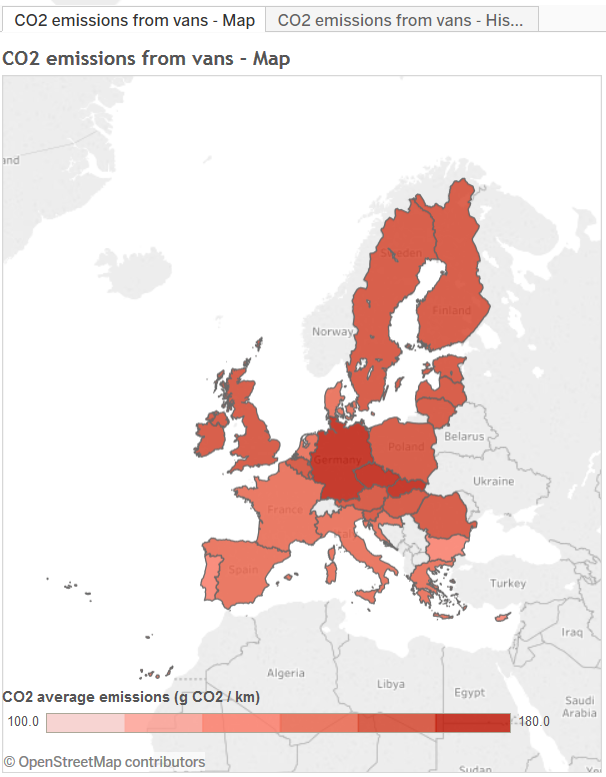
  • The average fuel-efficiency of new vans varied widely across Member States due to the different models and sizes of vehicles sold in each country. As last year, average emissions were lowest in Portugal (133.2 g CO2/km), Cyprus (133.4 g CO2/km) and Bulgaria (134.9 g CO2/km) and highest in the Czech Republic (173.6 g CO2/km), Slovakia (170.1 g CO2/km) and Germany (169.2 g CO2/km).
  • The average weight of new vans sold in 2017 also varied across countries. Smaller vehicles were sold in Malta, Cyprus and Portugal (< 1 570 kg); larger vehicles (>1 950 kg) in Slovakia, Czech Republic and Finland.
  • There is now an increasing number of electric and plug-in hybrid van models available on the EU market. Registrations of such vehicles increased by 32% in 2017, compared with previous year, representing 0.8% of the total EU van sales. However, this is significantly lower than electric and plug-in hybrid passenger cars’ 1.5 % share of total car sales in the same year.
  • Diesel vehicles continue to make up the vast majority of the new van fleet, constituting 96% of sales.

Background

The EEA collects and regularly publish data on new light commercial vehicles registered in Europe, in accordance with Regulation (EU) No 510/2011. The data reported by all Member States in order to evaluate the efficiency of the new vehicle fleet includes information on CO2 emissions and vehicle weight.

It has not yet been confirmed whether different manufacturers have met their own specific annual target for 2017, based on the average weight of the vans they sold. The EEA will publish the final data and the European Commission will confirm manufacturers’ individual performances in the autumn.

Testing vehicle emissions

Member States report new vehicles’ CO2 emission levels, measured under standardised laboratory conditions, following the requirements of the New European Driving Cycle (NEDC) test procedure. This procedure is designed to allow a comparison of emissions for different manufacturers. However, in recent years it has been widely recognised that the NEDC test procedure, developed in the 1970s, is out-dated and does not necessarily represent real-world driving conditions and emissions due inter alia to a number of flexibilities that have allowed vehicle manufacturers to optimise the conditions under which their vehicles are tested.

The EEA has published a non-technical guide explaining the key reasons for the differences observed between official and real world driving emissions. The ‘Worldwide harmonized Light vehicles Test Procedure’ (WLTP) has been introduced since September 2017 to decrease the divergence between laboratory test and real world emissions. 


Press release: Auditors identify challenges to integration of migrants in EU

Download PDF


Sofia declaration of the EU-Western Balkans summit, 17 May 2018

Your request will be handled by the Press Office of the General Secretariat of the Council in accordance with the provisions of Regulation (EC) No 45/2001 on the protection of individuals with regard to the processing of personal data by the Community institutions and bodies and on the free movement of such data.

Your data will be stored in the database until you unsubscribe from the service.

Certain data (name, e-mail address, preferred language, media name, media type) may be disclosed to the press offices of the European institutions, the Permanent Representations of the Member States and to European Union agencies, under the conditions laid down in Articles 7 and 8 of Regulation 45/2001.

If there is data which you would not like to be stored, please let us know at: press.office@consilium.europa.eu


New vans sold in Europe in 2017: large decrease in annual average CO2 emissions

The average van registered in the EU in 2017 emitted 156.0 grams of CO2 per kilometre (g CO2/km), which is 7.7 grams less than in 2016. This reduction brings the EU average emissions 10.9% below the 2017 target of 175 g CO2/km. This target was already met in 2013. Further efficiency improvements of 6% are still needed to reach the EU’s more stringent target of 147 g CO2/km set for 2020.

Key findings

  • In 2017, almost 1.6 million new vans were registered in the EU as in 2016. Higher sales in Sweden (+48%), Czech Republic (+26%) and Slovenia (+20%) were balanced by lower sales in Croatia (-27%), Hungary (-16%), Ireland (-13%), Poland (-12%) and United Kingdom (-10%).
  • Two out of three new vans (64%) registered in the EU were sold in just four Member States: the United Kingdom (20%), France (19%), Germany (15%) and Italy (10%).
  • The average fuel-efficiency of new vans varied widely across Member States due to the different models and sizes of vehicles sold in each country. As last year, average emissions were lowest in Portugal (133.2 g CO2/km), Cyprus (133.4 g CO2/km) and Bulgaria (134.9 g CO2/km) and highest in the Czech Republic (173.6 g CO2/km), Slovakia (170.1 g CO2/km) and Germany (169.2 g CO2/km).
  • The average weight of new vans sold in 2017 also varied across countries. Smaller vehicles were sold in Malta, Cyprus and Portugal (< 1 570 kg); larger vehicles (>1 950 kg) in Slovakia, Czech Republic and Finland.
  • There is now an increasing number of electric and plug-in hybrid van models available on the EU market. Registrations of such vehicles increased by 32% in 2017, compared with previous year, representing 0.8% of the total EU van sales. However, this is significantly lower than electric and plug-in hybrid passenger cars’ 1.5 % share of total car sales in the same year.
  • Diesel vehicles continue to make up the vast majority of the new van fleet, constituting 96% of sales.

Background

The EEA collects and regularly publish data on new light commercial vehicles registered in Europe, in accordance with Regulation (EU) No 510/2011. The data reported by all Member States in order to evaluate the efficiency of the new vehicle fleet includes information on CO2 emissions and vehicle weight.

It has not yet been confirmed whether different manufacturers have met their own specific annual target for 2017, based on the average weight of the vans they sold. The EEA will publish the final data and the European Commission will confirm manufacturers’ individual performances in the autumn.

Testing vehicle emissions

Member States report new vehicles’ CO2 emission levels, measured under standardised laboratory conditions, following the requirements of the New European Driving Cycle (NEDC) test procedure. This procedure is designed to allow a comparison of emissions for different manufacturers. However, in recent years it has been widely recognised that the NEDC test procedure, developed in the 1970s, is out-dated and does not necessarily represent real-world driving conditions and emissions due inter alia to a number of flexibilities that have allowed vehicle manufacturers to optimise the conditions under which their vehicles are tested.

The EEA has published a non-technical guide explaining the key reasons for the differences observed between official and real world driving emissions. The ‘Worldwide harmonized Light vehicles Test Procedure’ (WLTP) has been introduced since September 2017 to decrease the divergence between laboratory test and real world emissions.