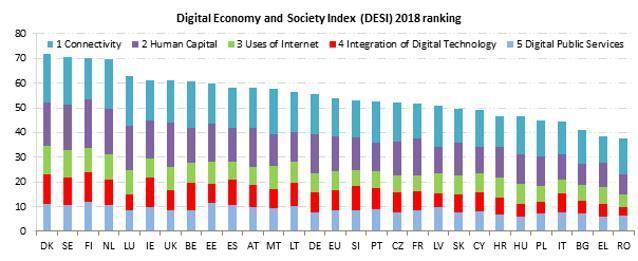
Digital Economy and Society Index (DESI) 2018


I – Results of DESI 2018
What is the Digital Economy and Society Index?

The Digital Economy and Society Index (DESI) is a composite index published every year by the European Commission since 2014, measuring progress of EU countries towards a digital economy and society. It brings together a set of relevant indicators on Europe’s current digital policy mix.

The DESI is composed of five principal policy areas which regroup overall 34 indicators:

1 Connectivity

Fixed broadband, mobile broadband, fast and ultrafast broadband and broadband prices

2 Human capital

Basic skills and internet use, advanced skills and development

3 Use of internet service

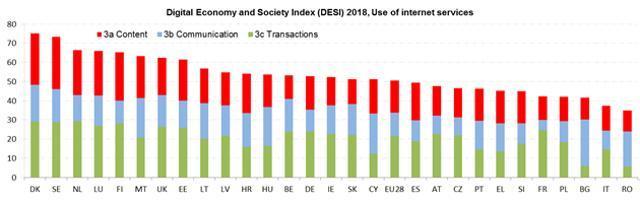
Citizens’ use of content, communication and online transactions

4 Integration of digital technology

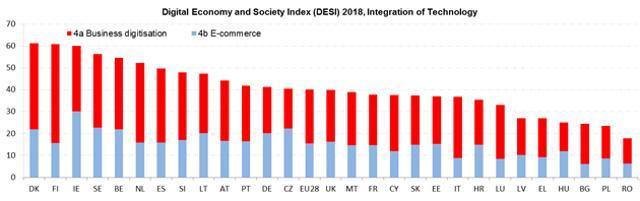
Business digitisation and e-commerce

5 Digital public services

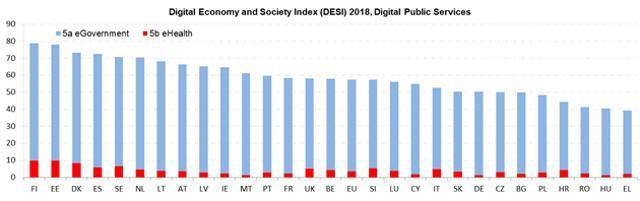
eGovernment and eHealth

 Here the results for 2018 DESI:

ranking

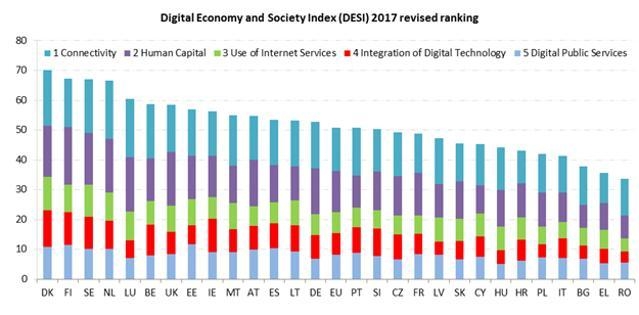
In 2017, all Member States improved in the DESI results. Denmark, Sweden, Finland, and the Netherlands have the most advanced digital economies, followed by Luxembourg, Ireland, the UK, Belgium and Estonia. Ireland, Cyprus and Spain progressed the most (by more than 15 points) over the last four years, while the lowest increase in digital performance was recorded in Greece (below 10 points).

Here is the revised ranking for DESI 2017:
2

How do the Member States perform on the five dimensions of the index?
connectivity

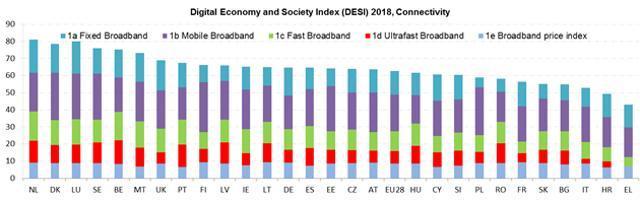
Regarding connectivity to broadband networks, the Netherlands, Luxembourg and Denmark show the highest overall connectivity levels.

Fixed broadband is available to 97% of Europeans, and 80% of European homes are covered by fast broadband (at least 30 Mbps). Ultrafast connectivity – measured for the first time by DESI (at least 100 Mbps) – is available to 58% of Europeans.

4G mobile networks cover on average 91% of the EU’s population, measured as the average of each mobile telecom operator’s coverage within each country.

75% of European homes subscribe to fixed broadband, and one third of all homes have at least 30 Mbps. The results also show that having an ultrafast broadband connection is increasingly more common. 15% of homes subscribe to ultrafast broadband, which is twice as high as two years ago.
hc

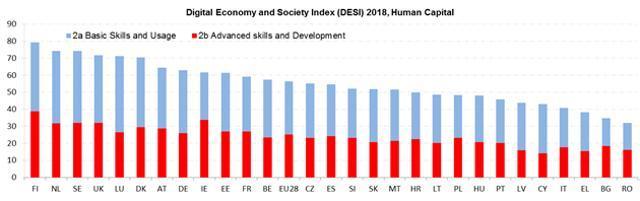
Regarding the Human Capital dimension, 81% of Europeans go online regularly (at least once a week). This is 2 percentage points more than in the previous year. However, 43% of Europeans still do not have basic digital skills. Finland, the Netherlands and Sweden have the highest scores in this dimension.

The results show that the EU improved slightly in the number of Science, Technology, Engineering and Mathematics (STEM) graduates. While only 18.4 out of 1000 people between 20 and 29 years old graduated in STEM in 2013, this increased to 19.1 in 2015. Moreover, there were 8.2 million ICT specialists in the EU in 2016, growing from 7.3 million 3 years earlier.
is

The percentage of internet users engaging in various online activities has overall slightly increased in comparison to the DESI 2017 results. 72% of internet users read news online, 46% make video or audio calls, 65%, use social networks, 68% shop online and 61% use online banking.
 

integration

As for the Integration of technology, European businesses are increasingly adopting digital technologies. This includes the use of a business software for electronic information sharing (from 26% in 2013 to 34% of enterprises in 2017), sending electronic invoices (from 10% in 2013 to 18% of enterprises in 2016) or using social media to engage with customers and partners (from 15% in 2013 to 21% of enterprises in 2017). This trend is most advanced in Denmark, Finland and Ireland.

eCommerce by SMEs also grew slightly (from 14% in 2013 to 17% of SMEs in 2017). Nevertheless, less than a half of those trade online sell to another EU Member State while the majority operates only within their country.
 dps

The Digital Public Services dimension measures the digitisation of public services, focusing on eGovernment and eHealth. Modernisation and digitisation of public services can lead to efficiency gains for the public administration, citizens and businesses. The European champions in Digital Public Services are Finland, Estonia and Denmark.

How does the EU compare to other digitised countries worldwide?

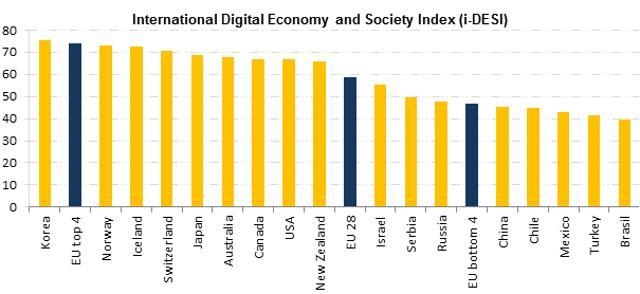
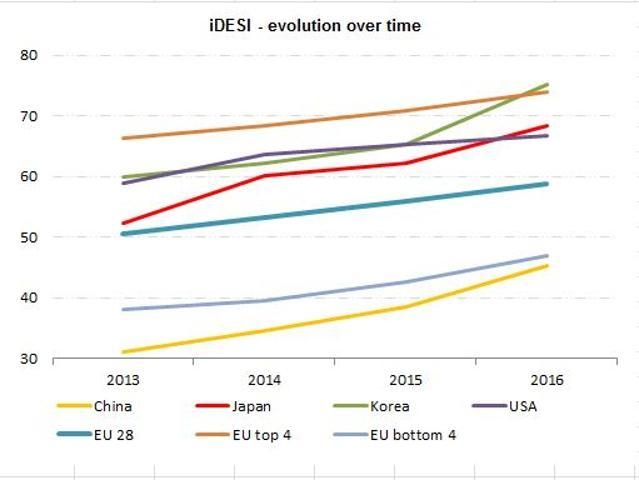
The Commission also compare the digital performance of EU countries with 17 non-EU countries. The International DESI (I-DESI) evaluates the performance of both the individual EU countries and the EU as a whole in comparison to Australia, Brazil, Canada, Chile, China, Iceland, Israel, Japan, South Korea, Mexico, New Zealand, Norway, Russia, Serbia, Switzerland, Turkey and the United States. This is the second time the Commission compares the DESI with international data.
1 

The results of the forthcoming study show that the top four EU countries (Denmark, Finland, Sweden and the Netherlands) are among the global leaders. They are just behind Korea and have higher scores than the United States and Japan. At the same time, however, the comparison shows that the EU’s average in digital performance is significantly lower. The full iDESI report will be available in June.

I-DESI includes the same five dimensions as the DESI, but it is built on a slightly different set of indicators than DESI due to some DESI indicators not being available in non-EU countries. As a result, the I-DESI rankings and scores are slightly different to those of the DESI.


II – DESI methodology

Where does the data come from?

The majority of DESI indicators come from the surveys of Eurostat, the statistical office of the European Union. Some broadband indicators are collected by the Commission services from the Member States through the Communications Committee. Other indicators are derived from studies prepared for the Commission (e.g. some eGovernment and broadband indicators). See the full list of indicators, exact definitions and sources.

How is the DESI score calculated?

To calculate a country’s overall score, each set and subset of indicators were given a specific weighting by European Commission experts. Connectivity and digital skills (‘human capital’), each contribute 25% to the total score. Integration of digital technology accounts for 20%, since the use of ICT by the business sector is one of the most important drivers of growth. Finally, online activities (‘use of internet’) and digital public services each contribute 15%. For more details, see the DESI methodological note.

How are EU countries clustered?

Three clusters were created based on the DESI score.

  • High performing countries are the 9 EU Member States with the highest DESI score. These are Denmark, Sweden, Finland, the Netherlands, Luxembourg, Ireland, the UK, Belgium and Estonia.
  • Medium performing countries have close to average DESI scores. These are Spain, Austria, Malta, Lithuania, Germany, Slovenia, Portugal, the Czech Republic, France and Latvia.
  • Low performing countries are the 9 Member States at the bottom of the list. These are Slovakia, Cyprus, Croatia, Hungary, Poland, Italy, Bulgaria, Greece and Romania.

What has changed in the DESI compared to 2017?

To improve the methodology and take into account the latest technological developments, a limited number of changes were made in DESI 2017:

Connectivity

  • The Ultrafast Broadband sub-dimension was added measuring Ultrafast Broadband coverage (the combined footprint of Fibre to the Premises and Cable Docsis 3.0., measured as the percentage of homes) and Ultrafast Broadband Take-up (percentage of homes subscribing to at least 100 Mbps). Fast Broadband Take-up is measured as the percentage of homes in DESI 2018 instead of the percentage of subscriptions used in earlier publications. Spectrum was removed from the index.
  • Broadband prices: A more robust methodology was used for the calculation of fixed broadband prices, assessing 12 consumption baskets and household income

Human capital

  • STEM graduates: the historical data were revised by Eurostat

The Use of Internet Services and the Integration of Digital Technology dimensions were not affected by any change.

Digital Public Services

  • eHealth was re-introduced as a sub-dimension with one indicator measuring the percentage of people who used health and care services provided online. Under eGovernment a new indicator was added on digital public services for businesses.

In addition, a limited number of historical data points were revised for other indicators, too. As a result of the above changes, the rankings for the previous years have slightly changed.

How did the improved methodology affect the ranking of last year?

As a result of the improved methodology, the rankings for the previous years have slightly changed.


For more information

Press Release

Country profiles

Factsheet: Digital Single Market for benefits of all Europeans

Factsheet: Data Economy for all Europeans

Creating a Digital Single Market – European Commission action since 2015
Videos

#DESIEU


How digital is your country? Europe needs Digital Single Market to boost its digital performance

According to it, the EU is getting more digital, but progress remains insufficient for Europe to catch up with global leaders and to reduce differences across Member States. This calls for a quick completion of the Digital Single Market and increased investments in digital economy and society.

Andrus Ansip, Vice-President for the Digital Single Market, said: This is a shift, albeit small, in the right digital direction. As a whole, the EU is making progress but not yet enough. In the meantime, other countries and regions around the world are improving faster. This is why we should invest more in digital and also complete the Digital Single Market as soon as possible: to boost Europe’s digital performance, provide first-class connectivity, online public services and a thriving e-commerce sector.”

Mariya Gabriel, Commissioner for Digital Economy and Society, said: We look forward to a rapid progress on major reforms such as the European Electronic Communications Code aiming at boosting investments in enhanced connectivity. This year’s Digital Economy and Society Index demonstrates that we must deploy further efforts to tackle lack of digital skills among our citizens. By integrating more digital technologies and equipping them with skills, we will further empower citizens, businesses and public administrations. This is the way to succeed the digital transformation of our societies.

Over the past year, the EU continued to improve its digital performance and the gap between the most and the least digital countries slightly narrowed (from 36 points to 34 points). Denmark, Sweden, Finland and the Netherlands scored the highest ratings in DESI 2018 and are among the global leaders in digitalisation. They are followed by Luxembourg, Ireland, the UK, Belgium and Estonia. Ireland, Cyprus and Spain progressed the most (by more than 15 points) over the last four years. However, some other EU countries still have a long way to go and the EU as a whole needs to improve to be competitive on the global stage.

ranking

2


DESI 2018 shows:

Connectivity has improved, but is insufficient to address fast-growing needs

  • Ultrafast connectivity of at least 100 Mbps is available to 58% of households and the number of subscriptions is rapidly increasing. 15% of homes use ultrafast broadband: this is twice as high as just two years ago and five times higher than in 2013.
  • 80% of European homes are covered by fast broadband with at least 30 Megabits per second (Mbps) (76% last year) and a third (33%) of European households have a subscription (23% increase compared to last year, and 166% compared to 2013).

The number of mobile data subscriptions has increased by 57% since 2013 reach 90 subscriptions per 100 people in the EU. 4G mobile networks cover on average 91% of the EU population (84% last year).

Indicators show that the demand for fast and ultrafast broadband is rapidly increasing, and is expected to further increase in the future. The Commission proposed a reform of EU telecoms rules to meet Europeans’ growing connectivity needs and boost investments.

More and more Europeans use the internet to communicate

The highest increase in the use of internet services is related to telephone and video calls: almost half of Europeans (46%) use the internet to make calls, this is almost a 20% increase compared to last year and more than 40% increase compared to 2013. Other indicators show that 81% of Europeans now go online at least once a week (79% last year).

To increase trust in the online environment, new EU rules on data protection will enter into force on 25 May 2018.

The EU has more digital specialists than before but skills gaps remain

  • The EU improved very little in the number of Science, Technology, Engineering and Mathematics (STEM) graduates (19.1 graduates per 1000 people aged 20 to 29 years old in 2015, compared to 18.4. in 2013);
  • 43% of Europeans still do not have basic digital skills (44% last year).

Alongside the Digital Skills and Jobs Coalition, the Commission has launched the Digital Opportunity Traineeships to tackle the digital skills gap in Europe. The pilot initiative will provide digital traineeships for up to 6,000 students and recent graduates until 2020 in another EU country.

Businesses are more digital, e-commerce is growing slowly

While more and more companies send electronic invoices (18% compared to 10% in 2013) or use social media to engage with customers and partners (21% compared to 15% in 2013), the number of SMEs selling online has been stagnating over the past years (17%).

In order to boost e-commerce in the EU, the Commission has put forward a series of measures from more transparent parcel delivery prices to simpler VAT and digital contract rules. As of 3 December 2018, consumers and companies will be able to find the best deals online across the EU without being discriminated based on their nationality or residence.

Europeans use more public services online

58% of internet users submitting forms to their public administration used the online channel (52% in 2013).

  • 18% of people use online health services.

In April 2018, the Commission adopted initiatives on the re-use of public sector information and on eHealth that will significantly improve cross-border online public services in the EU.

Background

The annual Digital Economy and Society Index (DESI) aims to measure the progress of EU Member States towards a digital economy and society. It helps EU countries identify areas requiring priority investments and action. The DESI is also a key tool when analysing digital in the European Semester, which allows EU countries to discuss their economic and budget plans and monitor progress at specific times throughout the year.

This year, both DESI and the more detailed analysis of national digital policies, providing an overview of progress and of policy implementation by Member States (previously called Europe’s Digital Progress Report) are published jointly using the DESI name. A more detailed Telecoms Chapter for each Member State is annexed to the reports. To make better comparison between Member States, DESI also develops cross-country analyses in connectivity, skills, use of the internet, take-up of digital technology by businesses, digital public services, ICT R&D and innovation investment and use of Horizon 2020 research and innovation programme funds by Member States.

The Commission has presented 29 legislative proposals under its Digital Single Market strategy and called, in a recent Communication, the European Parliament and Member States to adopt these proposals by the end of 2018.

For more information

Q&A

Country profiles

Factsheet: Digital Single Market for benefits of all Europeans

Factsheet: Data Economy for all Europeans

Creating a Digital Single Market – European Commission action since 2015

Videos

#DESIEU


Denmark: First EIB support for nearly-zero-energy-buildings

  • EUR 100 million for two “nearly-zero-energy-building” complexes in Copenhagen.
  • Project comprises 6 new buildings with a total of 660 new energy-efficient apartments.

The European Investment Bank (EIB) is has signed a EUR 100 million loan agreement with Fastighets AB Balder, for the development of two residential complexes with nearly-zero-energy-building (NZEB) standards. The project comprises a total of six buildings which together will provide 660 new apartments in the Copenhagen Metropolitan Area.

“After various projects in Sweden and Finland, this is the first so-called “NZEB” project the Bank finances in Denmark.” said EIB Vice-President Alexander Stubb. “With this project, Balder is ahead of the curve in terms of legislation requiring all new buildings in the EU to have nearly-zero-energy characteristics by 2020. It is also very much in-line in line with the EIB’s energy and climate action objectives, and will contribute to increasing the supply of better quality housing, with lower energy costs, in Denmark.”

“We are proud to have signed this agreement with the EIB regarding the financing of two of our ongoing projects in Denmark. The cooperation with the EIB shows that our sustainability efforts and our new production projects maintain a high level.” said Erik Selin, CEO of Balder.

The new buildings will already comply with the future NZEB requirements for Denmark, having a significantly lower net primary energy consumption compared to the proposed Danish NZEB standards. The average value is expected to lie around 18 kWh/(m2*y) and, overall, primary energy savings of 764 MWh/year are expected when compared with the existing building standards regulation.


Denmark: First EIB support for nearly-zero-energy-buildings

  • EUR 100 million for two “nearly-zero-energy-building” complexes in Copenhagen.
  • Project comprises 6 new buildings with a total of 660 new energy-efficient apartments.

The European Investment Bank (EIB) is has signed a EUR 100 million loan agreement with Fastighets AB Balder, for the development of two residential complexes with nearly-zero-energy-building (NZEB) standards. The project comprises a total of six buildings which together will provide 660 new apartments in the Copenhagen Metropolitan Area.

“After various projects in Sweden and Finland, this is the first so-called “NZEB” project the Bank finances in Denmark.” said EIB Vice-President Alexander Stubb. “With this project, Balder is ahead of the curve in terms of legislation requiring all new buildings in the EU to have nearly-zero-energy characteristics by 2020. It is also very much in-line in line with the EIB’s energy and climate action objectives, and will contribute to increasing the supply of better quality housing, with lower energy costs, in Denmark.”

“We are proud to have signed this agreement with the EIB regarding the financing of two of our ongoing projects in Denmark. The cooperation with the EIB shows that our sustainability efforts and our new production projects maintain a high level.” said Erik Selin, CEO of Balder.

The new buildings will already comply with the future NZEB requirements for Denmark, having a significantly lower net primary energy consumption compared to the proposed Danish NZEB standards. The average value is expected to lie around 18 kWh/(m2*y) and, overall, primary energy savings of 764 MWh/year are expected when compared with the existing building standards regulation.


If we wish to meet our growing demands for live-in care, we must recognise the rights of care workers

The EESC conference in Rome pointed to many shortcomings in Italy’s live-in care sector, which is on the rise in the country shown to be the second “oldest” in the world according to recent figures

Despite the high demand for live-in care services, Italy’s live-in care sector is still plagued by many irregularities, such as inadequate recognition of social and labour rights of carers, undeclared work and insufficient public spending on care. This was revealed by a meeting held on 16 May by the European Economic and Social Committee (EESC) at the CNEL in Rome.

Speakers at the meeting in Rome – the third of five EESC country visits that are part of its ongoing consultation procedure on the future of this rapidly growing sector in Europe – said that more than half of the care workers in Italy were not legally employed. Some 75 percent of live-in care work in the country is done by migrant women, many of them coming to Italy from Eastern Europe.

The EESC’s “going-local” meetings are a follow-up to its own-initiative opinion on the rights of live-in care workers, adopted in September 2016 as the first policy document at European Union level dealing with the sector of live-in care work in Europe, which has long remained almost invisible to EU and Member State policy-makers.

Their aim is to shine a spotlight on the precarious situation of these workers in Europe’s labour markets, but also on many uncertainties faced by care recipients who often recruit carers through informal networks or the internet.

The meetings are organised by the EESC Member and rapporteur of the opinion, Adam Rogalewski, who advocates the regularisation and professionalisation of the live-in care sector and the inclusion of live-in care workers in the long-term care system, with all the rights arising from relevant EU and Member State employment regulations.

The Rome meeting follows the one held in Berlin this March and the one held in London last November. Two more are planned for Poland and Sweden, representing some of the countries of origin and destination of live-in care workers.

The situation in Italy is often described as a telling example, with a growing number of domestic workers in the rapidly ageing Italian society and a welfare system which is unable to meet the increased demand for care, forcing families to almost exclusively bear the burden of care costs.

At the same time, Italy’s care workers – both foreign and Italian – share the fate of their European counterparts who work in difficult conditions, often with an unregulated employment status.

“Live-in care work entails a series of difficulties for carers. Most of them are migrant women and it is very difficult for them to reconcile work and private life. They live in solitude, far away from their loved ones, facing language barriers and having difficulties integrating into society”, Dr Luciana Mastrocola from CGIL, Italy’s largest trade union federation, told the conference.

She also pointed to the fact that neither foreign nor Italian carers in Italy enjoyed full protection of social rights, unlike most workers in other sectors, and that social recognition of their work was missing, despite the fact that it has today become indispensable, compensating for the shortcomings of the Italian care and welfare systems.

“The Italian government did not start implementing sustainable policies early enough. If we wish to keep meeting our demands for care, we must recognise the rights of these workers”, Dr Mastrocola said.

Many live-in carers in Italy have no documents, and, while families want to “legalise” these workers, the authorities are not willing to do so, said Sara Gomez, a live-in care worker and a member of CGIL. She stressed that people working in the sector were very isolated but, thanks to the efforts made by CGIL, a considerable number of them had now become unionised.

Italy introduced its first law on paid domestic work in 1958, its first special collective agreement in 1974 and ratified the ILO’s Convention 189 in 2013. The same year saw the signing of the collective agreement on domestic work between Italian trade unions and employer associations.

In her keynote speech at the meeting, Professor Sabrina Marchetti from the Ca’ Foscari University of Venice highlighted the strong need for inclusive measures for non-EU migrants and called for the “Italian collective agreement to be adapted to the requirements of the ILO Convention 189, particularly in regard to the maternity rights and sick leave of all care workers.”

She maintained that the Italian situation was different to other countries and affirmed that neither employment through agencies nor self-employment status were a suitable strategy for delivering live-in care.

Dimo Barlaan from the disability advocacy organisation “FISH onlus” called for the current situation of a 54 hour work week to be addressed through collective agreements for live-in care workers by creating part-time working arrangements.

Andrea Zini, vice president of the home care employers’ association Assindatcolf and of the European Federation of Domestic Workers (EFFE) put the number of legally employed care workers in Italy at 900 000, whereas as many as 1 250 000 million were in irregular employment.

According to Italy’s National Institute of Statistics (ISTAT), Italy is the second “oldest” country in the world, which means the demand for assistance and care can only grow, Mr Zini said.

“For this reason we are convinced that family, work and housing can be crucial factors for the revival of both the Italian and the European economy. But for this to happen, the government must become aware of this, because now the burden, including the economic burden, is entirely borne by employer families. If we could fully deduct the cost of domestic work, we would create a “virtuous” circle: more jobs and less irregular work, more professionalism and better well-being for families”, he said.

Mr Zini called for the professionalisation of domestic care work and for the creation of a European database for the sector, for the implementation of training and certification systems, and for the coordination of supply and demand at the European level.

The EESC Member Pietro Vittorio Barbieri stressed that it was impossible to achieve the transition from undeclared to declared work without addressing the issue of insufficient public spending in the sector. “Families are under strain. It is about time the government did more regarding demographic change which is a threat to Italy”, he said.

Another EESC Member, Pietro Francesco De Lotto, insisted on the role of national and local bilateral collective bargaining and on the need to increase tax deductions to families hiring live-in care workers. “We also need to invest more in training to upskill the existing workforce,” he added.

Concluding the meeting, Mr Rogalewski urged all stakeholders to implement Principle 18 of the European Pillar of Social Rights on long-term care before it is too late. According to Principle 18, “everyone has the right to affordable long-term care services of good quality”.

BACKGROUND:

The EESC opinion adopted in 2016 presented eight recommendations for Member States and 12 recommendations for EU legislators to improve the overall capacity of the sector to create quality jobs and deliver quality care. They include implementing processes for recognising qualifications and experience acquired by live-in care workers, improving the way they are posted and incorporating their rights into the European semester. A rigorous application of the Victims’ Rights Directive in cases where workers are victims of exploitation, and the improvement of safeguards in the Employers’ Sanctions Directive to protect labour rights of undocumented workers should also be high on the agenda. It is also necessary to collect adequate data on live-in care workers and carry out research into their working and living conditions.

The findings of the EESC country visits will be presented in a report which will be published later in 2018.

https://www.eesc.europa.eu/en/news-media/press-releases/europe-needs-proactive-policy-long-term-care-sector

https://www.eesc.europa.eu/en/news-media/press-releases/live-carers-face-precarious-conditions-despite-shortage-care-workers-eu-labour-market

https://www.eesc.europa.eu/en/news-media/press-releases/eesc-shines-spotlight-vital-role-live-carers