Good news for holiday makers: excellent water quality at vast majority of European bathing sites

Nearly all 21.801 bathing water sites monitored last year across Europe, of which 21.509 were in the 28 EU Member States (95.9%), met the minimum quality requirements under EU rules according to the report by the European Environment Agency (EEA) and the European Commission. Albania and Switzerland also monitored and reported on the quality of their 292 bathing water sites.

Specific results from monitoring showed a small drop in EU sites meeting the highest ‘excellent’ and the minimum quality requirements set out by the EU’s Bathing Water Directive. ‘Excellent’ quality standards across Europe dropped marginally from 85.5% in 2016 to 85% last year. Similarly those meeting minimum ‘sufficient’ standing fell from 96.3% to 96.0%. The reason for the slight drop was due mostly to the effect of summer rain on test results as well as changes in testing methodology in Romania and Sweden.

The number of overall ‘poor’ rated sites remained mostly unchanged from 2016 across the EU, Albania and Switzerland, dropping from 1.5% in 2016 to 1.4% in 2017.

Karmenu Vella, European Commissioner for the Environment, Maritime Affairs and Fisheries, said: “The quality of our bathing water is a source of pride for Europeans. That quality is due to good cooperation and constant vigilance. We all play a part: industry, local authorities and services together with citizens. We are happy to report that the European spirit of cooperation on bathing water is alive and continues to deliver for our citizens. When you add in our recently proposed measures to keep plastics out of our seas, it really has been a good year for European seas, beaches and lakes.”

Hans Bruyninckx, EEA Executive Director, said: “Reducing water pollution benefits the well-being of European citizens but also animals and plant life. But we cannot be complacent. Keeping our bathing water clean requires our sustained attention by policy makers. That is why regular monitoring and assessment of bathing sites remains a crucial task.”

Europe’s bathing water quality has vastly improved over the last 40 years, when the EU’s Bathing Water Directive was introduced. Effective monitoring and management introduced under the directive led to a drastic reduction in untreated or partially treated municipal and industrial waste water ending up in water.  As a result, more and more bathing water sites are not only meeting the minimum quality standards, but have also improved their quality to the highest standards. Alongside this year’s report, the EEA has also released an updated interactive map showing the performance of each bathing site. Updated country reports are also available here as well as more information on the directive.

Figure ES1: Proportion of bathing water sites with excellent water quality in European countries
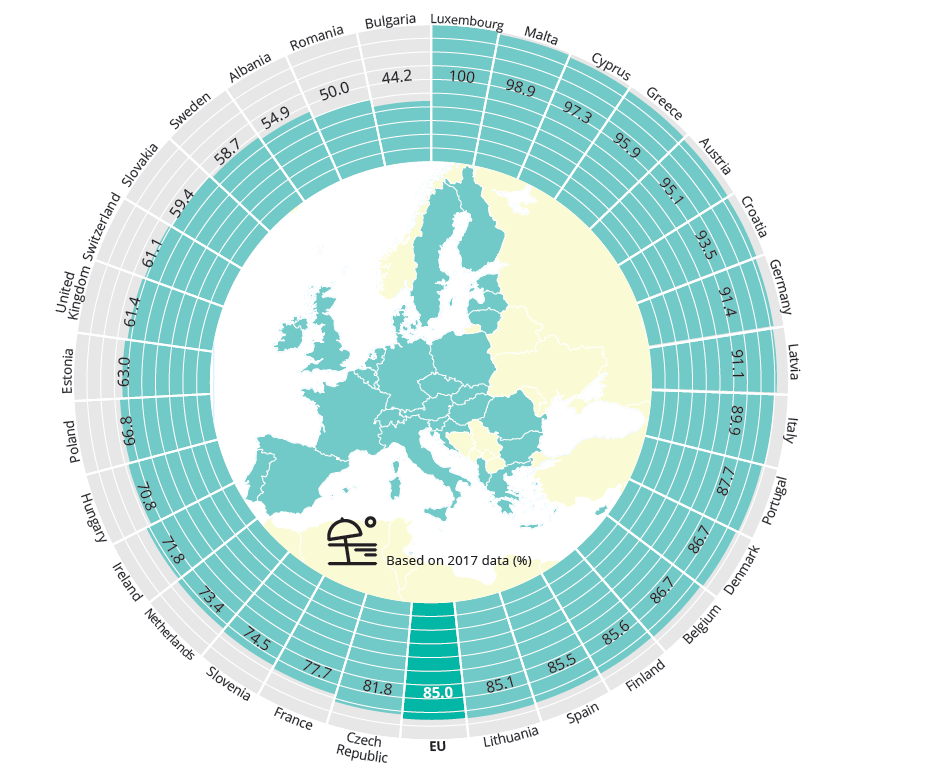
Figure ES 1

Other key findings:

  • In five countries, 95% or more of bathing waters were assessed as being of excellent quality: Luxembourg (all 12 reported bathing waters), Malta (98.9% of all sites), Cyprus (97.3% of all sites), Greece (95.9% of all sites) and Austria (95.1% of all sites).
  • All reported bathing water sites in Austria, Belgium, Croatia, Cyprus, Greece, Latvia, Luxembourg, Malta, Romania, Slovenia and Switzerland achieved at least sufficient quality in 2017 (in accordance with the minimum quality standards set by the Bathing Water Directive).
  • The three countries with the highest numbers of bathing water sites of ‘poor’ water quality were Italy (79 bathing water sites or 1.4%), France (80 sites or 2.4%) and Spain (38 sites or 1.7%). In the EU Member States, the highest proportion of bathing waters classified as  ‘poor’  was recorded in Estonia (four bathing waters or 7.4%), Ireland (seven bathing waters or 4.9%) and the United Kingdom (21 bathing waters or 3.3%). 

Background

The contamination of water by faecal bacteria continues to pose a risk to human health, especially if it is found at bathing water sites. Swimming at contaminated beaches or lakes can result in illness. The major sources of pollution are sewage and water draining from farms and farmland. Such pollution increases during heavy rains and floods due to sewage overflow and polluted drainage water being washed into rivers and seas.

All EU Member States, plus Albania and Switzerland, monitor their bathing sites according to the provisions of the EU’s Bathing Water Directive. The assessment of the bathing water quality under the Bathing Water Directive makes use of the values of two microbiological parameters: Intestinal enterococci and Escherichia coli. The legislation specifies if the bathing water quality can be classified as ‘excellent’, ‘good’, ‘sufficient’ or ‘poor’, depending on the levels of faecal bacteria detected. Where water is classified as ‘poor’, Member States should take certain measures, like banning bathing or posting a notice advising against it, providing information to the public, and taking suitable corrective actions.


ESMA updates Q&A on Short-Selling Regulation

The overall SSR Q&A revises a pre-existing answer regarding locate arrangements, further specifying the requirements for ‘easy-to-borrow and purchase’ lists.

The purpose of this Q&A is to promote common supervisory approaches and practices in the application of SSR. It aims at providing investors and other market participants with clarifications on the applicable requirements.

ESMA will periodically review these Q&A and update them where required.


Opening remarks by Vice-President Katainen and Commissioner Bieńkowska on the Commission’s proposal on Supplementary Protection Certificates

Vice-President Katainen

Today Elżbieta and I are here to present a new legislative proposal that has been designed to help EU-based companies tap into fast-growing global markets on pharmaceuticals.

Our proposal amends existing legislation on the protection of intellectual property rights covering pharmaceuticals, more specifically in the area of Supplementary Protection Certificates, or SPCs.

This subject matters. It matters because patents and SPCs support and sustain the world-class innovation capacity of the EU pharmaceutical industry. A sector that provides 570.000 jobs in the Union, invests €27 billion in Research and Development, and exports worth of €220 billion annually.

Our SPC rules are the strongest in the world, and for a good reason: to reward investment in innovation and protect intellectual property in the EU.

Pharmaceutical SPCs aim to offset the loss of patent protection for medicines that occurs due to the lengthy testing and clinical trials these products require prior to obtaining regulatory marketing approval. An SPC can extend a patent right in the EU for a maximum of five years.

That is the baseline and that will not change.

Let me briefly explain what the issue is right now, and Elżbieta will then present the initiative we are proposing.

EU and global pharmaceutical markets have changed dramatically since the SPC was introduced back in 1992. Global demand for medicines has increased massively, reaching €1.1 trillion in 2017. In this growing market, generics and biosimilars now represent an important part of the future. That was not the case in 1992 when our rules were first framed.

Today, the EU plays a pioneering role both in pharmaceutical research and in manufacturing of generic medicines and biosimilars.

However, Europe’s trading partners are increasingly involved in manufacturing for the quickly expanding market of generics and biosimilars.

This is why it is urgent to act now to maintain our leadership position in pharmaceuticals.

We are proposing a very limited and targeted change to the current regime to remove a legal barrier that was preventing our companies from competing on equal terms with our global competitors on non-EU markets.

Why? Because during the SPC period of protection of the product in the EU, EU-based generics and biomilars manufacturers cannot produce for any purpose. Not even for the sole purpose of exporting outside the EU to countries where SPC protection has expired or does not exist.

This puts our generics and biosimilar manufacturers in a clear competitive disadvantage as regards our global competitors.

What are the risks? Delocalisation of manufacturing out of Europe. Loss of investment in Europe. Loss of export markets. And, in addition, delays in new generics and biosimilars reaching the EU market.

So we need to act now. We will continue the top class protection of European innovators in the pharmaceuticals sector, but at the same we want our companies to be able to compete globally, whilst maintaining production in Europe.

Elżbieta will now tell you what we are proposing.

Commissioner Bieńkowska

Thank you Jyrki.

As you explained, we are acting today to remove an unintended competitive disadvantage for the EU-based generics and biosimilar when they go on the export markets.

The global pharmaceutical market is changing fast:

  • The total spending on medicines is to increase from €950m in 2012, to €1.1 trillion in 2017.
  • There is a shift towards ever-greater market share by generics and biosimilars, which could represent 80% of medicines by volume by 2020.

But today, our own legislative framework does not allow these generics and biosimilars to compete on export markets on an equal basis with non EU based companies.

And this has also an impact on their capacity to access our own EU market once the protection in the Single Market is over.

This is a paradoxical situation, especially at a moment when we expect a patent cliff by 2020, i.e. that a lot of medicinal products going off patent progressively as of 2020. In clear, there is a potential opening of a market of €95bn worldwide.

We therefore want to be sure that our EU based generics and biosimilar are in position to compete, from the EU, on equal terms, in order to capture part of this expected growth in the market.

Failing to do so, at a moment when these companies are making their investment decisions, we are running the risk of increased delocalisation, loss of export opportunities and loss of competitiveness of EU pharmaceutical industry as a whole.

So we have to act now.

We have listened carefully to all sides of industry. To their concerns and their expectations.

On that basis, today we are proposing a balanced, proportionate and well-calibrated exception to the current SPC system in the form of a “manufacturing waiver”.

We are not changing the core or length of intellectual property protection of pharmaceuticals. We are not changing the overall SPC system. We remain committed to strong IPR and SPC protection and enforcement in the Single Market and beyond. The IPR protection in Europe is the strongest in the world, and it will remain so with this proposal.

What we propose is to allow EU-based companies to manufacture a generic or biosimilar version of an SPC-protected medicine if they do so exclusively for the purpose of export to a non-EU market where protection has expired or never existed.

This will boost investment and job creation in Europe:

  • Up to 25.000 new and high-skilled jobs over the next 10 years could be generated in the EU;
  • with possible export gains for EU companies of €1 billion per year;
  • It will particularly benefit the many small and medium-sized enterprises in the field.

We will also re-affirm Europe’s position as a hub for pharmaceutical R&D and manufacturing.

Let me clear however. This proposal is not about rewarding one side of the industry – the generics and biosimilar industry – to the detriment of the other side – the originators.

This proposal is therefore accompanied with strong safeguards to ensure that the intellectual property protection in Europe is not undermined:

  • A notification procedure to competent authorities for using the waiver ensuring transparency;
  • A labelling obligation to ensure that what is produced for the export markets, is not diverted back towards the EU market;
  • A due diligence requirement on generics and supply chain to ensure that their supply chain apply the rules correctly.

So all sides stand to gain from this proposal.

This is good for the competitiveness of the overall EU pharmaceutical sector, it will improve patients’ access to medicine and help national health budget.

We therefore call on the European Parliament and the Council to adopt the Regulation swiftly in this legislative term, by next spring.

 __

Press release – Pharmaceuticals: Commission refines intellectual property rules

Frequently Asked Questions (FAQs) – Supplementary protection certificate for medicinal products


ESMA updates Q&A on Short-Selling Regulation

The overall SSR Q&A revises a pre-existing answer regarding locate arrangements, further specifying the requirements for ‘easy-to-borrow and purchase’ lists.

The purpose of this Q&A is to promote common supervisory approaches and practices in the application of SSR. It aims at providing investors and other market participants with clarifications on the applicable requirements.

ESMA will periodically review these Q&A and update them where required.


Letter to EFRAG on DP Equity instruments impairment and recycling

Download PDF