EU budget: A new Social Fund, Globalisation Adjustment Fund and Justice, Rights and Values Fund

For the period 2021-2027, the European Social Fund Plus would be worth €101.2 billion, and the Globalisation Adjustment Fund €1.6 billion. Both are geared to invest in people: ensuring they are equipped with the right skills needed to deal with challenges and changes on the labour market, following up on the European Pillar of Social Rights. The Justice, Rights and Values Fund will be worth €947 million over 7 years. It will further support the development of a European Area of Justice based on the rule of law and mutual trust and ensure people can enjoy their rights.

Vice-President for the Euro, Social Dialogue, Financial Stability, Financial Services and Capital Markets Union, Valdis Dombrovskis: “These proposals follow the fundamental questions we have been asking since the White Paper on the future of Europe and subsequent reflection papers: what European Union do we want, how will we shape it, and how do we pay for it? Our ambitions for a more social Europe are fully reflected: we need EU funding to fit our policies both to pro-actively support the most vulnerable in our societies, and to react when globalisation and digitisation make their impact felt.”

Commissioner for Employment, Social Affairs, Skills and Labour Mobility, Marianne Thyssen, said: “Europe wants to empower people. We put our money where our mouth is. Our new, flexible and simplified social funds are focused on investing in people: to make sure they have the right skills, to make sure they have modern social protection adapted to new forms of work, and to show solidarity with those who need it most.” 

Vytenis Andriukaitis, Commissioner for Health and Food Safety, stressed that: “Health is a fundamental value therefore it makes sense that the future EU budget envisions integrating the Health programme in ESF+ under the cluster of “values”. This will lead to new and stronger synergies with the other building blocks of the European Pillar of Social Rights and will allow better coordination of health related investments. It will also support health promotion and disease prevention, improving effectiveness, accessibility and resilience of health systems as well as reducing health inequalities and making healthcare better and safer for the benefit of patients and society at large.”

Věra Jourová, Commissioner for Justice, Consumers and Gender Equality said: “With today’s proposal for a new Justice, Rights and Values Fund, we make sure we can give the best support possible for initiatives upholding EU rights, values and the rule of law.
At a time where European societies are confronted with extremism, radicalism and divisions, it is more important than ever to promote, strengthen and defend justice, rights and EU values. NGOs and civil society play a crucial role in standing up for these European values. At the same time we need to support Member States in our joint effort to improve judicial cooperation and increase mutual trust in our common area of justice.”

 1. A European Social Fund Plus

The European Social Fund Plus will focus on investment in people and support the delivery of the European Pillar of Social Rights. This helps to respond to global challenges, maintain social fairness but also to drive Europe’s competitiveness forward. The European Social Fund Plus will be a more flexible and simpler version of the current European Social Fund by merging a number of existing funds and programmes. Pooling resources will allow the EU and Member States to provide more integrated and targeted support in response to the social and labour market challenges that people in Europe face today. For instance, integrating support to the most deprived into the ESF+ will benefit eligible persons through a better mix of material assistance and comprehensive social support.

Specifically, the European Social Fund Plus will merge:

The main features of the new Fund are:

  • Putting citizens’ concerns and key priorities at the centre: In consultation with Member States, resources will be allocated to measures that address key priorities and Europeans’ concerns. The ESF+ programmes will concentrate in particular on challenges identified under the European Semester and the European Pillar of Social Rights;
  • A focus on youth unemployment and social inclusion: Member States with a high rate of young people not in employment, education or training will have to dedicate a minimum of 10% of the ESF+ funding to support youth employment. The Fund will continue to contribute to the Skills Agenda for Europeand at least 25% of ESF+ funding should be allocated to measures fostering social inclusion and targeting those most in need. The ESF+ will also support Member States efforts to integrate legally present non-EU nationals into their labour markets and societies by focusing on measures that foster long-term integration. In this way, it complements the Asylum and Migration Fund which supports short-term integration measures;
  • Cutting red tape: The Commission proposes to make the rules less complex in the next long-term EU budget with less red tape and easier access to funding from different sources for authorities, citizens or organisations benefitting from EU support;
  • Tailored support to healthcare: the health strand will focus on the priority areas where EU cooperation has a proven benefit: strengthening cross-border crisis-preparedness, assisting Member States’ health authorities, digitising health and care, supporting EU health legislation and enhancing cross-border cooperation, for instance on rare and complex diseases via the European Reference Networks.

2. The post-2020 European Globalisation Adjustment Fund

The European Globalisation Adjustment Fund will be revised so that it can intervene more effectively to support workers who have lost their jobs. Currently, workers can only get support from the Fund when their dismissals are due to changing trade patterns or consequences of the financial and economic crisis. Under the new rules, other reasons for restructuring, such as automation, digitalisation and more, can be eligible for support, taking account of new challenges on the labour market.

The new rules will also lower the threshold of dismissed workers for a case to be eligible from 500 to 250, which will allow more workers to get support. Other proposed changes include an improved mobilisation process to simplify and speed up the procedures. Finally, the Fund’s co-financing rate, which currently stands at 60%, will be aligned with the highest ESF+ co-financing rates for a given Member State. In several cases this would mean that the EU co-finances a higher share of the total cost.

3. EU Justice, Rights and Values Fund

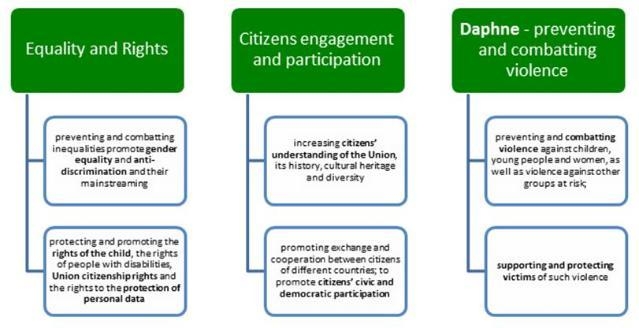
The Commission is also proposing a new Justice, Rights and Values Fund, comprising of the Rights and Values, and Justice programmes. The Fund has a proposed budget allocation of €947 million over the 7 years, €642 million for the Rights and Values programme and €305 million for the Justice programme.

At a time where European societies are confronted with extremism, radicalism and divisions, it is more important than ever to promote, strengthen and defend justice, rights, and EU values. For instance, this programme will help fight inequalities and discrimination, better protect children, and improve judicial cooperation to better fight criminality and terrorism. The Fund will contribute to the further development of a European area of justice based on the rule of law, on mutual recognition and mutual trust. It will also enhance and support the key role of Non-Governmental Organisations and civil society in promoting, safeguarding and awareness raising for EU common values and ensuring people can enjoy their rights.

The creation of the new Fund represents a simplification as compared to the current situation of 3 programmes. In particular, the area of citizenship, which is currently dealt with by 2 different programmes, will be covered by the new Rights and Values programme.

Next steps

A swift agreement on the overall long-term EU budget and its sectoral proposals is essential to ensure that EU funds start delivering results on the ground as soon as possible.

Delays similar to the ones experienced at the beginning of the current 2014-2020 budgetary period would mean that 100,000 EU-funded projects could not start on time; that many people in need of support, including urgent material and food assistance, would have to wait unnecessarily; that trainings, increased job opportunities, actions to improve the quality of key services would be delivered late, or thatschools would not be able to implement new quality educational programmes in time for the school year.

An agreement on the next long-term budget in 2019 would provide for a seamless transition between the current long-term budget (2014-2020) and the new one and would ensure predictability and continuity of funding to the benefit of all.

Background

The European Social Fund is Europe’s oldest and main instrument to invest in people.
It was established together with the Treaty of Rome in 1957. Today it is an important driver of job creation, promoting better education, more modern public administrations and social inclusion, and therefore a means of ensuring fairer opportunities for all citizens.

The European Globalisation Adjustment Fund is an expression of EU solidarity with European workers who lost their jobs because of the impact of the combination of changing global trade patterns and technological change. Its objective is to retain or reintegrate workers into the labour market.

Today’s proposals related to ESF+, EGF and the Justice, Rights and Values Fund are part of the Commission’s proposals for the long-term EU budget adopted by the Commission on 2 May 2018. The Commission’s proposal for the ESF+ is closely related to the proposal for a Common Provisions Regulation adopted on 29 May 2018 which establishes the framework for action for a number of EU shared management Funds.

For More Information

Memo: Questions and Answers on the new Social Fund and Globalisation Adjustment Fund for the period 2021-2027

Memo: Questions and Answers on the Justice, Rights and Values Fund

Factsheet: EU budget for the future: European Social Fund Plus and European Globalisation Adjustment Fund

European Social Fund website

Press Release: the European Social Fund celebrates its 60th anniversary: 6 decades of investing in people

Common Provisions Regulation

Follow Valdis Dombrovskis on Twitter

Follow Marianne Thyssen on Facebook and Twitter

Follow Vera Jourová on Twitter

Follow Vytenis Andriukaitis on Twitter

Subscribe to the European Commission’s free e-mail newsletter on employment, social affairs and inclusion


Statement by Commissioner Oettinger on Italy

I fully respect the will of voters being left, right or centre and in every country. By referring to the actual market developments in Italy, I did not mean to be disrespectful and I apologise for this. Italy as a founding member played and plays an important role in European integration and I hope it will continue on this path.


EU Trust Fund for Africa: new programmes worth €294 million to further foster stability and jobs and growth in the Horn of Africa

This new package complements 50 previously adopted actions amounting to €820.3 million for the Horn of Africa. Approved in seven packages in December 2015, April 2016, October 2016, December 2016, April 2017, December 2017 and February 2018, these actions all contribute to improving stability and addressing the root causes of irregular migration and forced displacement in the Horn of Africa region. Two additional cross-window measures (€26 million) also benefit the region in the area of protection of migrants along the Central Mediterranean route and in technical assistance.

Summary of the projects announced today:

Sudan

  • The programme “Youth, Employment, Skills (YES)” (EU Trust Fund contribution: €15 million) aims at improving the ability of young women and men to find employment or establish and grow their businesses through Technical Vocational Education and Training (TVET). The project will target youth and disadvantaged groups such as refugees and internally displaced persons of Darfur.
  • The programme “Simple, Spatial, Survey Method (S3M) survey for Sudan” (EU Trust Fund contribution: €1 million) will help to collect and disseminate data on malnutrition among young children, as well as pregnant and lactating women through a survey in Sudan.
  • The programme “Provision of air services to allow access for humanitarian and development actors in Sudan” (EU Trust Fund contribution: €1.5 million) will provide humanitarian and development actors, donor organisations and diplomatic missions in Sudan with better access to beneficiaries, especially vulnerable communities in hard-to-reach project implementation sites through the UN Humanitarian Air Services.

The two latter actions help implementing the humanitarian development nexus in Sudan.

South Sudan

  • The programme “South Sudan Rural Development: Strengthening Smallholders’ Resilience – SORUDEV SSR” (EU Trust Fund contribution increased from €7 million to €15 million) will be expanded to cover now 7 out of the former 10 states of South Sudan and will help responding to the food security crisis affecting large parts of the population. The action will strengthen resilience of communities, improving governance and conflict prevention and reducing forced displacements due to loss of livelihoods.

Ethiopia

  • The programme “Ethiopia Job Compact – Sector Reform and performance Contract” (EU Trust Fund contribution: €50 million) aims at supporting Ethiopia’s industrialisation strategy with €50 million. This will be done in the framework of the “job compact” initiative, an agreement between the Government and international partners to create decent employment opportunities for Ethiopians and refugees.

Kenya

  • The programme “Piloting Private Sector Solutions for Refugees and Host Communities in North-West Kenya” (EU Trust Fund contribution: €5 million) will promote better economic integration and self-reliance of refugees and host communities in the Kakuma and Kalobeyei area through market-led solutions that strengthen and deepen local markets and respond to key development challenges. This action also aims at supporting the implementation of the Comprehensive Refugee Response Framework (CRRF).

Somalia

  • The programme “Inclusive Local and Economic Development – ILED” (EU Trust Fund contribution: €83 million) will foster stability in Somalia by extending state authority and increasing legitimacy of local authorities and services, promoting local reconciliation and peacebuilding, creating economic opportunities and protecting the most vulnerable.
  • The programme “Somalia State and Resilience Building Contract” (EU Trust Fund contribution: €100 million) will increase the legitimacy and capacity of the Somali federal state, increase trust between the Federal Government and Federal Member States and reinforce economic reform.
  • The programme “Operational Support (Air Transport) Services”(EU Trust Fund contribution: €6.5 million) will continue facilitating air access both to and within Somalia to support the smooth and efficient implementation of EU development cooperation.
  • The programme “RESTORE – Building Resilience in Northern Somalia” (EUTF contribution increased from €8 million to €10 million) will receive additional funds to further contribute to addressing the adverse effects of el Niño on the resilience of already vulnerable communities of Northern Somalia, and reduce the effects of forced displacement and irregular migration in the region (this is a non-substantial amendment to an existing programme).

Regional

  • The EU Trust Fund contribution to the programme “Facility on Sustainable and Dignified Return and Reintegration in support of the Khartoum Process” will be stepped by €20 million (to €45 million) in order to help partner countries to develop and implement rights-based, development-based and sustainable return and reintegration policies.
  • The programme “Monitoring and Learning System” (EU Trust Fund contribution increased from €2 million to €4 million) will be expanded.

For more information

Press release – Protecting and supporting migrants and refugees: new actions worth €467 million under the EU Trust Fund for Africa

MEMO – EU Trust Fund for Africa: new programmes worth €173 million to protect migrants and support stability and employability in the Sahel and Lake Chad region

EU Emergency Trust for Africa


EU Trust Fund for Africa: new programmes worth €173 million to protect migrants and support stability and employability in the Sahel and Lake Chad region

This new package complements 79 already ongoing actions amounting to €1,376 million in that region approved in six packages in January 2016, April 2016, June 2016, December 2016, December 2017 and February 2018. The new actions aim at further fostering stability and economic opportunities in the region, and increasing the protection of migrants.

Summary of the projects announced today

Central Mediterranean route

  • In order to continue life-saving assistance to migrants and refugees, €70 million were made available to protect migrants and refugees along the Central Mediterranean route. This adds to the initial allocation of €115 million adopted in February 2018 to support the UN’s refugee agency (UNHCR) in providing international and emergency protection, basic and live-saving assistance, to refugees evacuated from Libya. Additionally, it will increase the number of migrants benefitting from protection and voluntary return while ensuring their sustainable and dignified reintegration in the frame of the EU-IOM Joint Initiative.

Mali

  • Additional assistance worth €10 million will be provided to address the rapidly degrading security situation in central Mali, in order to provide a fast and adapted response. It complements the support already provided by the EU to the G5 Sahel countries. Rule of law, territory control and increased security of the population will be some of the issues addressed, thus facilitating the creation of a trust bound between Malian security forces and local populations.

Nigeria

  • New activities worth €50 million will help to improve the employment skills of young people in Nigeria. This will enhance the economic and employment opportunities for up to 376,000 young Nigerians, of which at least 30% women. A strong focus rests on income-generating employment opportunities.

The Gambia

  • Economic development and future prospects for youth will be promoted in The Gambia through the project “Building a future – Make it in The Gambia”, worth €23 million. While nurturing positive prospects for local populations, the programme will also support the development of a reintegration referral mechanism by the IOM. The aim is to ensure that returning migrants receive access to skills development programmes and social reintegration, in order to increase their employability.

Cabo Verde and Guinea-Bissau

  • A project worth €5 million to be implemented in Cabo Verde and Guinea-Bissau will help to modernise and strengthen secure identity chains and documental security. This will further contribute to the fight against human trafficking and respect of human rights through enhanced security and migration management capabilities, for instance by increasing birth registration. The measure will also enable an effective management of legal migration, through documents issued by national authorities. It will also help to improve public planning through compiling reliable data and statistics on migration flows.

Regional

  • At regional level, the programme “ARCHIPELAGO: an African-European TVET initiative”(€15 million) will continue addressing youth and vulnerable groups’ employability through improved technical and vocational education and training and enhanced employment opportunities, therefore contributing to better match labour offer and demand.

For more information

Press release – Protecting and supporting migrants and refugees: new actions worth €467 million under the EU Trust Fund for Africa

MEMO – EU Trust Fund for Africa: new programmes worth €294 million to further foster stability and jobs and growth in the Horn of Africa

EU Emergency Trust Fund for Africa


Protecting and supporting migrants and refugees: new actions worth €467 million under the EU Trust Fund for Africa

The EU continues to deliver on its commitments to assist vulnerable migrants and refugees and address root causes of irregular migration. The new support measures in the Sahel/ Lake Chad region and the Horn of Africa will foster stability, jobs and growth, especially for young people and vulnerable groups.

They complement ongoing bilateral and multilateral efforts, such as through the Joint African Union – European Union – United Nations Task Force. Today’s additional funds will allow for live-saving assistance to be taken forward, including accelerating resettlements of refugees from Niger as a priority.

High Representative/Vice-President Federica Mogherini said: “We continue working to save lives, provide safe and dignified returns and legal avenues, and tackle the root causes of migration, by creating jobs and growth. With the UNHCR, we have evacuated 1,287 refugees from Libya to Niger, who need to be resettled swiftly now. With the IOM, we helped 22,000 people to return home and provide reintegration assistance. Today’s additional commitments will further consolidate our work towards managing human mobility – in a humane, secure and dignified way together with our partners.”

Commissioner for International Cooperation and Development, Neven Mimica, said: “The majority of today’s €467 million assistance package will be dedicated towards improving employment opportunities, especially for young people. But challenges remain, and the Trust Fund’s resources are running out. If we want to continue our live-saving assistance, additional contributions by EU member states’ and other donors will be crucial.”

Measures adopted today focus on the following areas:

Protection and assistance for people on the move

The European Union’s work with the UNHCR has so far allowed for 1,287 refugees to be evacuated from Libya to Niger through the Emergency Transit Mechanism, with 108 people having been further resettled to Europe. In parallel, together with the International Organisation for Migration, 22,000 migrants stranded along the routes have been assisted to voluntarily return home, where they receive reintegration support. Today, the EU mobilises an additional €70 million, of which €10 million will support accelerating resettlements under the UNHCR’s Emergency Transit Mechanism and €60 million ensure that voluntary return and reintegration assistance can be continuously provided by the IOM. In Kenya, an innovative approach to piloting private sector development will promote better economic integration of refugees and supports the implementation of the Comprehensive Refugee Response Framework. Additional €20 million in regional support will help countries in the Horn of Africa, in developing and implementing sustainable and rights-based return and reintegration policies.

Increase stability, resilience of local populations and improve migration management

Increasing stability and supporting the resilience of local populations is one of the pillars of the EU’s integrated approach. In central Mali, activities worth €10 million will address the rapidly degrading security situation, to increase trust between Malian security forces and local populations. Further new activities will promote conflict prevention, foster food security in South Sudan or improve knowledge on malnutrition in Sudan. In Sudan, support will also enable humanitarian and development actors to access hard-to-reach areas. In Cape Verde and Guinea Bissau new measureswill help to set up a reliable civil identification registration and document issuance system, to allow the population to benefit from enhanced mobility, document security and better access to rights.

Economic opportunities for young people

Providing sustainable employment opportunities for young people is key to tackle the root causes of irregular migration. New actions will support the skills development and vocational training of young people to help create better employment opportunities, for example in Ethiopia, Nigeria or The Gambia. In Sudan, a new support project, will strengthen the job skills of young people and support them through training to establish and grow businesses. This project will target disadvantaged groups, such as refugees and internally displaced people and, like all EU assistance in Sudan, will be realised through trusted implementing partners.

In order to ensure continuous monitoring of the effectiveness of Trust Fund for Africa programmes, the funding of the dedicated monitoring and learning system has been doubled from €2 million to €4 million.

Background

The EU Emergency Trust Fund for Africa was established in 2015 in order to address the root causes of instability, irregular migration and forced displacement. Resources currently allocated to this Trust Fund are €3.4 billion from EU institutions, European Member States and other donors.

Today’s assistance adds to the 147 programmes that were already previously approved across the three regions (North of Africa, Sahel and Lake Chad region and Horn of Africa) worth a total of €2,594 million, which was divided as follows: Sahel/Lake Chad €1,293 million (79 programmes), Horn of Africa €820.3 million (50 programmes), North of Africa €335 million (14 programmes). This amount also includes 4 cross-region programmes (€145.1 million).

For More Information

MEMO – Sahel Window

MEMO – Horn of Africa Window

EU – IOM Joint Initiative for Migrant Protection and Reintegration

EU Emergency Trust Fund for Africa