France : l’alliance européenne pour un logement social durable et inclusif lance une première vague de 650 millions d’euros de financements de long terme
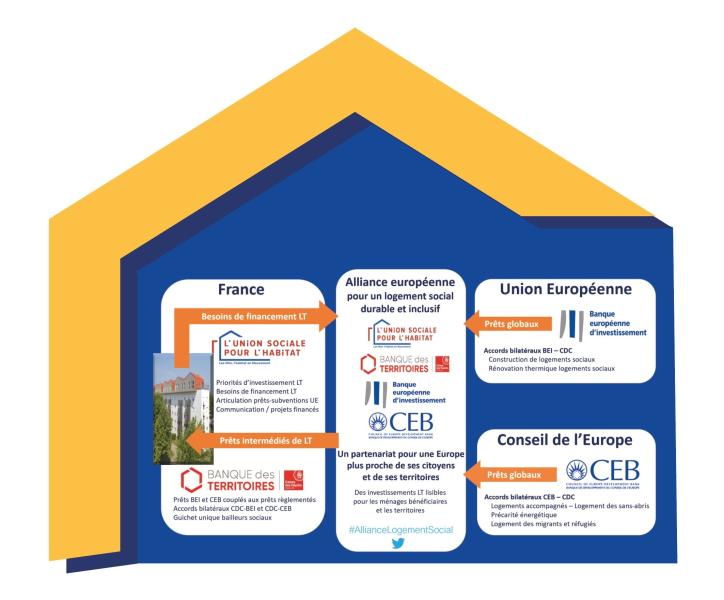
L’Union sociale pour l’habitat, la Banque des Territoires, la Banque européenne d’investissement (BEI) et la Banque de Développement du Conseil de l’Europe (CEB) ont établi un partenariat visant à faciliter l’accès des organismes de logement social aux financements européens pour leurs investissements de long terme en infrastructures sociales d’intérêt général.

Dans le cadre de la mise en œuvre de cette alliance, une première vague de 650 millions d’euros de financements de la BEI et de la CEB est mise à disposition des organismes de logement social par la Banque des Territoires en complément de ses prêts règlementés :

  • D’un montant de 500 millions d’euros, le prêt de la BEI vise à accélérer la construction de logements sociaux dans un contexte économique dégradé, en permettant à la Banque des Territoires d’élargir son offre de prêts « Booster » à taux fixes aux maturités de 35 et 40 ans ; 
  • Le prêt de la CEB d’un montant de 150 millions d’euros, reconduction d’un contrat existant portant son engagement total à 300 millions d’euros, a pour but de renforcer l’offre de prêts complémentaires de la Banque des Territoires à destination de l’habitat adapté, notamment pour les personnes en situation de précarité, le logement accompagné et les établissements médico-sociaux.

Cette alliance européenne a été scellée lors de la journée « Les Hlm, acteurs de la relance », organisée le 15 septembre à la Grande Arche à Paris par l’Union sociale pour l’habitat. Elle s’inscrit dans le cadre de la mise en œuvre du Pacte d’investissement signé le 25 avril 2019 par l’ensemble des acteurs du logement social et le gouvernement.

Cette alliance affirme le rôle de la Banque des Territoires dans la mobilisation des ressources européennes de la CEB et de la BEI au bénéfice de l’investissement dans le logement social en France, sur la base de financements bilatéraux conclus entre ces différents financeurs de long terme.

Ce dispositif d’intermédiation a pour objectif d’assurer aux opérateurs de logement social français un accès aux financements européens simple, équitable et cohérent, ouvert à tous les projets d’investissement en infrastructures sociales, quelles que soient leur taille et leur localisation territoriale.

L’accord portant sur la mise en œuvre opérationnelle de cette alliance européenne prévoit également une campagne de communication adaptée visant à informer les ménages bénéficiaires et les acteurs locaux, de l’engagement de l’Union européenne et du Conseil de l’Europe pour un logement social durable et inclusif dans leur territoire.

La complémentarité des financements de la BEI et de la CEB contribuera pleinement à la lutte contre le changement climatique ainsi qu’à l’inclusion sociale des populations fragiles en application de la Charte sociale européenne révisée du Conseil de l’Europe et du Socle européen des droits sociaux de l’Union européenne.

La mise en œuvre de ce Socle européen et de son Principe 19 « accès au logement social » ainsi que la vague de rénovation thermique des bâtiments du Green Deal et son « initiative logements abordables » de rénovation de 100 quartiers de logements sociaux dans l’Union européenne, représentent deux initiatives majeures pour le logement social lancées par la Commission von der Leyen dans son programme de travail 2021.

Christos Giakoumopoulos, Directeur Général des Droits de l’Homme et de l’état de Droit du Conseil de l’Europe a déclaré : « L’Alliance européenne pour un logement social durable et inclusif est un excellent exemple de la manière dont la Banque de Développement du Conseil de l’Europe, en s’associant avec d’autres acteurs, poursuit l’objectif de progrès social prévu par le Statut du Conseil de l’Europe et les objectifs du droit international des droits de l’homme. »

« Cette alliance européenne pour un logement social durable et inclusif que nous avons porté dans le cadre du pacte d’investissement, doit contribuer à nous permettre de faire face à ce nouveau défi du logement abordable post-Covid, en France et en Europe » a déclaré Emmanuelle Cosse, Présidente de l’Union Sociale pour l’habitat. « L’Union européenne et le Conseil de l’Europe sont désormais à nos côtés pour accomplir nos missions d’intérêt général en pleine mutation et faciliter l’accès des organismes Hlm aux ressources européennes et financements de long terme. »

Marianne Laurent, Directrice des Prêts de la Banque des Territoires, « La Banque des Territoires, prêteur de référence du logement social en France, collabore depuis plusieurs années avec la Banque européenne d’investissement et la Banque de Développement du Conseil de l’Europe. Ce partenariat matérialise sa volonté d’offrir, en complément de sa ressource propre, un accès simple, ouvert à tous et équitable aux financements européens afin de répondre aux objectifs ambitieux du secteur pour relancer l’activité de construction et de rénovation énergétique ».

« La BEI, Banque du Climat de l’Union Européenne, accompagne depuis plusieurs années la Banque des Territoires dans le cadre de sa mission de financement des opérateurs de logement social, notamment pour la rénovation thermique » a déclaré Ambroise Fayolle, Vice-Président de la BEI. « Ce partenariat signe la volonté de nos quatre institutions de conjuguer leurs compétences pour en maximiser l’impact sur une offre de logement abordable et durable. » 

« Cette Alliance souligne la complémentarité de nos quatre institutions et leur volonté de soutenir durablement une offre de logement cohérente, en particulier pour les populations les plus vulnérables » a déclaré Tomáš Boček, Vice-Gouverneur de la CEB. « Depuis 65 ans, la CEB – la Banque de développement social pour l’Europe – met à contribution son expertise pour renforcer la cohésion sociale, avec ses nombreux partenaires et notamment le Groupe Caisse des Dépôts et la Banque des Territoires. »



EIOPA’s Board of Supervisors agrees on changes to the PRIIPs key information document

Following a request from the European Commission in December 2020, EIOPA’s Board of Supervisors further analysed the draft RTS which was adopted today by a qualified majority of EIOPA’s Board.

While some national competent authorities at EIOPA’s Board continued to express reservations on the draft RTS, they supported the proposal based on the further details provided by the European Commission on their approach to the broader review of PRIIPs Regulation, namely that the review will thoroughly examine the application of the PRIIPs framework, including:

  • how to achieve better alignment between PRIIPs, Insurance Distribution Directive and Markets in Financial Instruments Directive II regarding provisions on costs disclosure;
  • the scope of products as foreseen by the PRIIPs Regulation;
  • how to ensure that the KID contains the key information necessary for retail investors while avoiding too much or too complex information for these investors;
  • how to allow the creation of a digitalised KID allowing layered information and reviewing the default paper basis of the KID, taking into account the specific challenges for different types of products (e.g. multi-option products (MOPs));
  • the need for a more tailored approach, such as for MOPs, in order to maximise understanding and use of the information, while continuing to allow for comparability of similar products.

Background

In July 2020 the ESAs informed the European Commission of the outcome of a review that had been conducted on the PRIIPs key information document. This followed an ESA consultation paper published on 16 October 2019 on draft RTS to amend the technical rules on the presentation, content, review and revision of KID (Delegated Regulation (EU) 2017/653). At that stage, the draft RTS was adopted by the Board of Supervisors of ESMA and EBA, but did not receive the support of a qualified majority at the Board of Supervisors of EIOPA.

In December 2020, the Commission invited the ESAs to submit an RTS to amend the KID within a six week period referring to the need to make urgent amendments to European Commission’s Delegated Regulation (EU) 2017/653.

Following the submission to the European Commission, the ESAs draft RTS is now subject to adoption. If adopted by the European Commission, the RTS would be subject to non-objection by the European Parliament and the Council of the European Union.


EIOPA’s Board of Supervisors agrees on changes to the PRIIPs key information document

The European Supervisory Authorities – ESAs (the European Banking Authority, the European Insurance and Occupational Pensions Authority and the European Securities and Markets Authority) submitted today to the European Commission  the draft Regulatory Technical Standards (RTS) on amendments to the key information document for packaged retail and insurance-based investment products (PRIIPs)

Following a request from the European Commission in December 2020 , EIOPA’s Board of Supervisors further analysed the draft RTS which was adopted today by a qualified majority of EIOPA’s Board. 

While some national competent authorities at EIOPA’s Board continued to express reservations on the draft RTS, they supported the proposal based on the further details  provided by the European Commission on their approach to the broader review of PRIIPs Regulation, namely that the review will thoroughly examine the application of the PRIIPs framework, including: 

  • how to achieve better alignment between PRIIPs, Insurance Distribution Directive and Markets in Financial Instruments Directive II regarding provisions on costs disclosure; 
  • the scope of products as foreseen by the PRIIPs Regulation; 
  • how to ensure that the KID contains the key information necessary for retail investors while avoiding too much or too complex information for these investors; 
  • how to allow the creation of a digitalised KID allowing layered information and reviewing the default paper basis of the KID, taking into account the specific challenges for different types of products (e.g. multi-option products (MOPs)); 
  • the need for a more tailored approach, such as for MOPs, in order to maximise understanding and use of the information, while continuing to allow for comparability of similar products. 
 
Background

In July 2020 the ESAs informed the European Commission of the outcome of a review that had been conducted on the PRIIPs key information document. This followed an ESA consultation paper published on 16 October 2019 on draft RTS to amend the technical rules on the presentation, content, review and revision of KID (Delegated Regulation (EU) 2017/653). At that stage, the draft RTS was adopted by the Board of Supervisors of ESMA and EBA, but did not receive the support of a qualified majority at the Board of Supervisors of EIOPA. 

In December 2020, the Commission invited the ESAs to submit an RTS to amend the KID within a six week period referring to the need to make urgent amendments to European Commission’s Delegated Regulation (EU) 2017/653. 

Following the submission to the European Commission, the ESAs draft RTS is now subject to adoption. If adopted by the European Commission, the RTS would be subject to non-objection by the European Parliament and the Council of the European Union.


EIB backs EUR 5.3 billion COVID-19 support, business, education, sustainable transport, and social housing investment, the day after meeting with civil society organisations

>@EIB
©EIB
  • € 1.5 billion to strengthen economic and public health resilience to COVID-19
  • € 1.9 billion to support business investment with local financing partners
  • € 1.8 billion for climate action, environmental protection and sustainable urban transport

The European Investment Bank (EIB) today approved new financing totalling EUR 5.3 billion to strengthen investment by companies and public services hit by COVID-19, alongside accelerating social housing, environmental protection, and climate action across Europe and around the world.

This follows a virtual meeting between the EIB Board of Directors and nearly 200 academic, civil society and stakeholder representatives on Tuesday to discuss responsible investment, strategic priorities and public consultations.

EUR 1.5 billion will ensure access to finance by companies and entrepreneurs most impacted by COVID-19 and back public sector investment that would otherwise be delayed by the pandemic.

“Despite the devastating COVID 19 crisis, in 2020 the EIB Group delivered on all its commitments, including the call for new extraordinary instruments such as the establishment of a new Pan European Guarantee Fund, or EGF, in record time. Of the EUR 77 billion in financing the Group activated, around 25 billion went to sectors specifically hit by the economic impact of the coronavirus. As we achieved this, we did not weaken our commitments on climate and environment. A record 40% of all our financing went to climate action and sustainability, taking us closer to our commitment to invest at least half of everything we do in climate and environmental sustainability by 2025. We also increased our investment outside of Europe to more than €10 billion, with half of that invested in Africa. The Group proved it remains an essential tool in furthering EU policies within the Union and beyond, both in the long term and at times of crisis”, said Werner Hoyer, President of the European Investment Bank.

Development and climate action priorities shared by the EIB and civil society

The EIB held its annual Civil Society Seminar ahead of the first board meeting of the year to provide an opportunity for direct engagement between EIB board members, senior management and technical experts and stakeholders, NGO’s and academic researchers.

Detailed discussions covered EIB public consultation on human rights, transparency, environmental and social frameworks, transport financing and anti-fraud measures.

The EIB also provided updates on the implementation of its Climate Bank Roadmap to strengthen EIB support for climate action and environmental sustainability and opportunities to further enhance the development, environmental, social and economic impact of EIB engagement outside Europe in the years ahead.

“The EU Bank belongs to EU Member States and their citizens. Our unique technical and financial expertise is strengthened by continual discussion, valuable insight and structured consultation with stakeholders and civil society. We value expert policy analysis, along with constructive criticism, such as that which emerged at yesterday’s annual Civil Society Seminar. It helps us ensure that, as the EU Bank, we set and follow global best practice and are perceived to do so”, Hoyer said.

€ 1.9 billion for high-impact businesses investment

The EIB today approved € 1.9 billon for direct business financing to support corporate research and development and scale-up lending programs with local financing partners.

New EIB backing for private sector investment includes leasing financing in Italy, business lending in Germany and Austria and support for creation of the new Hellenic Development Bank in Greece.

The Bank agreed on initiatives to enhance access to finance and industrial energy efficiency in Finland, accelerate corporate innovation in France, and allow companies across Africa to benefit from high-impact lending programs.

€ 1.8 billion to address climate action, housing, transport and waste challenges in cities

New EIB financing provided with local partners will improve the daily lives and health of millions of people living in cities across Europe and Africa.

In France, EIB backed urban transport schemes will provide sustainable transport alternatives to car use in Toulouse and Clermont-Ferrand.

The EIB board agreed to back sustainable urban investment in Greece and Poland and financing for social and affordable housing in the Italian region of Lombardy and across Spain.

It also approved investment to improve flood protection and urban waste treatment in towns across Benin and in Senegal in West Africa.

Ensuring reliable access to energy and water in Latin America and Africa

Communities across Latin American will benefit from improved public health and increased economic opportunities following EIB backing for water and sustainable energy projects in Ecuador and El Salvador agreed today. The EIB board unlocked financing for a nationwide sanitation improvement programme in Ecuador and a new scheme with the national development bank in El Salvador to accelerate financing for sustainable energy and COVID-19 projects.

The EIB also gave the green light for investment to expand electricity distribution across Rwanda, providing 190,000 new connections and rehabilitating operational equipment. 

Overview of projects approved by the EIB Board

Details on the European Guarantee Fund


EIB welcomes progress on COVAX support for global access to COVID-19 vaccines

>@Shutterstock
©Shutterstock

The President of the European Investment Bank today welcomed publication of the first interim distribution forecast of the COVAX initiative marking a key step in enabling equitable global access to COVID-19 vaccines.

“COVAX shows how multilateral cooperation can help to tackle the global impact of COVID-19. Today’s confirmation of the first distribution of COVID-19 vaccines to vulnerable groups and front-line health workers around the world brings hope to millions. The EUR 400 million EIB support for COVAX, as part of Team Europe, was crucial to make this distribution possible, because early contributions to COVAX-AMC have led to earlier availability, which is the critical impact of the EU Bank’s support for vaccine equity.” said Werner Hoyer, President of the European Investment Bank.

Publication of the interim distribution will enable national vaccination programmes to be planned by governments and health systems around the world. Final allocations will be published in due course.

Last December the European Investment Bank agreed to provide €400 million of financing to support the participation of low and middle income economies in COVAX Advance Market Commitment (COVAX AMC) as part of Team Europe’s support for the multilateral initiative. This has helped to accelerate up-front investment essential to deliver vaccine doses as soon as they become available.

The COVAX initiative should be able to reach at least 27% of the population of lower-income countries across the world in 2021.

Link to Gavi announcement: COVAX publishes first interim distribution forecast | Gavi, the Vaccine Alliance

COVAX blog story “Vaccine solidarity

EIB’s COVID-19 response page