What did the EU propose today?
The European Commission proposes to increase the external action budget to €123 billion for the period 2021-2027. Up from €94.5 billion in the period 2014-2020, this represents an increase of 30%. At the same time, it is proposing to significantly simplify its structure and make it much more flexible and effective to address today’s global challenges. The Commission proposes to reduce the number of instruments, which would allow a clearer focus on political objectives and engagements with partners, in line with the EU’s values and priorities.
What will be the impact of Brexit?
The EU is going to increase its external action funding even if the proposed total EU budget for the period 2021-2027 does not include a UK contribution. It would rise from €94.5 billion in the period 2014-2020 to €123 billion for the period 2021-2028, representing an increase of 30%.
In times of uncertainties all over the world, the EU strengthens its role as global player that is reliable, responsive and predictable – politically as well as financially.
What are the external action budget instruments?
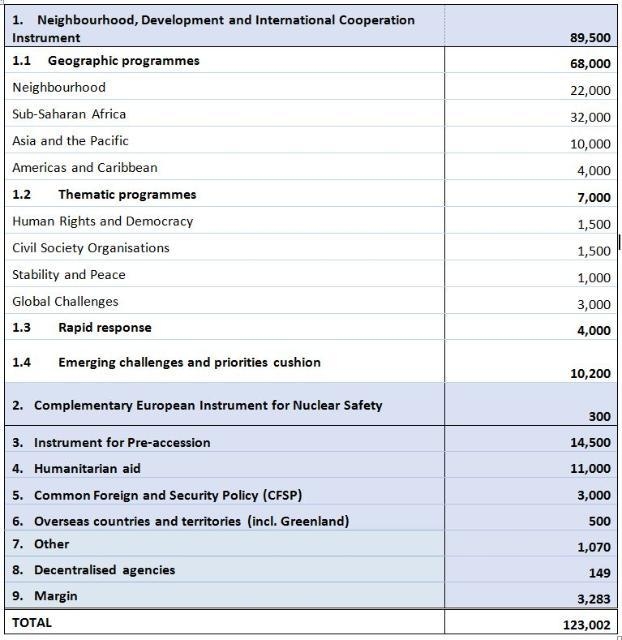
The new proposed instruments for EU external action are a Neighbourhood, Development and International Cooperation Instrument with €89.2 billion, complemented by a European Instrument for Nuclear Safety with €300 million; an Instrument for Pre-Accession Assistance with €14.5 billion; a humanitarian aid instrument with €11 billion; a Common Foreign and Security budget with €3 billion; and cooperation with overseas countries and territories including Greenland, with €500 million. In addition, and outside the EU budget, the High Representative, with support of the Commission, is proposing to establish a European Peace Facility, worth €10.5 billion (see factsheets here).
Why is a restructuring of the external action financial instruments needed?
Global challenges, which need to be tackled by external action, have increased in recent years. Moreover, they have become more complex, multidimensional, and rapidly evolving. To effectively address them, the European Union needs to strengthen its external action with efficient and flexible instruments. Having multiple instruments, with multiple sets of priorities, multiple management structures and multiple reporting procedures is not an effective approach. There is a need to tear down artificial boundaries between instruments, to ensure the right mix of short-, medium- and long-term policies for each region and each priority.
The new broad instrument, with a coherent set of principles, will allow the EU to pursue and achieve its policy objectives and overcome gaps, overlaps and inconsistencies that exist between today’s multitude of geographic and thematic instruments. More flexibility will enable the EU to react swiftly to evolving needs and priorities, and a simplified management structure will reduce the administrative burden for EU institutions, Member States and implementing partners.
Significantly simplified financial architecture
In the new proposed funding architecture for the EU’s external action (MFF 2021-2027), the Commission proposes to simplify its structure by tearing down artificial barriers between instruments. The new broad Neighbourhood, Development and International Cooperation Instrument (NDICI) would integrate the following instruments from the previous MFF:
- European Development Fund (EDF) – currently outside the budget
- European Neighbourhood Instrument (ENI)
- Development Cooperation Instrument (DCI)
- European Instrument for Democracy and Human Rights (EIDHR)
- Instrument contributing to Stability and Peace (IcSP)
- Partnership instrument for cooperation with third countries (PI)
- Guarantee Fund for External Actions
This broad instrument will be complemented by the:
- Instrument for Pre-accession assistance (IPA)
- Humanitarian aid
- Common Foreign and Security Policy (CFSP)
- Overseas countries and territories (OCTs) incl. Greenland
- European Instrument for Nuclear Safety (EINS)
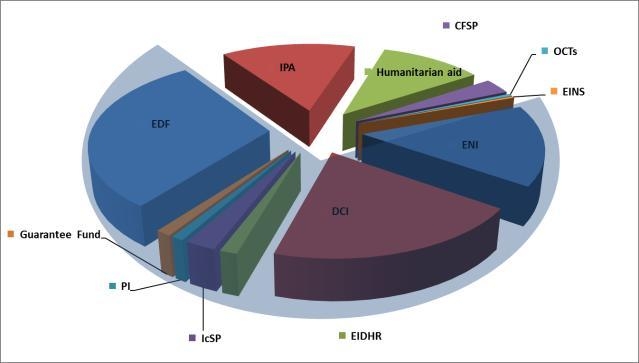
New structure of the EU’s external action funding under the Multiannual Financial Framework 2021-2027:
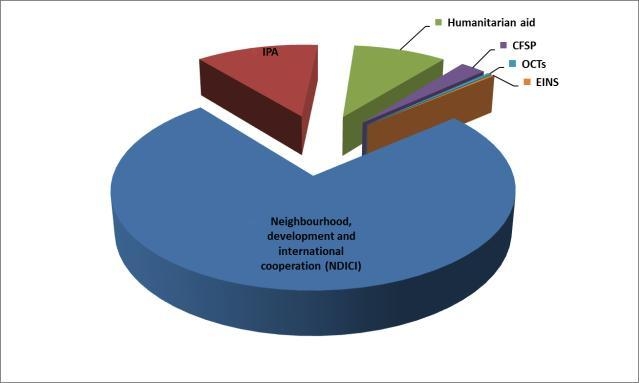
Proposed Multiannual Financial Framework 2021-2027 commitments in current prices:
Is the increase by 30% calculated in current or in constant prices?
The increase the external action budget from €94.5 billion in the period 2014-2020 to €123 billion for the period 2021-2027, constitutes an increase of 30%, as calculated in current prices. If we deduct yearly inflation up until 2027, the increase would be 13%.
Will the simplified structure mean less accountability?
Simplification or increased flexibility does not mean that there will be less scrutiny or accountability. On the contrary: for example by proposing to integrate the European Development Fund into the EU budget, the scrutiny powers of the European Parliament will be reinforced: In the new broad instrument for Neighbourhood, Development and International Cooperation, the same parliamentary procedures and scrutiny would apply across all development cooperation.
Furthermore, it will be essential to create a governance system that ensures political control and democratic scrutiny, while also ensuring efficiency and flexibility. The European Parliament will play its essential role as a co-legislator in the adoption of this governance structure.
How will the new instrument be more flexible?
It will allow for using and re-using unutilised funds on a multi-annual basis, mobilise funding from the rapid response pillar (€4 billion) for situations of crisis or emergency. Thanks to the flexibility cushion (€10.2 billion) the EU will be able to address new needs, unforeseen challenges and emerging priorities.
Will the increased flexibility come at the cost of predictability for partner countries?
No. The new Neighbourhood, Development and International Cooperation Instrument, notably through its geographic programming (at least 75% of the overall financial envelope), will remain predictable. It will continue to be based on country needs and other transparent criteria and respect principles of development effectiveness including country ownership. Increased flexibility will come from access to the emerging challenges and priorities cushion to face issues and events, which are by nature non-predictable and therefore non-programmable.
Will a one-size-fits-all approach mean that some countries will lose out?
One broad instrument does not mean a one-size-fits-all approach, and it does not mean less funding for certain regions or themes. On the contrary, the Commission’s proposal takes into account the strategic priorities of the EU, namely the European Neighbourhood, Africa, and countries that are most in need, as well as challenges regarding security, migration, climate change and human rights. The instrument earmarks funding dedicated to each region and policy area in order to reflect the EU’s political priorities.
Will democracy, human rights and civil society lose out in the new instrument?
No. The work on democracy, human rights and civil society will remain at the very core of the EU’s external action. By streamlining this in the geographic pillar of the Neighbourhood, Development and International Cooperation Instrument (NDICI), this will allow for a tailor-made approach taking into account the specific context and needs of each of the partner countries in question, while helping to strengthen their democratic processes, governance and oversight. Such actions will be complemented with action under the thematic pillar – with €1.5 bilion for Human Rights and Democray and €1.5 bilion for Civil Society Organisations. This is particularly relevant in places where human rights activists and civil societies are confronted with shrinking space for their activities.
What will be the impact on development cooperation? Will the new structure mean that development funding will be diverted to other objectives?
The policy framework for the EU’s development cooperation has been laid out in the European Consensus on Development, which sets the political vision underlying the financial proposals for the future MFF. The core objective of this vision remains the eradication of poverty and the implementation of the Sustainable Development Goals of the UN’s 2030 Agenda and its determination to leave no one behind. In that vein, the EU will continue to tackle challenges related to human development, climate change, migration and mobility, as well as promote good governance, democracy and human rights.
The countries most in need, particularly least developed countries, low income countries, fragile or crisis-stricken countries will be given particular priority. The NDICI maintains a horizontal spending target of 20% for human development and social inclusion, including gender equality and women’s empowerment. At least 92% of the funding in NDICI shall fulfil the requirements of the OECD Development Assistance Committee and hence count as Official Development Assistance. The countries most in need, particularly least developed countries, low income countries, fragile or crisis-struck countries will be given particular priority. The EU will continue to work towards achieving the target of investing 0.7% of its collective Gross National Income in official development assistance by 2030, and 0.2% to least developed countries. The NDICI instrument will significantly support EU Member States in deliver on this important political commitment.
What impact will the new financial architecture have on Africa?
Africa is and will remain one of the main priorities of the Union, as our prosperity and security in Europe are closely interlinked with that of Africa. The proposed allocation for Sub-Saharan Africa is at least €32 billion, up from €26.1 billion. These increased resources will allow for supporting development, inclusive economic growth, as well as African-led initiatives in the field of peace and security. In addition, the EU will aim to reinforce its continent-to-continent cooperation with the African Union.
The large majority of least developed countries are in Africa. The EU has committed to dedicate 20% of its official development assistance to human development and social inclusion, including gender equality and women’s empowerment. It further continues to work towards achieving the target of investing 0.7% of its collective GNI in official development assistance, and 0.2% to least developed countries.
Moreover, the integration of the European Development Fund into the budget and the creation of a single instrument will make is easier to finance policy priorities covering both North African and Sub Saharan African countries.
What will be its impact on Asia and the Pacific region?
The Commission proposes to allocate €10 billion for Asia and the Pacific region, compared to previously €9.8 billion. It will continue supporting developing countries, while take into account evolving needs and specificities of partner countries that may be graduating out of eligibility for official development assistance. Main topics in our relationship with the regions are connectivity, investments and infrastructure, economic and trade cooperation, climate change, and the sustainable management of natural resources.
The flexibility provided by the new financial architecture will allow to better account for emerging needs such as reconstruction needs in countries that suffered from instability and conflict.
What will be its impact on Latin America and the Caribbean?
The Commission has proposed to allocate €4 billion to this region, i.e. a slight increase compared to previously. While some countries in the region may be graduating out of ODA eligibility in the coming years, some are facing specific economic and environmental vulnerabilities, including climate change, natural disasters and other challenges. The EU will continue to closely work with and support its partner countries in Latin America and the Caribbean, to jointly tackle global challenges.
What impact will the new financial architecture have on EU-ACP relations?
The new external action budget will support the implementation of a modernised association agreement with countries of the Africa, Caribbean and Pacific group of states (ACP), and allow the EU and its ACP partners to develop further strong alliances on key global challenges.
What will be the impact of the new financial architecture on overseas countries and territories (OCTs)?
Cooperation with overseas countries and territories (OCTs) including Greenland, with €500 million, aims at supporting and strengthening the economic, political and cultural ties between the EU and the overseas countries and territories linked to the Union Member States. After the United Kingdom’s expected withdrawal from the European Union, only 13 of the currently 25 would remain EU OCTs.
How will funds for individual countries be allocated?
Allocations to individual countries, notably under the geographic pillar, will be programmed in a tailor-made and specific approach. They will take into account the needs and priorities of the countries in question. The process will be guided by the principle of ownership and dialogue between the European Union, its Member States and the partner countries concerned, including national and local authorities. It will also involve civil society, national and local parliaments as well as other stakeholders.
The allocations will come in the form of multiannual indicative programmes, which will be based on results and internationally agreed targets, in particular those set out for the Sustainable Development Goals. The European Parliament and the Council, together with Member States, are involved in the process of adoption of these programmes.
In development cooperation, the Commission has developed a transparent methodology based on quantitative as well as qualitative indicators. It takes into account country-specific situations and evolutions in their political and security situations. It also looks at partner countries’ commitments and performance regarding political reforms, economic and social development, as well as the partner countries’ absorption capacity. The countries most in need, in particular least developed countries or countries in fragile situations will be given priority. To promote coherence and effectiveness of EU policies, joint programming by the EU and its Member States will be the preferred approach for country programming, while leaving the possibility for other donors to join where relevant.
For the Neighbourhood countries, the relevant association agendas, partnership priorities and other equivalent jointly agreed documents are key points of reference for setting the priorities for EU support to neighbourhood countries.
For the new Instrument for Pre-Accession Assistance, the programming framework will be prepared for each priority on the basis of overall country needs to reach the jointly agreed objectives. The magnitude of funding available for each priority will be fully transparent. Partners will be invited to respond with strategies on how they intend to meet the objectives for each policy priority, thus increasing their country ownership. Funding will then be distributed on the basis of a “fair share” principle and transparent criteria such as project/programme maturity, expected impact and progress on accession criteria, rule of law, fundamental rights and economic governance.
Will you continue the External Investment Plan in the new MFF?
The new Neighbourhood, Development and International Cooperation Instrument includes an investment framework for external action. It expands the previous External Investment Plan to raise additional financial resources for sustainable development from the private sector, in order to foster sustainable and inclusive economic development. It will support investments in partner countries in order to promote decent job creation, strengthen public and private infrastructure, foster renewable energy and sustainable agriculture and support digital economy. Building on the successful experience of the External Investment Plan, the new investment framework will consist of the European Fund for Sustainable Investment (EFSD+) and the External Action Guarantee.
The EFSD+ will ensure world-wide coverage for blending, guarantees and other financial operations streamlining the current architecture. The External Action Guarantee will have a capacity of €60 billion to guarantee the EFSD+ operations, as well as macro-financial assistance and loans to third countries. Together with the private sector and thanks to the leverage effect, this may mobilise up to half a trillion euro in investments for the 2021-2027.
Particular attention will be paid to the EU Neighbourhood, the Western Balkans and Africa as well as countries experiencing fragility or conflict, least developed countries and highly indebted poor countries, or regions with critical infrastructure and connectivity needs.
What impact will the new financial architecture have on the Neighbourhood?
The new financial architecture offers much needed flexibility and coherence, while preserving the core specificities of the special partnership with the EU Neighbours. With an indicative funding of at least €22 billion, the EU Neighbourhood benefits from the largest increase of funding in the external action envelopes – by 24% compared to the previous period. The flexibility cushion of €10.2 billion will furthermore allow for a rapid and flexible reaction in the event of new crises and challenges in the EU Neighbourhood region.
How could such an instrument guarantee that the specificities of the Neighbourhood policy would be preserved?
The instrument includes a chapter dedicated to the Neighbourhood region, which contains specific provisions applicable to Eastern and Southern Neighbourhood only. These specificities and key principles are maintained and reinforced, notably the performance-based approach (‘more for more’), the differentiation approach, thus providing incentives for jointly-agreed political and economic reforms. Cross-border cooperation between EU Member States and partner countries, both in the Eastern and in the Southern Neighbourhood, will also be continued in view of the very positive results so far achieved.
Why not a separate instrument?
We don’t need a separate instrument to show that the Neighbourhood policy remains a key priority for the Commission. The Neighbourhood is at the core of the new Neighbourhood, Development and International Cooperation Instrument. The instrument offers much needed flexibility and coherence while preserving the core specificities of the special partnership with the EU Neighbours. This signals our long-term commitment to our partners, which attaches a lot of importance to their special relations with the EU.
What is the new Instrument for Pre-Accession (IPA III)?
The new Instrument for Pre-Accession (IPA III) will be clearly positioned in the context of the Western Balkans Strategy “A credible enlargement perspective for and enhanced EU engagement with the Western Balkans”. The new IPA aims to contribute to the transformation process in the Western Balkans through the six flagship initiatives included in the Western Balkans strategy. These flagships aim to support the implementation of robust economic reform programmes and enhance the focus on reforms necessary for future membership. At the same time, IPA III will be flexible enough to adapt to the evolving situation in Turkey and reflect developments in our relations with the country. The new instrument will increase steer from the Union, as its programming is based on priorities rather than country envelopes. This allows to reward performance and progress towards key priorities and increased flexibility to respond to the evolving needs of the partners in their path towards accession.
Will there be money if new Member States join during the MFF?
The rule in the long-term budget is that for new accessions to the European Union, the Multi-Annual Financial Framework shall be revised to take account of the expenditure requirements resulting from an accession of a new Member State. To help partner countries to reach that stage the pre-accession assistance has increased considerably, up to €14.5 billion (from €12.8 billion) in line with the priorities. There will be more funds available for the Western Balkans than in the past MFF, and preparations for new accessions will be made in good time.
Is the European Nuclear Safety part of the broad Instrument for Neighbourhood, Development and International Cooperation Instrument?
Nuclear safety is an important part of the EU external action, and the Instrument for Nuclear Safety will be closely linked and complement the Neighbourhood, Development and International Cooperation Instrument (NDICI). However, because some nuclear activities are in the competence of the Euratom Treaty (notably Article 203), they are not compatible with the ordinary legislative procedure of the NDICI. Therefore, while the Instrument for Nuclear Safety and Cooperation (INSC) has to be a separate instrument with a separate legal basis, it will seamlessly complement the broad NDICI instrument.
Will there be changes to EU humanitarian aid policy or funding?
The EU continues to be the world’s first humanitarian aid provider, and has increased its funding to meet growing global humanitarian challenges. EU humanitarian aid will continue to be provided exclusively based on needs and it will go to people in need, irrespective of their nationality, religion, gender, ethnic origin or political affiliation. Funding will continue to be provided only through trusted humanitarian partners such as United Nations agencies, NGOs and international organisations – not Governments.
How will the EU monitor and evaluate the implementation of its external action spending?
In line with its commitment to focus on results and effectiveness, the Commission will regularly monitor its actions and review progress made. This monitoring and evaluation system involves internal staff as well as implementing partners and external expertise. The effectiveness, efficiency, EU added value and coherence with other EU policies will be evaluated based on relevant and concrete indicators: from a rule of law score, the number of children immunised from diseases with EU support, over the amount of greenhouse gas emissions reduced, to political stability and absence of violence indicators. Lessons learned will help to identify any potential to further improve EU policies and their results, and to help maximise their impact.
The evaluations will be communicated to the European Parliament and to the Council, as well as feed into relevant decision-making processes.
How will you ensure that funding will not be misused, e.g. to fund corrupt governments?
All EU funding is strictly monitored and partners that receive funding are obliged to follow strict guidelines to ensure it is well spent.
To ensure that EU funding reaches those most in need, the EU has put in place and will continue to draw on a solid system of compliance controls, with significant ex-ante as well as ex-ante checks by both external auditors and Commission staff. This control system consists of preventive, detective as well as corrective measures.
Failure to respect the EU’s high standards can be met with the suspension and recovery of funds.
For more information
Press release
Legal texts and factsheets on the Neighbourhood and the World
European Peace Facility
Further information on the EU budget for the future