Follow FRA's Fundamentally Right podcasts

The series charts how events inspired people to dedicate their professional lives to promoting and protecting human rights. In each episode, a FRA staff member reveals their personal experiences of injustice, inequality and discrimination.

Earlier episodes include:


EASO publishes updated 'Country Guidance: Iraq'

The European Asylum Support Office (EASO) has published an update of the ‘Country Guidance: Iraq‘. The January 2021 update replaces the first edition of the guidance  of June 2019. 

In 2020, Iraq remained one of the top five countries of origin of applicants for international protection in the EU+. According to EASO Early warning and Preparedness System (EPS) data, applicants from Iraq lodged some 18 200 applications for international protection in 2020. Similarly to other countries of origin, the number of applicants from Iraq declined significantly since March, when the COVID-19 pandemic reached Europe, resulting in a 40 % decrease.

Some 22 200 first instance decisions were issued to Iraqi applicants in 2020 and, similarly to 2019, almost two in every five decisions were positive, granting refugee status or subsidiary protection. At the end of the year, the number of Iraqi pending cases at first instance stabilised to fewer than 15 000 cases, the smallest backlog since late 2014.

The ‘Country Guidance: Iraq’ publication provides an in-depth country-specific analysis in a practical tool for asylum officials examining the cases of Iraqi applicants. It addresses all elements considered in the examination of international protection needs of Iraqi nationals and stateless persons whose former habitual residence was in Iraq. Without replacing the individual assessment required in each case, the Country Guidance aims to assist decision-makers and to ensure that similar cases are treated and decided on in a similar manner and in accordance with the applicable international and EU legislation.

In this update, the following sections have been reviewed in light of up-to-date common country of origin information, published by EASO in 2020: 

  • Main actors of persecution or serious harm; 
  • The analysis of some of the most commonly encountered profiles of asylum seekers from Iraq; 
  • Subsidiary protection under Article 15(c) of the Qualification Directive;
  • Internal protection alternative; and 
  • The applicability of exclusion clauses.


The ‘Country Guidance: Iraq’ publication is available in a user-friendly electronic book format, as well as in pdf

The Country Guidance is drafted by national experts, with the support of EASO and with valuable input from the European Commission and UNHCR. The final text is agreed on by senior policy officials from EU+ countries and endorsed by the EASO Management Board. 
 
This publication follows the recent update on Afghanistan (December 2020), and the publication of the ‘Country Guidance: Syria’ (September 2020) and the ‘Country Guidance: Nigeria’ (February 2019). 

For more information about EASO’s role in fostering Member States’ efforts towards convergence in the assessment of international protection needs and the work on country guidance, visit https://easo.europa.eu/country-guidance.


Risk Dashboard: European insurers’ macro risk exposures decreased, while concerns going forward remain

The European Insurance and Occupational Pensions Authority (EIOPA) published today its Risk Dashboard based on the third quarter of 2020 Solvency II data. 

The results show that insurers’ exposures to macro risks decreased from very high to high level, while all other risk categories remain at medium level. Going forward, European supervisors expect an increase in credit, market and underwriting risks over the next 12 months, reflecting concerns over second lockdowns due to new waves of the pandemic as well as potential cliff effects once fiscal support measures will be over.

With regards to macro risk, Gross Domestic Product (GDP) growth forecasts, amid upward revisions, show the strongest expected decline in the last quarter of 2020 and the first recovery in the second quarter of 2021. However, potential cliff effects have to be considered in the future. The registered unemployment rate remained at the very high level in September. The 10 year swap rates decreased reaching new lows. Fiscal balance deteriorated as a consequence of the supporting fiscal packages by governments.

Financial markets positively reacted to the Covid-19 vaccine news in the second half of 2020 with market and credit risk indicators stabilising. The potential disconnect between market performance and the economic outlook remains a concern, as it could result in sharp valuation adjustments. The credit worthiness of the assets in insurers’ portfolios is under close monitoring. The outlook of those risk categories reflects information available until the fourth quarter of 2020.  Looking ahead, an increasing trend for market and credit risks is expected over the next 12 months due to the high uncertainty and the concerns related to decoupling between financial market performance and economic outlook.

Profitability and solvency risks remain at medium level. Solvency Capital Requirements (SCR) ratio for insurance groups undertakings slightly improved from the second quarter 2020 to the third quarter of 2020, although remaining at lower levels than in the last quarter of 2019. 

Insurance risks remain at medium level, amid decrease in premium growth. More specifically, year-on-year premium growth for both life and non-life reported a slight deterioration for the third consecutive quarter.

While market perceptions exhibit an increasing trend, they are still at medium level. The median price-to-earnings ratio of insurance groups in the sample increased dispersing from the low levels reached in the first half of 2020. 

Go to the Risk dashboard


WIPO-EUIPO meeting and signature of Joint Work Programme

February 09, 2021 EU Intellectual Property Network

WIPO-EUIPO meeting and signature of Joint Work Programme

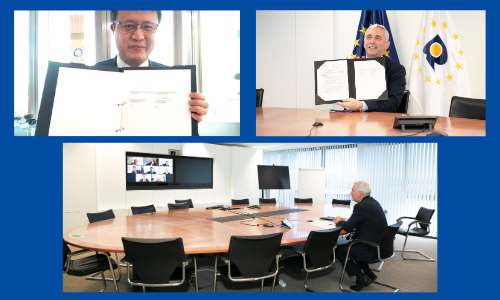
On 8 February, Mr Daren Tang, Director General of the World Intellectual Property Organization (WIPO) and Mr Christian Archambeau, Executive Director of the EUIPO, held a virtual high-level meeting to endorse the new EUIPO-WIPO Work Programme for 2021 and to discuss recent developments of both organisations.

Mr Archambeau and Mr Tang shared some new initiatives, such as the small and medium-sized enterprises (SMEs) programme, the new EUIPO EasyFiling tool and the establishment of a new sector on IP and Innovation Ecosystems at WIPO.

During the meeting, they both reaffirmed their commitment to enhance cooperation by signing the Joint Work Programme for 2021, covering a total of 26 joint activities. They also discussed on a number of new activities to be implemented in the framework of the Joint Work Programme, including new technologies, Artificial Intelligence and the role of IP offices to improve the image of intellectual property towards new stakeholders.

The new Work Programme reflects a common vision on the fundamental role of IP and underlines that, by working together, the two organisations can contribute to make the IP system more effective and more relevant for the benefit of users around the world.


Press release – EP Today

Live coverage of debates and votes can be found on Parliament’s webstreaming and on EbS+.

For detailed information on the session, please also see our newsletter.

All information regarding plenary, including speakers’ lists, can be found here.

Mitigating the effects of the pandemic

Parliament will debate, from around 8.30, the Recovery and Resilience Facility, designed to help EU countries alleviate the economic and social consequences of COVID-19. With 672.5 billion EUR available in grants and loans, it is the largest sum of the Next Generation EU recovery package. The vote will take place at 20.00, with results announced on Wednesday at 9.00.

Dorota KOLINSKA
(+32) 498 98 32 80
EP_Economics

Crackdown on the political opposition in Russia

At 15.00, MEPs will discuss the political turmoil in Russia – including Alexei Navalny’s case and country-wide protests – with EU Foreign Policy Chief Josep Borrell, a few days after his visit to Moscow. In recent weeks, thousands of Russians have taken part in protests to demand Mr Navalny’s release, as well as to criticise corruption and decreasing living standards, only to be met with mass arrests and a sweeping crackdown by the police.

Viktor ALMQVIST
(+32) 470 88 29 42
EP_ForeignAff EP_HumanRights

In brief:

De facto ban on abortion in Poland. In a debate in the morning, MEPs are likely to criticise the deterioration of abortion rights in Poland following the entry into force of the Constitutional Tribunal’s ruling.

Yemen/Myanmar. In the afternoon, the humanitarian situation in Yemen and the military coup in Myanmar will be debated with EU Foreign Policy Chief Josep Borrell. Resolutions will be put to a vote on Thursday.

Votes

Results of Monday’s votes will be announced at 8.30 on, among other issues:

  • the request to waive the immunity of Álvaro Amaro (EPP, PT)

  • the appointment of Frank Elderson as the Vice-Chair of the Supervisory Board of the ECB.

The first voting session, in which MEPs will vote on amendments to various reports and resolutions, will take place between 13.00 and 14.15. Results will be announced at 19.00.

The second voting session will take place between 20.00 and 21.15, with results announced on Wednesday morning at 9.00.

MEPs will cast final votes on:

  • Establishing the Recovery and Resilience Facility

  • The New Circular Economy Action Plan

  • Reducing inequalities with a special focus on in-work poverty

  • The impact of COVID-19 on youth and on sport

  • Human Trafficking

  • European Central Bank – annual report 2020

  • Public access to documents for the years 2016-2018.