Press release – COVID-19 vaccination: MEPs call for EU and global solidarity
In the plenary debate on Wednesday with the Portuguese Presidency and Commission President Ursula von der Leyen, MEPs commented on the state of play of the EU’s COVID-19 vaccination strategy.
Many members emphasised that the EU had made the right key decisions, especially on the collective European approach to vaccination and on standing up for its citizens’ rights by putting safety first and enforcing EU liability rules.
President von der Leyen defended the EU’s choice to order vaccines collectively, the need for global solidarity and the decision not to take any shortcuts on the safety and efficiency of vaccines. Lessons must be drawn from past mistakes, she acknowledged, as “we are still not where we want to be in the fight against the virus”.
Solutions to exit the crisis must be found in the spirit of solidarity, between member states as well as at global level, MEPs underlined. The EU has a responsibility for the rest of the world and must ensure vaccines are fairly distributed across the globe, they added, reiterating that “nobody is safe until everybody is safe”.
Members acknowledged that the EU underestimated the challenges of vaccine mass production and that concrete measures to ramp up production must now be taken as a matter of utmost priority. Many MEPs urged the Commission to enforce existing contracts and at the same time support member states in their vaccine deployment strategies.
In order to build citizens’ trust in the vaccination efforts and avoid disinformation, the EU must “tell the truth”, some MEPs pointed out. In this respect, many recalled the need for transparency with regard to contracts, as well as for comprehensive and clear data on vaccines rollout at national level.
Taking into account the large amounts of public money invested, several MEPs also called for increased parliamentary scrutiny of the implementation of the vaccines strategy.
Watch the video recording of the debatehere. Click on the names below for individual statements.
On 12 January 2021, MEPs quizzed the Commission on the latest developments regarding COVID-19 vaccines. A debate in plenary followed on 19 January focusing on the global EU strategy for COVID-19, while the Commission published an updated action plan to step up the fight against the pandemic on the same day.
During the plenary debate in January, MEPs expressed broad support for the common EU approach to fighting the pandemic and called for complete transparency regarding contracts and deployment of COVID-19 vaccines.
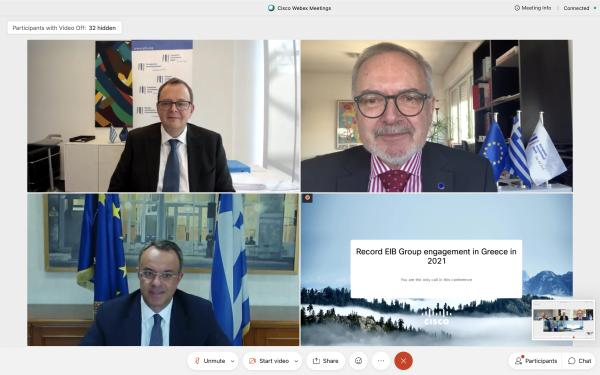
EIB Group engagement in Greece reaches record of EUR 2.8 billion in 2020
EIB also approved last year record EUR 4.3 billion of financing for future projects in Greece
Strengthening of EIB and EIF cooperation with Greek partners strengthens COVID-19 response, energy transition, road safety and private sector growth
45% of financing support climate action and environmental protection
Annual financing provided by the European Investment Bank Group and the amount approved for future investment plans reached record levels in Greece last year. In 2020 EUR 2.8 billion of new support for high-impact private and public investment across the country was agreed between the European Investment Bank and European Investment Fund and Greek partners and a further EUR 4.3 billion approved by the EIB for future investment.
EIB Group financing in Greece last year represented the third largest engagement in the European Union as a percentage of national GDP. Furthermore, EIB financing in Greece represented the second largest per capita engagement in the EU
Details of the EIB’s highly important financial and technical support for long-term investment to help Greek companies overcome COVID-19 challenges, accelerate energy transition and harness renewable energy resources, and improve road safety were outlined earlier today by Christos Staikouras, Finance Minister of the Hellenic Republic and Governor of the European Investment Bank, Werner Hoyer, President of the European Investment Bank and Christian Kettel Thomsen, EIB Vice President responsible for Greece.
“2020 was a uniquely challenging year for Greece, Europe and the whole world, due to the coronavirus pandemic and its social and economic consequences. These consequences rendered necessary the support of households and businesses with the use of every available tool, instrument and resource. The Greek Government responded to this challenge to the maximum possible extent. The European Investment Bank Group has had a crucial contribution in this direction. The close and fruitful cooperation between the Greek Authorities and the EIB’s dedicated Investment Team for Greece led to record-high financial results. The EUR 2.8 billion of new EIB and EIF financing agreed last year helps Greek companies – and, mostly, small and medium enterprises – to overcome the COVID-19 challenges and supports energy transition, climate action and investment in infrastructure. Furthermore, the EUR 4.3 billion of new financing approved by the EIB for Greece – which consists a historic high for EIB’s contribution in Greece and is almost three times higher compared to 2019 – guarantees that the EIB Group will further strengthen its role as a key technical and financial partner of Greece”, said Christos Staikouras, Minister of Finance of the Hellenic Republic and Governor of the European Investment Bank.
“The EIB Group is committed to supporting high-impact and transformational investment across Greece. Last year’s record EU Bank engagement to enhance economic resilience to COVID-19, increase climate action and support priority investment is only possible due to the close and continued cooperation between Greek authorities, business partners and the EIB Investment Team for Greece. EIB and EIF experts are learning from pioneering projects in Greece and sharing global best practice to help investment in Greece to deliver more. Looking ahead the impact of future EIB Group activity will be further strengthened by the record approval of new projects. The close partnership between Greece and the EIB Group is delivering and will be even stronger in the future” said Werner Hoyer, President of the European Investment Bank.
“EIB engagement is supporting business investment, transforming access to green energy and improving key services across Greece. The record EIB Group engagement last year is allowing thousands of companies to harnessing new opportunities and small-scale projects to deliver safer roads, better schools and protection from floods. This is only possible thanks to the shared commitment and dedication of our counterparts across the country and the EIB Investment Team for Greece.” said Christian Kettel Thomsen, European Investment Bank Vice President responsible for Greece.
Largest annual EIB support for climate action in Greece
45% of EIB financing in Greece last year will directly help to reduce carbon emissions and adapt to a changing climate.
This includes dedicated financing to encourage energy efficient investment and local projects to better protect homes and businesses from floods.
Reinforced EIB and EIF partnership helping companies invest and innovate
Last year the EIB Group provided EUR 1.2 billion for targeted credit lines managed by 11 leading Greek banks.
The new private sector financing is being used to support climate action, improve access to inclusive finance, encourage agricultural investment and help companies in sectors most impacted by COVID-19.
This includes EUR 423 million provided by the European Investment Fund, a significant increase on the EUR 29 million provided in 2019.
Supporting energy transition across Greece
Last year the EIB provided EUR 1.2 billion for energy investment in Greece.
This is supporting construction of new interconnections with Crete, which will allow the greater use of renewable resources in Greece’s energy mix, as well as enabling 7,000km of new electricity distribution infrastructure to be installed by PPC, improving reliable supply of electricity.
The EIB is also providing EUR 125 million to support construction of a new 826 MW power plant in Greece by Mytilineos S.A. that will allow greater use of renewable energy resources in the country, enabling the phasing out of lignite power generation in Greece by 2023, and cater for long-term energy demand.
Technical cooperation with Greece to share best practice and enhance project impact
Last year the EIB Group’s dedicated Investment Team for Greece provided technical expertise for 13 projects in Greece.
The EIB has also seconded financial experts to help set up the new Hellenic Development Bank and Recovery and Resilience Fund.
Press release – Human trafficking: stronger measures to protect women, children and migrants
In a report adopted with 571 votes in favour, 61 against and 59 abstentions, Parliament assesses the 2011 EU Anti-trafficking Directive and calls for more robust measures against all forms of trafficking, focusing on protecting women, children and migrants. MEPs regret the absence of comparable and detailed data on the scale of trafficking across the EU, and demand that cooperation among member states to fight what are often transnational crimes be reinforced.
Focuson sexual exploitation and victims in precarious situations
Sexual exploitation remains the most prevalent and reported purpose for which people are trafficked in the EU, predominantly affecting women and girls, and perpetrated mostly by men. The report calls on the Commission to amend the Anti-Trafficking Directive to ensure that member states explicitly criminalise the “knowing use” of services provided by victims of trafficking.
Asylum seekers, refugees and migrants, especially women and unaccompanied minors, are particularly vulnerable to trafficking, MEPs warn. They highlight the very low number of registered victims in international protection procedures and call on the member states to ensure that anti-trafficking and asylum procedures are interconnected. The special needs of victims such LGBTI people, persons with disabilities and people from racialised groups including Roma are often overlooked, Parliament criticises.
Use of social media and digital technologies
The internet, social media and new technologies are used to attract and trap potential victims of trafficking, including children. MEPs therefore call on the Commission and member states to address the use of online technologies in both the proliferation and the prevention of trafficking.
In addition, Parliament:
stresses that nearly a quarter of all victims are children, and calls on member states to develop specific measures to protect and assist them;
notes that the exploitation of victims of trafficking might take several forms, such as labour exploitation, forced begging, forced and sham marriage, forced criminality, but also the selling of babies, organ removal or illegal adoption;
warns that the situation of trafficked victims has worsened since the beginning of the COVID-19 crisis and denounces the increase in online advertisements featuring victims of trafficking and the demand for child pornography.
Quotes
Co-rapporteur Juan Fernando López Aguilar (S&D,ES) said “This crime has increased as a result of the COVID-19 crisis, and online tools are being used more and more to trap people. We call on the Commission to revise the anti-trafficking directive, so that all member states explicitly criminalise the use of services provided by victims of trafficking. We have to support and help victims, and guarantee the end of the culture of impunity surrounding this transnational crime.”
“Human trafficking violates life, physical and mental integrity, sexual freedom and human dignity. It dehumanises individuals and turns them into objects for sale. It predominantly targets women and girls for sexual exploitation, who are trafficked by men. The alarming increase in the trafficking of children affects undocumented migrants in particular. We call on the Commission to revise the anti-trafficking directive so that member states explicitly criminalise the use of services provided by trafficked victims”, said co-rapporteur Maria Soraya Rodriguez Ramos (Renew, ES).
Press release – MEPs: Minimum wage is a remedy for inequality and in-work poverty
The principle that ‘work is the best remedy for poverty’ does not apply to low-wage sectors, and those working under precarious and atypical working conditions. MEPs therefore urge the Commission and member states to include the prevention of in-work poverty in their overall goal to end poverty in the EU.
European directive on minimum wage
MEPs welcome the Commission’s proposal for an EU directive on adequate minimum wages, describing it as an important step to ensure that everyone can earn a living from their work and participate in society. The directive should ensure that statutory minimum wages are, where applicable, always set above the poverty threshold, they stress.They also make clear that employers should not deduct the costs for carrying out work, such as accommodation, the requisite clothing, tools, personal protection and other equipment, from minimum wages.
Equal labour conditions for platform workers
The legislative framework on minimum working conditions must be enforced for all workers as another important element of the fight against in-work poverty, MEPs underline. This includes atypical or non-standard workers in the digital economy who often work in precarious conditions. These workers must also be covered by existing labour laws and social security provisions as well as being able to engage in collective bargaining, they add.
Work-life balance
Transposing and implementing the Work-Life Balance Directive is key to fighting poverty and inequality, MEPs say. Given that women are more at risk of poverty and social exclusion than men, tackling the gender pay gap and guaranteeing access to affordable and quality childcare are important steps in this respect.
The text was adopted with 365 votes in favour, 118 against and 208 abstentions.
Quote
“The EU is one of the wealthiest regions in the world. However, 95 million Europeans live at risk of poverty. For this reason alone, we need urgent action to ensure a life free from poverty for all. Across Europe, we need social minimum standards and strong social security systems. We need wages and income that allow for a decent living. We should not allow economic interests to override social protection”, said rapporteur Ӧzlem Demirel (GUE/NGL, DE)
Background
According to Eurostat’s definition, individuals are at risk of in-work poverty when they work for over half the year and their yearly disposable income is below 60% of the national household median income level after social transfers. Eurostat figures show that 9.4% of European workers were at risk of poverty in 2018. Low wages have not increased at the same rate as other types of wages in many member states, exacerbating income inequalities and in-work poverty and reducing the capacity of low-wage earners to cope with financial difficulties.
Press release – MEPs: EU recovery instruments must also support young people and sports sector
“Both the EU’s recovery instruments and national recovery plans must offer short-term support to the sports sector and to our young people”, said Sabine Verheyen (EPP, DE), Chair of Parliament’s Committee on Culture and Education. “We must attend to the most vulnerable and we need greater flexibility to support all types of education, including vocational and informal learning. We must also increase investment in the digital transition.”
The resolution was adopted on Wednesday by 592 votes in favour, 42 against and 57 abstentions.
Helping young people deal with the pandemic
MEPs stress that the youth labour market is particularly sensitive to economic crises, with many working in unstable, low-paid, part-time jobs that are not legally well protected and have weaker social security standards. Data show that young people’s employment opportunities and income are particularly hit by the pandemic; MEPs fear that education, volunteering and training opportunities are disappearing .
National recovery plans must therefore focus on young people, and EU programmes (such as Erasmus+, European Solidarity Corps, Youth Guarantee, Digital strategy) must be harnessed to avoid “bitterly disappointing young people and future generations”, MEPs stress. Tailored schemes to retain and create jobs and retraining must be invested in, and vulnerable groups must be better protected, they add.
Guarantee recovery measures for sports sector
MEPs highlight the devastating consequences of the pandemic on the sports sector, which accounts for 2.12% of European GDP and 2.72% of total employment in the EU – representing around 5.67 million jobs.
They are concerned about possible lasting damage to professional and grassroots sports and, as a consequence, to public health in general . Member states should therefore support sports with national funds and include them in their recovery plans. In addition, the sector should have full access to the Recovery and Resilience Facility as well as sectoral programmes, such as the Regional Development Fund, Cohesion Fund and EU4Health. An EU-wide approach is needed to help the sector recover, notably by addressing recovery within the EU Work Plan for Sport.