The first EUIPO self-produced short film released: The IP Link

February 12, 2021 About the EUIPO

The first EUIPO self-produced short film released: The IP Link

Every picture tells a story and the EUIPO’s is one of accessible IP registration services for EU businesses, whether large or small. This is the starting point of The IP Link, a 7-minute short film which was made with the help of over 80 EUIPO staff members.

The film stars a freelance designer and his baby daughter and shows the life of a trade mark from its conception through the application process. We see intellectual property rights in motion, how they are used and registered by companies and professionals. We also get a glimpse of the EUIPO staff, their collaborative ways of working and their workplace in Alicante.

The IP Link is part of the Office’s move to make IP information more user-friendly and relevant for companies, linking it to real business needs. In fact, it is one of the promotional tools used for the array of SME initiatives that the EUIPO has launched in the past few months.

In an international context where small and medium-sized businesses (SMEs) are most hit by the pandemic, helping companies to secure IP rights in an easy and straightforward manner is more important than ever. The film can be seen on the About EUIPO page and the Ideas Powered for Business section of the EUIPO website, which provides a one-stop shop for EU businesses looking to gain a competitive edge with IP.

From information on trade marks and designs to personalised free intellectual property support and e-learning courses, the section also gives access to the SME Fund. This EUR 20 million grant scheme has been created in cooperation with the European Commission to help SMEs access their intellectual property rights.

All in all, supporting SMEs has received a passionate response from the EUIPO’s staff. The IP Link film tries to pay tribute to this public service commitment and to all the companies and professionals who entrust their trade marks and designs to the EUIPO. Shot entirely in Alicante, the film was produced internally, demonstrating a real cross-departmental effort with staff working as actors, production experts, casting assistants and scriptwriters. Don’t miss it.


The European Investment Bank and Raiffeisenverband Salzburg support regional companies with a further €100 million

Raiffeisenverband Salzburg (RVS) and the European Investment Bank (EIB) are intensifying their cooperation. Due to high demand for loans, RVS has signed a further €30 million financing agreement with the EU bank. This is the first tranche of an overall sum of €50 million for which RVS has secured the EIB’s agreement. To provide clear impetus for investment in the region, the new loan volume will also be doubled by Raiffeisen Salzburg to €100 million in the coming years.

The two banks have been working closely since 2017. Over this period, RVS has been cooperating with the EU bank directly to support companies in the region by granting loans on favourable terms. Projects that meet EIB criteria enjoy low interest rates. Since 2017, the EIB has granted promotional loans totalling €100 million to selected projects as part of this cooperation, with RVS doubling this amount to €200 million.

The scope of the EIB’s refinancing is broad: in previous years, the low-interest EU loans went towards supporting new expansion and modernisation projects conducted by small and medium-sized enterprises (SMEs) in the state of Salzburg and neighbouring regions, with a focus on environmentally friendly investment. These initiatives included renovation projects at tourism companies, which have reduced their CO2 emissions significantly thanks to new heating and ventilation technologies, thermal insulation and/or the use of energy management systems. The funds were also used for switching to energy-efficient production machinery and processes as well as constructing low-energy buildings for commercial use.

These newly signed agreements place even greater emphasis on climate action, with a particular focus on innovation. These favourable refinancing packages are primarily intended for companies operating in innovative fields and investments in pioneering products and processes.

Salzburg-based businesses and their future are particularly important to RVS General Manager Dr Heinz Konrad: “Small and medium-sized enterprises in particular form the backbone of the local economy. They create jobs and provide young people with training, thereby safeguarding the success of future generations. Even amid today’s economic challenges, we intend to keep looking to the future and ensure that increasingly important issues such as sustainability and business continuity do not fall by the wayside. Thanks to this refinancing, we can support our clients’ projects by granting medium- and long-term loans with favourable terms, while keeping red tape to a minimum.”

EIB Vice-President Thomas Östros added: “In the current difficult economic climate, marked by the COVID pandemic, we must ensure that access to fresh capital is not blocked. Against this backdrop, I am particularly pleased that we are stepping up our cooperation with Raiffeisenverband Salzburg, especially since the new funds have an even greater focus on financing climate action. Tackling the crisis and climate change are absolute priorities for the EIB, the EU bank.”

Background information:

Raiffeisenverband Salzburg

Raiffeisenverband Salzburg (RVS) is on the one hand a regional universal bank and on the other hand the regional headquarters of the Raiffeisen banking group Salzburg and is, together with the 41 independent Raiffeisen banks and a total of 119 bank branches, the largest banking group in the state of Salzburg. Since May 1st, 2020 Mr. Heinz Konrad is CEO of the Raiffeisenverband Salzburg.


Article – Plenary highlights: Covid-19 recovery, vaccines, circular economy

Covid recovery

On Tuesday, MEPs approved the Recovery and Resilience Facility, designed to help EU countries recover from the Covid-19 pandemic.

The impact of Covid-19 on young people and sport

MEPs called on the Commission and EU countries to do more to prevent the pandemic affecting young people and the sports sector in a report adopted on Wednesday.

Vaccinations

In a debate on Wednesday, MEPs said the EU should take measures to boost the production of vaccines.

Relief measures for aviation sector

To support the transport sector during the coronavirus crisis, MEPs agreed to extend rules for the use of airport slots to prevent empty flights and prolonged the validity of some licences used in the transport sector on Wednesday.

Circular Economy Action Plan

The Parliament called for tighter recycling rules and binding 2030 targets for materials use and consumption in a resolution adopted on 9 February 2021. The report represents Parliament feels should be included in the European Commission’s proposed Circular Economy Action Plan to achieve a circular economy by 2050.

Reducing inequalities

On Tuesday, MEPs called for a minimum wage, equal labour conditions for platform workers and a better work-life balance in order to fight inequality and in-work poverty.

Human trafficking

In a report adopted on Tuesday, MEPs called on the EU to step up the fight against human trafficking and strengthen protection for victims.

Social media and democracy debate

On Wednesday, MEPs called on the EU to regulate social media to protect freedom of expression while limiting harmful content.

Russia

On Tuesday, MEPs hit out at the Council for failing to adequately react to Russia’s aggressive policies and criticised EU foreign policy chief Josep Borrell for his recent visit to Moscow.

Myanmar

On Thursday MEPs called for democracy in Myanmar to be restored and demanded the unconditional release of all those illegally arrested followed Sunday’s military coup.

Abortion ban in Poland

In a debate on Tuesday morning, MEPs condemned the rollback on abortion rights in Poland following the entry into force of the Constitutional Tribunal’s ruling.


SIRIUS Annual Advisory Board Meeting: Celebrating a Full Partnership Between Europol and Eurojust

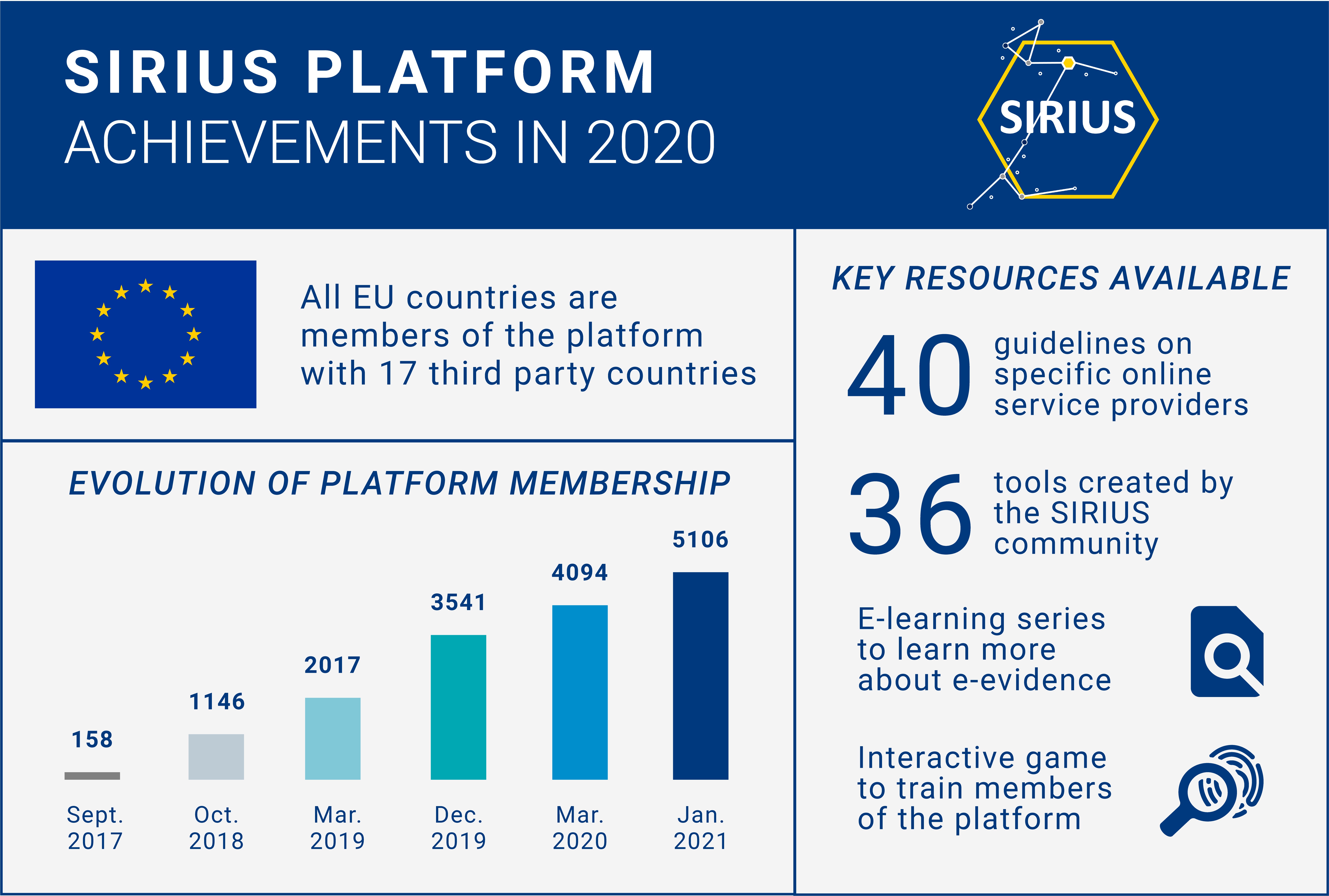
With more than 1,200 new registered members last year, the release of the EU Digital Evidence Situation Report 2020 and a growing hub of information and resources for EU authorities, the SIRIUS project hosted yesterday its annual Advisory Board meeting to present its 2020 main achievements. This event was the perfect opportunity for both agencies to highlight ambitious new activities for the upcoming year.

This event brought together representatives of the European Commission, CEPOL, the United Nations Counter-Terrorism Committee Executive Directorate (UNCTED), the UN Office on Drugs and Crime (UNODC), the United States Department of Justice, the European Cybercrime Training and Education Group (ECTEG), the European Judicial Network (EJN), the European Judicial Cybercrime Network (EJCN) and the European Judicial Training Network (EJTN)

2020 MILESTONES 

Building on a strong record of past successes, in 2020 SIRIUS reached 5,000 members via its platform on the Europol Platform for Experts. This space, dedicated to law enforcement and judicial authorities, now reaches all EU Member States and 17 additional third countries, and serves as a recognised centre of excellence at EU level in the field of electronic evidence. 

The event was also a chance to showcase the second edition of the EU Digital Evidence Situation Report, which focused on the status of EU authorities in retrieving electronic data held by foreign-based online service providers (OSPs), and highlighted the prevalence of electronic evidence in investigations today. Members of the SIRIUS community now have access to guidelines on over 40 different OSPs, and benefit from 36 tools created by their colleagues. 

Finally, participants were given an overview of the latest training activities and interactive games developed for the SIRIUS community and designed to facilitate investigations for law enforcement and judicial authorities of EU Member States.

LOOKING TO THE FUTURE

Looking ahead, the project team will further leverage its established visibility and position to support an even larger number of law enforcement and judicial authorities in developing the knowledge related to the retrieval of electronic data. The creation of new and additional resources tailored for an even larger community of experts will help SIRIUS reach new heights in 2021.

ABOUT THE SIRIUS PROJECT

The SIRIUS project, co-implemented by Europol and Eurojust, is a central reference point in the EU for knowledge sharing on cross-border access to electronic evidence. It offers a variety of services, such as guidelines, trainings and tools, to help with accessing data held by online service providers. These services are available to law enforcement and judicial authorities via a platform and an application. To this day, SIRIUS serves a community of competent authorities from 44 countries, representing all EU Member States and a growing number of third countries. 

The SIRIUS project has received funding from the European Commission’s Service for Foreign Policy (FPI) under grant agreement No PI/2017/391-896


Press release – EU is right place to tackle pandemic, but reform is needed, latest survey finds

At the end of 2020, more respondents saw things on the right path at EU level in comparison with their own country. Furthermore, nearly three out of four respondents (72%) believe the EU Recovery Plan would allow their country’s economy to recover more rapidly from the negative effects of the coronavirus pandemic. 

A new survey commissioned by the European Parliament and conducted between November and December 2020 by Kantar finds an increase of ten percentage points in the number of citizens who expressed a positive view of the EU (50%) compared to autumn 2019. 66% of respondents in this survey are optimistic about the future of the European Union.

Yet the individual outlook remains pessimistic in the face of the continuing pandemic: 53% of respondents believe that the economic situation in their country will be worse in one year’s time than it is now. Only one in five respondents (21%) believe that the national economic situation would improve over the coming year. More than half of respondents (52%) expect their individual living conditions in one year’s time to be the same as today. One quarter of respondents (24%) believe they will even be worse off in one year’s time, while 21% think that they would be better off.

Likely driven by these perceived consequences, citizens formulate a new top political priority for the European Parliament: 48% of respondents want the fight against poverty and social inequalities at the top of the agenda. This is the first priority in all EU Member States apart from Finland, Czechia, Denmark and Sweden, where the fight against terrorism and crime comes first. On EU average, measures to combat terrorism and crime (35%), to ensure a quality education for all (33%) as well as to protect our environment (32%) follow suit.

A similar shift also appears in citizens’ ranking of the core values the European Parliament should defend. While defence of human rights worldwide (51%) and equality between men and women (42%) remain on top, solidarity between Member States ends in third place with 41% of respondents wanting Parliament to defend this value above all others, compared to 33% one year ago.

The pandemic and other global challenges such as the climate emergency sustain citizens’ call for fundamental EU reform. 63% of respondents want the European Parliament to play a more important role in the future, an increase of 5 points compared to autumn 2019. And while the positive image of the EU was increasing at the end of last year, so did the call for change: Only 27% support the EU just the way it has been accomplished so far, while 44% ‘rather support the EU’ but want to see reform being brought about. Another 22% see the EU ‘rather sceptical but could change their mind again in light of radical reform’.

European Parliament President, David Sassoli said: “The message of this survey is clear: European citizens support the European Union and they find that the EU is the right place to seek solutions to the crisis. But reform of the EU is clearly something citizens want to see and that is why we need to launch the Conference on the Future of Europe as soon as possible.”